Takeover

corporate flag

 Guest blog by Steven Miller

(The following is an brilliant essay in 6 parts about the takeover of democracy by monopoly capitalism – that includes solutions.)

Capitalism in the 21st Century is no longer based largely on profits resulting from a real  economy productive process, windfall financial gains are acquired through large scale speculative operations, without the occurrence of real economy activity, at the touch of a mouse button.”  Michel Chussodovsky

Part I – Summary

It is a statement of fact, not ideology, that a class of billionaires, principally based in finance and speculation, control the levers of society. Since the Crash of 2008, the 1% has been waging a war against society that drives the 99% further towards disaster and ruin. Their End Game is the complete privatization of everything that is today owned by the public. This process is inevitable as long as political power remains in their hands. The question is: can this system be reformed? Another is: If not, can we fight and win? If so, how? These are strategic questions.

There are decisive moments in the history of capitalism when one form of wealth, one kind of property, becomes the most lucrative. The capitalists that control this property often become the dominant sector of the capitalist class and take control of the state, dictating policy to society. Marx writes, “The executive of the modern State is but a committee for managing the common affairs of the whole bourgeoisie.”  (1)

The ruling class – call them the 1%, call them capitalists – commonly wages war against itself to seize markets and articulate the strategic view that makes the most profit, especially for them. They call this “the free market”. It is rigged and completely stacked in favor of the billionaires.

When the most profit-making form of labor was slavery, the slave owners ran the government and the state. They were succeeded, after the Civil War, by the railroad barons, industrialists, who owned property in factories, coal, and iron. Slave production was replaced by industrial production. Human slavery was replaced by the far more productive wage-slavery. Early bankers played an enormous role in this transition. Industrial production predominated into the 1950s. It didn’t disappear, but the control of capital passed to banks, investors and finance.

Now it’s all changing again. The tools themselves, the technology, determine which sector of capitalists comes out on top. Today the most revolutionary tools are the vast array of digital, electronic and communication technologies. This revolution is transforming society in ways unforeseen just a decade ago. When Obama was elected in 2008 – the same year as the great economic Meltdown – there was no such thing as social media, no apps, no data in the cloud, no viral videos. The IPhone was only a few months old. The tools are changing fast, driven by constantly evolving hardware and software.

As you read through this essay and examine the evidence, please keep the bigger question in mind. Can this system actually be changed in some sort of meaningful way? What would it take? How do we fight and win?

The growing electronic production of almost everything demonstrates what Karl Marx was referring to when he said, “capitalism sows the seeds of its own destruction.” But it was Adam Smith, not Marx, who first proved that the real source of profit is human labor.

References and Resources

 Lead quote – Michel Chussodovsky. “The Speculative Endgame: The ‘Government Shutdown’ and Debt Default’, a Multibillion Bonanza for Wall Street”, Center for Global Research

 1)  Communist Manifesto. Chapter 1

To be continued.

***

Steven Miller has taught science for 25 years in Oakland’s Flatland high schools. He has been actively engaged in public school reform since the early 1990s. When the state seized control of Oakland public schools in 2003, they immediately implemented policies of corporatization and privatization that are advocated by the Broad Institute. Since that time Steve has written extensively against the privatization of public education, water and other public resources. You can email him at nanodog2@hotmail.com

photo credit: Adbusters Culturejammers HQ via photopin cc

Originally posted at Daily Censored

So You Want to Have a Revolution?

austerity protest

A 2013 study from Fairleigh Dickinson University reveals that 29% of Americans believe an armed revolution may be necessary in the next few years to “protect liberties.” The voter survey differed from most corporate media polls in that it included a substantial number of low income, cellphone only households.

18% of Democratic respondents shared this view, 27% of Independents and 44% of Republicans.

A decade ago, the notion that anyone other than a few thousand fringe extremists would contemplate violent revolution was unthinkable. At the very least, these results suggest a significant minority of Americans are profoundly disillusioned with the government’s apparent indifference to their needs and expectations.

The End of Growth: An Inconvenient Reality

Despite government claims to the contrary, recovery from the deflationary spiral that started in 2008 (aka The Recession) has been elusive. Although stock prices continue to soar, productivity, employment and consumer spending have stubbornly refused to return to pre-2008 levels. Some latter day (non-Wall Street) economists believe the era of economic growth has ended – permanently – owing to the soaring cost of fossil fuels. In their view, the world has returned to a steady state economy.

Given the historic link between growth and “full” employment (jobless levels below 10%), they are also predicting a scenario in which roughly half the adult population is unemployed. The paid work that remains will be low paid, part time, temporary jobs, unprotected by unions, employment rights or health and safety regulations.

To appreciate that US economic growth is at a standstill, it’s essential to look at undoctored economic data. For example, when Obama and the corporate media trumpeted a 7% unemployment rate for November, they neglect to mention that this figure only reflects the number of workers newly unemployed in the last six months (i.e. the number still receiving basic unemployment benefits). Unlike other countries, the official US jobless figure doesn’t include workers whose benefits have run out, who have stopped looking for work, or who want to work full time but are stuck in part time jobs.

Data from the Federal Reserve Bank of St Louis reveals that the US economy is shedding full time jobs, rather than gaining them. The percentage of unemployed Americans of working age has increased from 35.5% in 1999 to 41.7% in 2013 – the highest since 1980. Most of that increase (5%) has occurred since Obama was first elected in 2008.

The 2008 Economic Crash Was Predictable

Prominent members of the Peak Oil movement, most notably Michael Ruppert and Richard Heinberg, predicted the 2008 economic crash. They based their predictions on declining oil reserves, the failure of oil production to keep up with increasing demand from developing countries and the steep rise in oil prices that began in 2005.* Based on their calculations, mankind had extracted half of the world’s available oil reserves by November 2005. This was officially known as Peak Oil. We reached Peak Natural Gas several years before that, though we won’t reach Peak Coal for another decade or so.

Although there still remains tons of oil, gas and coal left in the ground for us to extract and burn, we are now on a downward slope. Not only is production continuing to outstrip demand, but most of the remaining oil, natural gas and coal are difficult to get at, expensive to extract and rely on dangerous, expensive, environmentally destructive and controversial technologies, such as deep sea oil drilling, tar sands extraction fracking and mountain top removal.

Capitalism and Productivity

The steady economic expansion we call growth is a relatively new phenomenon in human history. Prior to the 19th century, the major nations of the world operated steady state economies. In fact the argument Heinberg and others make is the burst of productivity most of the world attributes to capitalism had nothing to do with the capitalist economic model itself. Rather it was based on the widespread abundance of cheap fossil fuels. British economists at the Fiesta Institute provide abundant data justifying this argument in Fleeing Vesuvius: Overcoming the Risks of Economic and Environmental Collapse. They point out that even at current oil prices, it costs far less to use a machine to perform work than to employ a human being or even a draft animal.

The birth of capitalism wasn’t just about the exploitation of fossil fuels. It was about the exploitation of all natural resources – clear cutting forests, large open pit mines to extract steal, copper, gold, bauxite (for aluminum), gold diamonds and rare earth minerals, draining swamps and eradicating wetlands. When oil started becoming more expensive (in the 1970s), it was also about moving western factories to third world countries to enable wholesale exploitation of human labor. Government encouraged this wholesale extraction and exploitation because it produced enormous prosperity for most of western society over many decades.

At the same time there were immense human and environmental costs. Western capitalism produced incalculable suffering in the third world as indigenous people were driven off the land that gave them a subsistence living, with the lucky ones obtaining jobs in brutal sweatshops that paid starvation wages. Suffering in the first world was less visible until last decade, when residents of the industrialized world began to realize they were being systematically poisoned with toxic industrial chemicals, increasing levels of both nuclear and microwave radiation and harmful organisms that had contaminated our air, water and food chain.

*Historically the oil price ranged between $2-4 a barrel prior to 1973 oil crisis. It remained between $10-20 a barrel until 1979. From 1979-1986 it fluctuated between $20-38 a barrel until 1986, when it dropped below $20 a barrel until 1989. It dropped below $20 a barrel very briefly in 1999. It hasn’t been below $40 a barrel since 2004.

photo credit: athens.rioter via photopin cc

How an LVT Might Have Altered the Course of History

traumatizedsociety_DV

The Traumatised Society: How to Outlaw Cheating and Save Our Civilisation

by Fred Harrison (Shepheard-Wallwyn Limited, 2012)

Book Review – Part II

(In this section Harrison discusses the history of countries and communities that have tried to enact a Land Value Tax. See Part I here)

Britain’s Experience with Land Value Tax (LVT)

In Britain there have been several attempts to end predatory rent-seeking through the enactment of LVT. As a result of Henry George’s 1879 international bestseller Progress and Poverty, Winston Churchill (still a liberal in 1909) became one of the most vocal proponents of the People’s Budget. The law, passed by the British parliament in 1909, sought to shift the burden of taxation from wages to land. It was never implemented because the British aristocracy went to court to block the land valuation required to assess the tax. In 1931 Parliament passed a revised version of the People’s Budget, which Chancellor of the Exchequer Neville Chamberlain simply deleted it from the law book in 1934. If the LVT had been fully implemented, Britain would have been spared the worst effects of the Great Depression.

How an LVT Might Have Altered the Course of History

Harrison moves on to explore how an LVT might have alleviated severe economic and political turmoil in other countries:

  • Ireland – rent seekers “sucked: out all the wealth of Ireland for 200 years, a process that didn’t end with independence. Ireland’s “Celtic Tiger” could have been sustainable if it had been funded by a LVT rather than debt. The result was a debt/real estate bubble that left the country even worse off when the bubble burst in 2008. In 2010, Harrison advocated for Ireland to pay off its debt by implementing a LVT. This would have provided the revenue the Irish government needed to stimulate growth. Instead the IMF bailout and austerity cuts has deeply suppressed growth.
  • China – made a fatal error by failing to implement an LVT when they began to privatize collectively owned land in the 1980s. China is currently facing slowing growth, thanks to a $1.7 trillion debt incurred by their city and provincial governments. While the central government was building up massive cash reserves by selling cheap exports, they forced regional governments to self-fund their public services. The only way they could do this was by selling land to property developers and by borrowing money.
  • Cuba – made a fatal error on November 11, 2011 when they began selling collectively owned land to rent-seekers, and allowed rents to be capitalized into land prices – instead of taxing them.
  • Russia – Gorbachev envisioned land remaining in public hands as part of Glasnost. After a threatened military coup forced him to step down, Harrison went to Russia trying to persuade Yeltsin to adapt an LVT. Instead Russia’s first president opened the country to the IMF and western rent-seekers. Both sucked out sufficient wealth to set the country’s standard of living back several decades.
  • Africa – South Africa’s current economic difficulties relate to a fatal error they made in 2004. They amended their LVT to add a tax on property improvements but should have done the opposite – increase the LVT and reduce other taxes. Much of the land in the rest of sub-Saharan Africa is still communally owned. Thus there is still great potential for emerging African economies to adopt an LVT. This would allow them to develop debt-free, sustainable economies that don’t leave the majority of the population in abject poverty.
  • The US – suffers from a “constitutional neurosis,” according to Harrison. Supposedly the Declaration of Independence and US Constitution were based on the Scottish Enlightenment. Whereas John Locke talked about a universal right to “Life, Liberty and Estate (Land),” our founding fathers changed this to “Life, Liberty and the Pursuit of Happiness” even before the Constitution was written.

The Future of LVT

As Harrison points out, at present rent-seekers are extremely powerful and have absolute control over government, media, and public education. Nevertheless as countries in the Middle East, North Africa and Latin America escape US military control, it’s imperative they have an avenue to escape the economic control of local and international rent-seekers. By adopting an LVT, they guarantee themselves sufficient income to provide government and public services – without falling into the predatory clutches of international bankers and the IMF.

In his 2011 book Re-Solving the Economic Puzzle, Walter Rybeck relates how the US contemplated LVT enabling legislation during the Carter administration. As an assistant to Representative Henry Reuss (D-Milwaukee), Rybeck helped Reuss (as chair of the House, Banking, Finance and Urban Affairs Committee) promote land and resource taxes as a way to address crumbling infrastructure in financially strapped cities and states.

Enter Sarah Palin

According to Rybeck, a number of communities (and one state) have already adopted variations of an LVT. Alaska’s oil/gas tax is the best example of a resource-based LVT. This tax provides 80-90% of Alaska’s general fund, as well as providing annual dividends to residents. As governor of Alaska, Sarah Palin introduced Alaska’s Clear and Equitable Share (ACES), which charges a 25 percent tax rate on oil profits, with the rate increasing progressively as oil prices go up.

Five other states have passed LVT enabling legislationConnecticutMarylandNew YorkPennsylvaniaVirginiaWashington – to make it easier for local communities to adopt an LVT.

Other American communities that have already benefited from an LVT include California’s Central Valley, Fairhope in Alabama, Arden in Delaware, and Pittsburgh and other cities in Pennsylvania.

Originally published in Dissident Voice

The Trauma of Cultural Genocide

traumatizedsociety_DV

The Traumatised Society: How to Outlaw Cheating and Save Our Civilisation

by Fred Harrison (Shepheard-Wallwyn Limited, 2012)

Book Review – Part I

(The first half of Harrison’s book explores the history of land value tax and the cultural genocide that resulted from the Enclosure Acts and the dispossession of Europeans from communally owned lands.)

The Land Value Tax (LVT) is a “radical” form of taxation first proposed by Henry George in his 1879 Progress and Poverty (see Progress and Poverty: the Suppressed Economics Classic). What George proposes is to replace taxes on wages, purchases, and investments with a tax on unimproved land and natural resources. In The Traumatised Society, Fred Harrison  provides an exhaustive update of George’s original work.

As Winston Churchill famously observed, “History is written by the victors.” Nearly all history books written in the last 400 years were written by or on behalf of the ruling elite. The Traumatised Society is unique in that it recounts the history of the industrial revolution from the perspective of the 99%. Harrison also presents a simple, but elegant prescription for taking back power from the corporate oligarchy, ending economic inequality and the debt crisis, staving off ecological disaster, and preventing World War III. On the surface these claims appear extravagant and somewhat grandiose. Yet, in my view, Harrison makes his case very convincingly.

Adam Smith was the first prominent economist to propose the LVT as the most “moral” and least economically harmful tax in his classic Wealth of Nations. Neoconservative icon Milton Friedman also considered it the “least bad” kind of tax. The most famous contemporary Georgist is former World Bank Economist and Nobel Prize winner Joseph Stiglitz.

Basically the argument for an LVT goes as follows: because publicly funded infrastructure increases land values, this added value should return to the public. It shouldn’t return to the landowner, who has done nothing more than sit on his land. An LVT provides a valuable source of public revenue. It eliminates the need for governments to borrow from private banks without depleting the total wealth of the landowner.

Economies and personal freedom flourish wherever an LVT has been implemented. As Harrison reminds us, the economic surge known as the Asian Tiger didn’t start in China, but in Taiwan and Hong Kong – as a direct result of LVT-based economies. Moreover unlike China, economic growth in both Taiwan and Hong Kong has proved genuine and sustainable. In 2011, the per capita GDP of China was $8,400, while that of Taiwan was $37,900.

The Trauma of Cultural Genocide

The title The Traumatised Society is based on a severe dislocation Europeans experienced during the eighteenth century, a process remarkably similar to that of African slaves and indigenous people oppressed by colonization. The cause of this dislocation was The Enclosure Acts, a series of laws that drove our peasant ancestors off the communal farm lands that had supported them for a thousand years and fenced it to off as private property. In England alone, 160,000 freehold farmers were thrown off their land between 1700 and 1812. In addition to being stripped of their livelihood, our ancestors also experienced “cultural genocide,” as they lost a thousand years of cultural tradition linked to communal land ownership. This process is vividly described in the poems of 18th century poet John Clare, whose parents ended up in the poor house (i.e. jail) after being thrown off their land. Clare’s work was suppressed until the late 19th century, when the work of American journalist Henry George revived the British land reform movement.

The end result of this massive dislocation has been slavery, debt, alienation, depression, poverty (which was virtually non-existent prior to the Industrial Revolution), murder, rape, child abuse and alcohol and drug addiction. Counselors and therapists who work with African American and indigenous communities are very much aware of the trauma, which is passed from generation to generation, that results from severe economic dislocation and cultural genocide. Ironically, however, Europeans have no historical memory that we have been subjected to the same kind of trauma.

According to Harrison, the “moral evolution” of the human race ceased in the 1700s. This is when an authentic human culture of cooperation and interdependence was replaced with an artificial “cheating culture,” in which the highest ideal is to get something for nothing. The modern, free market version of Christianity is part and parcel of this phony culture – as is Marxism. Harrison feels Marx did us a great disservice by demonizing capitalism. The capitalistic funding model in itself isn’t the primary source of our major economic and social problems.

The Concept of Economic Rents

The Traumatised Society is written in classical economic language, in which “rent” refers to unearned income from the monopolization of land, natural resources, or the cultural commons (e.g. the public airwaves and money). Economic rent includes unearned profit gained from selling land that has increased in value (often due to land speculation). A “rent-seeker” is someone who derives unearned income from monopolization of these resources.

For most of human history land and resources were owned communally and any “rent” or unearned income went to finance public services. Beginning in the 18th century, this all changed. When “rent-seekers” privatized land and natural resources, they also captured control of government and shifted the burden of funding public services to workers. In this way modern capitalist society came to be divided into two classes, the Predators or rent-seekers, and the Producers, who engage in work to create economic wealth.

As more and more wealth is extracted from Producers, both as “rents” and as taxes, there is less and less money available to maintain public infrastructure. Eventually the number of Producers becomes inadequate to support the Predator rent-seeking class. At this point, the latter seeks to remedy the problem by conquering new lands and colonizing new populations, by using fossil fuel technology to increase productivity, by borrowing and extracting wealth from future generations, and/or by capital depletion (liquidating assets created by past production – like Greece).

Originally published in Dissident Voice

To be continued.

The Robber Barons Behind Neoclassical Economics

rockefeller

John D Rockefeller

Classical Economics as a Stratagem Against Henry George (free link)

By Mason Gaffney (2007)

Book Review-Part II

(In Part I, I discuss how Henry George’s work inspired the Populist and Progressive movements of the early 1900s and how the corporate elite struck back by inventing a new type of economics for the rich, called neoclassical economics.)

Who Paid for Neoclassical Economics to Take Over American Universities?

Gaffney’s book traces the phenomenal public support Georgism enjoyed before the tenets of neoclassical economics took hold in American universities. In addition to inspiring the Populist and Progressive movements, an LVT to fund irrigation projects in California’s Central Valley made California the top producing farm state. In 1916 the first federal income tax law was introduced by Georgist members of Congress (Henry George Jr and Warren Bailey) and included virtually no tax on wages. In 1934 Georgist Upton Sinclair was almost elected governor of California.

Gaffney also identifies the robber barons whose fortunes financed the economics departments of the major universities who went on to substitute neooclassical economics for classical economic theory. At the top of this list were

  • Ezra Cornell (owner of both Western Union and Associated Press) – founder of Cornell University
  • John D Rockefeller – helped found the University of Chicago and installed his cronies in its economics department.
  • J. P Morgan – investment banker and early funder of Columbia University
  • B&O Railroad – John Hopkins University
  • Southern Pacific Railroad – Stanford University

The final section of Gaffney’s book lays out the tragic economic, political, and social consequences of allowing the Red Scare and neoclassical economics to stifle America’s movement for a single Land Value Tax:

Economic Consequences

  1. The corporate elite has privatized, or is privatizing, most of the public domain (including fisheries, the public airwaves, water, offshore oil and gas, and the right to clean air) without compensation to the public.
  2. The rate of saving and capital formation continues to fall rapidly. This is the main reason there is no recovery. Although profits soar, corporations have no incentive to invest in expansion and jobs. Instead they invest their profits in real estate, derivatives, and commodities speculation.
  3. American capital is decayed and obsolete. The US has lost much of its steel and auto industries. Power plants and oil refineries are ancient and polluting. Most public capital (infrastructure) is old and crumbling.
  4. The number of American farms has fallen from 6 million in 1920 to 1 million in 2007.
  5. The USA, once so self-sufficient, has grown dangerously dependent on importing raw materials and foreign manufacturers.
  6. The US financial system is a shambles, supported only by loading trillions of dollars of bad debts onto the taxpayers.
  7. Real wage rates have continued to fall since 1975,
  8. Unemployment has risen to chronically high levels.
  9. Inequality in wealth and income continues to increase rapidly.

Political Consequences

  1. The corporate elite has nullified all the Progressive Era electoral reforms by pouring money into politics and “deep lobbying,” at all levels of government, including our institutions of higher learning and our public schools.
  2. The corporate elite continue to pour ever more of our tax money into prisons.

Social Consequences

  1. Homelessness has risen to new heights, in spite of decades of subsidies to home-building and, favorable tax treatment of owner-occupied homes
  2. Hunger is rampant.
  3. Street begging, once rare, is everywhere
  4. Americans have experienced a sharp loss of community, honor, duty, loyalty and patriotism.
  5. In the shadow world between crime and business there is now the vast, gray underground economy that includes tax evasion, tax avoidance, and drug-dealing.
  6. The US which once led the world in nearly every endeavor, has fallen far behind in infant survival, in longevity, in literacy, in numeracy, in mental health.
  7. American education no longer leads the world. Privatized education in the form of commercial TV has largely superseded public education.

photo credit: cliff1066™ via photopin cc

The Mythology of Neoclassical Economics

Classical Economics as a Stratagem Against Henry George (free link)

By Mason Gaffney (2007)

Book Review-Part I

Why do American school children study the beliefs of a German radical named Karl Marx, the villain Americans love to hate? Yet Henry George, whose views on land and tax reform gave rise to the Progressive and Populist movements of the 1900s, is totally absent from US history books. During the 1890s George, author of the 1879 bestseller Progress and Poverty, was the third most famous American, after Mark Twain and Thomas Edison. In 1896 he outpolled Teddy Roosevelt and was nearly elected mayor of New York.

In Neo-classical Economics as a Stratagem Against Henry George (2007), University of California economist Mason Gaffney argues that George and his Land Value Tax pose a far greater threat than Marx to America’s corporate elite. America’s enormous concentration of wealth has always depended on the inherent right of the wealthy elite to seize and monopolize vast quantities of land and natural resources (oil, gas, forests, water, minerals, etc) for personal profit. Adopting an LVT would essentially negate that right. What’s more, every jurisdiction that has ever implemented an LVT finds it works exactly the way George predicted it would. Productivity, prosperity, and social well being flourish, while inflation, wealth inequality, and boom and bust recessions and depressions virtually vanish. (See prior post Facebook’s Billionaire Tax Refugee).

When Progress and Poverty first came out in 1879, it started a worldwide reform movement that in the US manifested in the fiercely anti-corporate Populist Movement in the 1880s and later the Progressive Movement (1900-1920). Many important anti-corporate reforms came out of this period, including the Sherman Antitrust Act (1890), a constitutional amendment allowing Americans to elect the Senate by popular vote (prior to 1913 the Senate was appointed by state legislators), and the country’s first state-owned bank, The Bank of North Dakota (1919).

The Corporate Elite Strikes Back

As with any major reform movement, the corporate backlash was predictable. In Neo-classical Economics, Gaffney reveals that this backlash took two main forms. The first was the Red Scare (1919-1989), overseen by J Edgar Hoover as Assistant Attorney General and later as FBI director. The second was more insidious and involved the deliberate reframing of the classical economic theory developed by Adam Smith, Locke, Hume, and Ricardo as so-called neoclassical economics. The latter totally negates Adam Smith’s basic differentiation between “land”, a limited, non-producible resource. and “capital”, a reproducible result of past human production. Smith, Locke, Hume, and Ricardo all held that individuals have no right to seize and monopolize scarce natural resources, such as land, minerals, water, and forests. They believed that because these resources are both limited and essential for human survival, they should belong to the public.

Neoclassical economics, which first developed in the 1890s, was based on the premise that growth and development can only occur if a handful of rent-seekers are allowed to monopolize scarce land and natural resources for their personal profit. Henry George, who publicly debated the early pioneers of neoclassical economics, claimed the science of economics was being deliberately distorted to discredit him. Gaffney agrees. Because George’s proposal to replace income and sales tax with single land value taxed is based on logical concepts of land, capital, labor, and rent advanced by Adam Smith, Locke, Hume, and Ricardo, they all had to be discredited.

Gaffney believes neoclassical economic theory undermines George’s arguments for a single Land Value Tax in two basic ways: 1) by claiming that land is no different from other capital (ironically Marx made the identical argument) and 2) by portraying the science of economics as a series of hard choices and sacrifices that low and middle income people must make. Some examples:

  • If we want efficiency, we must sacrifice equity.
  • To attract business, we must lower taxes and shut libraries and defund schools.
  • To prevent inflation, we must keep a large number of Americans unemployed.
  • To create jobs, we must destroy the environment and pollute the air, water, and food chain.
  • To raise productivity, we must fire people.

Below, brief video of Gaffney discussing LVT:

To be continued.

Permaculture Village in Davis, California

A great video about a 30 year old community food forest in Davis California.

Despite working full time jobs, residents can produce 70% of their food needs in their front and back yards.

The beauty and simplicity of permaculture and perennial food forests.

Full video free online at

http://www.geofflawton.com/fe/60356-food-forest-suburb

Facebook’s Billionaire Tax Refugee

depardieu

French actor Gerard Depardieu

In January, Forbes reported that Facebook’s billionaire co-founder Eduardo Severin had renounced his U.S. citizenship to move to Singapore, where the top tax rate is 20%. The article about millionaires and billionaires fleeing high western tax rates was triggered by French actor Gerard Depardieu’s renunciation of his French citizenship to move to Russia. He chose Russia based on its top tax rate of 13% on individuals and 20% on corporations (except for the oil and gas industry – see below). France had just enacted a 75% tax on millionaires to pay off the 1.7 trillion euros it owes to international banksters. Socialist president Francois Hollande sees taxing the rich as a better alternative than laying off public servants and cutting health care, education, and pensions like Greece, Spain, Portugal, and Italy.

Forbes clearly disagrees. Predictably the article represents the traditional neo-classical economic viewpoint – slashing public services is always a better alternative than increasing taxes on the rich. They also leave out the most important part of the story – namely why income taxes in Singapore and Russia are so low.

The real reason income is taxed at a low rate in Singapore and Russia is because both countries have adopted a modified Land Value Tax (LVT). An LVT is a tax on unimproved land, resources and the cultural commons (e.g. public airwaves). It was journalist Henry George who first proposed replacing taxes on income and capital with a single LVT in his 1879 international bestseller Progress and Poverty. See Progress and Poverty: the Suppressed Economics Classic.

Singapore’s Economic Miracle

Singapore, a flourishing city-state of 5.3 million people, faced massive unemployment and a major housing crisis when it first gained its independence from Malaysia in 1965. Its leaders immediately launched a modernization program funded by an LVT. Although Singapore no longer relies on a single tax, income taxes still remains extremely low with corporate rates between 8.5 and 17%.

Thanks to the LVT, Singapore recovered much more rapidly than western countries from the 2008 economic collapse. In 2011 a 12% increase in GDP enabled them to pay a dividend to all adult citizens of approximately $269 each (total $1.22 billion).

How Putin Saved Russia’s Moribund Economy

Russia’s LVT, introduced by President Vladimir Putin as part of a 2001 tax reform package, falls more heavily on mineral (e.g. oil and gas) extraction than unimproved land. Taxes on oil and gas revenues amount to approximately 45% of net sales (compared to 12 percent in the construction industry and 16.5 percent in the telecommunications industry). Property owners pay a tax ranging from 0.1 – 0.3% on land value (and a comparable rate on state-owned land that they lease).

Experience with LVT in other countries

Hong Kong (1985) – thanks to LVT, enjoys low taxes, low inflation, high investment and high salaries. Often voted the world’s best city for business and the freest for residents. According to Bloomberg’s they, too, paid a $700 dividend to all adult residents in 2011. Unfortunately since rejoining China, Hong Kong has been gradually replacing land and resource taxes with income tax. This has resulted in a return of land speculation and increasing income inequality. The Hong Kong real estate holdings of China’s multimillionaire president Xi Jinping are valued at more than $24.1 million.

Taiwan (1949) – following the Communist takeover of mainline China, Chinese nationalists under General Chiang Kai-shek fled to Formosa (Taiwan), a brutally poor feudal island controlled by a handful of rich farmers. Chiang Kai-Sheck, a follower of Sun Yat-Sen, the first Chinese president and  a great admirer of Henry George, introduced a LVT. When plantation owners found themselves paying as much in taxes as they were collection in rent, they sold off their excess land to peasant farmers. Taiwan went on to set world records with growth rates of 10% per annum.

Denmark (1957) – the small Georgist Justice Party won seats in parliament and a role in the ruling coalition. A year later, inflation had gone from 5% to under 1%; bank interest dropped from 6.25% to 5%. By 1960, 100,000 unemployed (out of a population of 5 million) had found jobs and received the highest average pay increase in Danish history. In the 1960s, a media backlash funded by wealthy bankers and corporations caused the Justice Party to lose its seats. Land taxes were decreased and income tax and sales tax (currently at 25%) drastically increased. Inflation quickly rose to 5% and by 1964 reached 8%. Land prices began to sky-rocket, increasing 19-fold from 1960 to 1981 increasing 19-fold.

Estonia (1990s).- enacted a 2% LVT following the break-up of the Soviet Union. It was much easier to collect than the income taxes enacted by other former Soviet republics, more successful than trying to collect from others, succeeding over 95% of the time. It’s largely the LVT that has enabled Estonia to become the electric car capitol of the world. In addition to installing 165 electric vehicle fast-charging stations country-wide, it provides a 50% subsidy for residents who purchase electric vehicles.

Other jurisdictions that opted for LVT:

  • Ethiopia 1990s
  • Saudi Arabia, Kuwait, UAR – resource-based LVT on oil and gas exports
  • Baja California (Mexico) 1990s
  • British Columbia (1912) – resource-based LVT on forestry
  • Vermont 1978
  • Kansas City 1930s
  • Pennsylvania – Pittsburgh and Scranton in 1975 and 18 other cities following suit in the 1990s. Housing costs and crime in both Pittsburgh and Scranton have trended the lowest in the US, despite the collapse of the steel industry. Both avoided the 2000-2007 real estate bubble and 2008 collapse. Foreclosure rates in Pittsburgh remain the lowest in the country.

Single tax colonies founded by Henry George’s American followers:

  • Free Acres (New Jersey) 1910
  • Arden (Delaware) 1900
  • Fairhope (Alabama) 1894


photo credit: igorjan via photopin cc

How Permaculture Can Save Humanity

food forest

London Food Forest

How Permaculture Can Save Humanity and the Earth, but Not Civilization

by Toby Hemenway (2013)

Film Review

Below is another great video on the history of horticulture by permaculturist and ecologist Toby Hemenway. Hemenway’s main premise is that agriculture – even non-industrial agriculture – is unsustainable. He approaches the issue from an anthropological perspective, by examining prehistoric cultures that became extinct as a direct result of transitioning from horticulture to agriculture.

Hemenway defines horticulture as food production using small garden and food forests that incorporate and support existing ecosystems. Agriculture, in contrast, destroys ecosystems to create vast clear cuts dedicated to single crops. The archeological record reveals that agriculture first developed in the fertile crescent of Mesopotamia (modern day Iraq) around 10,000 BC. At the time it was lush forest and bush. However after 3,000 of artificial irrigation, the soil became too salty to support life. The land, which became a desert, still hasn’t recovered. The same thing happened in ancient Egypt and Greece.

Archeological evidence reveals that all agricultural civilizations follow a typical pattern of soil depletion after an average of 1,000 years. Then they either die out or moving to new land via conquest. According to Hemenway, the Oil Age was a great boon to our current agricultural civilization. Farm machinery and petroleum-based fertilizers and pesticides provided an immense burst in world food production. Unfortunately this only hastened soil degradation. At the same time a steep price increase (related to oil a natural gas scarcity) and made them unavailable for a growing number of farmers, especially in the developing world.

Hemenway also asserts that the prehistoric importance of horticulture has been greatly underestimated owing to three myths widely promulgated over the last two hundred years.

Myth one: food surpluses produced by agriculture are essential to produce the leisure time and specialization required for culture to flourish.

New archaeological evidence reveals human beings engaged in cultural activities such as basket weaving, art, and music for hundreds of years prior to the development of agriculture.

Myth two: horticulture was merely a brief transition between hunter gather and agricultural societies.

Fossil and other evidence suggests that Native Americans planted and maintained most of the East Coast, Mississippi, and Amazon as food forests for more than four thousand years before Europeans destroyed their horticultural societies.

Myth three (thanks to English philosopher Thomas Hobbes): horticultural cultures are made up of savages who live short, nasty, brutish lives.

Anthropological and archeological evidence suggests exactly the opposite. Hunter-gatherer and horticultural societies devote far less time to securing and producing food than farmers. The former spend an average of three hours a day harvesting a day’s worth of food for their families; whereas pre-industrial farmers spent an average of two to three days to producing one day of food. This excluded crops they sold to pay rent.

Skeletal remains suggest people in horticultural cultural societies were healthier, taller, and lived long than people in pre-industrial agricultural societies. Moreover the advent of agriculture introduced a host of degenerative diseases, including arthritis and deadly viral epidemics (influenza, small pox, measles, polio, etc) that people caught from domesticated animals.

Worst of all, the introduction of agriculture led to the advent of class society, military conquest, and famine. As Hemenway points out, war and famine are virtually unknown in hunter gatherer societies that migrate to follow their food source. Likewise it’s virtually impossible for a marauding army to steal the perennials out of a food forest.

Permaculture to the Rescue

Hemenway views our current food production system as a major culprit in the current ecological and resource crisis the planet faces (e.g. climate change, ocean acidification, mass species extinction, and fossil fuel, fresh water and topsoil depletion). He estimates that without drastic change, our species will survive another fifty years at most. If, however, human species could navigate a successful return to a horticultural society, they could potential persist for millennia.

He sees the widespread adoption of permaculture as a first step in a return to horticulture. Permaculture is an 80 year old branch of ecological design that produces sustainable buildings and self-maintained food production systems by modeling them on natural ecosystems. The movement already has several million adherents worldwide, through the Transition Town and comparable relocalization movements.

photo credit: London Permaculture via photopin cc

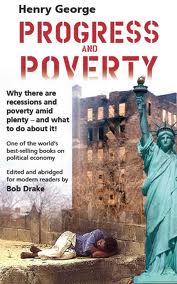
Progress and Poverty: A Suppressed Economics Classic

progress

Progress and Poverty

by Henry George (1879), edited and abridged by Bob Drake, Robert Shalkenbach Foundation (2006)

Downloadable as free PDF:Progress and Poverty

Book Review

Progress and Poverty is an economic classic which has been suppressed in the US owing to its subject matter: the elimination of poverty and economic inequality by restoring the Commons. Written over 130 years ago, the book provides uncanny insights for the current difficulties capitalism faces (i.e paralyzing recession, massive public and personal debt and growing income inequality). Internationally George’s economic theories are regarded as comparable to those of Marx, Keynes and Galbraith. Yet despite being the third most famous American in 1879 (after Edison and Mark Twain), George’s work remains largely unknown outside of Australia, New Zealand, Hong Kong and Taiwan.

Why Development Always Produces Poverty

George’s goal in writing Progress and Poverty is to explain, in economic terms, why material progress (i.e. economic development) is always accompanied by poverty and increasing inequality. Employing Adam Smith’s classical definitions of labor, capitol, wages and interest and Ricardo’s Law of Rent, he argues that development must always produce poverty and inequality so long as a privileged elite holds an exclusive monopoly on the ownership of land and basic resources.

George starts from the premise that land and natural resources are the source of all wealth, though wealth itself can only be created through human labor. According to George, the relative monopoly the elite hold on land allows them to capture all increases in productivity and production as “rent” increases.

The History of Land Privatization

George’s approach is relatively unique for political economists in his emphasis on the role ideology plays in the economic theories that gain popular acceptance. In contemporary society, no one questions the right of a privileged elite to monopolize land and natural resources for their own benefit. However private land (and resource) ownership is a relatively new concept originating in seventeenth century Britain with The Enclosure Act.

About a third of Progress and Poverty traces the historical evolution of private land ownership. In all human societies, the common right of all people to use the earth to support themselves has been sacrosanct. The concept of individual land ownership only emerged as societies advanced and either concentrated power in privileged classes or seized land and slaves through military conquest. Prior to the rise of Greek and Roman civilization, all land was communally owned and the notion of an individual claiming a patch of land as his exclusive possession was unthinkable.

Henry George sees the mass seizure of land by the nobility (in Rome this was referred to as the latifundia) as responsible for the death of democracy in these early societies and the ultimate collapse of both civilizations.

After the Roman Empire fell, feudalism was characterized by systems of communal and private property rights that operated in parallel. A feudal estate was considered to belong to society at large. The king, as the chief representative of the people, merely granted its use in trust to church leaders and military officers in return for services rendered to the commonwealth. Churches were expected to provide for the care and welfare of the sick and poor. For their part, feudal lords were expected to defend the king’s military interests.

Because they allowed the British system of private land ownership to persist in the US, George accuses the founding fathers of failing in their efforts to establish a true republic. Despite abolishing heredity titles and establishing the right to vote, they failed to reestablish the communal property rights that enabled the Greek and Roman democracies to flourish. He contends that political equality, when coexisting with wealth inequality, must always lead to either dictatorship or anarchy.

Restoring The Commons Through a Land Tax

George proposes that the wealth inequality, recessions and numerous other evils commonly attributed to the capitalist economic model could be totally eliminated by restoring public ownership of land and resources.

Rather than advocating outright government seizure of private land, he proposes to accomplish this by imposing a tax on unimproved land roughly equivalent to its rental value. Such a system would allow landholders to preserve their right of tenure, while discouraging them from speculating by holding land and resources out of production. While ending land speculation and recessions, this type of tax would simultaneously expand land and resource access for workers and capital investment. Any productivity increases (beyond interest on capital), would accrue to the government, rather than private landholders.

According to George, the government could use revenue from land and resource taxes to abolish taxes on wages and capital (which discourage production) and to pay down public debt.