EU Plans War to Keep Europe White*

Reblogged from Libya360

For more than 500 years, Europeans have invaded and looted the planet, yet their home civilizations are deemed so fragile that they must be insulated against the cultures of the formerly colonized peoples. Having created millions of Muslim and African war refugees, the Europeans now gear up to attack the boats that might bring them to Europe.
20150428-LIBYA-slide-GK7J-superJumbo

By Glen Ford

“The thousands of deaths at sea are crimes of Europe and the United States.”

The United States has been the big, bad leader of the imperial world for so long, we may sometimes forget that most of the evils that beset our world have their origins in Europe, a small corner of the Earth that has for 500 years grown fat off the blood and resources of the rest of the planet. This Europe is a greedy little place, most of whose inhabitants believe they have somehow earned what they have stolen from the world’s darker peoples, and that they are entitled to continue stealing in perpetuity.

In 2011, in league with the United States, European members of NATO launched a totally unprovoked 7-month bombing campaign against Libya, resulting in the murder of Col. Muammar Gaddafi and the empowerment of Islamist jihadists throughout the northern tier of the African continent. Col. Gaddafi had warned that the Euro-American aggression would turn Libya into another Somalia, with vast numbers of people desperately fleeing across the Mediterranean Sea to escape the turmoil. Gaddafi was right, of course. Not only has Libya been reduced to a state of sheer anarchy and terror, but thanks to Europe and the United States, Hell has descended on Syria, and conditions in Somalia have grown even worse. The Europeans and their American cousins are intent on wiping out every vestige of civilization in the Muslim world – all the while spouting the same twisted, racist logic that they have employed for half a millennium: that Muslims and Africans are unsuited to civilization, and must be guided by the white hands of Europe, for their own good.

“Col. Gaddafi warned that the Euro-American aggression would turn Libya into another Somalia.”

The refugee crisis, the thousands of deaths at sea, are crimes of Europe and the United States. The Euro-Americans are just as unquestionably guilty as the arsonist who sets the fire that causes apartment dwellers to jump to their deaths from high windows to escape the flames. Now, the nations of the European Union, all 28 of them, are backing plans to launch air and naval attacks against boats in the ports of Libya and on the high seas, to make sure that the refugees that Europe and America have created do not wind up on European shores.

Read full article at Libya360

The 1% at Their Finest

The Super Rich and US

BBC (2015)

Film Review

The Super Rich and Us features casual cameos of British billionaires openly displaying their narcissistic indulgence in trophy assets. There is also a brief appearance by economist and author Thomas Piketty (Capital in the Twenty-First Century). The goal of the documentary is twofold: to debunk trickle down theory and to critique government policies that have made Britain one of the most unequal nations on the planet.

The filmmakers maintain that Britain’s top 1% generates and consumes all the so-called growth the UK has experienced over the last five years. None of it derives from increased investment, job growth, wages or productivity.

The British 1% has doubled their income between 1980 and 2015, while income for everyone else has stagnated or declined. Likewise the Conservative government’s 80 billion pounds in austerity cuts is roughly equal to the bonuses banks paid out to CEOs.

Why Britain Has the Most Billionaires

The UK has more billionaires per head (104) than any other country. This stems largely from a policy decision to compensate for factories moving overseas by making the country a tax haven for rich colonials seeking to avoid taxes in their own country – under the delusional belief it would make everyone else richer.

In the 1980s, Margaret Thatcher significantly reduced taxes on Britain’s native millionaires and billionaires. She argued, as Reagan did in the US, that taxing the rich made society poorer. These policies, which have changed little over thirty years, have made Britain the world’s favorite tax haven, as international pressure forces other traditional tax havens (Switzerland, Luxemburg, Cayman Islands, etc) to shut up shop.

Trickle Up vs Trickle Down

Thanks to the wholesale repeal of banking and corporate regulations, none of this surplus wealth trickled down to the rest of the population the way Thatcher claimed it would. Instead the super rich have been sucking up shrinking lower and middle classes resources into their vast reservoir of private wealth. The main reason trickle down doesn’t work is that the 1% spends their surplus wealth on diamond jewelry, yachts, sports cars and other luxury goods that generate income for only a handful (if any – most of these goods are imported) of working people.

The film contrasts British tax policies with those of Sweden and Denmark, which the rich pay a fair share of taxes. Not only do both have GDPs equal to or higher than the UK’s, with numbers that reflect genuine improvement in productivity and job and wage growth. When polled, eighty-eight percent of Danish people are perfectly happy with their tax rate because they see it reflected in generous government services.

The Case for Unconditional Basic Income (UBI)

Transitions for Society: Job Guarantee and Basic Income

Prosocial Progress foundation (2014)

Film Review

This 20 minute documentary attempts to address the structural unemployment that seems to have become a permanent feature of monopoly capitalism. According to the St Louis Federal Reserve, as of February 2015, only 62.8% of working age Americans have jobs – translating into a 36.2% unemployment rate. A substantial proportion of the jobless are young adults between 16 and 24. Who face more or less permanent exclusion from the economy.

The premise of the film is somewhat unusual. The filmmakers lay out the proposition that the political elite could save capitalism by enacting an unconditional basic income (UBI) for all citizens. However based on past history, they probably won’t. Instead of making the necessary reforms, they will allow human misery and social unrest to increase until the system is overthrown by popular revolt. They see a small chance one or more European countries could enact a UBI. A grassroots Swiss movement has successfully petitioned for a (binding) UBI referendum in 2016.

Martin Luther King’s Call for a UBI

Martin Luther King first called for a UBI in 1967 – in combination with a job guarantee. He maintained the US could easily afford such a program based on the massive automation-related productivity gains. He could not have predicted the financialization of the US economy that would occur in the 1970s, when Wall Street abandoned manufacturing to focus on selling financial products. Nor that this transformation would ensure that the benefits of higher productivity would accrue to the capitalist class, rather than workers.

A UBI, financed by progressive taxation, pays a fixed income to all citizens regardless of their employment or financial status. The most common argument against UBI is that it’s wrong to pay people for doing nothing. However as one interviewee points out, western governments presently pay billions in subsidies to corporations who provide no social benefit whatsoever. If we paid these subsidies to real people instead of corporations, society as a whole would gain gains by reducing the social costs of chronic unemployment and poverty.

How UBI Increases Productivity

Studies in third world countries show that guaranteeing income security causes people to increase their productivity by working more.

The most interesting section of the film describes a pilot program in Madhya Pradish India, in which all men, women and children were paid a UBI. After eighteen months, investigators found their was a clear reduction in illness (due to better nutrition and improved access to health care), a clear increase in the number of women farming their own land and a significant increase in school attendance.

Goldman Sachs the Vampire Squid

money and power

The Secret is Not Getting Caught

The world’s most powerful investment bank is a great vampire squid wrapped around the face of humanity, relentlessly jamming it’s blood funnel into anything that smells like money.” Matt Taibbi, Rolling Stone 2009

In his classic Rolling Stone article, Matt Taibbi blames Goldman Sachs for causing the Great Depression, the Internet bubble and the skyrocketing price of gasoline. Author William D Cohan dismisses the article as a “screed” and “conspiracy theory journalism.” Yet after reading Cohan’s 604-page Money and Power: How Goldman Sachs Came to Rule the World, I have to agree with Taibbi. For over 133 years, the secret of Goldman’s success has been an uncanny ability to extract a fee from any transaction involving human need.

It’s hard to read a book like this without understanding the complicated derivatives trading responsible for the 2008 Wall Street crash. Cohen does a credible job of explaining these complex financial trades. What comes across loud and clear is that derivatives trading is merely a sophisticated form of gambling. Like the owner of a Las Vegas casino, Goldman knows exactly how to turn the odds in their favor. This almost always entails unethical and illegal conduct. Goldman executives excel at not getting caught, which seems to be the main reason they receive such massive bonuses. They’re also really good at maximizing their high level connections in the federal government.

After reading Money and Power, I’m more convinced than ever that the only way to end Wall Street corruption is to break up the big banks by ending their ability to create money out of thin air. Once the creation and control of our money supply is rightfully restored to public control, no bank will ever be too big to fail.*

US Justice System Too Slow and Cumbersome

Goldman’s history is filled with a litany of criminal indictments and civil lawsuits stemming from unethical and illegal activities. Although both federal and state government’s have a wealth of anti-corruption laws they could use to prosecute Goldman and other Wall Street banks, the American criminal justice system is far too slow to inflict severe enough penalties the criminal activity. The close involvement of Goldman chief executives in federal government (which Cohan refers to as “government Sachs”), most notably Robert Rubin in the Clinton administration and Hank Paulson in the Bush junior administration, is also be a major factor in the bank’s enduring financial success. Remaining limited Goldman partners while holding cabinet appointments, both men were responsible for a range of federal initiatives favorable to their “former” employer.

Goldman’s Role in 1929 Crash

The first federal indictment against Goldman was lodged in 1947, an antitrust lawsuit related to the fraudulent and speculative activity by Goldman and sixteen other Wall Street banks which caused the massive 1920s stock market bubble and 1929 crash. In 1929 alone, Goldman created $1.7 billion of market value through a pyramid scheme in which they resold the same shares of stock seven times. The lawsuit was dismissed in 1950 – the Department of Justice couldn’t produce convincing evidence the seventeen banks actively colluded.

Finding Charges that Would Stick

In 1970 Goldman faced over twenty lawsuits and a SEC complaint for selling commercial paper (from Penn Central Railroad and Mill Factors Corporation) when they knew it was worthless. This time the court found for the SEC and Goldman was forced to settle the civil cases.

In 1986 two Goldman vice presidents pleaded guilty to insider trading.

In the late 1980s and early 1990s, Goldman lost a series of sexual discrimination suits by female traders.

In 1994, two pension funds sued Goldman for disposing of Maxwell Communications Assets and disturbing the proceeds to Maxwell’s estate rather than the pension funds. Goldman settled for $400 million after the Justice Department threatened them with criminal charges.

Enter Eliot Spitzer**

In 2002, Goldman faced a series of federal and state indictments related to their role in the dot com bubble. Specifically the SEC and New York attorney general Eliott Spitzer charged them with bribing independent analysts to issue favorable reports on worthless Internet stocks, as well as with “spinning and laddering”*** to drive up the share price. Goldman eventually settled with the SEC for $40 million and with the state of New York for $110 million.

The following year Spitzer charged them with fraud and “front running” (ie insider trading) in trading in non-traditional insurance products and reinsurance. Goldman settled for $800 million.

Goldman faced a rash of new indictments and lawsuits stemming from the 2007-2008 crash. In December 2007 the Massachusetts attorney general cited Goldman for selling mortgage backed securities without informing them that the mortgagees were at high rate of delinquency. Goldman settled for $10 million, as well as spending another $50 million to alter the terms of the mortgages to reduce the risk of default.

Later in 2007, a Mississippi pension fund (representing 300,000 pensioners) sued them for knowingly selling worthless mortgage backed securities.

The 2008 Wall Street Collapse

In 2010, the Securities and Exchange Commission (SEC) sued Goldman for incorrectly forecasting the performance of mortgage backed securities they sold to clients while betting against the MPS’s by purchasing credit default swaps (CDS)**** on them. Goldman began purchasing credit default swaps in February 2006 as soon as they realized the mortgage market was unraveling. Goldman settled this suit for a record $800 million.

Goldman was the only Wall Street bank not to suffer major losses in 2007 and 2008. Because of their massive holding holdings in credit default swaps, they easily absorbed losses from mortgage backed securities that became worthless when real estate values crashed and mortgages became delinquent.

In 2007 they had a net profit of $11.4 billion, despite a $1.2 billion loss in their mortgage backed securities. In 2008, their net profit was $2.3 billion, despite a $1.7 billion loss in their mortgage division.

Goldman CEO Lloyd Blankfein argued against receiving a TARP bailout because they obviously didn’t need it. Treasurer Secretary Hank Paulson insisted they take a $10 billion bailout anyway to “inspire investor confidence.” Goldman repaid it with a 23.5% annualized dividend in July 2009 – banks with outstanding TARP loans were restricted in the size of CEO bonuses they could pay.

Goldman would also receive $14 billion of the bailout AIG insurance received. This covered the credit default swaps AIG had sold them.


*See An IMF Proposal to Ban Banks from Creating Money
**Eliot Spitzer was one of the few government prosecutors willing to go after Wall Street banks for white collar crime. His popularity resulted in his election as governor of New York in 2007. The banks fought back behind the scene and forced his resignation in 2008 by exposing his involvement with a high end prostitution ring. This is described in the 2010 documentary The Rise and Fall of Eliot Spitzer
***”Spinning,” which is illegal, is defined as the offering of free or discounted IPO (initial public offering) shares to executives of an outside company, in the hope they will influence the company to buy additional shares at an inflated price. “Laddering” is another illegal practice in which underwriters and clients collude to drive up share prices (by trading them at inflated prices) and selling them once they hook in enough suckers. Many analysts suspected laddering occurred in the Amazon initial public offering (IPO), with the share price bottoming out when all the insiders sold their shares.
****A credit default swap (CDS) is a type of insurance, a bet that pays off if a particular security goes belly up. CDS’s are traded like other derivatives and you don’t have to own the security for the CDS to pay off.

Also posted at Veterans Today

Did Global Economic Growth End 15 Years Ago?

life after growth

According to London Broker, Global Economy is Shrinking

The main premise of Life After Growth: How the Global Economy Really Works – and Why 200 Years of Growth are Over  is that global economic growth has ended. Western governments conceal this fact through debt creation, inflation and clever manipulation of statistical economic indicators. According to Tim Morgan, leading analyst at the London financial brokerage Tullett Prebon, economic growth ended in 2000 and the economy has been shrinking ever since.

Morgan attributes the end of global economic growth to the high cost of fossil fuels.* This is because the real economy (which many people confuse with the financial economy) is a direct function of surplus energy. In pre-agricultural times, there was no energy surplus: human beings derived exactly the same amount of energy from their food as they expended acquiring it. With the advent of farming, they managed to produce a small surplus of energy that enabled a small minority to engage in work other than food production.

In the 18th century the invention of the heat engine enabled surplus energy (and the real economy) to grow exponentially over the next 200 years. Now that the cheap fossil fuel has been used up, our energy surplus is declining. This, in turn, is reflected in the gradual shrinkage of the global economy.

Measuring Surplus Energy

Energy surplus is measured as EROEI (Energy Returned Over Energy Invested), the ratio between the energy produced and the energy consumed in the extraction or production process. 1930s oil fields had an EROEI of 100:1. Once the easily accessible oil was used up, the EROEI began to decline. It was 30:1 in 2000 and it declines by about 2% a year. In 2014 it stood at 14:1. Unconventional oil sources have an extremely low EROEI (eg tar sands and fracked shale oil have an EROEI of 3:1).**

Declining EROEI’s are always accompanied by a spike in oil prices. This translates into higher prices for everything, due to the energy required for food production and manufacturing. Owing to higher prices, people consume less and the economy slows.

Globalization Has Been Extremely Damaging

Morgan is highly critical of politicians who fail to distinguish between the real economy of goods and services and the shadow economy of money and finance. He also feels globalization and rampant consumerism have been extremely damaging to the real economy. The mistake western countries made with globalization was reducing their production without reducing consumption. Instead they increased consumption levels by increasing borrowing and debt. Globalization was extremely beneficial for banks, due to the voracious demand for their product (loans). Meanwhile the diversion of large sums from production to the finance sector – aggravated by consumerism and the rise of consumer debt – hastened the decline of the real economy.

This wholesale debt creation and the widening split between the real economy and the financial economy is largely reflected in inflation and the destruction of the value of money. The US dollar lost 87% of its purchasing power between 1962 and 2012, which the government systematically conceals through misreporting of key economic indicators.

All economies function best when the financial economy coincides with the real economy. At present the primary methods of debt destruction are quantitative easing*** and inflation (it’s always easier to repay debts with devalued money). Other methods in the wings are cuts in pensions and Social Security payments and eventually bank failures and government defaults. Morgan feels that resource poor countries like Japan and the UK are at highest risk for default.

How Governments Lie with Statistics

My favorite chapter details the decades of statistical manipulations that have made government indicators of inflation, growth, output, debt and unemployment totally meaningless. John Kennedy was the first to exclude “discouraged” workers (who weren’t actively seeking work) from the unemployment rate. Johnson was the first to conceal the size of the government deficit by including the Social Security surplus in the federal budget. Nixon was the first to exclude energy and food costs (which rise the fastest) from core inflation calculations.

I was most shocked to learn that 16% of GDP consists of “imputations” or dollars that don’t actually exist. The largest single imputation the US government adds is “owner equivalent” rent. This is an amount equivalent to the rent all rent homeowners would have to pay if they didn’t own their own home. In 2011, this added up to $1.2 billion (out of a total GDP of $12.7 trillion).

The second largest imputation involves non-cash benefits employers give their workers (medical insurance, meals, accommodation, etc) and free banking services.

The US Government is Technically Bankrupt

This over-reporting of GDP, combined with under-reporting of inflation, makes it appear that the US economy is growing when it’s not. .

Morgan estimates that as of 2011 true US debt (government, business and personal) was 449% of GDP. Technically this means the US is insolvent as collective liabilities far exceed any realistic prediction of future income.

Politicians Need to Stop Lying

Morgan maintains that industrialized societies urgently need to living with less surplus energy. Rather than continuing to delude themselves (and us), our political leaders must face up to the reality that our claims on future energy surpluses (aka debt) are totally unrealistic.

They need to end globalization and rampant consumerism and enact policies (support for renewable energy, public transport and strong local economies) that will help people adapt to the new economic reality.


*Most analysts predict oil prices will return to $100+ a barrel in June 2015, once the US surplus is used up.
**Some other EROEI’s (for the sake of comparison):
• Coal 8:1
• Solar PVC panels 8:1
• Solar concentrating power: 17:1
• Large hydro generation: 22:1
• Small hydrogenation 32:1
• Landfill/sewage gas cogeneration 40:1
• Onshore wind 20:1
*** Quantitative easing (QE) is an unconventional form of monetary policy where a Central Bank creates new money electronically to buy financial assets, like government bonds. This differs from conventional money creation, in which private banks create money out of thin air as new loans (see An IMF Proposal to Ban Banks from Issuing Money).

Also published in Veterans Today

Financial Exploitation of Communities of Color

dream2105

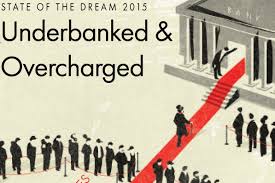
Dream 2015 is a shocking new report describing the systematic impoverishment of people of color. By denying them access to banking services (eg checking accounts to cash their pay checks), Wall Street forces them to rely on fringe financial services, such as check cashing outlets, payday loans and auto title lenders. As Robert Manning writes in Credit Card Nation, many of these predatory outlets are owned by the big banks. Charting interest rates as high as 730% a year, they siphon off $103 billion annually from desperately poor communities.

In 2014, 16.7 million Americans were “unbanked,” ie had no access whatsoever to banking services. Another 50.9 million were “underbanked.” The “underbanked” typically have a checking account but lack access to small dollar loans and other banking services.

A total of 53.6% of black households and a total of 46.4% of Latino households are unbanked or underbanked. The most common reasons given are the absence of full service banks in communities of color and insufficient income to meet minimum balance requirements and overdraft fees. Ninety-three percent of all bank branch closings in 2008 were in zip codes with below median income.

Dream 2015 proposes a number of practical solutions to a problem that clearly plays a major role in growing poverty and income inequality. Among other potential solutions, they propose

• Enacting federal legislation capping interest and limiting the size and length of payday loans. Seventeen states have anti-usury laws, but according to Manning, fringe financial companies evade these laws by incorporating in states that don’t have caps. An existing federal law prohibits lenders from charging military personnel more than 36% annual interest – this protection needs to be extended to all Americans.
• Strengthening the Community Reinvestment Act to require all banks to provide small dollar loans to the communities they serve.
• Strengthening the Consumer Financing Protection Bureau.
• Strengthening public-private partnerships such as Bank On and Lending Circles  that provide microlending* services to communities of color.
• Modernizing US electronic payment technology. In the US electronic transfers take three to five business days to be credited to the recipient bank account. In most other countries (including New Zealand and Mexico), electronic transfers take at most a few hours.
• Expanding financial services at all 36,000 US post office branches to include checking, debt, savings and small loan services.

In my view, the latter is the most practical and easily implemented. Last year Senator Elizabeth Warren argued eloquently argued for it in the Huffington Post. There are post offices in most communities, regardless of income level, postal workers already get financial services training (because they sell money orders), and it would provide a new source of income now that digital communications are eroding the demand for snail mail service.

The US post office used to offer postal savings accounts between 1911 and 1917. They were phased out because they couldn’t compete with the higher interest rates banks offered (no longer an issue now that US banks pay less than 1% interest on savings).

Presently France, Germany, Japan, China, Brazil, India and New Zealand offer banking services in their post offices. New Zealand’s Kiwibank is a full service bank offering low cost credit and debit cards and mortgage loans in addition to checking and savings accounts. They also have some really clever TV ads.**


*Microlending or microcredit is the extension of small loans to enterpreneurs too poor to qualify for traditional bank loans.

**The surly looking suits represent the Australian banks that own all but one of our private banks.


A New Economic Model to Save the Planet

plenitude

Plenitude: The New Economics of True Wealth

by Juliet Schor

Penguin Press (2010)

Book Review

The main premise of Plenitude is that neoclassical or free market economic theory falls short in addressing the global economic crisis because it fails to account for the negative ecological impacts (aka externalities*) of markets. The author Juliet Schor proposes a new economic model which addresses both environmental impacts and inequality.

Schor’s new “plenitude” model builds from ideas on downshifting and simplified living she introduced in her 1998 book The Overspent American. It’s based on four main principles.

The first involves a new allocation of time away from the market economy and a reduced reliance on money to meet individual needs. By Oct 2009, eight million jobs had disappeared in the US alone. There’s no way these jobs will ever be restored. However by reducing their hours of work (either voluntarily or involuntarily), people can make a conscious trade-off of money for time. With more time, households can increase their social networks and supports and find new ways (other than money) of procuring consumption goods.

The second principle involves diversifying away from the traditional economy by “self-provisioning,” growing and making things for ourselves instead of paying other people to do it. Schor sees distributed production facilitated by 3D printing** as a big part of this process.

The third principle is what Schor calls “true materialism,” an environmentally aware approach to consumption in which people are more aware of the ecological impact of their purchases. Rather than sacrificing a comfortable lifestyle, this might mean paying more for better quality clothes, shoes and consumer goods.

The fourth principle is restoring our investment in one another and our communities. Especially in times of crisis, these connections, sometimes referred to as social capital, are every bit as important as money or material goods.

Government Interventions Required

Despite numerous examples Schor gives of individuals, groups and cities that have already transitioned to the new model she proposes, new government policies will be essential to ensure the planet reduces its carbon footprint in time to avert ecological catastrophe.

Unlike French economist Thomas Piketty, author of the bestseller Capital in the 21st Century, she specifically opposes after-the-fact taxation to redistribute market income. She rightly points out that it fails to increase new wealth. Instead she would support a proposal put forward by Peter Barnes to set up a Sky Trust similar to the Alaska Permanent Fund. The Sky Trust would tax corporations on the carbon dioxide emissions (and possibly their destruction of habitat and discharge of toxic chemicals) and return the revenue earned as a dividend to citizens.

Secondly she calls for the adoption of social program (single payer health care, support for child care and tertiary education and reliable pensions) common in other industrial countries. She cites studies the common misperception that Americas work the longest hours in the world to acquire more consumer goods. The real reason they stick with jobs with impossible long hours and stress is because that’s the only way they can pay for health care, child care, college and a secure retirement.

Third she calls for a change in intellectual property laws to facilitate sharing new techniques and technologies) permaculture, agroforestry, biodynamic farming, cob, earthen and strawbale home construction, alternative technology, renewable energy systems) that enable more efficient use of resources.

Fourth she sees an essential government role in cleaning up toxic waterways and brownfields and restoring forests, which are also fundamental steps in restoring true wealth and reducing inequality.

Finally she would call on government to abandon their growth at all cost policies. She blames the financialization of the US economy for the pressure for constant growth. Although the sale of financial products produces no new wealth, it requires a continuous increase in economic growth to pay shareholders and bondholders.

Reigning in the Financial Sector

The main weakness of Plenitude is Schor’s failure to propose specific policies to reign in an out-of-control financial sector. In European parliaments, the main policies being explored include ending the ability of banks to create and control the money supply (restoring this function to government)*** and a financial transaction tax.****


*In economics, an externality is a consequence of an industrial or commercial activity which affects other parties without this being reflected in market prices, such as rainforest destruction.
** 3-D printing is a manufacturing process that builds layers to create a three-dimensional solid object from a computer model. Video of houses being printed in China:

***See The IMF Proposal to Ban Banks from Issuing Money
**** A financial transaction tax is a levy placed on financial institution for specific types of monetary transactions.

Credit Card Nation

credit card nation

Credit Card Nation

by Robert D Manning

Basic Books (2000)

Book Review

Credit Card Nation is about the role of plastic money in the rise of consumer capitalism. In addition to heartbreaking stories of real people struggling with credit card debt, it provides a comprehensive macroeconimc overview of the credit industry. The two main points Manning emphasizes are 1) marketing credit cards to unemployed college students and the working poor saved all the major banks from insolvency in the 1980s and 2) credit cards increase wealth inequality by offering free credit to the wealthy and usury to the poor.

As Manning describes it, the living standards of wealthy Americans are being subsidized by the usurious interest rates paid by the poor. Banks divide credit card users into two groups: the “convenience” (commonly referred to “deadbeats” by bank managers) users who pay their full balance every month and the “revolvers” who accumulate debt by only paying the minimum charge. As Mann points out, convenience users who pay their full balance are getting a month of free credit.

The Poor Are the Credit Niche Market

When banks first began issuing credit cards in the sixties and seventies, their credit card divisions lost money by only marketing them to the low risk middle class users with sufficient income to pay the full balance every month. This changed when US wages began their steep decline in the 1980s, as Reagan’s deregulatory regime lead to a frenzy of factory closures (as companies shut down and moved overseas) and merger-related downsizing. This enabled banks to discover the “niche” credit card of unemployed students (banks had the brainstorm of waiving parental signatures on credit card applications) and the working poor, a bonanza of consumers who were too poor to pay more than the minimum monthly payment.

Soaking the Poor to Service the Rich

Ratios between convenience and revolver credit card users vary. In 2000, there were 33.5 million convenience users for 44.5 million revolvers. When the percentage of convenience users gets too high, banks typically increase penalties and interest rates on revolvers. Credit card interest rates soared in the late eighties when banks began using credit car fees to subsidize deeply discounted auto and corporate loans.

In the interim, credit card interest rates have skyrocketed. Average annual interest rates on credit card balances increased from 1.4 to 14.3% between 1981 and 1992. By 2000, they had increased to 18.3%.*

The History of Credit

Credit Card Nation also provides an excellent overview of other types of consumer credit, starting with the boom in installment credit that fueled the initial post war consumption engine. Installment credit expanded rapidly as big box malls drove put neighborhood pharmacies and community merchants out of business. Both typically carried informal “open book” credit accounts for established customers.

Manning also traces the devastating effect of banking consolidation – the lost of community banks due to mergers and acquisitions into a handful of “too big to fail” banks. Aside from a one time gain from layoffs and interest-related tax deductions, studies show that big banks are less efficient and less profitable. They’re also deadly for start-up and small businesses, which are the most consistent job creators. Bank loans to small businesses virtually ceased in the early nineties. For both, the only credit option left is risky high interest credit card cash advances.

The Corporate Face of Loan Sharking

The most eye opening chapter is the one on fringe banking and second tier financial services that have moved in as banks have closed their inner city branches. The book examines the full range of fringe banking services, which charge average (annual) interest rates of 180-730%. These include check cashing and pay day loan companies, pawnshops, rent to own companies, sale-leaseback loans, auto title loans and cash leasing.

Many of these enterprises operate as nationwide chains and partner with major banks they rely on for capital. Cash America was the first pawnshop company to trade on the New York Stock Exchange. Ace Cash Express, the largest US check cashing company, trades on the NASDAQ.

Rent-to-own companies charge average interest rates of 180-360%, though most clients typically make only 3-4 payments before the appliance is repossessed.

Cash leasing is the worst. The term “leasing” rather than “loan” is used to evade state usury laws. A borrower pays 30% interest every fifteen days on the loan amount (730% total annual percentage rate). They must have an active checking account and verified ownership of three electronic items (TV, computer, etc) that can be pledged as collateral.


*According to Al Jazeera average US credit card interest rates hit 21% in April 2014

Unemployed Youth: the Lost Generation

youthRecovery? What Recovery?

High youth unemployment is a defining characteristic of the current recession. Despite the so-called recovery, a fifth or more of young people under thirty remain unemployed. In most countries, youth joblessness is triple the general unemployment rate. In some regions with harsh austerity regimes, youth unemployment is increasing.

In the US the preferred approach to youth unemployment, both by government and the media, is to ignore it. Elsewhere the attitude towards youth unemployment is mixed. In Europe, the European Commission has appropriated $1 billion euros to address youth joblessness. Yet only Germany and Switzerland have come up with real solutions.

Pundits offer a variety of explanations for the stubborn problem of youth unemployment: globalization (i.e. jobs moving to the third world), automation (i.e. replacement of jobs with robots), the greed of baby boomers who refuse to retire (greasing the wheels for social security and pension cuts) and government policies that allow billionaires to suck all the money out of the economy for their personal pleasure.

An increasing number of economists see youth unemployment as symptomatic of structural economic changes related to the end of global growth. Despite all the corporate media babble about perpetual economic growth, the phenomenon is actually quite new. Prior to the harnessing of fossil fuels by the industrial revolution, all human civilizations were based on steady state economies.

Of the three documentaries below, the first, from Canada, is the best. Portraying youth unemployment as a permanent structural problem, it’s highly critical of the Canadian government for refusing to address it.

The four important points Generation Jobless (Canadian Broadcasting Corporation 2014) makes are

1) by 2030 half of all the current jobs will be gone
2) the “lost generation” (the 20% of Canadians under thirty who remain unemployed) is highly unlikely to ever land permanent good-paying jobs
3) Canadian universities are training young people for obsolete jobs instead of offering them new skills needed in the present economy.
4) Canada’s student loan program is a fraud – students are pressured to take on vast amounts of debt on the promise of good paying jobs that don’t exist.

The film disputes the frequent claim that a large aging population is a drag on the Canadian economy – the real drag on the economy is the underutilization of Canadian youth. This has drastic implications for the future health of the Canadian economy. Most of a society’s wealth comes from the skills of its workforce.

This first documentary also highlights two examples of programs that are successfully cutting youth unemployment, one at the University of Regina (UR) in Saskatchewan and the other in Switzerland.

The UR Guarantee program, which promising all entering students will be placed in a job on graduation, has a 97% success rate. From day one, the curriculum for all students includes career counseling and career education, consisting resume writing, interview skills and networking. Students also participate in an apprenticeship program in their chosen field, thanks to a cooperative agreement UR has with local businesses. Finally, they get a guarantee: any graduate who fails to find work in six months returns for an extra year (free of charge) to further hone their skills.

In Switzerland, youth unemployment is 2.8% (roughly a tenth of other industrialized countries), thanks to a high school program that allows them to start an apprenticeship at fifteen. The Swiss Employers’ Association helps local high schools set up their apprenticeships, which include white collar fields, such as health care, banking and IT, as well as the traditional trades.

The 2013 BBC documentary Young and Jobless is less hard hitting. Unlike the CBC documentary, it fails to emphasize the failure of the British government to acknowledge or address the problem of youth unemployment. In fact, it tends to trivialize the problem by comparing superficial snapshots of youth unemployment in different countries.

That being said, there’s an excellent segment about lawsuits American young people have filed (and won) against corporations that have exploited them via unpaid internships.

I was also intrigued by the number of countries that deal with youth employment by encouraging young people to emigrate (as we do in New Zealand). In Spain, for example, there are specific programs to assist Spanish youth in locating jobs in the UK. In contrast, Irish youth are encouraged to emigrate to Australia.

Video 3 Young, Jobless and Living at Home is a 2014 BBC documentary about the “boomerang generation,” the growing tendency of young people under thirty to move in with their parents, either because they can’t find jobs or because they can only find low paid, part time and/or temporary work that doesn’t cover their living expenses. Radio DJ Grey James follows six unemployed youth for six months.

The statistics say it all: in 2014 20% of young Brits under thirty were unemployed but twice as many (40%) were living with their parents.

photo credit: Caelie_Frampton via photopin cc

Also published in Veterans Today

New Hope for Underwater Borrowers


freddie mac

One for Our Side

Anti-eviction activists were thrilled with a November 25 ruling by the Federal Housing Finance Administration (FHFA), which seems to reverse the position taken by the Obama administration in federal court. Prior to the new ruling, homeowners foreclosed by Fannie Mae or Freddie Mac (the Enterprises)* found themselves in the painful position of watching their foreclosed homes being sold for much less than they paid for them.

Deadbeat Homeowners vs Deadbeat Banks

As the 2008 economic collapse caused over inflated real estate values to plummet, more than a fifth of all mortgage holders (7.5 million) discovered that – through no fault of their own – they owned more on their mortgage than their property was worth. By December 2013, the percentage of underwater (aka negative equity) mortgages had decreased to 13% (6.4 million)  By December 4, 2014, thanks to an October “rally” in home prices (i.e. new real estate bubble) , this figure had dropped to 8% (4 million) .

Prior to the new ruling, both Fannie and Freddie (both owned by the taxpayer since they were nationalized** in September 2008) required homeowners who had been through foreclosure and wanted to buy their home back had to pay the entire amount owed on the mortgage. The Enterprises argued that allowing former home owners to repurchase their homes at the true (lower) market value created a “moral hazard” because it encouraged deadbeat home buyers to default on their mortgage to repurchase their property at its real value. I find this really rich, given that it was deadbeat banks and mortgage companies who caused the economic downturn to begin with.

Thanks to the new FHFA policy, both Fannie and Freddie must now permit the sale of existing real estate owned (REO) properties to any qualified purchaser (including the former owner) at the property’s fair-market value.

Old Policy Violated Massachusetts Law

A year ago, two Massachusetts residents filed suit against Freddie Mac, with the support of the Boston anti-eviction group City Life/Vida Urbana, for violating a Massachusetts consumer protection statute that explicitly forbids this type of refusal. On November 18, the Obama administration argued that state laws are non-binding on Fannie and Freddie while they’re under federal receivership. Extremely unfavorable publicity may partially explain the FHFA’s surprise ruling a week later. Now that the pressure of mid-term elections has passed, it’s quite a safe lame duck type decision.

City Life/Vida Urbana

City Life/Vida Urbana was first started (as the Jamaica Plain Tenants Action Group) in 1973 to pressure inner city slumlords to property maintain their buildings and to pressure the city of Boston to enact rent control. Since the 1980s, they have also campaigned against property speculation, gentrification and condominium conversion. Since 2008, defending against foreclosure and other evictions has been their primary focus. Joining forces with Occupy Our Homes, which grew out of Occupy Wall Street, they have employed a two prong approach. In addition to helping home owners fight fraudulent foreclosures legally in court, they also organize local activists to block evictions through mass occupation and civil disobedience in foreclosed homes. In many cases, the negative publicity this generates will pressure lenders to renegotiate more reasonable repayment terms.

Thanks to trainings City Life/Vida Urbana conducts across the US, many communities are starting grassroots anti-eviction organizations.


* Roughly half of all US mortgages are held by two government sponsored enterprises (GSEs), nicknamed Fannie Mae and Freddie Mac because federal bureaucrats kept getting the two confused. The Federal National Mortgage Association (FNMA), commonly known as Fannie Mae, was founded in 1938 under the New Deal. Its purpose was to expand the secondary mortgage market. The latter attracts new capital for mortgages by buying mortgage loans from banks and bundling them as securities to on-sell to pension funds, insurance companies and hedge funds. This allows lenders to reinvest their assets in more lending, theoretically increasing the supply of funding available for home purchases. Fannie was privatized in 1968 to become a publicly traded company. The Federal Home Loan Mortgage Corporation (FHLMC), known as Freddie Mac, is a publicly traded GSE created in 1970 to further expand the secondary mortgage market.
**On September 7, 2008, George W Bush nationalized Fannie and Freddie by placing them under FHFA conservatorship and causing them to issue new senior preferred stock and common stock warrants to the US Treasury amounting to 79.9% of each GSE. In 2010 both were delisted from the New York Stock Exchange after Fannie’s stock traded below $1 a share for over 30 days. Since 2010 both stocks have continued to trade on the Over-the-Counter Bulletin Board.

photo credit: Mike Licht, NotionsCapital.com via photopin cc

Also published in Veterans Today