Europe’s Co-op Movement

Together: How Cooperatives Show Resilience to the Crisis

CECOP/CICOPA Europe  (2012)

Film Review

Together examines how the cooperative movement enabled tens of thousands of European workers to survive the 2008 downturn. As of 2012, there were 1.5 million co-op workers in Europe. The filmmakers interview workers from French, Polish, Italian and Spanish worker cooperatives. All agree that the traditional capitalist model – in which a financial group loots an enterprise for a few years and abandons it – is obsolete because it inevitably predisposes to financial crisis.

In France, workers converted 150 failed businesses to cooperatives between 2008 and 2012. The first co-op featured is a foundry workers converted with the help of a French organization that specializes in this type of conversion.

The Polish example is a bottling plant that survived Poland’s transformation to a “free market economy” in the 1990s. There were many so-called worker cooperatives in communist Poland, but they were controlled by the state, rather than workers themselves.

The Italian example features the “social cooperatives” enabled by Law 381 in 1991. These are worker-run public-private ventures that provide social services and work integration schemes for the disadvantaged. Italy has a total of 10,000 social cooperatives, and they increased, rather than decreased, staff following the 2008 downturn.

The documentary also showcases the world-famous Mondragon Cooperative Corporation in the Basque region of Spain. Mondragon, which was first started in 1943, is actually a consortium of 100 worker-owned businesses. Ninety-four are located outside of Spain.

Mondragon workers believe they survived the 2008 downturn due to their heavy emphasis on research and worker upskilling. They’re especially proud of the Mondragon electric car project. After the global economic crash, 500 Mondragon workers moved to a new co-op when their original work area shut down.

The Drug Shortage Scandal

pills

This morning I was intrigued to learn that the US has been experiencing regular shortages of anesthetics, painkillers, antibiotics, cancer treatments, heart drugs and other lifesaving medications. Doctors routinely deal with these shortages by “rationing.” In other words, deciding which patients are more deserving of treatment.

Although the problem has been going on a decade or more, most doctors don’t inform patients when they withhold clinically indicated treatments. Prior to a January 29 New York Times article Drug shortages forcing hard decisions on rationing treatment, the American public was also totally in the dark.

Did you know there was a Drug Shortages Summit in 2011 to address this public health emergency? I sure didn’t. Nor did I know know about the Food and Drug Administration Safety and Innovation Act (FDASIA) Congress passed four years ago to address the crisis.

The FDA Solution: A New App

A recent examination of the FDA website, which lists nearly 100 current drug shortages, suggests FDASIA isn’t working that well. However taxpayers will be pleased to learn the FDA has created a new app for android devices that sends alerts when the Agency adds or updates shortage information. They are currently working on an iOS version, which will be available soon.

The New York Times article profiles several doctors who talk about the difficulty of deciding which patients are more worthy of treatment. Some institutions have formal committees that include ethicists and patient representatives to decide which patients receive a needed drug — and which do not.

A February 8 Times editorial waffles about the “root cause” of the drug shortage crisis. Their list of possible causes includes “manufacturing quality and compliance problems, raw material sourcing, and drug company consolidation and business decisions that result in the discontinuation of critical drugs.”

M.E. Markowski is far more direct in a 2012 Harvard Law School paper The Problem of Inadequate Profits. Markowski states, in essence, that pharmaceutical companies have no profit incentive to create a sufficient supply of essential medications to meet patient need.

Unbelievable. The US spends twice as much (per capita) as any other country. Drug company profits are soaring. Meanwhile patients are dying because they can’t get medications they need for life threatening conditions.

The Solution is Easy

Although the OECD ranks New Zealand far below the US in economic standing (20th as opposed to 4th), we don’t suffer from major drug shortages here. Like all other industrial countries (except for the US), we have a national health service. In this country, drug availability isn’t determined by drug companies seeking to increase their profits. In New Zealand Pharmac, a government agency staffed by health professionals, makes all our drug purchasing decisions.

Photo credit: J. Troha (Photographer) [Public domain or Public domain], via Wikimedia Commons

Falling Oil Prices: a Saudi Viewpoint

Inside Story – What’s Behind the Falling Oil Prices

Al Jazeera (2015)

Film Review

A most revealing documentary. Unlike western pundits who speculate about conspiracies to wipe out shale oil producers (ie fracking) and the oil  economies of Russia and Venezuela, these Middle East analysts stick to economic fundamentals.

The three analysts identify three main factors behind the present oil glut: shale gas production, a big increase in renewable energy production and dropping demand by emerging economies such as China.

They maintain Saudi Arabia’s primary motivation for current output levels is fear of losing “market share” if they unilaterally cut oil production.

There’s also an interesting discussion about the Saudi plan to introduce taxation to help reduce their $98 billion deficit.

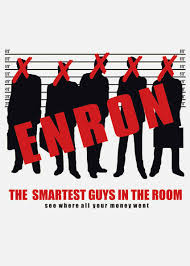
The Greedy Bastards Who Gave Us Enron (and Bankrupted California)

enron

Enron: The Smartest Guys in the Room

Alex Gibney (2005)

Film Review

The subject of this documentary is the historic Enron collapse in September 2001.

The Enron scandal occurred prior to the blossoming of social media, and the corporate media deliberately minimized the criminal behavior that led to the collapse of the world’s largest energy company.  They blamed Enron’s demise on “bookkeeping irregularities.” This film tells a very different story.

When Enron, which was founded in 1985, went bankrupt it was the largest corporate bankruptcy in history. Its late founder, Ken Lay, was close personal friends with Bush senior, who engineered millions in federal subsidies to help launch the company. Lay subsequently donated heavily to Bush junior’s presidential campaign.

Trading Energy Like Financial Derivatives

A big proponent of corporate deregulation, Lay teamed up with Jeff Skilling in 1990 to transform energy production and delivery (natural gas and electricity) into financial instruments that could be traded like derivatives.

To manipulate their stock prices, Enron employed two novel (and illegal) bookkeeping practices. With the first, mark-to-market accounting, they recorded potential future profits as real time revenue. The second accounting scam involved creating hundreds of “subsidiaries” to hide $30 billion of Enron debt from investors and regulators. Each subsidiary was personally managed by Enron Chief Financial Officer Andy Fastow, who pocketed $45 million from one deeply indebted subsidiary.

These devious accounting schemes allowed Enron to conceal that their company was losing millions of dollars a year. They kept the company afloat via $25 million bank loans from all the major Wall Street investment banks, using their overpriced stock as collateral.

Enron Bankrupts California

Prior to seeing this film I was vaguely aware that Enron was responsible for the California power crisis in 2000-2001 and the $38 billion deficit that led California governor Gray Davis to be recalled and replaced with Arnold Schwarzenegger. I had no idea of the criminal behavior behind the power crisis.

Enron’s purchase of Pacific Gas and Electric in the late nineties gave them total control of most of the state’s power generation and 26,000 miles of power lines. To drive up the cost of power, Enron’s unscrupulous energy traders caused rolling blackouts by “loaning” California power to other states and creating artificial shortages. They jacked the price of power even higher by deliberately shutting down regional power plants for “routine maintenance.” In this way, they succeeded in driving the cost of electricity from $30 per kilowatt to $1,000 per kilowatt.

Governor Davis declared a state of emergency while he pleaded with Bush junior and the Federal Energy Regulatory Commission (FERC) to impose a price cap on California electricity. By the time Congress forced FERC to implement a price cap, California was $38 billion in the hole and the Terminator was the new California governor.

Management Screws Enron Employees

Even more scandalous was the decision by Enron management to freeze trading by employees as the stock price plummeted. This enabled all the top executives to dump their stock while 29,000 employees had their pension plans wiped out.

Andy Fastow pleaded guilty to fraud and embezzlement charges (receiving a $23 million fine and 10 years in jail) in return for testifying against Skilling and Lay.

Skilling would receive a 14 year sentence for insider trading. Ken Lay was also convicted of insider trading but died of a heart attack (2006) prior to sentencing.

https://vimeo.com/71902085

Migrants Who Cross the Deadly Sonora Desert

Sonya Dooley in the USA – Border Wars

BBC (2013)

Film Review

Most Sonya Dooley documentaries are contextless valley girl puff pieces, but this one isn’t too bad.

Border Wars is about the one million migrants who attempt to cross the Sonora Desert every year to gain illegal entry to the US. The Mexico-Arizona border is sparsely patrolled in the desert. The US Border Patrol catches approximately 300,000 illegal migrants every year and returns them to Mexico. An estimated 600,000 make it safely to major US cities, where they find work. Several thousands become lost during the five day desert crossing and die of dehydration.

The documentary begins in the small Mexican town of Alta, which is under the control of Mexican drug cartels. In addition to smuggling illegal drugs across the border, the cartels also provide the coyotes (people smugglers) who charge up to $7,000 each to escort migrants across the border.

Dooley interviews migrants staying in a charity hostel while they wait for their coyote. She also visits a Red Cross trailer that provides free medical care, as well as an informational leaflet providing tips for surviving the five-day desert crossing.

Two migrants she interviews are mothers leaving small children behind because she has no way to provide for them in Mexico. Her only hope is to try to find subsistence-level work in the US and send money home for them.

One man Dooley interviews was raised in the US and deported after twenty years, despite having a US-born wife and children. Several migrants tell her they’re from Guatemala.

Out of the seven migrants she profiles, only one succeeds in making it to California, where she now earns $300 a week as a farm worker. To earn a comparable sum in her southern Mexico village would take two months.

Privatization and the Theft of the Commons

Catastroika

by Aris Chatzistefanou and Katerina Kitidi

Film Review

Catastroika is a Greek documentary on neoliberalism, with a specific focus on the privatization of publicly owned resources. Although it makes no mention of historian Richard Linebaugh, its depiction of the neoliberal privatization movement provides an elegant illustration of the ongoing theft of the Commons (see Stop Thief: the Theft of the Commons).

After a brief overview of the University of Chicago economists (championed by Milton Friedman) who first put neoliberal theory into practice during the Pinochet dictatorship, the documentary tracks the wholesale privatization of Russia’s state owned industries after the 1993 coup by Boris Yeltsin, in which he illegally ordered dissolution of the Russian parliament (see The Rise of Putin and the Fall of the Oligarchs).

The fire sale of state assets to oligarchs and western bankers would virtually destroy the Russian economy, throwing millions of people into extreme poverty and reducing average life expectancy by ten years.

The Privatization of East Germany

With German reunification in 1990, East Germany would be the third major target for massive privatization. According to German economists interviewed in the film, the process amounted to an “acquisition” of East Germany by West German bankers. The West German government set up an agency called Treuhand to buy up state owned East German businesses at the rate of ten to fifteen a day – a total of 8,500 businesses in four years. The process, undertaken with virtually no oversight, predictably resulted in massive chaos and fraud. Many well-performing East Germany companies were dissolved for the simple reason they competed with West German businesses. Three million (out of 4.5 million) East German workers lost their jobs, which East Germany’s GDP shrank by 30%.

Using Debt to Compel Compliance

With the gradual demise of the world’s dictatorships during the 1990s, debt, rather than brute force, became the main mechanism to compel people to give up their publicly funded assets. At present, most of the focus is on Greece.

Current EU Commission Jean-Claude Juncker holds up Treuhand (which incurred a 250 million euro debt German taxpayers are still paying off) as a model for the Greek Asset Development Fund. The latter has been steadily selling off (at bargain basement prices) Greek railroads and municipal power and water systems.

The Dismal Track Record of Privatized Utilities

The filmmakers end the film by highlighting the disastrous outcome of Britain’s decision to privatize its railroads in 1993, the city of Paris decision to privatize its water service in the 1980s (it’s recently been re-municipalized due to massive public unrest – like privatized water systems in Bolivia, Ecuador and Argentina) and California’s experiment with electricity deregulation in the 1990s (leading to the Enron scandal).*


*The Enron scandal involved massive securities fraud and a deliberate conspiracy by power companies to withhold power to drive up electricity prices.

The Rise and Fall of Syriza

The latest news from Greece is that Prime Minister Tsipras has resigned and called a new election. This follows a rebellion by 1/3 of Syriza MPs, who voted against the IMF bailout Greek voters rejected in the 5 July referendum. According to the The Guardian, 25 Syriza MPs have broken away to form the anti-austerity party Popular Unity, led by former energy minister Panagiotis Lafazanis. Some analysts predict the new party will call for Greece to exit the euro monetary union: see Senior Syriza MP Greece Must Exit Monetary Union

The following documentary lays out some of the economic and social realities that led to the rise of Syriza.

Greece on the Brink

Manuel Reichetseder (2014)

Film Review

Greece on the Brink is a 2014 documentary about brutal living conditions in Greece that led to the rise of the left wing Syriza government. At the time the film was made, 65% of Greek youth age 15-34 were unemployed. Millions of Greeks had no income at all and were scavenging food out of garbage cans. Twenty thousand were homeless and one third had no access to privatized health care.

The film documents that only a tiny proportion of the $206.9 billion bailout Greece received between 2010-2013 went to public services:

  • 48% went to European creditors
  • 28% went to Greek banks
  • 22% went into the national budget (of this 16% went to interest payments, most of the balance went to the Greek military)

In addition to bolstering Syriza’s rise to power, the Greek economic crisis has led to numerous experiments in worker self-organization: solidarity clinics run by health professionals volunteering their services, solidarity networks that provide free food, a journalist cooperative in which journalists run their own newspaper, various worker co-ops which have occupied and taken over shuttered factories, and TV journalists and engineers who took over the state broadcasting service after the Greek government shut it down.

Most of the commentators featured in the film are militant Syriza members who predicted a year ago  (based on compromises Tsipras made to propel his party into power) that Syriza wouldn’t solve the problems faced by the Greek working class.

The most interesting section is a Marxist analysis by British economist Allen Woods about the real cause of the 2008 “credit crunch” that triggered Greece’s sudden economic collapse. According to Woods, debt is the mechanism capitalists use to avoid the crisis of overproduction. Marx believed that overproduction was an inevitable structural defect of so-called free market capitalism. By its very nature, capitalist production always overshoots the ability of the market to regulate it.

As Marx noted 150 years ago, capitalism tries to make up for this defect by expanding credit (ie debt). Woods gives the current 30% overcapacity of the global automotive industry as an example. This is illustrated by an article that appeared in Zero Hedge a year ago about new car graveyards – see Where the World’s Unsold Cars Go to Die

Woods predicts that there will be no solution to the current global economic crisis until overproduction (and the debt that supports it) are eliminated.

Behavioral Economics

Mind Over Money

PBS Nova (2010)

Film Review

Mind Over Money is an intriguing Nova documentary about the new field of behavioral economics. At present, banks and governments use complex mathematical models in making decisions about lending, investment, taxation and government borrowing. These models are based on the premise Adam Smith put forward in Wealth of Nations that the “rational self-interest” of groups of individuals causes economic markets to be perfectly self-regulating without government regulation or control.

While the economic “rationalists” who subscribe to this belief acknowledge that not everyone makes totally rational decisions about money, they claim enough do to enable bankers, governments and economists to 1) predict the behavior of markets mathematically and 2) guarantee the overall stability of markets without government interference.

In contrast, behavioral economists argue that most decisions around money are based on emotional and unconscious factors. They further argue that without government regulation, waves of irrationally sweep through the stock market and mercantile exchange (where commodities are traded), causing destructive speculative bubbles and crashes as they did in in 1929 and 2008.

John Maynard Keynes was the first economist (during the Great Depression) to raise concerns that destructive booms and busts result from irrational investing behavior. Because he could offer no clear explanation why this was happening, his views were largely dismissed.

Economist Robert Shiller echoed Keynes concerns in his 2005 book Irrational Exuberance, in which he predicted the 2008 global economic crash.

Thanks to a pressing need to understand the 2008 downturn (and prevent another one), social psychology research into spending and investing behavior is enjoying its own boom. The documentary describes a number of fascinating experiments that validate Keynes’s original claim that these decisions are largely controlled by emotional and unconscious factors.

For my own part, I question why we need to produce absolutely scientific certainty for something that’s blatantly obvious. In contrast to economists, Wall Street traders all readily agree that Wall Street volatility is driven by waves of emotion. It strikes me that Wall Street economists refuse to accept the behavioral basis of market activity because they have a vested interest in continuing the high priesthood of complex mathematical models.

The film implies that more market regulation is needed to prevent this type of market volatility. I disagree. In my mind, the best way to strip Wall Street of this vested interest is to strip banks of the power to create money out of thin air and restore money creation to public control (as Andrew Johnson and Abraham Lincoln attempted to do.) See An IMF Proposal to Ban Banks from Creating Money


Land Value Taxation 101

The Taxing Question of Land

Directed by Yoni Higsmith

2014

Film Review

The Taxing Question of Land is a British documentary about Land Value Taxation (LVT), a concept first proposed by American Henry George in 1879 (see Progress and Poverty: a Suppressed Economic Classic).

The filmmakers use simple animated infographics to argue that LVT is an ideal solution to a global debt-based economic crisis, especially as nothing else has worked. I tend to agree, provided LVT is combined with a return to sovereign money.* So long as bankers retain the power to create money out of thin air, they will always tilt any taxation scheme in their own favor.

The basic definition of Land Value Taxation is a tax that captures a percentage of land value on an annual basis to cover public expenditures. In his 1879 book Progress and Poverty, Henry George’s main argument for Land Value Taxation is that it restores the Commons. This film focuses mainly on secondary arguments that revolve around fairness and economic equality.

The filmmakers point out that a property’s increasing value nearly always depends on its proximity to public services (ie schools, water mains, sewers, roads, public transport) paid for by taxpayers – making it utterly reasonable that taxpayers should claim a share of this increased land value. They describe LVT as a “tax shift,” rather than a new tax, as it would reduce and/or eliminate most other taxes.

They also argue

• That unlike income, corporate and sales taxes, LVT wouldn’t suppress production and jobs.
• That intelligently implemented LVT would eliminate the need for government borrowing (and debt) because it would raise sufficient revenue to cover all government services.
• That LVT would eliminate tax avoidance because unlike other wealth, land is impossible way to hide.
• It offers and fair and painless way to reduce wealth inequality as the rich start to share the cost of paying for public services.

They go on to list a number of jurisdictions (New South Wales, Hong Kong, Estonia, Singapore, Taiwan, Pennsylvania and Mexicali) that have significantly reduced other taxes by establishing an LVT.

LVT is also unique in its bipartisan appeal. In Britain, it has adherents belonging to the Greens, Liberal Democrat, Labour and Conservative Party. Conservatives like it because it simplifies the tax system.


*In a sovereign money system, the public (as opposed to private banks) maintains the sole right of issuing and regulating money. See An IMF Proposal to Ban Banks from Creating Money

California’s Smart Meter Conspiracy

Smart Meter


According to Josh Del Sol (Take Back Your power) writing for Activist Post, evidence has now been made public of illegal actions and collusion between former California Public Utilities Commission president Michael Peevey and utility PG&E, as criminal investigations continue.

As part of a federal and state investigation into what appears to be systemic corruption involving former senior executives at PG&E and the California Public Utilities Commission, 65,000 emails have been publicly released, revealing collusion and conspiracy.

Former commission president Michael Peevey and former PG&E Vice President Brian Cherry are wishing investigators would have been kept in the dark. The pair privately discussed problems with so-called “smart” meters, violating their own rules of procedure while admitting to health harm and overbilling problems which several thousand Californians had been warning about since 2010.

Details continue to surface, as press and researchers continue to delve into the mountain of collusion.

It is perhaps justly ironic that we now see, made public, the private email correspondence of those who have teamed up to deploy technology which, according to a 2012 US Congressional Research report, facilitates unprecedented in-home surveillance.

Here are some highlights from their correspondence:

1) Peevey knew – since 2010 – that “smart” meters can cause physical harm.

And he believed PG&E should do something about it, albeit “quietly”. However, instead of regulating the utility to ensure public safety, he deferred his lawful duty to PG&E – the entity causing the harm. Here are some highlights from their correspondence: From a 2010 email:

peevey-email-1-smart-meters*

“Peevey wanted PG&E to keep it quiet,” writes Sandi Maurer, Director of the EMF Safety Network. “He didn’t want other customers, or the rest of the world to know there’s a problem with smart meters causing customers pain.”

Read more here


As Del Sol rightly points out, former Public Utilities Commission President Michael Peevey had a legal responsibility to protect California residents against the health risks of smart meters. Instead he colluded with PG&E in their determination to strong arm unsuspecting households (using local police in Naperville) into installing them.


Photo credit: Tom Rafferty (http://www.flickr.com/photos/traftery/4493063693/) [CC BY-SA 1.0 (http://creativecommons.org/licenses/by-sa/1.0)], via Wikimedia Commons