For me, the most interesting part of the talk is his discussion of the historical link between debt and the rise of the world’s major religions (Hinduism, Christianity, Confucianism, Islam, Buddhism, Judaism) between 500 BC and 600 AD.
As Graeber describes it, all commerce was based on credit prior to the development of coinage around 500 BC. In all societies, coinage arose in conjunction with the onset of empire building – traveling armies had to be paid in hard currency rather than credit. The result, according to Graeber, was the simultaneous rise of military/coinage/slavery* empires in Greece, China and India.
According to Graeber, all the major religions arose around the same time – as a “peace movement” opposing militarism, materialism and slavery.
Around 400 AD, when the Roman and other empires collapsed, coinage vanished, along with the standing armies that necessitated its creation. During the Middle Ages, nearly all financial transactions were based on credit. Until 1493, when the “discovery” of the New World initiated a new cycle of empire building, accompanied by militarism, coinage and slavery.
I was also intrigued to learn that Adam Smith stole most of his thinking about free markets from medieval Islamic philosophers. The Islamic ban on usury enabled the Muslim world to operate pure free markets that were totally outside of government influence or control. Trying to operate an economy without such a ban (or a system of debt forgiveness like the Biblical practice of Jubilee) leads to inevitable economic chaos and ultimately collapse, even with government intervention.
People who like this talk will also really like a series Graeber recently produced for BBC4 radio entitled Promises, Promises: The History of Debt. In it, Graeber explores the link between Native American genocide and the harsh debt obligations imposed on the Conquistadors. He also discusses the formation of the Bank of England in 1694, the role of paper money as circulating government debt and the insanity of striving for government surpluses.
* In ancient times, the primary mechanism by which people became enslaved was non-payment of debt.
June 2016 was a bad month for the US nuclear power industry. In a single month, Exelon decided to retire its Clinton and Quad Cities nuclear plants; the Omaha Public Power District decided to retire Fort Calhoun; and PG&E decided not to pursue license renewal for Diablo Canyon.
The views expressed by former US Nuclear Regulatory Commission member Peter Bradford in a March 2013 Bulletin article, which described the situation facing the US nuclear power industry as grim, now seem restrained. Bradford predicted that “an abundance of natural gas, lower energy demand induced by the 2008 recession, increased energy-efficiency measures, nuclear’s rising cost estimates, and the accident at the Fukushima Daiichi Nuclear Power Station” would result in trouble for the US nuclear power industry. “Here’s what the US government must do to bring about a gradual phase-out of almost all US nuclear power plants: absolutely nothing,” Bradford wrote.
He predicted that, without massive government assistance, new nuclear power projects would not be built and existing nuclear power plants would only operate until the end of their NRC licenses, meaning that the US nuclear fleet would largely be gone by the late 2050s. Since 2013, the factors listed in Bradford’s article have driven electricity market prices to low levels, resulting in the early retirement of operating units and stopping development of new nuclear power plants.
This documentary teaches the rules and techniques of dumpster diving for food. In the Los Angeles region, dumpster divers operate by a strict code of conduct:
Only take what you need.
The first one there has first refusal rights to any food but is expected to share.
Always leave the dumpster cleaner than how you found it.
This film examines the wasteful habit many supermarkets have of discarding perfectly good food because its arbitrary “sell-by date” has expired. According to the filmmakers, 3,000 pounds of edible food is discarded every second. Meanwhile globally one billion people go hungry.
Not only is this a tremendous waste of water (it takes 147 gallons of water to produce one pound of meat) and other natural resources, but discarded food (comprising 20% of all solid waste) in produces massive amounts of the most harmful greenhouse gas – methane.
Filmmakers noticed a significant increase in dumpster diving with the 2007 global economic crash. Yet despite the 1996 Good Samaritan Food Donation Act*, supermarkets (except for Albertson’s) have been reluctant to set up programs to donate their food waste to food banks and homeless shelters.
It’s mainly been up to voluntary grassroots organizers, such as the God Provides food bank in El Monte California to take the initiative in keeping edible supermarket food out of the dumpster.
Fortunately in the nine years since this documentary was made, more supermarkets have come on board with Fresh Rescue and similar programs.
A new law France passed in February 2016 forbids food wastage by supermarkets. Its passage spurred New Zealand supermarkets to forestall a similar ban by voluntarily implementing food donation programs. It would appear the French law has had a similar effect in the US and UK.
*The Good Samaritan Food Donation Act encourages the donation of food to non-profit charitable organizations by exempting donor from liability related to food-borne illnesses.
***
This second UK film Wasted/Wanted (2014) explores the work of the charitable organization FairShare. Their volunteers are granted access to warehouses of discarded food that never reach the supermarket. They sort and deliver the food to food banks, soup kitchens and homeless shelters. In most cases, this food hasn’t reached its sell-by date and is discarded for other reasons:
flawed packaging
bar codes that don’t scan
damaged cartons that make the food difficult to transport
At a June 15 press conference, Federal Reserve Chairwoman Janet Yellen made the surprise announcement that the Fed “might legitimately consider” using “helicopter money” in an “all-out” effort to rescue the U.S. economy from a severe downturn.
“Helicopter money,” a term coined in 1969 by late economist Milton Friedman, is money government creates by spending it into the economy.
As economist Richard Murphy describes in The Joy of Tax, government has always played a role in creating money whenever private banks generate insufficient money (by issuing loans from money they create out of thin air) to maintain the smooth running of the economy. Following the 2008 recession, the Obama administration pursued a policy called “quantitative easing,” in which the US Treasury created $500 billion (out of thin air). Unlike “helicopter” money, quantitative easing provided these funds directly to private banks, hoping they would use them to generate more loans. This, in turn, was meant to stimulate business investment and job creation.
Although it probably prevented the US economy from collapsing, Obama’s quantitative easing did little to promote business investment and job creation. This was because the banks used most of these funds for purposes other than making new loans – ie buying back their stock (to increase stock prices) and paying obscene CEO bonuses.
In contrast, “helicopter money”, a policy that has been virtually taboo for fifty years, calls for a central bank to print money and spend it into the economy for social services, infrastructure development, or even a citizen’s dividend. The idea is to put the money directly into people’s hands – rather than using banks as an intermediary – as they are more likely to stimulate the economy by spending it.
As Murphy details in The Joy of Tax, libertarian corporatists obsessed with balanced budgets, government debt and austerity are largely responsible for the taboo against public money (aka sovereign money) that the government creates and spends into the economy. Their position is that only private banks should be allowed to create money – in most cases due to immense financial benefits (from interest payments) they derive from this type of money creation.
Ironically former Federal Reserve Chairman Ben Bernanke also raised the possibility of the US using “helicopter money” as a tool to stimulate a flagging economy in an April blog post.
And in a similar move , 18 Members of the European Parliament have written to European Central Bank (ECB) president Mario Draghi requesting that the ECB should revisit its opposition to using “helicopter money” to boost the EU’s deteriorating economy.
The Joy of Tax: How a Fair Tax System Can Create a Better Society
by Richard Murphy
Corgi Books (2015)
Book Review
Although the topic is economics, I personally guarantee this product to be totally painless. Murphy describes economics in ordinary comprehensible language – unlike mainstream economists who treat economics like a religion that can only be understood by high priests – and who speak and write in obscure language so you can never be sure if they’re telling the truth or not.
In The Joy of Tax, UK Tax Justice Network co-founder Richard Murphy offers a radically pioneering approach to tax and fiscal policy. Murphy is one of the first economists to link tax policy to the 400- year-old reality that nearly all money is created by private banks out of thin air.
For political reasons, most economists try to conceal that private bank loans, i.e. debt, are the source of nearly all money in circulation. According to Murphy, the recent admission by the Bank of England (Quarterly Bulletin April 2014) about the true source of our money makes it possible to debunk a number of myths perpetuated by mainstream politicians and economists. Some examples: that investment is only possible when there are sufficient savings in the economy, that government debt is bad and that austerity, balanced budgets and government surpluses are good.
A point Murphy emphasizes repeatedly is that government also has the ability to create money out of thin air. Moreover it has regularly exercised that right to stimulate a stagnant economy. In fact, because all money is created as debt, it’s essential for government to “create” money (by spending it into the economy) whenever private banks fail to create sufficient credit. If this didn’t happen, severe economic recession results.
In Murphy’s view, the primary purpose of taxation is to reclaim the money government creates to keep it from over-inflating the economy. He claims the conservative elites who rabbit on about repaying government debt are really making the case that only private banks should have the right to create money. Aside from making them enormously rich, this makes no sense. Private banks are incapable of acting in the public interest – by law they can only act in the interest of their shareholders.
Citing Adam Smith in The Wealth of Nations, Murphy maintains a rational tax system can deliver other important goals, such as reducing inequality, recovering externalized costs (e.g. pollution, toxic waste) imposed by corporations and promoting economically and ecologically sustainable growth.
For the current tax system to accomplish these goals, it would need to be far less regressive. At present most of the tax burden falls on middle and low income taxpayers. According to Murphy, the global economy will continue to stagnate until the wealthy shoulder their fair share of tax.
To make our current tax system fairer, Murphy proposes to introduce a number of “progressive” taxes, including a financial transaction tax, a wealth tax, a carbon/pollution tax, a land value tax to fund local government and a special tax on corporations that fail to re-invest their profits. He also proposes to do away with the current welfare bureaucracy by introducing an Unconditional Basic Income (UBI).
Although most of these tax reform proposals are specific for the UK, they would clearly produce similar benefits for the US and other post-industrial economies.
This is a five-part miniseries describing how European banks have hijacked the euro monetary union to vastly increase their wealth. The upcoming Brexit vote in Britain makes this a particularly relevant topic.
Part 1 A Bank Crisis a Week
The series begins by describing the history of the European monetary union. Built at the height of neoliberalism it adopted all the rhetoric of Ronald Reagan, Margaret Thatcher and Alan Greenspan promising that globalized capitalism and free markets would end economic crises, increase prosperity and end inequality.
What really happened is that creating the euro massively increased inequality between northern and southern Europe and between workers and the super rich.
In seeking to make European banks as strong and competitive as US and British banks, Eurozone leaders ceased regulating them. Wall Street is often blamed for the EU’s 2008 meltdown. In actuality, deregulated European banks were equally guilty of risky speculation in derivatives and subprime mortgages.
Following the 2008 economic crash, European banks required massive government bailouts to keep European economies from collapsing. Promised banking reforms to prevent a recurrence of 2008 never happened. And according to the IMF, the global banking system is even more unstable today as it was right before the meltdown.
Part 2 Austerity Till the Grave
The bailouts required to keep their banks (and economies) going virtually bankrupted all Eurozone governments. All borrowed deeply (from the global banking system they had just bailed out) to keep their governments going. As a condition of this borrowing, the banks required them to reduce their deficits via deep austerity cuts. To qualify for further loans, they all cut pensions and benefits and laid off public service workers.
This segment focuses on Spain, where workers are organizing to block evictions, and Greece, where unemployed parents are forced to drop their kids off at orphanages because they can’t get welfare benefits to support them.
Part 3 Tax Haven Europe
This segment begins by profiling the Greek shipping magnates who run the largest merchant fleet in the world and pay virtually no tax. Corporations and the super rich pay far less tax than working people in all the EU countries. This massive tax avoidance forces all European governments to acquire major debt to keep from collapsing.
The documentary offers the example of Belgium, where the average tax rate is 12.5% and the most profitable corporations pay only 5% of their earnings in tax.
The filmmakers maintain that workers create wealth, though I doubt most neoliberals would see it that way. In 1981 Europe, 74% of the wealth workers created was returned to them as wages and government benefits. By 2012 only 49% of this wealth was returned to them and the super rich claimed the rest.
Part 4 Bratwurst, Lederhosen and Minijobs.
This was the most eye-open segment for me. It exposes the punitive conditions imposed on German workers from 2000 with the goal of making German export industries more competitive. Under former chancellor Gerhart Schroeder, massive wage reductions were imposed on all German workers – something IMF chief Christine LaGarde likes to call “labor market reform.”
Among other labor “reforms,” were a massive increase in “minijobs” – low wage part-time temporary positions that pay an average of 400 ($US 448) euros a month. Given Germany’s high cost of living, both parents need to work 2-3 “minijobs” (if they can find them) to cover a family’s basic needs.
The result was truckloads of cheap German imports flooding into southern EU countries (Greece, Spain, Portugal and Italy), shutting down local industries that couldn’t compete.
In this way, Germany’s vicious attack on their own workers forced wages down in other EU countries. This, in turn, forced countries like Greece and Spain to borrow lots of money from German banks to keep their governments going.
Ironically Germany currently has the highest number of working poor (7 million) of all EU countries.
Part 5 What Kind of Europe Do We Want?
It’s vital for people to understand that the mantra EU governments repeat ad nauseum – that saving the euro is essential to strengthening the EU and restoring prosperity – is pure propaganda. Seven years of austerity is massively increasing deficits and debt by putting so many people out of work.
The truth is that the Eurozone has been hijacked by banks and multinational corporations who are determined to use trade agreements to lock member countries into austerity and statutory destruction of Europe’s proud tradition of democratic socialism.
The only solution is a public takeover of too-big-to fail banks. Continuing to bail them out, while allowing them to privatize all the profits, is simply legalized theft of public monies. And a yes vote on Brexit.
According to the business press, auto manufacturers are investing big time in car sharing companies. The reason? Declining new car ownership among young people. Americans under forty (most of whom work for minimum wage) simply can’t afford the luxury of a new car at $32,000 a pop. According to Zero Hedge, half of 25-year-olds still live with their parents, and one third of US households struggle to pay food, rent and transportation every month (ie they have to choose between the three).
Despite all the hype put out by the Obama administration, the economy isn’t recovering. The global economy is shrinking, and more importantly the total number of jobs is shrinking (as Wall Street continues to transfer our jobs to third world countries or replace us with computers or robots). A significant decline in wage and salary levels has accompanied the loss of jobs – with most workers extremely grateful to have any work at all.
Thanks to this dire economic scenario, an entire generation is opting not to buy cars but to rely on public transportation, active transport (ie cycling, walking etc) or car sharing. Auto manufacturers, seeing the writing on the wall, are all joining forces with car sharing companies. Last month, the New York Times reported on the partnership Toyota is forming with Uber, with Volkswagen is investing $300 million in the European car sharing company Gett and General Motors $500 million in an Uber competitor called Lyft. Meanwhile BMW, Mercedes Benz, Daimler and Audi are starting their own car sharing companies.
According to TechCrunch, BMW, which already operates a European car sharing program in ten cities, has just started a program in Seattle called ReachNow. It enables enable Seattle residents to access 400 cars that they can pick up and drop off wherever they like. Daimler has a similar service called Car2Go that’s available in New York, Austin, Minneapolis, Vancouver and Portland, Oregon. Earlier this year, Audi has launched a car-sharing service in San Francisco and Miami called Audi at Home.
The fact that financial analysts (and auto makers) are anticipating the end of private car ownership is one of the more ominous reminders that the middle class is vanishing. As wages and employment levels continue to decline, private cars are going the way of airplanes – only the 1% can afford them. The other 99% of us are expected to share.
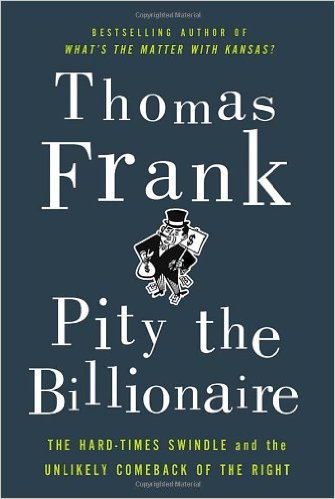
Pity the Billionaire: the Hard Times Swindle and the Unlikely Comeback of the Right
By Thomas Frank
Havill Secker (2012)
Book Review
Pity the Poor Billionaire describes how the right wing corporate elite used the 2008 economic crash to build a pseudo-populist movement (aka the Tea Party) to build blue collar support for harsh free market austerity policies that benefited Wall Street at the expense of working people.
According to Frank, the Tea Party was the fourth conservative uprising in the last half century. The first was the backlash against the anti-Vietnam war movement that resulted in Nixon’s election in 1968 and 1972. The second was the Reagan revolution in 1980; the third the Contract with America revolution that won Republican control of Congress (in 1994) during Clinton’s first term.
The Demise of Unions and the Left
With each of these movements, US political and economic life became increasingly conservative, with all public institutions – churches, hospitals, universities, museums, the US Post Office and even the Army and CIA – succumbing to pressure to operate according to free market principles.
The same period saw the virtual demise of both labor unions and any organized US left. Nevertheless, according to Frank, right wing strategists managed to flood the media with rhetoric ramping up popular fear the left was “on the march.” It mainly focused on a fictitious behind-the-scenes conspiracy to provoke a crisis – through overspending that would collapse the US economy.
Swaying Popular Anger from Wall Street to the Government
This messaging, crafted by right wing think tanks funded by right wing billionaires like the Koch brothers and delivered by Glenn Beck, Russ Limbaugh and similar right wing celebrities, was spectacularly effective in convincing a majority of Americans that the neoliberal corporatist Obama is really a socialist.
Oil billionaire Charles Koch warned back in 2008 that the global economic downturn could lead to the same “loss of liberty and prosperity” (for billionaires) as the Great Depression did. He and his brother David went on to deliberately manufacture an “astroturf”* movement (ie the Tea Party) to thwart Obama from enacting the same type of public spending projects Roosevelt used to reverse the 1929 depression.**
They did this by using Tea Party protests and right wing media to sway public anger away from Wall Street and onto the government. Via sophisticated psychological propaganda, working people were systematically conned into believing their interests coincide with those of Wall Street corporations.
*Astroturfing is the practice of masking the sponsors of a message or organization to make it appear as though it originates from grassroots participants.
**Frank challenges (with data) the common Tea Party assertion that Roosevelt’s New Deal reforms failed to halt the 1929 depression (ie that it took the World War II mobilization to lift the US out of depression). Between 1929 and 1933 (when Roosevelt took office), the US GDP dropped by more than 50 percent. Following the enactment of the New Deal, it increased by 11% in 1934, 9% in 1935, 14% in 1936 and 13% in 1937. Overall GDP growth 1933-37 was the highest the US has seen outside of war time.
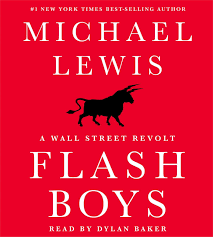
Flash Boys is a true story about front running, the unethical practice of a stockbroker executing orders on a stock while taking advantage of advance knowledge of pending orders from elsewhere in the market.* From the bleak picture Lewis paints, it appears that investors – whether institutional or private – have virtually no way of protecting themselves against front running.
Like Lewis’s 2010 book The Big Short, Flash Boys reads just like a thriller, complete with exquisitely drawn heroes and villains. In this case, the heroes are crusading Canadian banker Brad Katsuyama and the assorted geeks and nerds who helped him start his own stock exchange. Katsuyama started IEX in 2013, after the Royal Bank of Canada and the Securities and Exchange Commission (SEC) refused to support his efforts to expose and end the practice of front running. By purposely slowing their transmission rates, IEX makes it impossible for high frequency traders to “front run” the trades occurring on the exchange. This has enabled Katsuyama to protect investors who use his exchange, while simultaneously collecting data on suspicious trades.
Flash Boys, a bestseller, originally came out in 2014. The 2015 edition includes an afterward in which Lewis describes being viciously attacked by the big Wall Street banks and brokers. He also enumerates a number of prosecutions of high frequency traders and brokerage firms (by the FBI, SEC and Financial Regulatory Authority) resulting from from the publicity Katsuyama’s work received from Flash Boys’ publication.
*The way this works in practice is you order 10,000 shares of a stock at a given price and a high frequency trader somewhere buys 10,000 shares at that price and resells them to you at a slightly higher price. Complex computer algorithms enable high frequency traders to exploit minute differences in transmission frequency to execute these secret trades – which usually take place in “dark pools” – private stock exchanges which keep no public record of their trades. All the major investment banks (Goldman Sachs, JP Morgan, Bank of America etc) have dark pools and high frequency traders pay for the privilege of trading in their dark pools.
The Shock Doctrine: The Rise of Disaster Capitalism
Directed by Michael Winterbottom (2009)
Film Review
Based on Naomi Klein’s best-selling book by the same name, this documentary explores predatory capitalism’s use of psychological trauma to crush human rights and forcibly transfer vast sums of money from the poor to the rich.
Like the book, the documentary begins with Dr Ewan Cameron’s CIA-funded research at McGill University into the long term effects of shock therapy, sleep deprivation and other deliberately inflicted trauma. The Agency would incorporate Cameron’s findings in their Kubark counterintelligence interrogation (ie torture) manual. They went on to use Kubark to train fascist South American military officers at the School of the Americas and to interrogate random prisoners (the vast majority were never charged) at Guantanamo and Iraqi prisons.
The film also explores the “economic shock therapy” developed by the late University of Chicago economist Milton Friedman. Friedman was a master at exploiting natural and contrived disasters to impose the kind of extreme free market reforms that crush unions and wages, shut down or privatize public services and create massive unemployment – while simultaneously transferring obscene amounts of wealth from the working and middle classes to the rich.
Friedman and his cronies seized the opportunity to put their predatory theories into practice when the CIA helped overthrow democratically elected governments in Chile, Brazil, Uruguay and Argentina; during the neoconservative regimes of Thatcher and Reagan; in Russia after the Berlin Wall collapsed; in New Orleans after Katrina; in Sri Lanka after the 2004 tsunami; and in Iraq after 9/11.




 The Most Revolutionary Act