The Dream of a Stateless Society

Engines of Domination
(2014)

Film Review

In Engines of Domination, filmmaker Justin Jezewski and author Mark Corske lay out a historical and philosophical argument for anarchism – a stateless society people run themselves via direct democracy.

They begin by comparing class society to sheep herding. The latter began around 10,000 BC. Class society began around 5,000 BC when institutions of power (initially kings and priests and later nations and corporations) began domesticating people as well as plants and animals. The goal of this kind of domestication is to capture the energy of an entire community. Initially chattel slavery was the primary mechanism employed to domesticate human beings.

Since no one agrees voluntarily to being treated this way, this has to be done through a combination of force and deception.  The methods employed were developed over centuries through a process of trial and error. “Engines of domination” are the historical institutions that make this domination possible and which keep it in place.

Land Confiscation

The process begins with the confiscation of communal land by force (this happened to Europeans via the Enclosure Acts between 1500 and 1850), forcing the inhabitants to work for the ruling elite by depriving them of the ability to feed themselves. In Corske’s view, this denial of life support is a fundamental act of violence.

Maintaining control of confiscated land requires a command structure, i.e. a monarchy or its equivalent, the rule of law and weapons. Without weapons, domination over other human beings is impossible. Finally the ruling elite creates upper and ruling classes and provides them a range of privileges for keeping the working class in line.

Deception and Thought Control

This is the true structure of modern society. However it has to be concealed via deception and thought control. The working class vastly outnumbers the elite, and human beings would never submit to forced labor voluntarily. Prior to 200 years ago, this thought control was disseminated via state religion (it still is in Israel and Muslim countries). In so-called western democracies, it’s disseminated via compulsory public education and the mass media.

Replacing the Engines of Domination with the Engines of Liberation

At present, the very biosphere that supports human life is being destroyed by a ruling elite whose sole focus is to amass more wealth. The only way to halt this ecological destruction, according to Corske , is to abolish political power, central authority and the institutions that support it. The engines of domination must be replaced by engines of liberation. This may seem like an impossible task, but this is because we are all conditioned to accept our captivity, much like domesticated animals who stay in the cage or pasture even when the door or gate is opened.

Corske believes we must employ the same trial and error process to walk back the layers of institutional domination that enslave us. Although the ruling elite is intensively organized, we have both superior numbers and human nature on our side. Contrary to contemporary mythology, human beings are basically freedom loving and incline towards cooperation rather than violence towards our fellow human beings.

Building a mass movement to take advantage of our superior numbers is essential. Corske feels the best way to do this is to organize for specific reforms with the ultimate goal of abolishing central authority.

This short documentary is based on Mark Corske’s book Engines of Domination, published in 2013.

Why Capitalism is Failing

The Zero Marginal Cost Society

Authors at Google (2014)

Film Review

As the global economy continues to tank, it becomes increasingly apparent that capitalism is incapable of meeting the survival needs of the great majority of the planet. In the video below, economist Jeremy Rifkin explains the concept of zero marginal cost, a phenomenon that is steadily shrinking the global economy. He blames a fundamental “paradox” in the capitalist economic model. Marx also identified a similar structural flaw that would eventually cause capitalism to collapse.*

Here’s how Rifkin explains it:

All businesses have two types of costs: fixed costs and marginal costs. Your fixed costs are your initial investment in the facilities and equipment you need to manufacture products or provide services. Your marginal costs are the recurring expenses you incur to keep the business going – wages, energy, phone, stationery, paper clips, postage and so on.

Due to competition, entrepreneurs face continual pressure to increase productivity and decrease their marginal costs. In this way, they can lower their prices and increase their market share. Businesses that don’t compete effectively go bankrupt.

Over the past forty years, businesses that haven’t moved overseas, have mainly lowered marginal cost by replacing workers with machines. The advent of the Internet has speeded up this process by reducing the marginal cost of numerous products to zero or near zero.

Napster and YouTube led the way by enabling young people to download music and films for free. As the formal economy continued to shed jobs and cut wages, consumers discovered they could get news, how-to information and books for free on the Internet. This killed off the recording industry and has nearly killed off newspapers, book sellers and publishers.

How Renewable Energy, 3D Printers and Car Sharing Reduce Marginal Cost

Marginal costs are also approaching zero in other sectors of the economy. Take renewable energy. After consumers pay off their fixed costs for their wind turbines and solar panels (which takes 3-8 years), the energy they use in their homes is virtually free.

Meanwhile 3D printer technology makes it possible to produce an endless array of consumer goods at near zero marginal cost. After the initial fixed cost, the consumer downloads free software and uses recycled feedstock (in Scandinavia, they’re using recycled plastic and paper and even sand and gravel).

The growing trend by millenials to share cars, bicycles, cabs, home stays, tools and toys significantly increases the range of products and services they can get for nothing. Millions grow their own food and barter to meet other essential needs.

The Internet of Things (IoT)**

By increasing efficiency (by interconnecting devices, systems and services), the Internet of Things will further reduce the marginal cost of even more products and services. Rifkin calls this the third industrial revolution. When most goods and services are free or shared, we will no longer need vertically organized companies to serve as middlemen.

The Jobs Issue

The most obvious impact of the technological innovations Rifkin describes will be the continuing loss of jobs in the formal market exchange economy. Rifken believes jobs will be less important in an economy where people cease to rely on money to meet their basic needs. He also feels that most of the new jobs will be in the nonprofit social commons. The social commons, which has always operated in parallel to the formal market economy, is responsible for social capital, i.e. providing education, social welfare, culture, sports, community and existential meaning.

Ironically the social commons has been growing as the market economy shrinks. Between 2000 and 2010, it saw a 42% increase in revenue, while overall GDP only increased by 16%.

Why the US is Falling Behind the EU and China

According to Rifkin, who consults internationally, Europe and China are eagerly embracing this third industrial revolution. Sadly the US is still desperately propping up an archaic economic model on the verge of collapse. He contrasts China, which is investing $80 billion to roll out a distributed energy network to enable all its residents to produce their own energy, with Obama’s proposal to spend $3 billion over 20 years on a centralized “smart” and (horribly inefficient) electrical grid.***

The Flies in the Ointment

Rifkin envisions two serious obstacles that may obstruct the full roll out of the third industrial revolution. The first relates to pending legislation that would end Net Neutrality.**** Cable companies and Internet providers are lobbying hard for the right to charge a premium for Internet access. This would allow rich people priority access (faster and more expansive) to the Internet.

The second relates to profound disruptions in the water cycle (stemming from global warming) that may have disastrous implications for food production.

*Marx predicted that replacing workers with technology would ultimately cause capitalism to self-destruct. According to Marx, the only source of profit is surplus value (the difference between what you pay a worker and the value of the work they perform). There is no surplus value if you replace a worker with a machine. You have to pay a machine the full value of the work it performs.
**The Internet of Things (IoT) refers to the interconnection of uniquely identifiable embedded computing like devices within the existing Internet infrastructure. Typically, IoT is expected to offer advanced connectivity of devices, systems, and services.
***Under a centralized grid system, only 30-35% of the energy generated by a power plant comes out as electricity at the other end.
****Net Neutrality is the principle that Internet service providers and governments should treat all data on the Internet equally, not discriminating or charging differentially by user, content, site, platform, application, type of attached equipment, and modes of communication.


The Approaching Mass Extinction

under a green sky

Under a Green Sky

By Peter D. Ward Ph.D

Smithsonian Books 2008

Book Review

Under a Green Sky is a compilation of the research linking mass extinction events with prehistoric episodes of global warming caused by high atmospheric concentrations of carbon dioxide (CO2) and methane. Ward explores the likelihood that current, unprecedented increases in both greenhouse gasses will likely cause a man-made mass extinction within the next 200 years.

The Asteroid that Wiped Out the Dinosaurs

The dinosaurs were wiped out by a mass extinction 144 million years ago at the end of the Cretaceous era. Most evidence suggests it was triggered by a massive asteroid striking the Earth. This collision produced massive quantities of dust that blanketed the earth, significantly reducing the solar radiation reaching the surface of the Earth. This, in turn, led a planet with a universally tropical climate to experience a decade or more of freezing temperatures. Most of Earth’s plant species were killed off, along with the animal life that relied on them.

Accord to Ward, the fossil evidence suggests that this K-T (Cretaceous-Tertiary) extinction was only one of multiple extinction events occurring in the presence of adverse living conditions that couldn’t support complex plant and animal life. Fossil remains suggest that smaller extinction events occurred every 26 million years, mostly triggered by massive increases in volcanic activity, leading to high atmospheric concentrations of CO2 and methane.

Under a Green Sky details Ward’s role in the excavations that support this conclusion, as well as the scientific methodology used to determine prehistoric CO2 levels, e.g. the size of plant soma* and differential ratios of carbon and oxygen isotopes.

What the Next Mass Extinction Will Look Like

The book concludes by outlining the mass extinction event Ward predicts for the 22nd century if atmospheric CO2 and methane levels continue to increase at their current rate. Based on past extinction events, this is the scenario he predicts:

1) A decrease in equator/polar temperature differences leads to total disruption of the thermohalene conveyer currents** responsible for oxygenating the ocean depths. Cold oxygenated water is steadily replaced with warm oxygen-poor water.
2) Sulfur-eating bacteria proliferate in the anoxic water (termed a Canfield Ocean) and release toxic hydrogen sulfide (the rotten egg smell associated with thermal hot springs).
3) Hydrogen sulfide rises into the upper atmosphere where it destroys s down the ozone layer protecting us from solar ultraviolet radiation. A massive increase in UV radiation kills off the phytoplankton, the ultimate food source of all ocean swelling animals.
4) A combination of intense heat and toxic hydrogen sulfide kills off many land based higher plants and animals.
5) The ocean turns purple, due to green and purple sulfur-eating bacteria. The sky turns green, owing to the proliferation of yellow dust from drought-stricken continents in the mid-latitudes.

Ward calculates that Antarctica’s ice sheet will have totally melted by 2200 and Greenland’s by 2300. By 2050, a steady rise in sea levels will have flooded all the world’s coastal cities, as well as all the deltas that presently contribute to global food production. Millions of people will die from famine (due to drastically reduced agricultural yields), extreme weather events and resource wars.

*The soma are tiny organs in plant leaves that capture sunlight to combine CO2 and water to produce plant sugars. They become more numerous as atmospheric CO2 concentrations increase.
**Plant fossils contain varying concentrations of carbon-13 and carbon-14 isotopes and oxygen-16 and oxygen-18 isotopes (the number varies according to the number of neutrons in the atom’s nucleus) depending on the relative atmospheric concentration of CO2 and oxygen when the plant was alive.
***Thermohaline circulation is an ocean conveyor belt that moves a massive current of water around the globe, from northern oceans to southern oceans, and back again. See Ocean Conveyer Belt

Resist or Die

END:CIV Resist or Die

2011, directed by Franklin Lopez

Film Review

According to the promo, END:CIV “examines our culture’s systemic addiction to violence and environmental exploitation.”

The title is drawn from Pac Man, an arcade came that first came out in 1980. In one of the world’s first video games, the player guides Pac Man, a small faceless mouth, through a maze while he devours Pac Dots and tries to escape blob monsters. The first three minutes of END:CIV superimpose a Pac Man game over images of old growth clear cuts, belching smokestacks, factory hog farms, wild fires, hurricanes and the US military’s ruthless killing machine. The sequence ends as a gigantic “GAME OVER” flashes across the screen.

The film is based on the Endgame, the best selling two volume book Derrick Jensen published in 2006. In Endgame, Jensen argues that mankind urgently needs to bring down “civilization” before it destroys the planet. He bases his case on twenty basic premises he lists at the beginning of both volumes. The film END:CIV examines four of them.

Premise 1 – industrialized civilization has never been and will never be sustainable, mainly because it’s based on non-renewable resources.

The film, like Jensen’s book, traces the rise of cities, which by necessity steal resources from distant regions and eventually denude the entire landscape of those resources. After making the case that the corporate elite are mindlessly and voraciously consuming an ever increasing amount of energy, land, water and other resources, the filmmaker reminds us that we live on a finite planet. He then argues that corporations will most likely continue this greedy consumption until everything is used up – or until we stop them.

Premise 2 – A major focus of industrialized civilization has been to destroy indigenous communities by force – because they don’t willingly allow the confiscation of their natural and mineral resources. A corollary of Premise 2 is that without its heavy reliance on violence, industrial civilization would collapse.

In an cameo from a public forum, Jensen explains that much of violence is invisible and a matter of conditioning. He gives the example of the cop who will pull a gun and drag you to jail if you don’t pay your rent or satisfy your hunger by eating off grocery shelves. Yet we are all indoctrinated to believe that people must pay for the right to exist on this planet.

The film goes on to criticize the main message put out by the nonprofit environmental movement: that people can remedy pervasive violence, resource theft and exploitation by making politically correct purchases.

In the view of Jensen and other activists featured in the film, Greenpeace, Sierra Club, Forest Ethics and similar “eco-bureaucracies” have essentially sold out by making preservation of the global economy more important than saving the planet.

This section is also highly critical of the dogmatic opposition of the environmental movement towards violent resistance. Jensen does a great send up of the movie Star Wars. In his version, the rebels don’t destroy Darth Vader by blowing up the death star. Instead they promote eco-tours and Fair Trade products from endangered planets and send waves of compassion and loving kindness towards Darth Vader, while locking themselves down on his ship. They also vote to condemn and exclude the renegades who propose to blow up the death star – for allowing themselves to be contaminated by Darth Vader’s culture of violence.

Premise 3 – the culture (of industrialized society) as a whole and most of its inhabitants are insane.

The section points out that, contrary to popular belief, no combination of fossil or alternative fuels will allow us to continue our current “happy motoring” society. It focuses on Alberta’s insane tar sands project, the most environmentally destructive enterprise in history.

Premise 4 – from the beginning, the culture of civilization has been a culture of occupation.

The film ends with a brief overview of the resistance movement in Nazi-occupied Europe. In the final scene, Jensen poses the provocative and disarming question:

“If your homeland was invaded by aliens who cut down the forests, poisoned the water and air and contaminated your food supply, at what point would you resist?”

Economics for the Young (At Heart)

Four Horsemen (Ross Ashcroft 2012)

Film Review

 Four Horsemen is full length documentary specifically produced for YouTube and aimed at a younger audience. Its primary goal is to demystify economics, which is a total turn-off for most people because it appears so complicated and uninteresting.

In the view of the filmmakers, a corrupt system of money creation and taxation has enabled a greedy corporate oligarchy to usurp control of western democracy and institute an obscene wealth transfer from the poor to the rich. The corporate elite has cleverly concealed this enormous Ponzi scheme by inventing a kind of voodoo economics to discourage people from taking a closer look at how the economy actually operates.

How Banks Create Money Out of Thin Air

The film provides an elegant description of fractional reserve lending, in which banks create money out of thin air and lend it to us at interest. Although this has been the main form of money creation for centuries (except briefly under Lincoln), most people still mistakenly believe that government issues and controls the money supply.

So do the majority of lawmakers. Ironically the majority of economists also believe that government creates the money we use to run the economy. This is because our banks fund the universities and think tanks where economic theory is taught. In other words, it’s a deliberate deception.

The banks also don’t want us to know where government debt comes from, i.e. that all governments borrow money from banks to fund military, intelligence and public services. Or that repaying all public and private debt would cause the global economy to collapse because this is the only mechanism we have for issue money.

What’s the Solution?

The filmmakers believe that the only solution to the economic, ecological and resource crises faced by humankind is for ordinary people to rebuild a new society from the bottom up.

They have started a YouTube channel called Renegade Economist, as well as publishing a book Four Horsemen: the Survival Manual. According to the authors (Ross Ashcroft and Mark Braund), it describes a model of bottom-up reform that combines government-issued money with a land value tax that replaces income and sales tax.

The second video is a public debate they held a few months after the release of Four Horsemen. The purpose of the debate was to begin public discussion about how to go about how to go about building the new society they envision. In my view the Q&As starting at 47:00 are the most interesting part of the discussion.

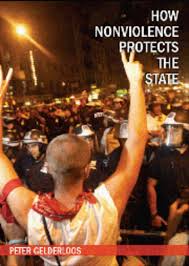
How Nonviolence Protects the State

how nonviolence protects the state

(more from my research for A Rebel Comes of Age)

How Nonviolence Protects the State

Peter Gelderloos (2007 South End Press)

Book Review

How Nonviolence Protects the State takes up where Ward Churchill’s 1985 Pacifism as Pathology leaves off – expanding on Churchill’s basic premises (see previous blog) with more recent historical examples. Like Churchill, Gelderloos bemoans the determination of nonviolence proponents to impose their ideological views across the entire progressive movement. He blames this mainly on The Nation magazine and other “alternative” media outlets for falsely framing the debate as a question of “nonviolent” vs. “violent” organizing strategy. No one, he argues, endorses pure violence as a tactic.

Gelderloos divides his book into seven chapters. Each explores specific weaknesses of exclusive nonviolence as a political strategy:

Chapter 1 Nonviolence is ineffective – Here Gelderloos exposes the falsified history of “successful” nonviolent resistance movements – which he maintains are neither exclusively nonviolent or successful. In the case of Gandhi’s Quit India campaign, the Mahatma was elevated to fame by the British press. The latter chose to focus on his acts of civil disobedience, rather than the hundreds of freedom fighters who were planting bombs and assassinating British officials and native civil servants.

Gelderloos describes a parallel process occurring in the case of Martin Luther King’s nonviolent civil rights campaign. The mainstream media never reported on the Birmingham civil rights marches that degenerated into riots, which, in many cases, were the real trigger for both local and federal law changes.

He also contrasts the millions of peaceful demonstrators who were unable to stop the 2003 US invasion of Iraq – with the single 2004 train bombing that led Spain to withdraw their troops from occupied Iraq.

Chapter 2 Nonviolence is racist –  Gelderloos agrees with Churchill that the vast majority of dogmatic nonviolent proponents are privileged middle class whites, for whom the full repression of the capitalist state is never a genuine fear. Black looting (usually for food and basic necessities) is condemned as “violence.” In cntrast, white activists cut a chain fence to trespass on a military base are embraced as “nonviolent” and acceptable. White progressives are also quick to condemn third world autonomy movements, such as the Iraq and Afghan insurgencies against US occupation.

Chapter 3 Nonviolence is statist (i.e. serves the state) – Nonviolent activists share the fundamental view that the state (via police, FBI, CIA and military) should hold the monopoly on violence. In moments of conflict, they always line up with state authority. Among other examples, Gelderloos cites the Poor Peoples March at the 2004 Republican National Convention, where Mayor Bloomberg handed out badges to protestors who committed to nonviolent protest. When the police manhandled and arrested protestors (without badges) who were either black, covered their faces or refused to submit to arbitrary searches, white nonviolent marchers failed to come to their defense and blamed the arrestees for the police decision to target them.

Chapter 4 Nonviolence is patriarchal (i.e. supports male oppression of women and sexual minorities) – The nonviolent movement only permits women to use violence to defend themselves in individual cases of attempted rape. It’s not considerable acceptable in situations of ongoing domestic violence. Nor against the gradual systemic violence – for example the harmful corporate-produced chemicals in their breast milk – that is gradually poisoning their children.

Chapter 5 Nonviolence is tactically and strategically inferior – The nonviolent movement is totally focused on short term tactics and unable to show how any of these tactics will achieve their long term goals. When confronted with their inability to achieve goals, nonviolent advocates give the pat response: “Political change takes a long time and may not come in our lifetime.”

Gelderloo bemoans the millions of dollars wasted on grassroots lobbying, which is almost never effective. Even when Congress meets your demands on paper, they always backtrack. He gives the example of the School of the Americas (SOA) campaign, which sucked up years of organizing and nonviolent protests When enough public pressure built up, the Pentagon simply closed the SOA and reopened it under a new name.

He proposes the provocative question: ” Does it make more sense to blockade a bridge for a few hours by forming a human chain – or putting it out of commission for six months by blowing it up?”

Chapter 6 Nonviolence is deluded – The nonviolent movement is full of extreme contradictions. Nonviolent advocates support state violence all the time, simply by paying taxes. Activists from the privileged class need to understand what the rest of the world has known all along: neutrality isn’t possible. The question is which violence scares us the most and which side we will stand on.

Chapter 7 The alternative: possibilities for revolutionary activism – Gelderloos finishes with his vision of strategies that are most likely to succeed in dismantling corporate rule. He envisions building a loose confederation of local autonomous groups that will form non-corporate structures (free clinics, cooperatives, farmers markets, etc) to meet local needs. While he sees no need to convert everyone to anarchism, he warns of the need to be continually on guard against cooptation by the Institutional Left. And the need to learn self defense. If activists occupy a building to create a free clinic, they need to make sure the police can’t take it away from them.

A PDF of Gelderloos’ book can be downloaded free at zinelibrary

***

Rebel cover

In A Rebel Comes of Age, seventeen-year-old Angela Jones and four other homeless teenagers occupy a vacant commercial building owned by Bank of America. The adventure turns deadly serious when the bank obtains a court order evicting them. Ange faces the most serious crisis of her life when the other residents decide to use firearms against the police SWAT team.

$3.99 ebook available (in all formats) from Smashwords:

https://www.smashwords.com/books/view/361351

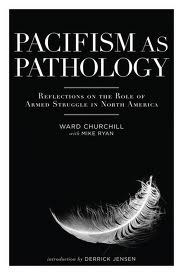
Pacificism as Pathology

pacifism as pathology

(more of my research for A Rebel Comes of Age)

Pacifism as Pathology: Reflections on the Role of Armed Struggle in North America

By Ward Churchill (2007 AK Press)

Book Review

Pacifism as Pathology is a collection of essays centered around Ward Churchill’s original 1985 essay “Pacifism as Pathology: Notes on an American Pseudopraxis.” The premise of the essay is that the militant nonviolent stance assumed by the US progressive movement is based on irrational psychological reasons rather than strategic reasons or moral principle.

Viewpoints from a Range of Activists

The 2007 edition contains a preface by Derrick Jensen, who lays out compelling reasons for the necessity of “violence” in bringing about genuine political change in his 2006 book Endgame. Jensen’s argument, as in Endgame, is primarily ecological. Humankind is being systematically killed off by the capitalist class, via their poisoning of the air, water and food chain, as well as their heedless imposition of catastrophic climate change. Jensen poses the very reasonable question: are we willing to retaliate violently to save our own lives and those of our children and grandchildren?

The next essay is Ed Mead’s preface to the 1998 edition of Pacifism as Pathology, immediately following an 18 year prison term as a result of armed actions (bombings of state and federal buildings in Washington State) conducted by the George Jackson Brigade. Based on his experiences, he arrives at the following conclusions: 1)  pacifism as a strategy of achieving social, political and economic change can only lead to dead end liberalism – the most vicious and violent ruling class in history won’t give up privilege without a physical fight; 2) because 99.9% of practitioners of political violence will eventually confront death or imprisonment, it’s imperative that political violence be carried out in a manner calculated to win; and 3) although the George Jackson Brigade applied the tool of revolutionary violence when its use wasn’t appropriate, he feels pride that they erred on the side of making revolution instead of the alternative.

The book also contains an afterwards by Canadian Activist Mike Ryan describing his frustration after 20 years of nonviolent resistance as part of the Canadian peace movement – and his conclusion that violent resistance must be allowed as a tactic for genuine political change to occur.

Churchill’s Infamous Assault Rifle Workshop

Churchill explains, in his 1998 introduction, that Pacificism as Pathology was originally written in 1985 as part of a four year debate over a workshop “Demystification of the Assault Rifle” that he gave at a 1981 Radical Therapy conference. He was invited to give the workshop owing to an admission by many activists that their fear of weapons was chiefly responsible for their rejection of violence as a political strategy. The reaction of some conference participants was to pass a resolution banning similar workshops in the future, as well as the presence of firearms (except those of the police or military) at any Radical Therapy conference. Churchill was invited to write an article on his views for the magazine Issues in Radical Therapy, which was subsequently Xeroxed and distributed widely throughout North America. While Churchill acknowledges the right of all activists to personally reject violent strategies and tactics, he challenges the right of nonviolent proponents to condemn activists willing to embrace property destruction and/or armed self-defense among a diversity of strategies. As he points out, activists willing to engage in violent resistance wouldn’t dream of trying to force their views on nonviolent activists.

Armed Jewish Uprisings Under Nazi Occupation

For me, the most valuable part of the book is the first section about Bruno Bettelheim and Jewish armed uprisings, in the Warsaw and Bialystok ghettos and in numerous concentration camps during the second world war. This is an aspect of World War II history I was totally unaware if, as the work of Bettelheim and other scholars documenting armed Jewish resistance are carefully sanitized from the history textbooks served up to US high school and college students.

Bettelheim, who contrasts the Jews who resisted violently with the majority of Jews, who followed the Nazis passively to the camps and even to the gas chambers, makes a strong case for his belief that the persecution of the Jews was aggravated by the pervasive lack of fight back. He blames their failure to resist on strong psychological denial – a pathological need to cling to an illusion of “business as normal” – that ultimately overwhelmed their basic survival needs. The logical position would have been to accept the cold reality that their own lives were doomed and to use their deaths to save the life of other Jews by making the extermination more difficult. He points out that Jews had easy access to guns in 1930s and 1940s Germany, and there was no reason why every Jew that was arrested couldn’t take one or two SS officers with them.

Churchill describes how all the revolts inflicted significant damage on the Nazi machine. The revolt at Auschwitz killed 70 SS officers and destroyed the crematorium. Armed rebellions at Sorbibor and Reblinka were even more effective, and Sorbibor had to be closed following the uprising. There were also lesser insurrections at Kruszyna, Krychaw and Kopernik.

Militant Nonviolence: Racist, Deluded and Irrational

Churchill devotes the rest of the book to correcting historical distortions regarding Gandhi’s and Martin Luther Kings nonviolent resistance movements (which have been totally whitewashed by the ruling elite); a brief historical overview of the ineffectiveness of nonviolence in contrast to campaigns incorporating violent resistance; an analysis of the inherent racism implicit in the dogmatic nonviolence promoted by white upper middle class activists; and an outline of the irrational psychological motivations underlying militant nonviolence.

According to Churchill, the main reason white upper middle class activists reject violent resistance relates to intense ambivalence whether they really want to dismantle capitalism and give up their position of privilege.

Pacifism as Pathology can be downloaded free from Prison Legal News

Ward Churchill is a Native American author and American Indian Movement (AIM) activist. He was a professor of ethnic studies at the University of Colorado Boulder from 1990 to 2007. His best known book is the 1990 Cointelpro Papers.

***

Rebel cover

In A Rebel Comes of Age, seventeen-year-old Angela Jones and four other homeless teenagers occupy a vacant commercial building owned by Bank of America. The adventure turns deadly serious when the bank obtains a court order evicting them. Ange faces the most serious crisis of her life when the other residents decide to use firearms against the police SWAT team.

$3.99 ebook available (in all formats) from Smashwords:

https://www.smashwords.com/books/view/361351

The Way Forward

battle

Guest Post by Steven Miller

(In this final of 6 guest posts, Miller discusses the role of reform in drawing people into action against the state.)

Nothing Can Be Done by Fighting for Reforms and Nothing Can Be Done Without Fighting for Them

We can summarize the salient features of the situation. Speculators wield massive political power in the US and the world. This is rooted in their absolute control of all forms of technology as private corporate property. At the same time, corporations are merging with the state. Speculators direct the capitalist class to use state political power against the people. They are engineering an escalating class war from the top against the rest of society. The capitalist class is compelled to implement electronic laborless production only in the narrow and limited ways that guarantee corporate profits.

Speculators crashed the economy in 2008 by bundling toxic mortgages into “investment tools”. Now they are doing the same with rents. Meanwhile, the situation has metastasized. There is no longer just one economic bubble. The Masters of the World are addicted to financial warfare based in bubble wars. In essence, these are just sophisticated video games that are played 24 hours a day using the assets of the public. Like days of yore, armies of mercenaries rampage across the land, despoiling the public. Like video games, they produce thrilling speculative battles with individual winners and losers. Unlike video games, they do this with the necessities of life.

So… can this situation be reformed? In other words, can the power of capital be limited or significantly altered so that the current crisis of destruction can be reversed, so that humanity can develop a sustainable economy that benefits people, rather than debasing them?

The answer is pretty clear: there can be no significant reforms. Capitalism’s feeble efforts to address Global Warming indicate this. As with the economy itself, capitalism is driving things inexorably towards greater instability and crisis. Reforming even one aspect of the situation – simply halting evictions, for example – would take a social movement on a scale never before seen. Even the uprisings of the Arab Spring have not fundamentally altered the situation. Everything today is influenced by the subjective understanding of the enormous class of people who can only survive by working.

The paradox is that nothing can be won by fighting for reforms and nothing can be won without fighting for them. There are no revolutionary reforms by definition. Reforms do not alter political power, yet reform is what draws people into action against the state. People must engage in the revolutionary struggle for reforms by doing the teaching, by elevating the discussion of where these political struggles are headed. This includes presenting a revolutionary vision of what society could be if technology were used to create real economic democracy, with democratic popular control of technology guaranteed at every level.

Capitalism intends to control and sanitize this debate:

Capitalism is a sorry excuse for an economic system. With no present viable alternative, contemporary capitalism continues to produce cruel economic results and a twisted morality. But a debate is underway. Even the Harvard Business School, the birthplace of many of capitalism’s excesses has a large project in ‘Rethinking Capitalism.” (23)

So re-think this. Everyone sees that the private corporate control of technology is not sustainable. It inevitably leads to short-term thinking, based only on the interests of private profit. This produces nightmares in every direction from climate change to corporate agriculture, new diseases, Big Pharma and the despoliation of the environment from the insane overuse of petroleum in all forms. Corporations are behind it all.

But the corporate control of technology is not an Act of God. In fact, in the ‘90s, the US Post Office proposed developing an open and democratic Internet for everyone. Bill Clinton immediately squashed that one, intoning that corporations are the best way to develop this amazing tool. Since corporations inevitably deform the potential uses of technology in order to make a profit, they are not fit to control it. Period.

Youngdahl can see “no present viable alternative” because he cannot imagine the public seizure of private corporate property. Capitalism uses its Media-Industrial State to confuse the issues. We are supposed to believe that democracy is an economic system, which it is not. Then they confuse the concepts of the government and the state. We are supposed to rail against “big Government” when government is a fundamental necessity to guarantee people the things they cannot provide for themselves. Like sewers, for example. What people really don’t like – as we see with the NSA scandal – is the capitalist state, not the government.

Some people believe that we can succeed in replacing the rule of the 1% by ignoring it and building local cooperative efforts. This view is what Chris Hedges argues in “Overthrow the Speculators!”:

We can wrest back control of our economy, and finally our political system, from corporate speculators only by building local movements that decentralize economic power through the creation of hundreds of publicly owned state, county and city banks… Public banks also protect us from the worst forms of predatory capitalism.” (24)

Interesting question. Why bother to get rid of simply the worst forms of predatory capitalism? It’s still predatory; it’s still capitalism.

Today Americans are under an onslaught from ALEC, the corporate lobbyists who write the corporate laws, the NSA and public surveillance in many forms, a governmental refusal to regulate capitalism in any form, plus the legalizing of extraordinary rendition and drones. The state is not going to permit any weeds to grow in the garden of speculation. This strategic question is not something to ignore.

Takeovers can work both ways. America has reached the point twice before where forms of private property were strangling the very life out of society. In the 1770s, when the 13 Colonies were the private property of the King, the American people rose up and abolished this private property. This power was exercised through private corporations, such as the Virginia Corporation, which raised private armies of mercenaries. Corporations today have reclaimed this power, aided and abetted by the Department of Homeland Security. In the 21st Century, there are more private police than public police in America.

In the 1850s, private property in slavery controlled all three branches of government – the Presidency (which includes the army), the Supreme Court, and the Congress. Slave property worked day and night to extend its rights over the rights of regular people, through the Dred Scott decision, the Fugitive Slave Act and a host of other actions. Recognizing that they could no longer continue to live free, the North waged the Civil War to expropriate private property in slaves and break their political power.

Move To Amend – an organization developed to abolish corporate rights as people and money as speech – is one group that addresses the issue of expropriation: “Slavery is the legal fiction that a person is property. Corporate personhood is the legal fiction that property is a person.” (25) After all, if corporations can expropriate the public – as they are actively doing today – the public can expropriate the corporations.

The third time is the charm.

Steven Miller, Oakland, California, January 2014 –  nanodog2@hotmail.com

….And a big Shout-Out to the Zapatistas – 20 years ago today!

References and Resources

23)  Jay Youngdahl. “2013 was a year of Heroes and Hope”. East Bay Express. 12-25, 2013

24)  Chris Hedges. “Overthrow the Speculators!”. 12-29-2013

25)    The Myth of Corporate Personhood. Turning the Tide.
photo credit: ryanophilly via photopin cc

***

Steven Miller has taught science for 25 years in Oakland’s Flatland high schools. He has been actively engaged in public school reform since the early 1990s. When the state seized control of Oakland public schools in 2003, they immediately implemented policies of corporatization and privatization that are advocated by the Broad Institute. Since that time Steve has written extensively against the privatization of public education, water and other public resources. You can email him at nanodog2@hotmail.com

Originally posted at Daily Censored

Takeover

corporate flag

 Guest blog by Steven Miller

(The following is an brilliant essay in 6 parts about the takeover of democracy by monopoly capitalism – that includes solutions.)

Capitalism in the 21st Century is no longer based largely on profits resulting from a real  economy productive process, windfall financial gains are acquired through large scale speculative operations, without the occurrence of real economy activity, at the touch of a mouse button.”  Michel Chussodovsky

Part I – Summary

It is a statement of fact, not ideology, that a class of billionaires, principally based in finance and speculation, control the levers of society. Since the Crash of 2008, the 1% has been waging a war against society that drives the 99% further towards disaster and ruin. Their End Game is the complete privatization of everything that is today owned by the public. This process is inevitable as long as political power remains in their hands. The question is: can this system be reformed? Another is: If not, can we fight and win? If so, how? These are strategic questions.

There are decisive moments in the history of capitalism when one form of wealth, one kind of property, becomes the most lucrative. The capitalists that control this property often become the dominant sector of the capitalist class and take control of the state, dictating policy to society. Marx writes, “The executive of the modern State is but a committee for managing the common affairs of the whole bourgeoisie.”  (1)

The ruling class – call them the 1%, call them capitalists – commonly wages war against itself to seize markets and articulate the strategic view that makes the most profit, especially for them. They call this “the free market”. It is rigged and completely stacked in favor of the billionaires.

When the most profit-making form of labor was slavery, the slave owners ran the government and the state. They were succeeded, after the Civil War, by the railroad barons, industrialists, who owned property in factories, coal, and iron. Slave production was replaced by industrial production. Human slavery was replaced by the far more productive wage-slavery. Early bankers played an enormous role in this transition. Industrial production predominated into the 1950s. It didn’t disappear, but the control of capital passed to banks, investors and finance.

Now it’s all changing again. The tools themselves, the technology, determine which sector of capitalists comes out on top. Today the most revolutionary tools are the vast array of digital, electronic and communication technologies. This revolution is transforming society in ways unforeseen just a decade ago. When Obama was elected in 2008 – the same year as the great economic Meltdown – there was no such thing as social media, no apps, no data in the cloud, no viral videos. The IPhone was only a few months old. The tools are changing fast, driven by constantly evolving hardware and software.

As you read through this essay and examine the evidence, please keep the bigger question in mind. Can this system actually be changed in some sort of meaningful way? What would it take? How do we fight and win?

The growing electronic production of almost everything demonstrates what Karl Marx was referring to when he said, “capitalism sows the seeds of its own destruction.” But it was Adam Smith, not Marx, who first proved that the real source of profit is human labor.

References and Resources

 Lead quote – Michel Chussodovsky. “The Speculative Endgame: The ‘Government Shutdown’ and Debt Default’, a Multibillion Bonanza for Wall Street”, Center for Global Research

 1)  Communist Manifesto. Chapter 1

To be continued.

***

Steven Miller has taught science for 25 years in Oakland’s Flatland high schools. He has been actively engaged in public school reform since the early 1990s. When the state seized control of Oakland public schools in 2003, they immediately implemented policies of corporatization and privatization that are advocated by the Broad Institute. Since that time Steve has written extensively against the privatization of public education, water and other public resources. You can email him at nanodog2@hotmail.com

photo credit: Adbusters Culturejammers HQ via photopin cc

Originally posted at Daily Censored