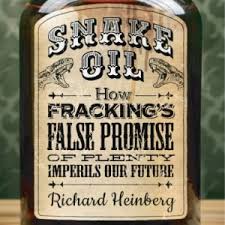
Snake Oil: How Fracking’s False Promise of Plenty Imperils Our Future
Richard Heinberg (Post Carbon Institute, 2013)
Book Review
Snake Oil is all about the economics of fracking. Also known as hydraulic fracturing, fracking refers to using pressurized water and chemicals to release oil or natural gas trapped in underground rock formations. Heinberg’s new book describes the behind-the-scenes role of Goldman Sachs and other investment banks in driving the present fracking boom.
Technology to extract oil and gas deposits trapped in rock formations was first developed in 1866. Because the process is extremely capital intensive, fracking for oil only became economically sustainable in when the price of oil tripled a decade ago. In the case of natural gas, it took the elimination of price controls and federal tax credits to make fracking financially feasible.
How Fracking Loses Money
According to Heinberg, fossil fuel companies are losing money on fracking. The recent boom has led to a surplus of natural gas. This, in turn, has driven the price down, forcing the oil/gas industry to sell it for less than they spend to get it out of the ground. Because only a small fraction of shale gas can be extracted cost effectively, production declines by an average of 80-90% over the first 36 months. Industry data indicates it costs between $10-20 million to operate a fracking rig that will produce $6-15 million worth of natural gas in the well’s lifetime.
Obviously you can’t tell investors that fracking for natural gas is a money-losing proposition. Investors only want to hear that fracking is the miracle solution to America’s dependence on dirty coal and foreign oil. Thus oil/gas companies, the banks that finance them, the federal agencies that regulate them and Obama himself all parrot the hype that fracking will supply cheap natural gas to fuel US power plants for the next 100 years. According to Heinberg, this wildly optimistic prediction was calculated by extrapolating the best production rates of the best fracking sites over the 20,000 or so existing rigs. The problem with this methodology is that it fails to allow for rapid depletion rates or the fact that the best wells are already tapped out.
This pressure to meet financial targets forces the companies to sink more and more wells. Thirty-five to fifty percent of existing wells (7,200 wells) must be replaced every year “just to pay off the bankers.”
Fracking Based Derivatives
The only way companies can stay in business is by selling assets and financial products. This includes unused oil and gas leases* they acquired cheaply in the 1990s, company shares, derivatives and credit default swaps. The investment banks themselves have created their own fracking-based derivative called volumetric production payments (VPPS). The banks bundle them and sell them to gullible pension fund managers, just like they did toxic mortgages before the 2008 crash.
The billions they’re losing explains why the industry is so keen to start exporting fracked gas as Liquified Natural Gas (LNG) to China, Japan and India. These countries are happy to pay $15 per million BTUs, nearly four times the domestic price of $4. A growing export market will quickly drive up US prices.
Environmental Consequences of Fracking
Meanwhile the explosion of fracking rigs across the landscape is causing massive environmental damage and eating up scarce dollars we should be investing in renewable energy. Owing to strong public opposition, fracking is banned or strictly regulated in most of Europe. As a result, Europeans are far more likely to invest energy dollars in renewables. In 2012, Germany obtained 23% of their electricity from renewable sources, Denmark 41% and Portugal 45%
Snake Oil debunks the widely promoted myth is that that burning natural gas to produce electricity creates less greenhouse gasses than burning coal. If you count all the methane (a greenhouse gas 20-100 times more potent than CO2) released during fracking, using fracked natural gas to fuel power plants produces 20-100% more greenhouse gas emissions than coal.
The massive amount of freshwater consumed by tens of thousands of fracking wells is also a major concern, especially in drought-stricken regions. The water take for a single well pad cluster can exceed 60 million gallons. The Halliburton Loophole, championed by Dick Cheney, amended the Clean Water Act in 2005 to remove the requirement that oil and gas companies disclose the toxic chemicals they use in fracking. This is especially concerning given recent studies documenting serious health problems in people and livestock adjacent to fracking sites.**
In 2011, the EPA made the determination that fracking waste is too radioactive (from exposure to underground cesium and uranium) to be processed in municipal waste facilities. Thus most of it held in large evaporation pools or re-injected into old wells. A recent US Geological Service study has linked deep well re-injection to a rash of earthquakes in regions that rarely experience them. In 2011 central Oklahoma experienced a fracking-related 5.7 earthquake that destroyed 14 homes and a highway and injured two people.
Other Unconventional Production Methods
Snake Oil also debunks the flimsy economic hype used to promote other methods of unconventional oil and gas production (e.g. oil fracking, deep sea oil drilling, tar sands, etc), as well as examining what the inevitable transition to renewable energy will look like. Because renewable energy will never be as cheap as fossil fuels, some modification will be necessary in our current energy intensive lifestyle.
*An oil or gas lease is a contract by which a landowner authorizes exploration for and production of oil and on his land, usually in return for royalties from the sale of the oil or gas.
**According to Al Jazeera, a jury has just awarded a Texas family $3 million for fracking related health problems.
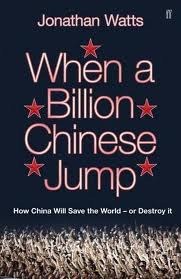
When a Billion Chinese Jump: How China Will Save Mankind – Or Destroy it
By Jonathan Watts (2010 Faber and Faber)
Book Review
(Yesterday the Wall Street Journal reported that nearly 1/5 of China’s farmland is contaminated with heavy metals, such as arsenic and cadmium, that are absorbed by rice and very damaging to human health.)
The major premise of When a Billion Chinese Jump is the enormous threat China’s burgeoning middle class poses to climate stability with their insatiable demand for gas-guzzling cars and energy-intensive homes and consumer goods.
The reader comes away with an overall impression of an environmental war zone: severely contaminated rivers, aquifer depletion, clear cut forests, smog, landslides, toxic waste-related cancer villages, and mass species extinction
Watts makes no secret of his belief that catastrophic climate change can’t be prevented – no matter what the rest of the world does – unless China drastically curbs its reliance on coal for energy production.
China: the West’s Industrial Cesspool
Watts traces a variety of political, economic, and philosophical influences that have led to China’s current ecological disaster. Ironically the key factor behind the country’s rapid development – the outsourcing of western industry – is number one on the list. For the past thirty years, western companies have been exporting their industrial base to China and other Asian countries to exploit low labor costs. They have simultaneously exported the major ecological damage associated with heavy industry – along with mountains of defunct electronic devices for end-of-life disposal.
The second major cause of China’s ecological nightmare is the reality that most of provincial China operates outside the law. Despite China’s “totalitarian” central government real power, according to Watts, rests in a middle band of local party chiefs, factory owners, and foreign investors and outsourcers.
He believes centralized control of China began its decline with Mao’s death. In his view, each successive government is more politically “timid” than the previous. The Ministry of Environmental Protection has developed many far-sighted environmental regulations that the Politburo is afraid of enforcing at a regional and local level. They are terrified of imposing any measures that might impair development. Without elections, the central government has no popular mandate. This means that surging development and nationalism are the only source of their legitimacy.
An interesting side effect of this endemic corruption is that illegal protests and riots – usually over crop and health damage caused by pollutions – are extremely common. In most cases, rioting is the only way to ensure environmental protections are enforced.
The Chinese Environmental Movement
The book’s most interesting chapter concerns the Chinese environmental movement. When Beijing shut down the pro-democracy movement after the 1989 Tienanmen Square massacre, many pro-democracy advocates found it was safer to transplant their activism to the environmental movement. Especially after President Hu Jintao explicitly called for greater public, NGO (non-governmental organization) and journalistic oversight to expose companies that breach environmental regulations.
Despite nominal central support for greater openness and transparency, Chinese environmentalists still play a cat and mouse game with government authorities. National environmental networks have been forbidden since 2008, owing to deep Politburo suspicion of the role the CIA played in instigating the 2004-2005 color revolutions in Eastern Europe.
Watts talks about an invisible line circumscribing acceptable activism – activists, journalists and lawyers don’t know where the line is till they cross it and local security officials beat them up and throw them in jail.
(This is the 9th of a series of emails about ending the right of private banks to issue money. It concerns WikiHouse and a proposal to remove the means of production from the monetary system through publicly owned Open Source technology.)
In the following video, architect Alastair Parvain envisions using WikiHouse and comparable Open Source manufacturing tools to take architecture, construction and manufacturing out of the monetary system by allowing people look to the commons to meet their basic human needs – via freely available Open Source technology.
Originally applied to free, publicly available software, the term Open Source has been expanded to include architecture, scientific research and other technical information which is made freely available in the public arena. See Open Source and Sustainability.
WikiHouse has been described as an open source construction set. The aim is to allow anyone to design, download and “print” CNC-milled houses which can be assembled by a small group of people with minimal formal skill or training. A CNC wood cutter is a CNC (computer numerical control) router that creates objects from wood along the same lines as a 3D printer.
WikiHouse has caught on in a big way in New Zealand, thanks to the 2011 Christchurch earthquake that caused over 6100 businesses that were displaced and needed to relocate quickly to survive. WikiHouse seemed an ideal solution to Martin Luff and Danny Squires, who founded New Zealand’s WikiHouse Lab
In addition to offering relatively low cost rehousing for businesses and residents, it also builds community solidarity by turning house building into a social event. Prior to the fossil fuel era, home building was a major community event in which your friends and neighbors got together to build you a house. With skyrocketing energy costs, we need to look more to community and cooperation, rather than technology, to meet our basic needs.
Parvain stresses that the world currently faces major economic, ecological and resource crises. These urgent dilemmas can’t be solved by either corporations or non-profit organizations so long as they continue to treat citizens as passive consumers.
(This is the seventh of a series of posts about ending our debt based monetary system and reckless emphasis on perpetual economic growth. Dave Gardner makes the ecological case for ending our addiction to continuous economic growth.)
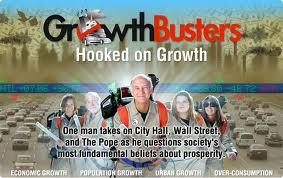
Growthbusters is the inspiring story of Dave Gardner’s efforts to challenge conservative Colorado Springs’ failed growth promotion policies. The film also takes a broader theoretical look at the overall failure of economic growth to solve the global economic crisis.
While Gardner is clearly an environmental crusader concerned about the link between unlimited growth on carbon emissions, resource scarcity and species extinction, he inserts a heavy dose of economic reality into the discussion. All of us involved with local government have heard the same insipid assertions about the urgent need to cut corporate tax and regulations to attract new industry and jobs, as well as the need to spend to spend billions of dollars on new infrastructure to accommodate the hoards of people we want to attract to our cities and towns.
In reality, the people and institutions who promote growth most heavily are the only ones who benefit from it – at the expense of everyone else. This includes real estate developers who derive profits from building more homes, office blocks and shopping center; the mining and fossil fuel companies that fuel this economic activity, as well as heating all the new homes and powering the new cars; and the banks who finance all this. In other words the super rich.
The Population Bomb
In addition to tackling the pro-growth agenda head on, Gardner also makes the important link between exploding population growth and environmental degradation. Paul Ehrlich, who appears briefly in the film, warned in his 1970 book The Population Bomb that mankind was rapidly outstripping the Earth’s natural resources. Dennis Meadows, who directed the 1973 Club of Rome project resulting in the book Limits to Growth, also appears. Based on advanced computer modeling, this controversial report warned forty years ago that population growth and resource scarcity would cause the global economy to falter at the beginning of the 21st century. Apparently, as Meadows reminds us, the 2008 global economic crisis was right on schedule.
As Gardner, Ehrlich, Meadows and other experts point out, humankind is living beyond our means, “liquidating” resources we should be should be saving for our children and grandchildren. If we were still growing all our food locally, as we were at the beginning of the 20th century, it would be obvious there is no longer enough land in cultivation to feed 7 billion people. However because of globalization, most of the industrialized world has no idea where their food comes from. While the one billion people who die of starvation or gradual malnutrition are virtually invisible.
Family Planning: the Best Way to Reduce Carbon Emissions
Gardner doesn’t advocate for mandatory population control like they have in China. However he argues strongly for major environmental groups like the Sierra Club to use their public profile to begin educating governments and communities about making informed decisions around family size.
There’s no way we can possibly change enough light bulbs or plant enough trees to compensate for all the babies born to our children and our children’s children. Population control is a critical ecological issue. The “official” environmental movement is letting us all down by refusing to take it up.
New Paths Forward
Gardner himself does his part. When he’s not running for city council or making movies, he’s out in the street distributing free Endangered Species Condoms on the street. The condoms come in choice of packaging featuring endangered panthers, polar bears and cute critters.
He also encourages people to join the Transition movement to help in strengthening their communities, re-localizing economic life and rebuilding skills that don’t depend on corporations and fossil fuels.
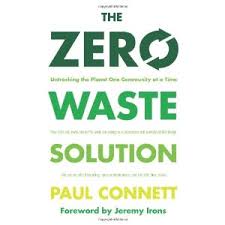
The Zero Waste Solution: Untrashing the Planet One Community at a Time
by Paul Connett (Chelsea Green 2013)
Book Review
The Zero Waste Solution is about 100% waste recovery and reuse, the new gold standard in recycling. Paul Connett’s new book summarizes the state of play of the zero waste movement in local communities around the world. His detailed descriptions of existing programs and technologies provide powerful ammunition for local activists trying to pressure city and town governments to be more environmentally responsible.
According to Connett, we have had the technological capability to recycle 80-90% of our waste stream since the mid eighties. What has held us back has been an artificial corporate-centered view that maximizes profit for waste management companies, the contractors who build and operate incinerators and soft drink bottling companies.
Waste management companies and incinerator contractors have powerful lobbies, as will as cozy relationships with many community councils. Connett also documents the little known role of the Business Environmental Action Coalition (BEACC) in lobbying major cities to provide curbside recycling for glass and aluminum cans. Following the first Earth Day in 1970, BEACC, whose members included Coca-Cola, the Aluminum Association and 7 Up, feared the introduction of producer-focused waste reduction laws (e.g. mandatory deposit/return programs). They viewed limited curbside recycling as a way to head this off.
History of the Zero Waste Movement
The zero waste movement first got its start in Berkeley California in the 1980s and in Canberra Australia in the 1990s. At present, California and Italy are at the forefront in terms of community participation. By 1996, 300 California communities had achieved 50% trash diversion (from landfills and incinerators). San Francisco reached 80% diversion in October 2012 and expects to reach 100% by 2020. More than 200 Italian communities have achieved 70% diversion, with some small towns reaching more than 80%.
Not only is zero waste recovery better for the environment and human health*, but it’s far more economical than traditional waste management. Recycling and reusing resources always saves money. Loss of revenue, stemming from the 2008 economic downturn, has forced many corporations to focus on more efficient resource use. Japanese companies are the clear leader here, with nearly 2800 producing zero landfill waste. A surprising number of Fortune 500 companies (including Anheuser Bush, Apple, Hewlett Packard, Pillsbury Xerox, Ricoh electronics) have also committed to zero waste.
The Twelve Master Categories of Discards
Zero waste experts divide the waste stream into 12 reusable fractions:
1. Reusable goods – repairable appliances, demolition debris and reusable clothing, furniture and household items.
2. Metals
3. Glass
4. Paper
5. Plastic polymers (including plastic bags)
6. Textiles (including non-reusable clothing)
7. Chemicals, including reusable solvents, paints, oil and lubricants.
8. Wood from non-reusable lumber and furniture (can be made into wood chips)
9. Plant debris
10. Putresibles – kitchen waste, manure
11. Soils – from barren or developed land
12. Ceramics, rock, porcelain, concrete and non-reusable brick
At present, more than 90% of the waste stream can easily be recovered for resale. The non-recoverable fraction consists mainly of hazardous materials such as batteries, electronic equipment, mercury-laden fluorescent bulbs and disposable diapers. Many zero waste advocates want to implement extended producer responsibility (EPR) to deal with hazardous waste. Under EPR, the manufacturer is expected to come up with a non-toxic alternative or to accept the product back for safe disposal.
Of the 12 recoverable fractions, kitchen waste, which comprises 33-40% of the waste stream, is the easiest to resell (as compost). Connett contrasts communities in Italy that merely encourage backyard composting, with Seattle and other cities that offer curbside collection of kitchen waste. The latter has proven far more cost effective, largely because backyard composting isn’t an option for the hotels, restaurants and supermarkets, which generate most of it.
Zero Waste Creates Jobs
In view of the immense cost savings, I was surprised to learn that job creation is another important benefit of a zero waste approach. Rising land, energy and transportation costs make landfills and incinerators so expensive that zero waste programs are always cheaper, despite employing more people.
*Recycling reduces the burden of climate change by eliminating methane production (one of the most damaging greenhouse gasses) from decaying landfills and carbon emissions given off by waste incineration. Both landfills and incinerators pose major health hazards. Landfills leak toxic substances into the water table. Incinerators produce dioxin, which is linked to cancer, birth defects, and immune and neurodevelopmental problems.
Below Pete Seeger performing my all time favorite folk song “Garbage (Garbage, Garbage, Garbage) Garbage”
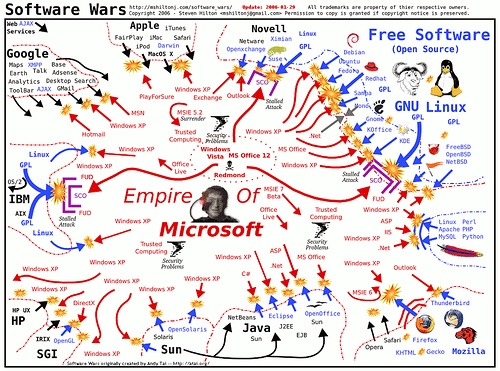
As strange as it may sound, switching to Open Source operating systems and software can save a lot more carbon emissions than changing your lightbulbs.
I myself have switched to Firefox (instead of Microsoft Explorer) and Open Office (instead of Microscoft Word) and plan to download Linux soon to replace Windows. As a community organizer for 30+ years, Microsoft has been the bane of my existence. Most of the activists I work with use MS Word (and before that MS Works) to create documents. Predictably Microsoft has come out with a new version of Word that is unreadable by older versions. Clearly this is a calculated maneuver to force customers to continually purchase new upgrades.
Opening Pesky Docx Files
This time, however, I followed the advice of a fellow Green Party member and downloaded Open Office, provided free by Sun Microsystems Open Source software. Thanks to the Open Source movement, every time Microsoft comes out with a new word processing program, Open Office offers upgrades to translate the new program to either Open Office or an older version of Word. Not only does it open those pesky docx files, but it creates spreadsheets and slideshows and allows you to save graphics as either PDF or JPG files. It probably does lots of other things I haven’t discovered yet.
The other great thing about Open Office is that, like other Open Source software, it runs faster than Microsoft programs, crashes less and is less much likely to have security problems. This is because Sun Microsystems makes Open Office code freely available for other programmers to improve and build on. Computers aren’t like soup. By involving more people in creating code, you make it far more likely someone will find all the bugs and security problems.
So, people ask me, how does this reduce carbon emissions? There are obviously small energy savings (related to DVD production, packaging, transportation, etc) when an individual downloads software instead of buying it off the shelf. However the big emissions savings occur when large companies that maintain vast amounts of data switch to Open Source. Recently the Bank of New Zealand vastly reduced their energy costs and carbon emissions by converting their front end systems to Open Source.
They save money and energy by speeding up and simplifying their data processes with a single (Red Hat Linux) program, instead of relying on three or four programs for different functions.
Companies Going Open Source
In response to the global recession, the immense cost savings is leading many government agencies and Fortune 500 companies to switch to Open Source for part or all of their data processing. The best known are BART (Bay Area Transit System), Burlington Coats, CISCO, Conoco, the Mobil Travel Guide (Exxon’s consumer website), Royal Dutch Shell, Panasonic, Hilfiger, Toyota Motor Sales USA, US Army, US federal courts, the Pentagon, the Department of Homeland Security and the US Post Office.
Countries Going Open Source
Third world countries are also benefiting from Open Source cost savings. Brazil was the first to mandate Open Soft systems for all their government offices. In 2013, 16 third world countries (Nigeria, Uganda, Tanzania, India, Kenya, Guatemala, Botswana, Rwanda, Togo, Lesotho, Mali, Ghana, Namibia and Chad) saved over $100 million dollars by installing Open Soft software to track their health care workforce.
Open Source Design: Reclaiming the Commons
Engineers, architects and climate change activists in the Open Sustainability movement are expanding Open Source Design beyond its computer applications to ensure the rapid spread of ideas and technologies that reduce energy use and carbon emissions.
The Creative Commons – a nonprofit California organization devoted to expanding the range of inventions and creative works available for others to share and build on.
Singularity University – “a grand scheme to assemble, educate and inspire a cadre of leaders who strive to understand and facilitate the development of exponentially advancing technologies to address Humanity’s Grand Challenges.”
Public Library of Science – a nonprofit open access scientific publishing project aimed at creating a library of open access journals, with the eventual goal of making all scientific medical research freely available to the public.
Wikipedia – a free open source encyclopedia (which I discuss in my next post).
Michael Shuman’s latest book, Local Dollars, Local Sense is valuable for three different groups of readers: sustainability activists seeking financial support for small locally owned businesses; local business owners seeking start-up and expansion capital; and investors seeking to move their IRA accounts and other Wall Street holdings to safer, more profitable and more socially responsible and environmentally friendly investments.
There is growing consensus among economists and anticorporate activists about the importance of relocalization as the centerpiece part of any realistic solution to the economic, energy and environmental crises that face us. Across the planet, thousands of neighborhoods and towns are coming together to opt out of corporate agriculture and energy production in favor of local food and energy production schemes. The biggest obstacle they face is finding sustainable funding to support their work.
A Dearth of Funding Options for Local Business
At present options for small businesses seeking start-up funding for organic farms, solar installation companies and similar “green” enterprises are extremely limited. A small business owner needing finance has two basic choices. They can take out a time-limited loan at interest or they can sell shares and allow other people to become part owners and share in the profits (or losses).
Even prior to the 2008 economic crisis, it was virtually impossible for small business owners to find conventional bank loans. Nearly all the neighborhood banks we grew up with have been bought out by global investment banks, which have no incentive to make loans to small local businesses. The recent move by millions of Americans to move their accounts out of global banks to local banks and credit unions – which do support local business – has been a move in the right direction. Yet as Michael Shuman points out in Local Dollars, Local Sense, this is merely a drop in the bucket compared to the $30 trillion Americans have invested – mostly through IRAs and pension plans – in Wall Street Fortune 500 companies.
Shuman, a member of the Post Carbon Institute and partner at Cutting Edge Capital makes, a compelling case for moving half ($15 trillion) of it out of Wall Street and investing it locally. He presents strong evidence that local businesses provide a higher and more reliable return than the Wall Street casino, as well as providing a host of benefits for society and the environment. Unlike multinational corporations, they have to be accountable to local residents who patronize them. This translates into a strong incentive to be environmentally responsible, to treat workers fairly and to contribute positively to the community.
How Banks and Corporations Game the System
Although small local businesses produce 50% of the US GDP, as well as providing 50% have the jobs, fewer than 1% of Americans’ combined savings and investments help to finance local business. Most Americans still keep their short term savings (if they have any) in large multinational banks. In most cases, their only long term savings are tied up in IRA plans and pension funds. With the exception of municipal bonds, nearly all of this is invested in Fortune 500 corporations with no loyalty whatsoever to any community, state or country.
The main reason most Americans invest in Wall Street is because powerful bank and corporate lobbies give them no choice. There are serious legal obstacles preventing people from investing in local business. Outdated securities laws passed during the Great Depression make it virtually impossible for “unaccredited” investors (approximately 98% of Americans) to invest even small amounts in local companies. “Accredited investor” is a term delineating the qualifications needed to participate in “high risk” investments, such as seed money, limited partnerships, hedge funds, private placements, and “angel” investments. In the US, an accredited investor must have an income of $200,000 (for three years) and a net wealth of at least $1 million (excluding their residence).
A new business seeking funding from “unaccredited” investors is required to register with the SEC and state regulators. This, in turn, requires the creation of a disclosure and other legal documents at a cost of $25,000-150,000 in attorney fees. The U-7 or SCOR (Small Company Offering Registration) form alone is 39 pages, and each form must be accompanied by 14 disclosure documents.
There seems little hope of reforming these archaic laws while powerful Wall Street lobbies control both Congress and the White House. However according to Schuman, communities across the US are trying exciting new financing models that circumvent existing securities law:
Worker and/or consumer cooperatives – workers and/or workers and consumers pool their resources and share ownership in the local business they are starting or taking over from a prior owner.
Pre-sales Contracts – companies generate start-up funding by lining up customers to pay in advance for their products.
Local Investment Opportunities Networks (LIONS) – local networks deliberately cultivate relationships between business owners and potential investors (the SEC and state regulators often waive the requirement for a SCOR if the investor is a family member or “friend”).
BIDCOs (Business Development Companies) – a type of investment club. BIDCOS aren’t required to register with the Security and Exchange Commission (SEC) but must provide managerial and technical assistance to beneficiaries as well as capitol. No Small Potatoes in Maine is an example of a BIDCO
Low cost DPOs (Direct Public Offerings) – if the business is limited to operating within state or offers the investment opportunity without public advertising, it may qualify for exemption from registration requirements. The business owner will still need to fill out a SCOR, but a number of public interest attorneys are seeking to streamline the process by creating “fill-in-the-blank” software.
Crowdfunding – a technique for pooling of large numbers of small contributions, usually via the Internet, for a specific project. If there is no expectation of return (except for a token gift or premium), there is no requirement to register with the SEC. Small business owners can register potential projects for crowdfunding at Kickstarter.
Local/Regional stock exchanges – in 1985 there were approximately a dozen regional exchanges (for example the Pacific Stock Exchange and the Boston Stock Exchange). Most were bought out by either the NYSE the AMEX or the NASDEQ. However according to Shuman, Mission Markets in New York is the most promising model for what future regional exchanges will look like. Mission Markets calls itself a “private marketplace” because obtaining SEC approval to become an “exchange” (where shares are traded) would involve major bureaucratic hurdles and cost half a million dollars.
Local Savings Pools – issues interest-free loans for a fixed period. According to Shuman, there is less risk of fraud as lenders and borrowers are more likely to know one another. Since there is no expectation of financial return, there is no requirement to register with the SEC or state regulators.
P2P (person-to-person) lending – www.kiva.org, an international microlending (providing loans as small as $25 to third world entrepreneurs) website, is the best example. Inspired by the Grameen Bank founded in Bangladesh by Muhammad Yunis, Kiva has many imitators.
The term “economic relocalization” describes a global movement of loosely knit grassroots networks working to strengthen local and regional economies and systems of food and energy production. Most of the last eight years of my life have been focused on grassroots relocalization activities.
What I like best about Economics of Happiness is learning I am part of a global movement. I hate the title, which suggests the film concerns some kind of airy-fairy New Age spirituality. It doesn’t.
The 2011 film, narrated by Helena Norberg Hodge, is based on her 1991 book Ancient Futures: Learning from Ladakh and her 1993 film by the same name. The book and both films draw their inspiration from the nearly forty years Norberg-Hodge spent living and working in Ladakh, a small Himalayan region in the India-controlled (and disputed) state of Jammu and Kashmir. Economics of Happiness includes local footage from the 1993 film, as well as substantial documentary footage relating to the world’s current economic crisis and impending ecological crisis (stemming from catastrophic climate change and mass extinctions).
The Psychological Devastation of Globalization
The film opens with the same narrative Norberg-Hodge recounts in her earlier Ancient Futures film. We are shown the “before” image of Ladakh, a rich thriving culture in which residents live in large spacious homes, enjoy generous leisure time and have no concept of unemployment. Then we have the “after” image where, thanks to globalization, cheap (government subsidized) food, fuel and consumer goods have flooded the region and destroyed residents’ traditional livelihoods. Previously pristine communities face rising levels of air and water pollution, while Ladakhi teenagers face continual bombardment with pro-consumption messages.
It’s heartbreaking to see the psychological effect of all this. Most young Ladakhi have come to regard themselves as backwards and poor, while the communities they live in face rising racial tensions, juvenile delinquency and epidemic levels of major depression.
The Destructive Nature of Urbanization
The film goes on to sketch the mechanics of globalization, stressing the deregulation that forces small self-contained regions like Ladakh to open their markets to foreign goods, which quickly supplant local products. Norberg-Hodge paints an even uglier picture of urbanization, an inevitable result of forcing millions of small formers off their land. She stresses that city living is vastly more resource intensive than rural lifestyles. All city residents rely on food, energy and water transported from some distant source. They burn up additional fossil fuels transferring their waste as far away as possible. She stresses that most city residents go along with the massive ecological and social devastation they produce because it occurs on the other side of the world. Thus they don’t see it.
Rebuilding Local Communities and Economies
The solutions Norberg-Hodge offers for all these problems are similar to those proposed by an increasing number of dissident (non Wall Street) economists. First and foremost we must acknowledge that humankind has exceeded the earth’s carrying capacity – that the corporate drive for continual economic growth must end. Secondly people of conscience need to opt out of the corporate economy to facilitate the creation of more efficient and environmentally accountable regional and local economies.
Norberg-Hodge also sees the process of rebuilding local communities as a remedy for what she describes as the “crisis of the human spirit.” She blames this pervasive spiritual crisis on the demise of community engagement that has accompanied globalization and urbanization. Although the process is most striking in remote regions like Ladakh, where it occurred suddenly, nowhere in the developed or developing world has escaped it.
The film ends on an extremely optimistic note, with numerous examples of international and community organizations supporting people in reclaiming their lives from multinational corporations.
Economics of Happiness can be rented (and watched online) from the filmmakers for $5
The title Sacred Economics sounds like a New Age treatise on spirituality. The book is actually about the end of capitalism. It offers an extremely well-researched discussion of the history of money, capitalist economics and the world wide movement for economic re-localization. By avoiding simplistic clichés about greedy corporate CEOs and amoral banksters, Eisenstein arrives at some startling conclusions. Tracing the western conception of money back to its earliest origins, he makes a strong case that money itself is responsible for rapacious growth and resource depletion, greed and the demise of community.
Money and the Loss of the Commons
The main focus of Part I is an exploration of the profound effect money has on human thinking and psychology. Part II focuses on economic relocalization and other practical steps activists can take to restore the original gift economy.
Part I begins with an analysis of the dual illusions of separateness and of scarcity. Both, Eisenstein argues, are mistaken beliefs stemming from the privatization of communally owned land. This, in turn, was an early consequence of the introduction of money.
Prior to Roman times, land, like air and water, was considered part of the commons and couldn’t be owned. Under Roman tradition, there was no way for an “individual” (a Greek invention related to the concept of money and personal wealth) to legitimately take possession of common lands. Thus the Roman aristocracy had to seize it by force, just as Europeans stole the communal lands of Native Americans, Maori and indigenous Australians.
During the many centuries our ancestors had access to communal lands for their herds and crops, they enjoyed a sense of interconnectedness and interdependency. This was lost when the wealthy began fencing it off as private property. This loss of interconnectedness has left all of us with a profound inner emptiness we experience as never having enough.
How Money Destroyed the Gift Economy
Part I also describes the gift economy that characterizes all primitive cultures. Public gift giving was the primary mechanism all early societies used to satisfy basic survival needs. As civilizations became more complex, gift exchange and barter were impractical over long distances. This led money was introduced as a common medium of exchange.
An early artifact of the introduction of money is the mistaken belief that the basic necessities of life are in short supply. This illusion underpins all western economic theory. In fact many textbooks define economics as the study of human behavior under conditions of scarcity. As Eisentein points out, this is a ludicrous notion in a world in which vast quantities of food, energy and raw materials go to waste.
The Origin of Greed
Eisenstein attributes greed to this illusion of scarcity. He can see no other explanation for low income people giving away far more money, relative to income, than their rich counterparts. Rich people worry about money more and are more inclined to perceive scarcity when none exists. Einstein talks about the immense anxiety people in rich countries experience over “financial security.” No matter how much they accumulate, it’s never enough.
Debt, Usury and Perpetual Growth
Sacred Economics argues that what economists commonly refer to as growth is the expansion of scarcity into areas of life once characterized by abundance. Fresh water, which was once abundant, has become scarce following its transformation into a commodity most of us are forced to pay for.
The fractional reserve banking system, which allows bankers to loan money they create out of thin air, accentuates the pressure to convert more and more of the commons into commodities. The amount of debt created is always greater than the money supply. Current global debt ($75 trillion) is more than twice global wealth ($30 trillion). This results in constant pressure to create more goods and services to repay personal, corporate and public debt.
Growing pressure to repay debt only hastens the rate at which natural resources, such as fossil fuels, minerals, forests, fish and water, are converted to commodities. A parallel process is causing the social, cultural and spiritual commons to be dismantled. Stuff that was free throughout all human history – stories, songs, images, ideas, clever sayings – are copyrighted or trademarked to enable them to be bought and sold.
Einsenstein’s Confusion About Marxism.
The only weakness of Sacred Economics are some mistaken and contradictory assumptions Eisenstein makes about Marxism. He makes the assertion in Part I that capitalism needs to be replaced, but not in a “Marxist” way. He claims this would remove any “monetary” incentive for people to produce goods and services that are useful to the community. This seems to contradict his call for the a return to a gift economy in which people contribute to the community for intangible rewards (public recognition, status and esteem) rather than monetary reward.
Below Eisentein speaks briefly about his book.
***
In celebration of read an ebook week, there are special offers on all my ebooks (in all formats) this week: they are free.
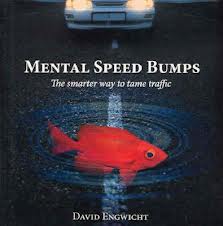
Mental Speed Bumps: A Smarter Way to Tame Traffic.
by David Engwicht, Envirobook 2005
Book Review
David Engwicht is an Australian social inventor who consults internationally with town planners and social engineers about traffic calming measures. Mental Speed Bumps describes a revolutionary bottom-up approach to traffic calming called “street reclaiming.” The main focus of street reclaiming is to reclaim city streets for people instead of motor vehicles.
Because of their immediate change effect, street reclaiming activities are extremely effective for inspiring optimism about political change. As well as helping to repair broken social networks, they encourage ordinary citizens to see themselves as change agents, rather than waiting for indifferent and/or corrupt political leaders to make changes on their behalf.
As Engwicht points out, most people tend to blame someone else – either city officials – or drivers from other neighborhoods – for their traffic problems. However on closer scrutiny, they usually discover that they and their neighbors are responsible for about one third of the traffic on their street.
The “Living Room” Analogy
Based on working with neighborhood activists all over the world, Engwicht recommends street reclaimers follow five basic steps:
1. Reclaim your street as a socializing space
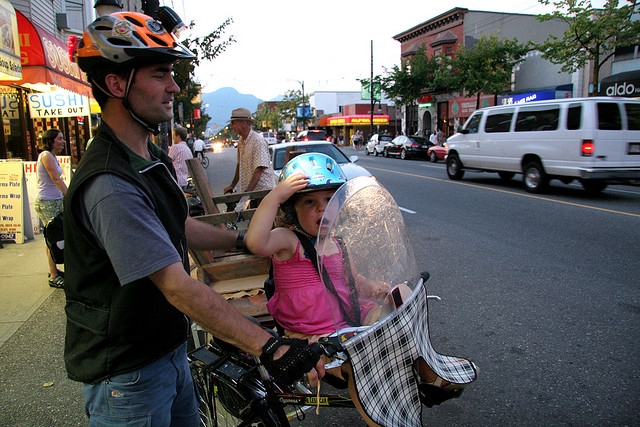
Move some of your normal activities closer to the street (e.g. reading your book in your front yard or on the sidewalk – working on painting, refinishing, and other do-it-yourself projects in your parking space instead of your garage or basement).
Supervise children playing on the sidewalk or in the roadway.
Walk your kids to school
Walk to local destinations and greet people you encounter.
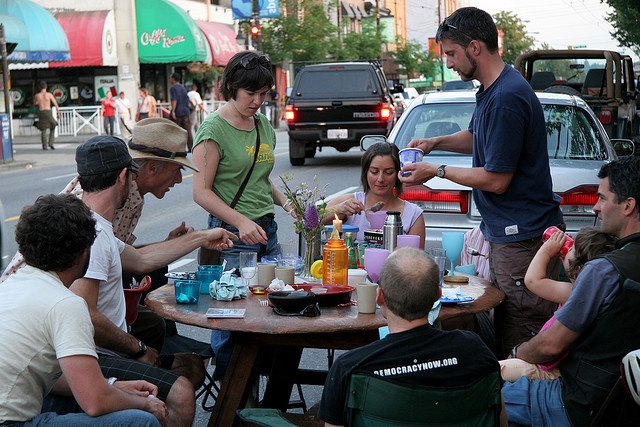
Hold a street party.
2. Move more slowly and gently
Reduce your own car use to a minimum.
If you must drive, do it more slowly and casually.
Teach your kids to walk or cycle to school.
3. Intrigue travelers by engaging them in the social life of the street.
Wave to motorists.
Put something intriguing, such as a veggie garden, in your front yard or parking strip
Blur the boundary between your private home and the street (e.g. take down your front fence and curtains). This is common in many European communities to maintain the street as a social space.
4. Work with neighbors to create “Linger Nodes” to facilitate social life in your street.
Create a socializing node on your private land (seating, drinking fountain community notice board, sculpture, etc) or on the sidewalk.
Encourage local businesses to connect with the street by placing an activity outside their premises.
5. Evolve your street from a "corridor" into a "room."
Put “furniture” and “art” in your room.
Work with your city on design elements that make your street feel more like a room (for example a landscaped entryway, a ceiling made of flags or banners, and walls created from furniture or art).



 The Most Revolutionary Act