How Climate Change is Killing People in Bangladesh

30 Million

Directed by Daniel Price and Adrien Taylor (2016)

Film Review

Thirty Million is a New Zealand documentary about how rising sea levels in Bangladesh are already displacing (and killing) people in low lying coastal areas. It depicts quite dramatically how coastal farmers inundated by rising tides are moving into incredibly congested cities, where there is virtually no housing or infrastructure to support them. There many of them die – through lack of food, untreated medical illness or a variety of catastrophic events (fires, building collapse, floods, etc.). Those with above average wealth attempt to leave Bangladesh for Europe, Australia, New Zealand and other destinations.

The film features former Prime Minister Helen Clark in her new role as the administrator of the UN Development Programme. She speaks very eloquently about the urgent need to reduce global carbon emissions. I find it a bit hypocritical in few of her failure to make a serious effort to reduce New Zealand’s CO2 emissions during her stint as prime minister (1999-2008).


https://vimeo.com/170108444

The True Cost of Cheap Meat

farmageddon

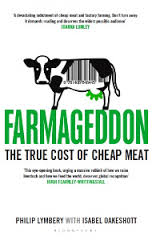
Farmageddon: The True Cost of Cheap Meat

By Philip Lymbery with Isobel Oakeshott

Bloomsbury Press (2014)

Book Review

Farmageddon is about the false economy of industrial meat production. While the corporations that promote factory farming applaud themselves for producing “cheap meat” for poor people, when societal costs are counted, industrially produced meat costs society approximately 25 times the sticker price. So as not to infringe on corporate profits, the excess costs (for environmental clean-up and a myriad of health problems) are transferred to the taxpayer.

Lymbery, a long time organic farming proponent, provides an extremely thorough and compelling expose of the numerous drawbacks of raising livestock in concrete warehouses. The side effects of living adjacent to a factory farm include air and water pollution by toxic herbicides and pesticides, nitrates, pathogenic bacteria and arsenic; loss of songbirds, bees and other insect species; reduced life expectancy,* increased exposure to disease carrying mosquitoes, loss of earthworms (due to fertilizer-related soil acidification), increased incidence (by threefold) of childhood asthma; increased antibiotic resistance (due to routine feeding of antibiotics to factory farmed cows, pigs and chickens); reduced sperm counts and increased breast cancer and renal tumors related to Roundup, the herbicide used with GMO crops.

Lymbery also includes a section on industrially farmed fish and they risks they pose to the health of wild fish populations.

His final chapter includes a variety of policy recommendations that could facilitate a move away from industrial farming to safer, less environmentally destructive traditional farming.


*Individuals who live adjacent to intensive dairy farms have a ten year decrease in life expectancy.

Prince Charles’s Organic Farm

The Farmer and His Prince

Bertram Verhag (2014)

Film Review

The Farmer and His Prince is an English language film produced by German film director Bertram Verhag. It features an in-depth tour of His Royal Highness Prince Charles’s organic farm at High Gatehouse in Gloucestershire and substantive discussions with the Prince of Wales himself on industrial agriculture, factory farming, genetic modification, global warming and sustainable organic farming.

Prince Charles, the world’s most high profile organic farmer, converted his estate to organic agriculture in the 1980s. He raises sheep, dairy cows, rare breed pigs and a range of foot crops. Although he plays little role in the day-to-day management of the farm, he conducts tours there and is active in lobbying government policymakers and the food industry – both in Great Britain and internationally.

His farm supplies local hotels and markets and presently turns a small profit.


An Indigenous Approach to Learning

Relearning the Land: A Story of Red Crow College

Enlivened Learning Project (2015)

Film Review

Relearning the Land is the first in a series of documentaries exploring various alternative universities Canada, Mexico, Peru, Brazil, Argentina, Chile, Australia, New Zealand, Thailand, India, the USA, UK and Costa Rica. The Enlivened Learning Project maintains that modern university education is in deep crisis. Increasingly profit-driven and competitive, they tend to serve the interests of the global elite at the expense of society as a whole. Because they tend to alienate students from nature, community and one another, they are ill-equipped to prepare young people to address the urgent global economic and ecological crises we presently face.

This first film focuses on Red Crow Community College on the Kaina Reserve (part of the Blackfoot Confederation) in Southern Alberta. Founded in 196, the community college offers two year degrees in arts, science, nursing and Kaina Studies and is open to non-Blackfoot students. In addition to offering classes in Blackfoot language and First Nations history, Kaina studies offers classes in Blackfoot ecological knowledge, handed down from ancestors trained to look after the beaver bundle. A beaver bundle is knowledge of how to survive that plants and animals gift to human beings.

In the Blackfoot world view, human beings are the baby species and must learn from older species how to adapt and fit in. The European settlers erroneously believed their culture and technology was superior to that of First Nations people, which is why they tried to destroy their culture and technology by kidnapping their kids and forcing them to attend residential schools.

For the most part, first Nations technology, geared towards adaptation and survival was far superior to that of the Europeans. Left unchecked, European ignorance and arrogance is on track to destroy the entire human species.

Update: Sadly Red Crow College was burned down by an arsonist in August 2015 and the Blood Tribe is seeking donations to help rebuild it.

Debunking Large Scale Hydroelectric Dams


Damocracy

Directed by Todd Southgate and Tolga Temugle (2013)

Film Review

Damocracy is a documentary debunking the myth that large scale hydroelectric dams combat global warming by producing emission-free electric power. In reality, they create massive amounts of methane by flooding and killing large areas of vegetation. Because methane is a far more dangerous greenhouse gas than CO2, it takes approximately 41 years for a dam to produce any net benefit for the climate.

The film focuses on global protest movements which have formed in reaction to two specific dam projects: Ilisu on the Tigris River in Turkey and Belo Monte in Brazil.

In addition to displacing more than 35,000 rural residents, the Ilisu Dam would flood more than 300 unique Mesopotamian heritage sites. It would also aggravate water shortages in southern Iraq and Iran.

The Belo Monte dam would displace 40,000 indigenous people, virtually destroying 18 distinct ethnic cultures.

Despite strong support for the Bel Monte dam by former president Dilma Rousseff, mass popular resistance forced her government to discontinue the Bel Monte project in April 2016.

Turkish president Recep Erdogan continues construction on Turkey’s Ilisu Dam despite UN and high court rulings ordering him to desist. Ongoing local and international protests have significantly delayed the damn’s completion, originally slated for 2015.

See Corporate Watch and Iraqi civil society.


Can We Stop Climate Change Without Dismantling Capitalism?

The Cross of the Moment

By Jacob Freydont-Attie (2015)

Film Review

Can climate change be addressed without dismantling capitalism? The current track record of world leaders suggests not – especially with the election of the world’s most prominent climate denier to the US presidency.

The Cross of the Moment is a documentary exploring the climate change dilemma and various options for limiting global warming and mitigating the effects of catastrophic climate change. It’s produced in a panel discussion format, with the filmmaker posing specific questions to prominent astrophysicists, climate scientists, political economists and climate activists (including Bill McKibben, Gary Snyder, Derrick Jensen, Peter D. Ward, Jill Stein, Bill Patzert, and Guy McPherson). I’m not normally a big fan of talking heads, but the optimism conveyed by this film – in stark contrast to the usual alarmist arguments – definitely held my attention.

I was especially impressed with Bill McKibbon’s elegant explanation of why changing light bulbs and other market-based behavioral changes aren’t going to end global warming. The climate activist lays out an elegant argument why systemic structural changes is needed to wean humanity off of fossil fuels and why fossil fuel companies aren’t going to allow this without a major global movement to counter their power and greed.

The other panelists present a range of views on the specific structural/systemic changes that are necessary to prevent climate changes from wiping out our ability to produce food. Most seem to agree that fossil fuels could be totally phased out – and replaced by renewable energy – by 2050. They estimate this could be done for a total capital cost of $15 trillion (which according to the IMF is less than we currently spend annually to subsidize the fossil fuel industry*).

The film offers a number of viewpoints on how to bring this about. One economist favors a carbon tax; another would totally ban wasteful industries such as packaging (the third largest global industry after energy and food) and junk mail (which produces 51 millions tons CO2 annually in the US alone). Two activists express the view that the political corruption exerted by the fossil fuel industry couldn’t be overcome without dismantling capitalism altogether.


* According to the IMF, fossil fuel companies benefit from $5.3 trillion a year in subsidies.


Reconciling Heathrow’s Third Runway with UK Climate Commitments

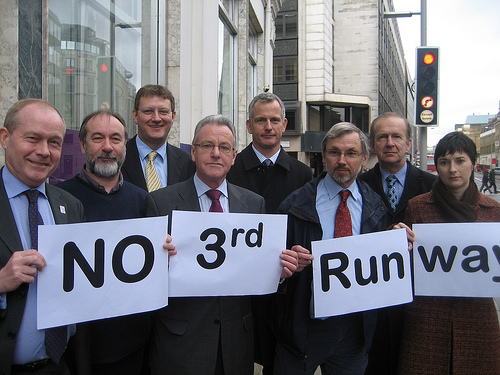
no-3rd-runway

BBC News reports the British cabinet has just approved the extremely controversial third runway at London’s Heathrow airport. It will allegedly bring billions of dollars of economic benefit to Britain’s economy and create tens of thousands of new jobs.

Oh really? Big business is always promising pie in the sky economic benefits and job creation for big infrastructure projects that seriously disadvantage the rest of us by evicting us from our homes and otherwise destroying our quality of life. Experience teaches these economic projections aren’t worth the paper they’re written on. Thanks to the growing complexity of the global economy, economists can predict what the economy will do next month – much less 20 years from now.

The inimitable George Monbiot says it all in an October 18 opinion piece in the Guardian: “In a world seeking to prevent climate breakdown, there is no remaining scope for extending infrastructure that depends on fossil fuels.”

As Monbiot rightly points out, there’s no way Prime Minister Theresa May can allow Heathrow to build a third runway and simultaneously uphold the Paris climate change agreement Britain signed last year.

Subsidizing Air Travel for the Rich

He cites last year’s Airports Commission report, which offers two possible strategies for ensuring the new runway (and extra flights) won’t conflict with the climate pledges Britain made in Paris. The first is for the rest of the economy to make extra cuts in greenhouse gases to accommodate aviation. Already the Climate Change Act imposes a legal target of 80% reductions by 2050. But if flights are to keep growing as the commission expects, those cuts would have to rise to 85%. This is fundamentally unjust. The large majority (75%) of Heathrow’s international passengers are holiday travelers. As they also have a mean income of £57,000, this option makes everyone else pay for the holidays taken by the well off.

The second option they offer is a carbon tax on aviation. An analysis by the Campaign for Better Transport suggests that the tax required to reconcile a new runway with Britain’s carbon commitments is somewhere between £270 and £850 for a return flight for a family of four to New York.

IMF Calls for Carbon Tax on Aviation

The International Monetary Fund is also calling for a carbon tax on aviation and shipping to help the industrialized world meet the carbon reduction goals it agreed to in Paris. Emissions from planes and ships, presently accounting for 4% of global emissions, are steadily increasing. Unlike other forms of transportation, it’s impossible to replace jet fuel with more carbon neutral energy sources such as electrification.

As Monbiot points out in his article, it makes absolutely no sense to spend billions of dollars on this infrastructure boondoggle and then price people out of the air travel market with a carbon tax. For this simple reason, he predicts the third runway won’t happen. The current timeline proposed by the Department of Transport is so long and convoluted, construction on a third runway couldn’t start before 2020. I suspect Monbiot is right – that it won’t happen at all.

photo credit: Liberal Democrats Brian Paddick with London Borough leaders campaigning against Heathrow expansion via photopin (license)

Economic Impacts of Climate Change

Stories of Climate Change

University of North Carolina Institute for the Environment (2016)

Film Review

Stories of Climate Change is a short documentary about the economic impact of changing climate – rising sea levels, floods, droughts, short springs and warmer water temperatures – on various North Carolina business owners. Each vignette is a little under four minutes. (If Vimeo is set on autoplay Parts 1-6 and 7-11 should autoplay sequentially. The alternative is to click individual vignettes as they appear in the preview panel on the right).

First up is a beekeeper who reports that shorter springs (resulting in a decline in flowering plants and nectar) kill off up to 50% of her bees every year.

Next is the manager of a seafood market, who talks about sea bass dying out as warmer water temperatures interfere with spawning and other fish species moving as far north as Maryland and New England.

In the third vignette a hunting guide talks about the decline in the number of migratory birds flying south due to warmer temperatures.

In Part 4 a wildlife refuge manager talks about rising sea levels causing increased soil salinity and killing off pine forests that used to support woodpeckers and other native birds.

In Part 5 a fishing guide talks about his region experiencing the drought of the century, the flood of the century and the killing frost of the century – along with a mass of crop failures – in the last five years. He also observes that city people don’t see climate change because they’re out of touch with the natural landscape.

In Part 6 a hunter/fisherman talks about the loss of seasonal variations, resulting in long winters, hot dry summers and unprececidentated infestations of mosquitoes and tics that can last up to Christmas.

In Part 7 a family of asthmatics discusses the direct impact of climate change (long hot summers with lots of pollen and wildfires) on their health.

In Part 8 a trout farmer discusses how decreased oxygenation has caused several years where her entire stock was wiped out.

In Part 9 an oyster fisherman describes how a rise in sea levels is causing increased erosion and sedimentation that is suffocating oyster beds.

In Part 10 an apple grower who took over a 100 year old orchard 200 years ago talks about the loss of his entire crop for four years running. Buds form prematurely due to unseasonably warm March weather and are killed by sudden cold snaps in April.

In Part 11 a ranchers talks about her difficulty managing longer more severe droughts, longer more severe rainy periods and sudden severe heat waves. A few years ago she lost 50 chickens and turkeys when the temperature rose from 70 to 100 in 45 minutes.

If the Bees Die Off, We Go With Them

More Than Honey

Directed by Marcus Imhoof (2012)

Film Review

More Than Honey is a documentary investigating colony collapse disorder, the mysterious condition that threatens to wipe out the global honeybee population. As the great majority of our food crops rely on bees for pollination, this would also have dire consequences for humankind.

Scientists featured in the film report that colony collapse disorder has three main causes: insecticide (neonicotinoid*) poisoning, veroa mites and “stress.” They emphasize that the European honeybee (also the sole source of the US honeybee population) has been “domesticated,” just as larger farm animals have. This domestication reduces their stress tolerance: they can no longer tolerate two day trips across the US (in trucks) the way they once did.

More Than Honey includes some fabulous footage of bees doing their elaborate wangle** dance and struggling with mite infestation and after effects of pesticide spraying.

What I found most intriguing about this documentary was learning that Africanized honeybees may be the salvation of the domestic bee population. Commonly maligned as so-called “killer bees,” African bees are good pollinators and honey producers. They are also resistant to veroa mite.


* Since More than Honey was made in 2012, the EU has placed a total ban on neonicitinoid use.

**When bees return to the hive, bees perform a special wangle dance to communicate to other bees the location of a good nectar source.


The Earthship Movement – Transforming Garbage into Homes

Garbage Warrior

Oliver Hodge (2007)

Film Review

Garbage Warrior is a about architect and Earthship inventor Mike Reynold’s 30+ year rear radical experiment in sustainable living in Taos New Mexico. An Earthship is a home built out of tires packed with earth or sand and recycled glass and plastic bottles and other waste. Using the tires as a massive thermal mass to absorb heat, it relies on a passive solar design for heating and cooling. Totally off the grid in terms of power, water, and sewage, Earthships are typically build around a central greenhouse used for food production and temperature control.

All Earthshhips must incorporate five basic principles:

  • They must be built with natural or recycled materials
  • They must rely exclusively on solar or wind power and thermal mass for energy, heating
  • They must have a self-sufficient water harvesting system
  • They must have a self-contained sewage system.
  • They must incorporate food production

The Greater World Community

Reynolds began his first Earthship community, the Greater World Community, on ten acres of land in 1990. The idea was to give Mike’s young work crew and followers a low cost plot of land and support them in building their own Earthships. He eventually built two much larger Earthship communities in the Taos area.

Most of the film relates to the legal difficulties Reynolds encountered with local and state authorities, over the failure of Earthships to comply with building codes. In the early 1990s, he voluntarily surrendered his New Mexico architects license to avoid being sued for malpractice. In 2004 he reached a compromise with the county by reclassifying his Earthship “communities” as “subdivisions.”

After three years of intensive lobbying, in 2007 he persuaded the New Mexico legislature to approve his Earthship communities as a “sustainable living test site.” This effectively exempted them from state and local permit requirements. The best part of the film shows him teaching Andaman Islands residents whose homes were destroyed by the 2004 Indonesia tsunami how to build Earthships. This segment provides the most detailed depiction of the actual construction process.

2014 Update

The second film is a 2014 update of the “sustainable living test site” Taos Earthship community. It highlights a number of the technological improvements that have occurred in Earthship construction. It devotes special attention to the unique water management system that allows Earthship owners to survive in desert conditions with nine inches of rainfall per year.