
Working Class Culture

limbo

Limbo: Blue-Collar Roots, White Collar Dreams

by Alfred Lubrano

Wiley (2004)

Book Review

Limbo is based on the premise that working class Americans (regardless of ethnic background) have their own distinct culture, values, language and world view. This cultural conditioning, based on early childhood experiences, provides an instinctive approach to the world that persists throughout adulthood – regardless of advanced education or changes in social status.

Lubrano coins a new word in Limbo: “straddler.” It describes a professional of working class origin, who owing to profound cultural differences, never totally fits in with middle class colleagues. As this perfectly describes me in relation to the medical profession, it’s a subject very dear to my heart.

For the most part, middle class Americans are totally unaware that working class people have their own distinct culture. Although many liberal academics and professionals happily weigh in on America’s scandalous wealth inequality, the concept of social class is much more difficult for them. They unconsciously cling to the myth that class differences have vanished in the US – that all Americans have an equal opportunity to become billionaires if they work hard enough.

America’s Loss of Class Identity

Meanwhile, thanks to a steady diet of pro-corporate propaganda, low income Americans have lost any sense of working class identity or solidarity. They, too, cling to the myth that all Americans are “middle class.” This is unsurprising, given that TV is often their sole source of information and entertainment. The average American watches an average of 5 hours of TV a day, with the heaviest viewers coming from low income households

Based on income,* more than 70% of Americans qualify as working class. Yet nearly all the characters we see in TV dramas and sitcom are unquestionably “middle class.”**  Recession-themed programming (where people are thrown out of their homes, work three jobs, wait in line at the food bank or struggle to see a doctor) are virtually unheard of. Instead we get reality TV, cooking and renovation shows, dystopian fiction with or without vampires.

The issue of working class culture received little attention until World War II, Korean and Vietnam veterans began attending university on the GI bill and Kennedy and Johnson established federal student loan programs to allow other working class Americans access to tertiary education. Kennedy’s Health Professions Student Loans program made it possible for me to attend medical school.

Despite being immensely grateful for the opportunity to attend university, the realization that we have nothing in common with our mainly middle class peers can be extremely alienating. In my own case, post graduate psychiatric training was particularly difficult. My middle class peers often complained I made them uncomfortable. They had absolutely no awareness that we dressed, thought and talked differently due to differing backgrounds. Instead they insisted I had “personality problems” and in one instanced suggested I take medication. change.

World’s of Pain

Sociologist Lillian Breslow Rubin published one of the first definitive studies of working class culture in her 1976 classic: Worlds of Pain: Life in the Working-Class Family.

Limbo differs from Worlds of Pain in being more descriptive and less scientifically oriented. Personally I prefer Limbo, which Lubrano bases on personal experience and 50 interviews with self-identified “straddlers.” I especially appreciate his effort to describe the value system that characterizes working class culture.

He starts his book with an analysis of fundamental working class values that distinguish them from the middle class:

1. A powerful work ethic (unlike the middle class, which places higher value on getting something for nothing).
2. A strong, unambivalent respect for parents that persists into adulthood.
3. Strong ties to extended family..
4. A forthright approach to interpersonal communication devoid of hidden agendas.
5. Intense personal loyalty.
6. Firm limit setting for children.
7. A preference for common sense problem solving as opposed to book learning.
8. Comfort in openly displaying affection and anger.


*Based on 60% working poor and 10-15% unemployed.

**I can count working class TV series on one hand and most are pre-1980: Jackie Gleason’s The Honeymooners, Amos and Andy, Roseanne, Cheers  All in the Family and possibly Two Broke Girls. I don’t really watch TV that much, and I’m sure people can think of others.

The Neocon Myths Behind Afghanistan and Iraq

The Power of Nightmares

Directed by Adam Curtis

BBC (2003)

Part 3 Shadows in the Cave

Film Review

Part 3 concerns the mythology the neoconservatives created around international terrorism to justify the US wars against Afghanistan and Iraq.

The US Invents al Qaeda

The final video starts with the car bombing of American embassies in Kenya and Tanzania in August 1998. These were the first attacks Bin Laden and Zawahiri organized against US interests as part of their new international jihad (see How the CIA Funds Jihad). They recruited four bombers from training camps Abdullah Azzam started during the Soviet occupation.

Contrary to the myth promoted by the neocons, these camps were exclusively dedicated to training Muslims to conduct jihad in their own countries (e.g. Uzbekistan and Chechnya). Their leaders wanted absolutely nothing to do with international terrorism or Bin Laden’s jihad against the US. They allowed Zawahiri and Bin Laden to recruit from these camps because he was financing them. Nevertheless, even members of Islamic Jihad opposed what they were doing.

In Jan 2001 the US government brought the embassy bombers to trial in the US. They also tried Bin Laden in absentia. To charge him under existing US law, federal prosecutors had to prove an organized group he commanded carried out the bombings. Because no such group existed, they invented one. The name al Qaeda came from a paid FBI informant.

9-11

Immediately following his election George W Bush, like his father, totally rejected the neoconservative’s insistence that the US should invade other nations and “dictate how to run their countries.”

9-11 would change all this, propelling Richard Perle, Wolfowitz, Cheney and Rumsfeld to international power with four terrifying myths:

  1. That Bin Laden was responsible for the 9-11 attacks (according to official FBI accounts, Khalid Sheik Mohammed was responsible for the “plane operations).”*
  2. That “al Qaeda,” a phantom organization the neocons latched onto for propaganda purposes, was a genuine international entity running sleeper cells in 50-60 countries.
  3. That “al Qaeda’s” ultimate goal was to force the US to live under Islamic fundamentalism.
  4. That the invasion of Afghanistan was essential to destroy the heart of “al Qaeda.”

During the invasion and occupation of Afghanistan, the US and NATO allied themselves with the Afghan Northern Alliance. The latter hated the foreign Muslims who came to came to Afghanistan for training and received a generous bounty for handing them over to US troops. Nearly all of them ended up in Guantanomo, despite having no connection with bin Laden or international terrorism.

The Role of Hollywood

Following the US invasion, the neocons invested two new myths. The first was that bin Laden was hiding out in a sophisticated bunker built into the Torah Borah caves on the Afghanistan-Pakistan border. The second was that the US was harboring a vast network of terrorist sleeper cells preparing a new attack on US soil. Although both were totally discredited by mid-2003, these myths would be solidified in the public mind by dozens of TV dramas about hidden terrorist sleeper cells in major US cities.

A popular theme of these dramas was the dirty bomb*, which according to actual DD tests was unlikely to kill anyone because the radiation produced by a dirty bomb was so dispersed.

So-called “dirty bombs** featured prominently in most of these productions, despite numerous Pentagon tests demonstrating dirty bomb radiation is too widely dispersed to kill anyone.

World Leaders Rush to Sign On

Inspired by the immense power this ideology of fear gave political leaders, other western leaders quickly signed on to the terror agenda. When the neocons began circulating the new mythology in mid-2002 that Saddam Hussein was linked to al Qaeda and 9-11, British Prime Minister Tony Blair became one of its most vocal proponents. Despite knowing from the outside that the war on Iraq was based on fabricated evidence.


*This video was produced in 2003, when it was still widely believed that 19 Muslim hijackers were responsible for the attack on the Twin Towers. This version of events is now totally discredited.
**A dirty bomb is an explosive device made from nuclear waste combined with conventional explosives – with the intent of spreading radioactive material over a widely populated area
***This revelation is all the more remarkable given that Curtis made this documentary prior to Dr David Kelly’s so-called “suicide” in 2003. Kelly worked for the British Ministry of Defense and was a former UN weapons inspector in Iraq. He came to public attention in July 2003, when a BBC journalist published an-off-the record discussion about the British role in fabricating evidence about Iraq’s weapons of mass destruction. He died under extremely suspicious circumstances in later that month. A group of British doctors is demanding a fresh investigation into Kelly’s death: Doctors Claim Cover Upl

http://vimeo.com/84421510

How the CIA Funds Jihad

The Power of Nightmares

Directed by Adam Curtis

BBC (2003)

Part 2 The Phantom Victory

Film Review

Part 2 focuses on the Soviet occupation of Afghanistan between 1979 and 1989 – and how the CIA funded and trained the Islamist Mujahideen to combat the occupation.

Both Carter’s National Security Adviser Zbigniew Brzezinski and the neoconservatives claim credit for the hare-brained and incredibly short sighted scheme to recruit, fund and train a jihadist army in Afghanistan. In addition to providing sophisticated weaponry, the CIA trained the Mujahideen in terror techniques, such as assassination, car bombs and improvised explosive devices (IDEs).

Abdullah Azzam, the Palestinian who led the Mujahideen, put out a call for all Muslims to join Afghanistan’s holy war. He believed that victory in Afghanistan would inspire foreign fighters to return to their homelands and overthrow corrupt secular dictators the US was propping up.

One Saudi who answered this call was a phenomenally wealthy construction contractor named Osama bin Laden. He, too, provided funding for the Mujahideen.

Arab governments, recognizing a unique opportunity to expel their own jihadist troublemakers, opened their jails and exiled their Islamic extremists to Afhanistan. Egypt released Islamic Jihad founder Dr Zawahiri and his followers.

Gorbachov Orders Soviet Withdrawal

In 1987 when Gorbachov came to power, the Soviet Union was on the brink of economic collapse. Believing he could still save it through political reform, Gorby quickly commenced Soviet troop withdrawal from Afghanistan. He also reached out to the Bush senior administration to help install a stable government in Kabul. He warned that failure to do so would allow the Mujahideen to install an Islamic dictatorship. The neoconservatives who ran the Pentagon and State Department refused. With Pakistani support, the Mujahideen (renamed the Taliban) took control of Afghanistan and installed a brutal fundamentalist regime.

Both the neoconservatives and the Taliban/Mujahideen would claim sole credit for victory over the Soviets in Afghanistan. Both groups (and Zbigniew Brzezinski) would also credit US intervention in Afghanistan for the demise of the Soviet Union. In reality the USSR collapsed due to gross economic mismanagement and internal decay.

The Split Between Azzam and Zawahiri

Following the Soviet withdrawal, a major rift occurred between Zawahiri and Azzam. As it turned out, torture also radicalized Zawahiri. Who now proclaimed that politicians who were in bed with the Americans – and their civilian supporters – were legitimate targets for assassination.

Azzam, in contrast, compelled Islamic freedom fighters to swear an oath not to kill innocent civilians. Osama Bin Laden, former deputy to Azzam, joined forces with Zawahiri shortly before the latter’s assassination in 1989.

By the early nineties, powerful movements the Islamic Jihad (and related groups) had built in Egypt and Algeria were on track to win national elections. Aided by the US and France, the Algerian military launched a coup and cancelled the Algerian elections. Egypt, in turn, banned the Muslim Brotherhood and arrested and tortured their leadership.

Islamic Jihad responded by attempting to launch violent jihad in both countries. Owing to their failure to attract a mass following, in May 1998 Zawahuri and Bin Laden would announce a new strategy: taking jihad to their real enemies: the US and Israel.

Meanwhile Back in Washington

Following the fall of the Soviet Union, the neoconservatives were more committed than ever to promoting the myth that the US was the sole force for good in a world of evil regimes. Fingering Saddam Hussein as the next satan to be overthrown, in 1990 they put immense pressure on Bush senior to overthrow the Iraqi government during the first Gulf War. Bush wisely took the sage advice of Pentagon advisers who warned that a full scale invasion of Iraq would result in a hopeless quagmire.

Mainstream Republicans Back Clinton

In 1992, mainstream Republicans, frightened by the religious fundamentalism that had overtaken the Republican Party, voted for Clinton in droves. The neocons, in turn, latched onto Clinton as the new evil. They began a vicious propaganda campaign against him, spearheaded by the conservative American Spectator. The campaign widely disseminated spurious allegations that the Clintons had committed financial fraud in Whitewater*, murdered their friend Vince Foster and participated in drug smuggling at the Mena Airport in Arkansas.**

Under immense pressure, Clinton agreed to appoint Kenneth Starr as special prosecutor to investigate these allegations. Starr couldn’t find any evidence of Clinton wrongdoing until he stumbled onto the President’s affair with Monica Lewinsky.

Following their failure to impeach Clinton, the neocons became as marginalized in the US as Bin Laden, Zawahiri and their ragtag followers in the Arab world.

All this would change with 9-11, which would propel both the Islamists and the neocons.


*The Whitewater controversy involved a questionable real estate deal Clinton engaged in while he was attorney general of Arkansas. The Whitewater investigations would result in criminal convictions for several of Clinton’s associates. Although there was insufficient evidence to file criminal charges against the President, his conduct was clearly unethical: see Whitewater Scandal

**While there’s no evidence Governor Clinton was directly involved in cocaine smuggling, he was unresponsive to strong grassroots demand that he investigate the CIA’a drug-gun smuggling operation at the Mena Airport – and to Ross Perot’s (presidential candidate in 1992 and 1996) request that Clinton back the Internal Revenue’s investigation of Menta.

Marketing Terror

The Power of Nightmares

Directed by Adam Curtis

BBC (2003)

Part 1 Baby It’s Cold Outside

Film Review

This final series of Adam Curtis documentaries is the oldest and, in my view, the best. It has special relevance given the current western crusade against evil incarnate (and CIA creation) ISIS.*

The Power of Nightmares traces the parallel movements of radical Islam and neoconservativism – how both rose to power by inventing terrifying fantasies which they promise to protect us from them.

Curtis begins by tracing the roots of radical Islam, which dates back to 1949 when Egyptian scholar Sayed Qutb attended college briefly in Greely Colorado. Qutb was instantly repelled by the pervasive decay, crassness and vulgarity stemming from America’s fanatical devotion to individualism (an ideology perpetuated by saturation pro-consumption messaging by Edward Bernays’ public relations industry – see The Science of Thought Control).*

The Americans Qutb met were unbelievably selfish and materialistic and lived lonely, sterile lives surrounded by perfectly manicured lawns.

Returning to Egypt in 1950, he was horrified to see that that western individualism, materialism and moral degradation had corrupted his own country, thanks to the invasion of American pop culture.

Believing Islam provided a moral framework to protect Egypt from this selfish individualism, in 1952 he joined the Muslim Brotherhood and supported Gamal Nasser in overthrowing British rule in Egypt.

The CIA Teaches Egypt How to Torture

As Nasser’s vice president, Anwar Sadat (who would become president in 1970) invited the CIA to set up Egypt’s security services and train them how to torture members of the growing Muslim Brotherhood.

As often happens, torture radicalized Qutb. He came to believe that individualism unleashes a barbarous violence and that Muslims infected by materialism cease to be true Muslim. This, in turn, makes them legitimate targets for assassination.

Following Qutb’s execution for treason in 1966, Dr Ayman Zawahari assumed leadership of the Muslim Brotherhood. After Sadat signed a peace treaty with Israel in 1979, Zawahiri founded the Islamic Jihad (IJ). The treaty was taken as evidence that Sadat was no longer a true Muslim and thus a legitimate assassination target. In 1981, IJ members of his military guard would assassinate him.

Leo Strauss: Father of Neoconservatism

Leo Strauss, German-American political philosopher and Zionist, is considered the father of neoconservatism. Refusing to give interviews or publish articles, Strauss spread his ideas by surrounding himself with a dedicated band of students at the University of Chicago.

Like Qutb, Strauss was horrified by the moral degeneration and social decay he witnessed in the fifties and sixties. He blamed it on liberalism, with its claims hat morality his relative ( i.e. that each individual is entitled to set their own standards of morality). He taught that political leaders had an obligation to set strong moral standards by creating powerful myths for the masses to live by.

In the early seventies, his students, Irving and William Kristol, Paul Wolfowitz and Francis Fukyama, would formally launch the neoconservative movement to disseminate the myth that the US is the only force for good in a world full of evil.

According to this world view, any country or individual that opposes US policies is satanic. The neoconservatives were perfectly aware they were deliberately creating a fear-inducing myth. Yet according to their Straussian belief system, this was a necessary myth and a necessary fear for the overall good of society.

The Neocons Target Henry Kissinger

Their initial target in their crusade against evil was Nixon’s National Security Adviser Henry Kissinger. In 1972, Kissinger was trying to reduce fear and instability through world cooperation, détente with the Soviets and propping up fascist dictators (he called this Realpolitik).

Recruiting Donald Rumsfeld and Dick Cheney (Secretary of Defense and Chief of Staff under Gerald Ford) to the neoconservative cause, they blanketed the media with claims that the Russians were cheating on the nuclear test ban treaty. This directly contradicted CIA evidence that Soviet air defenses were on the verge of collapse, owing to the sorry state of the Soviet economy. So the neocons claimed the Soviets had devised methods of cheating the CIA was incapable of detecting.

When Carter assumed the presidency in 1976, they would revive the Committee on the Present Danger to promote their mythology that the Soviet Union posed a growing threat to the US. Ronald Reagan would be their most prominent recruit.

Politicizing Christianity

Simultaneously, like the Muslim Brotherhood, the neocons embraced fundamentalist Christianity as a vehicle for enforcing socially redeeming moral values. Fundamentalist pastors had always discouraged their congregations from participating in the political process. Guided by the neocons, they reversed themselves, transforming millions of fundamentalists into popular force to lobby for the neoconservative world view.

In 1980, millions of them voted for the first time for Ronald Reagan.


*See excellent article by British historian Nafeez Ahmed tracing the history of ISIS: How the West Created ISIS

** As I am. What emotionally balanced rational being wouldn’t be repulsed by the empty sterile lives Americans lead?


http://vimeo.com/84414208

EU Members Purchasing Oil from ISIS

oil tanker

WTF? How can the EU call for air strikes against ISIS when they’re backing them financially by buying their oil?

From Press TV :

A senior European Union official has revealed that some EU member states have purchased oil from ISIL Takfiri militants despite their rhetoric against the group.
**

In a briefing to the European Parliament Foreign Affairs Committee, EU Ambassador to Iraq Jana Hybas-kova said some European countries have purchased crude from the ISIL.

She, however, refused to disclose any names despite pressure by some Parliament members to do so.

The EU official also warned against any support by the West for separatist Kurdish groups who, she said, would destabilize the Middle East.

Earlier reports accused Turkey of buying and transporting oil from both the ISIL and Qaeda-linked Nusra Front. According to the reports, Western intelligence agencies could track ISIL oil shipments as they moved across Iraq and Turkey.

ISIL reportedly controls eleven oil fields in northern Iraq as well as Syria’s Raqqa province.

US intelligence officials estimate that the Takfiri militants earn more than USD 3 million a day from oil profit, theft, human trafficking and ransom. They say the militants sell oil and other products via established networks in Turkey, Jordan and Iraq’s Kurdistan region. Turkey has denied reports of involvement in ISIL’s oil smuggling operations.


photo credit: aad.born via photopin cc

Human Beings as Machines

Trapped: What Happened to Our Dream of Freedom

Adam Curtis

BBC (2007)

Film Review

Part 2 The Lonely Robot

Part 2 takes a close look at the role American economist James Buchanan played in extending free market economic theory to human biology, politics and governments. The Impossibility Theorem is fundamental to Buchanan’s concept of “market democracy.” According to the Impossibility Theorem, collective will is impossible in a democracy because the desires of millions of individuals are too varied and complex. Buchanan maintained the only way to respond democratically to people’s wishes was to allow them to fully pursue their selfish self-interest in the marketplace.

Clinton Dismantles New Deal Welfare Programs

A direct result of Buchanan’s influence over Margaret Thatcher, John Major, Tony Blair, Ronald Reagan and Bill Clinton was massive cuts in taxes and social services, coupled with a repeal of corporate regulation. The most immediate result was a massive increase in inequality. Corporate elites became much, much richer – while nearly everyone else became much poorer. Ironically the gap between rich and poor would increase far more rapidly under liberal-leaning Blair and Clinton than under Thatcher and Reagan. Clinton will go down in history as the president who dismantled the welfare programs Roosevelt enacted under the New Deal.

Meanwhile overconfidence in computers and so called “behavioral economics” (free market theory) would result in government departments run by targets and incentive schemes. Sociopaths and economists quickly learned how to game the system by cheating on their targets.*

The Selfish Gene Hypothesis

Likewise biological scientists used free market and game theory to promote the Selfish Gene hypothesis. This theory conceptualized a simplistic view of human beings as machines that were controlled entirely by their genes. It held that genes, which were likened to on-board computers, compelled people to act selfishly to guarantee their genes’ survival.

This mechanistic view of human biology would lead to a profound change, led by psychiatrists and drug companies, in the way Brits and Americans viewed themselves. The new checklist diagnostic system the American Psychiatric Association (APA) launched in 1979 (see Part 1), coupled with the aggressive marketing of selective serotonin reuptake inhibitors (SSRIs) would lead people to view themselves as machines – machines that needed to be fixed if they experienced unpleasant emotional states, such as worrying, conflict, insecurity or anxiety.

People Pop Pills to Cope with Deteriorating Social Conditions

Because these checklists deliberately ignored life circumstances that might cause unpleasant feelings, common reactions to life stresses became medicalized. This, in turn, led to an expectation that people would take pills to adjust to steadily worsening social conditions.**

The theoretical basis of behavioral economics began to unravel in the 1990s. The Selfish Gene hypothesis was abandoned when new genetic research revealed that cell’s ability to choose, based on environmental conditions, which parts of the DNA molecule become operational.


*More recent research shows that only two sectors of society are driven purely by self-interest: sociopaths and economists.

** For example, loss of good paying and secure jobs, loss of representation in a rigid and corrupt government and overall loss of control over our lives.

Free link to film: The Trap 2 The Lonely Robot [BBC]

Ecosystems, Cybernetics and the Club of Rome

All Watched Over By Machines of Loving Grace*

Adam Curtis

BBC (2011)

Part 2

Film Review

Part 2 in this series discusses how utopian ideas about computers led the scientific community to promote a totally erroneous model of natural ecosystems.

The term ecosystem was first defined by ecologist Arthur Tansley. He mistakenly believed that ecosystems work just like computers – that all of nature is linked through organized networks that self-regulate by means of feedback loops. As ecology became the predominant scientific discipline of the early seventies, he and his colleagues went so far as to portray these interconnected networks as electrical circuits. Meanwhile Silicon Valley computer engineers, heavily influenced by Ayn Rand’s radical individualism (earlier post), as well as this erroneous view of ecosystems, made a deliberate decision in 1968 to focus on personal computer technology rather than mainframe computers.

The work of Tansley and his colleagues would be totally discredited by new data that would emerge demonstrating were chaotic and unpredictable and tended towards wild fluctuations that never returned to an equilibrium point. Like many scientists, the early ecologists had oversimplified and distorted the data they collected to fit their model of nature as a self regulating system.

The Rise of Cybernetics

Meanwhile the scientific community’s fascination with computers would also give rise to the field of cybernetics, which looks at society as if human beings were a vast interconnected system of machines. Buckminster Fuller, inventor of the geodesic dome, was a strong proponent of this systems-oriented view of both nature and society. A strong egalitarian, Bucky envisioned a society (which he referred to as Spaceship Earth) that did away with authoritarian hierarchies and allowed people to live together as equal members of a closed system that would self-regulate – as a spacecraft does.

In the early seventies, disillusioned by the failure of the anti-Vietnam War, a half million young Americans left the cities to start experimental non-hierarchical communes in the countryside. It would be the largest mass migration in US history. Their goal was to create egalitarian communities in which people sacrificed their individuality for the benefit of the system.

Most of these communes would fail. Curtis blames their failure, without any real evidence, on a rigid absence of structure that allowed stronger and more dominant personalities to dominate and bully weaker ones. He likens the failure of the commune movement to the failed Color Revolutions* of the 1990s – which left Eastern European countries even more corrupt and unequal.

He seems to be making the case that egalitarian societies are impossible, which I strongly question. In my view the Color Revolutions failed for the same reason as the 2011 Arab Spring revolutions: because they were instigated, organized and funded by the CIA, State Department (and George Soros in the case of Eastern Europe) for the purpose of installing new governments favorable to US corporate interests.**

Enter the Club of Rome***

Two additional outcomes of the new field of ecology would be the formation, in 1968, of the elite roundtable group the Club of Rome and the first international environmental conference in Stockholm in 1972.

In 1972 the Club of Rome commissioned a study based on the theory that all human and natural activity was merely a vast interconnected system of feedback loops. The MIT computer scientists they hired developed a complex computer model based on the best population, resource, industrial production, agricultural production and pollution data. Their modeling, which the Club of Rome published in their 1973 bestseller The End of Growth, predicted major economic and environmental collapse in the first decade of the 21st century. The book maintained that the only way to prevent environmental and economic collapse was for western societies to give up their fixation with continuous economic growth.

The European left became extremely concerned that growth restriction would lock the ruling elite (who ran the Club of Rome) into their existing positions of privilege and power. They launched major protests against The End of Growth. They argued the proper role of the environmental movement should be to end the greed of political elites. That being said, the computer modeling on which the book is based predicted the 2008 economic collapse.


* Title of 1967 monograph distributed free by California cybernetics enthusiast Richard Brautigan. Available for $400 from Abe Books

**Serbia Otpor (Resistance) Revolution (2000), Georgia Rose Revolution (2003), Ukraine Orange Revolution (2004) and Kirghizistan Cotton Revolution (2005) – see The CIA Role in the Arab Spring

***The early Club of Rome was financed by corporate oligarch David Rockefeller, the Congress for Cultural Freedom (see  and the Ford Foundation. The two latter entities are well known conduits for CIA funding (see CIA-funded Foundations)


Ayn Rand, Alan Greenapan and the 2008 Crash

I’ve just discovered another exciting series of documentaries by Adam Curtis

All Watched Over By Machines of Loving Grace*

Adam Curtis

BBC (2011)

Part I

Film Review

Despite its deceptive title, this BBC documentary is about Ayn Rand and her immense influence over Silicon Valley and Rand devotee Alan Greenspan.

Prior to seeing the film, I had no idea about the cult following Rand inspired in the computer geniuses who flocked to Silicon Valley in the late sixties. Believing they could create a new kind of democracy by combining Rand’s radical individualism with computer technology, they set up Ayn Rand reading groups and named their children after her. They were convinced that linking computers in vast self-regulated networks would do away with the need for politicians and authoritarian hierarchies. However instead of decentralizing power, as they envisioned, the computer revolution only further concentrated the power of wealthy elites.

Rand called her underlying philosophy “objectivism” and disseminated it through her novels and a close-knit group of devotees. It was a philosophy of selfishness. She believed it was in the best interest of humanity for everyone to pursue their own rational self interest, unimpeded by religion or morality. She maintained that altruism was especially destructive, as it interfered with happiness and freedom.

Rand Devotee Alan Greenspan

Former Federal Reserve chair Alan Greenspan was an early member of Rand’s Collective, the small select group that met weekly to hear chapters of her newest novel. He married a fellow Collective member and remained fiercely loyal to Rand even after her sexual jealousy broke up the group.

After cunningly convincing one of her strongest supporters to follow his own self-interest by having an affair with her, she somehow persuaded his wife (also a Collective member) to commit the sin of altruism by agreeing to it. When he continued to follow his own self interest by becoming romantically involved with a younger woman, Rand brutally attacked him (verbally and physically) and ordered him out of the Collective.

The Most Powerful Man in the World

After becoming Federal Reserve chairman in 1987, Greenspan became the most powerful man in the world.** In 1993, he somehow persuade the newly elected Bill Clinton to cut taxes instead of restoring the social programs Reagan and Bush had cut (as he promised during his campaign). Greenpan argued this would cause markets to boom, enabling Clinton to repay the sizable federal debt he inherited from Reagan and Bush.

So Clinton cut social programs even further. Markets boomed, as Greenspan predicted, but not because of tax cuts. The real cause was an enormous credit bubble by massive Wall Street lending to unstable Southeast Asian markets. All the Wall Street banks erroneously believed that feedback loops in their computer networks would protect them by allowing them to hedge (bet against) their risky loans.

Greenspan Recognizes His Error

By 1996, even Greenspan could see that productivity wasn’t increasing despite the massive increase in profits. He tried to warn Congress that stocks were overvalued in his December 1996 “rational exuberance” speech.*** The corporate media crucified him and he recanted, acknowledging that computers might be increasing productivity he ways he couldn’t decipher.

Robert Rubin Launches Indonesian Coup

The credit bubble Wall Street created in Southeast Asia led Thailand, Malaysia, South Korea and Indonesia built thousands of homes and commercial buildings that couldn’t be sold. In 1997, the bubble burst. Clinton, who was busy being impeached over Monica Lewinsky, was powerless to act. He allowed his Treasury Secretary, former Goldman Sachs executive Robert Rubin, to take over his Southeast Asia policy. Rubin, in turn, organized an attempted coup against Indonesian president Suharto for refusing to accept an IMF bailout.

Faced with massive civil unrest, Suharto eventually accepted the bailout and the structural adjustment conditions the IMF imposed (massive cuts in government spending on food subsidies and other social services, throwing millions of people out of worked). As typically happens, the IMF bailouts went to pay off the Wall Street banks. While the IMF-imposed austerity cuts (helped along by currency trader George Soros) led the currencies of all four countries to collapse. Residents of Thailand, Malaysia, South Korea and Indonesia were plunged into abject poverty comparable to the Great Depression of the 1930s.

China Escapes from Wall Street Domination

The most important outgrowth of the 1997-98 Southeast Asia economic crisis was a major shift in Chinese economic policy. Determined to remove themselves from Wall Street domination, China’s leaders devalued their currency, flooded the US with cheap consumer goods and used their profits to finance growing US indebtedness by buying US Treasury bonds.

In the mean time, Greenspan cut interest rates to near zero percent and the US was flooded with trillions of dollars of cheap (borrowed) money. Wall Street, in turn, recycled these funds as subprime loans to the third world population in American ghettos.

Again believing computers would keep them safe, Wall Street banks created the largest credit bubble in history. When it burst in 2008 Wall Street, as usual, got bailed out. This time Americans paid for the bailout, as they were plunged into widereaching soul-crunching misery.

The documentary features fascinating archival interviews with Rand and members of her Collective.


* Title of 1967 monograph distributed free by California cybernetics enthusiast Richard Brautigan. Available for $400 from Abe Books

**On reflection, it seems a great pity Rand didn’t have the affair with Greenspan. We could have been spared the 2008 economic crash.

***”How do we know when irrational exuberance has unduly escalated asset values, which then become subject to unexpected and prolonged contractions as they have in Japan over the past decade?”


http://vimeo.com/38724174

The History of CIA-Funded Foundations

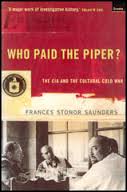
who paid the piper

Who Paid the Piper: The Cultural Cold War1

by Frances Stoner Saunders

Granta Publications (1999)


Book Review

Who Paid the Piper: The Cultural Cold War is about the covert “cultural” propaganda the CIA carried out between 1950 and 1967. The Congress for Cultural Freedom, the centerpiece of this operation, had offices in 35 countries, published over 20 magazines, held art exhibitions and provided major financial support for American artists, poets, authors and playwrights. Its primary purpose was to “nudge” the intelligentsia of Western Europe away from Marxism and communism towards a more accommodating view of US interests.

At the end of World War II, Europeans tended to view the US as “a culturally barren nation of gum chewing, Chevy driving, Dupont-sheathed Philistines.” To counteract this stigma, Truman issued an appendix to executive order NSC-4A, directing the CIA director to undertake covert psychological activities in support of American anti-Communist policies.

As Saunders details, this strategy included CIA support for both US and foreign Non-Communist Left (NCL) organizations, trade unions who agreed to weed out “dangerous radicals” and leftist intellectuals. The rationale was to create and support “parallel” organizations to provide an alternative to Communist groups over which the CIA had no control.

A strong advocate of this approach was “liberal” Kennedy adviser and biographer Arthur Schlesinger, a long time member of the Congress for Cultural Freedom. He was one of the few non non-CIA employees Congress members who knew the CIA was running it. Schlesinger also sat on the executive committee of Radio Free Europe, which the CIA set up in 1950.

Without Budgetary Limits or Oversight

Over the next two decades the CIA acted as a de facto ministry of culture, pumping millions of dollars into the Congress for Cultural Freedom. The Congress had no budgetary limits and was accountable to no one for the way they spent their money.

Via the this front organization, the CIA built the reputations of numerous American composers by funding European premiers of their work. Among the most prominent were Samuel Barber, Leonard Bernstein, George Gershwin, Menotti and Aaron Copeland.

They also financed European performances of American plays, in essence solidifying the careers of Lillian Hellman, Eugene O’Neill, Thorton Wilder, Tennessee Williams, William Saroyan, Clifford Odets, and John Steinbeck.

And paid for the European distribution of American books, by authors such as Louisa May Alcott, Faulkner, Hemingway, James Thurber, Edith Wharton, Thomas Wolfe, T.S. Eliot and socialists Norman Cousins and Carl Sandburg.

The Wall Street Families Who Started the CIA

Who Paid the Piper focuses heavily on the personalities of the men who founded the Office for Strategic Services (OSS), which in 1947 would evolve into the CIA. Nearly all were from wealthy Ivy League and Wall Street families who attended the same cocktail parties and sent their kids to the same prep schools. They automatically identified the “American way” with the privileges of their class, including a well-rounded classical education. During this period, it was fairly common for high level CIA officers to edit literary magazines, as well as publishing poetry and fiction and writing book reviews for the New York Times.

The Rise of CIA-Funded Foundations

Although Tom Braden, director of the CIA’s International Operations Division (IOD), ran the Congress, on paper it appeared to drive its funding from “pass-through” foundations. The best known foundations serving as a conduit for covert CIA funds were (are?) the Ford Foundation, the Rockefeller Foundation, the Kaplan Foundation, the Whitney Trust and the Farfield Foundation. Many of these foundations set up separate administrative units to handle CIA pass through money and collaborate with them on specific projects.

Arthur Schlesinger sat on the board of Farfield Foundation, as did William van den Heuvel, another prominent liberal close to the Kennedy family (and father of Katherine van den Heuvel editor of the “left leaning” Nation magazine).

C. D. Jackson, long time managing director of Time-Life International was another high profile Congress member.2 The Congress also assigned a full time CIA operative to Paramount pictures. His role was to edit and reject scripts that portrayed the US in an unfavorable light.

Tom Braden Goes Public

In 1966, details of the CIA role in the Congress for Cultural Freedom were leaked to the radical zine Ramparts and ended up as a New York Times expose. A few months later Braden, who left the CIA in 1956, published a confessional in the Saturday Evening Post. In “I’m Glad the CIA is Immoral,” he brags about all the reporters and trade unions on the CIA payroll when he ran the OID.

A growing body of research indicates that the CIA continues to fund the Non-Communist Left. Based on the work of Sherman Skolnick, Bob Feldman, Brian Salter and others who research the 990A tax returns of so-called “liberal” foundations, CIA pass-through foundations are clearly alive and well.

Frequently referred to as “Left Gatekeeping Foundations,” they fund numerous so-called “alternative” media outlets. This may be why the Nation, Democracy Now, FAIR and similar outlets that rely on pass-through founding categorically refuse to cover the 9-11 Truth movement or the clear government role in the assassinations of the Kennedy brothers and Martin Luther King.


1The book was published in the US under the title The Cultural Cold War: The CIA and the World of Arts and Letters. The CIA has posted a review of the US edition on website
2In 1953-54, Jackson was instrumental in establishing the Bilderberg Group. In 1963 he purchased the Zapruder film of the JFK assassination and kept it out of the public domain by locking it in a Time-Life vault for 15 years.

In the following video, liberal feminist Gloria Steinem discusses the funding she received from the CIA for her work:

Originally posted at Veterans Today

Child Marketers: a New Kind of Pedophile

Consuming Kids: the Commercialization of Childhood

Adriana Barbaro & Jeremy Earp 2008

Film Review

The Commercialization of Childhood is about the constant, insidious targeting of American children with corporate marketing.

The US is the only country in the industrialized world that refuses to regulate children’s advertising. In 1984 the Reagan administration stripped the Federal Trade Commission (FTC) of any ability to regulate any children’s advertising or programming. Starting from age three or earlier, American children are bombarded with an average of 3,000 commercial messages a day. Because children under twelve lack the critical faculties to recognize deception, this constant bombardment with pro-consumption messaging has a profoundly negative impact on their psychological development and physical health.

The Nag Factor

Most child marketing is centered around what public relations specialists call the “nag factor” – children’s ability to make their parents miserable if they don’t buy them want they want. In addition to the $40 billion kids themselves spend every year, they also influence their parents’ spending to the tune of $700 billion a year. It’s often children who determine where families spend their holidays and what kind of car, computer and cellphone aps they buy.

Children’s advertising is no longer limited to TV ads and cereal boxes but intentionally pervades every area of their lives. Many contemporary children’s programs are deliberately centered around branded products, such as Sponge Bob Square Pants and Teenage Ninja Turtles. Marketers then play on children’s identification with these toys to get their parents to buy them Sponge Bob and Teenage Ninja Turtles video games, lunch boxes, tee shirts, cookies, crackers and even macaroni and cheese.

Meanwhile financially strapped schools make extra money by displaying brand logos in hallways and auditoriums and on sports fields. Many get free computers and satellite dishes by playing Channel One informercials at the beginning of the school day.

Child Marketers are Like Pedophiles

One of the psychologists interviewed compares child marketers to pedophiles. In addition to maximizing the nag factor, children’s marketing deliberately taps into powerful developmental needs. Public relations specialists spend hundreds of hours filming children’s in supermarkets, at school and even in the bathtub. As well as organizing special focus group slumber parties to expose them to new products, they get them to join fake online social media groups. Here they can earn money and free products by providing personal information about their friends. In most cases, these activities take place without the parents’ knowledge.

This continual bombardment with corporate messaging is leading to a total remodeling of children’s psyche. One particularly alarming example is the sexualization of young girls via “tween” marketing. This is designed to heavily promotes short skirts, skimpy tops and sexy make-up and hair products to 6-12 twelve year olds. After years of this insidious brainwashing, western society is left with a staggering number of young women who think they only have worth if they’re pretty and thin and wear designer clothes. As well as an alarming increasing in anorexia nervosa, which is often fatal.

Meanwhile enticing ads for junk food and soft drinks is responsible for an epidemic of obesity, diabetes, high blood pressure and strokes – conditions that were once extremely rare in childhood.