Hacking for a Living

Internet Hackers in 2017

First Documentary (2017)

Film Review

This documentary provides a general overview of black hat, white hat and gray hat hacking. A black hat hacker hacks into government and/or corporate IT systems for criminal or political gain. At the time of filming, black hats had worked out how to hack into and disrupt high speed trains, blast furnaces, computerized SUVs and baby monitors. A white hacker hacks into corporate IT systems and alerts them to potential security vulnerabilities in return for a “bounty.”*

The private security industry is a billion dollar industry. According to the filmmakers, the US Secret Service has primary responsibility for investigating cyber crimes that threaten the security of US “financial markets.” Meanwhile the US military trains up future soldiers in the art of cyberwarfare.

The last half of the film concerns the current culture of surveillance we presently live in. For the most part, citizens of the industrialized world have traded privacy for security and convenience. In addition to ubiquitous CCTV cameras in most urban centers, Smartphones track people wherever they go. Most users are aware that Google, Facebook and AT&T spy on them and collect (and sell) their personal data but don’t seem to care.

The documentary also raises the alarm regarding the extreme vulnerability of modern computerized infrastructure to both cyber attack and natural events, such as solar storms. Solar flares nearly shut down all computerized infrastructure in 2012, 2013 and 2014. One black hat hacker interviewed by filmmakers claims it would only take him an hour to bring down the whole Internet.


*Sounds to me like a garden variety protection racket. I hate to think what happens to companies who refuse to pay the bounty.



Linux: Escaping Microsoft’s Clutches Via Open Source

The Code: The Story of Linux

Directed by Hann Puttonen (2011)

Film Review

This documentary tells the story of Finnish programmer Linus Torvolds and his creation, in 1991, of the open source operating system Linux.

In contrast to Microsoft Windows, not only is Linux be freely downloadable off the Internet, but the source code used to run it is freely available for other programmers to improve on. In the last 26 years, millions of programmers from all over the world have helped improve on Linux. As a result, Linux-based operating systems are far more reliable than Windows and Mac operating systems that profit from keeping their source code private. They are also far less prone to security flaws (such as the one Wannacry and similar ransomware prey on).

In addition to greater reliability, many Linux fans are philosophically opposed (as I am) to the practice of limiting access to software and source code to those with the ability to pay for it. This directly conflicts with World Wide Web founder Tim Berners-Lee’s vision of a free Internet access to everyone regardless of income or status.

The filmmakers maintain that Linux (as a freely downloadable operating system) represents the biggest transfer of wealth from the industrial north to the third world. Its easy access is also largely responsible for China’s impressive IT advances.

Although anyone can download Linux free from the Internet, most users prefer to access it through Red Hat and similar commercial entities specializing in installing Linux and providing technical support to its users. Linux is also the operating system of choice in home appliance computers.

Taxing Amazon and Starbucks: Seattle Passes Corporate Wealth Tax to Fund Low Income Housing

According to the The Guardian, Seattle City Council has passed a new tax that will charge large corporations $275 annually per worker to help address the city’s growing homelessness crisis.

About 60% of the tax revenue will go to new housing projects for low and middle-income Seattle residents. The remainder would go to homeless services, including shelter beds, camps and overnight parking.

Source: Tax Amazon: Seattle Passes Corporate Wealth Tax to Fund Housing

Russian Sami Organize to Fight Mining Operations

Russia’s Tundra Tale

Al Jazeera (2015)

Film Review

Free link: Russia’s Tundra Tale

This documentary concerns the battle of the indigenous Sami people of Russia’s Kola Peninsula to protect their Arctic homeland against encroachment by mining companies. The mining operations (fossil fuels, platinum, gold and aluminum) are destroying the pasture of the reindeer herds the Sami depend on for their livelihood. Unable to support their families, many have abandoned the tundra for Russian cities. Those who stayed are  organizing to preserve their collectively owned land.

Most of the political organizing is done by Sami women. To counter the Russian government, which tends to support the mining interests, the Sami have set up their own parliament in Murmansk. Sami women are also working to strengthen community solidarity in their villages.

One parliament member, a Sami woman named Sascha, is shown meeting with a potential reindeer farm more financially viable. Filmmakers also follow her to Norway, where she meets with Sami activists who employ direct action (eg a hunger strike in front of the Norwegian parliament) to force concessions from Norway’s mining industry. Linking up with Sami activists in Norway, Finland and Sweden has greatly enhanced the strengthen of Russia’s Sami movement.

Cities Take Back Power

Power to the City

VPRO (2014)

Film Review

This documentary argues for shifting major political power away from countries to cities, in part due to the current paralysis national governments face in enacting legislation and in part to the greater likelihood of bottom-up democratic participation in decisions that are made locally.

The filmmakers interview various political scientists who argue for a return to the system of city-state governance that was prevalent prior to the era of colonization.

They give three recent examples in which cities have collaborated with grassroots citizens movements to enact reforms which went on to have major national and global influence:

1. Seattle (Washington) – which in 2014 voted to enact a mandatory $15/hr living wage.

2. Eindhoven (Netherlands) – where citizens collaborated with business leaders and elected officials to create a high tech hub to replace 36,000 jobs that were lost overseas.

3. Hamburg (Germany) – which has  retained its pre-1871 city-state governance structure as a federal state within the German federation. As such, it takes on numerous functions normally performed by a national or state government – such as collecting taxes and running schools and universities. It allows its citizens to enact legislation by binding referendum, and in 2014 they voted to buy back the energy grid from a private Swedish company (to hasten its transformation to renewable energy).


Granny Fight Club: Elderly Kenyan Women Learn to Fight Off Rapists

Granny Fight Club

RT (2017)

Film Review

Granny Fight Club is an RT documentary about the self defense program in Korogocho Kenya that teaches elderly women to fend off prospective rapists.

The deliberate rape of elderly women is an increasing problem in Kenyan slums – largely due to the prevailing myth that raping a grandmother will cure a younger man of AIDS.

The women are taught a strategy that relies mainly on self-confidence and a loud aggressive voice. However they also practice delivering blows to vulnerable areas of a man’s body.

The Battle of Newbury Bypass: How Organizing and Persistence Pay Off

Tales of Resistance: the Battle of Newbury Bypass

Directed by Jamie Lowe (2016)

This inspirational video is about the massive British resistance movement that arose in the 1990s to oppose the frenetic highway building spree of Margaret Thatcher and her successor John Majors. It culminated in the Battle of the Newbury Bypass, which destroyed nine miles of pristine old growth forest to build and extension to the M3. The stand-off between tree sitters and police lasted three months. The protestors were eventually evicted and the highway built – but at immense cost to the government. By the time the protest ended, public opposition to the highway expansion scheme was so strong the government had to end it.

The documentary depicts quite elegantly the advanced technical expertise required to carry off a massive tree sitting campaign, as well as the powerful sense of community that evolved between the protestors who assembled from across the country. Surprisingly the hardest aspect of this type of direct action is boredom, ie the long wait for the police to take action.

The footage of the police and security personnel brutally removing protestors from hundreds of trees is ugly enough. The scenes of majestic hundreds of years old oaks and evergreens being felled are heart wrenching.

The BBC

The EU and the Colonization of Europe

The Forbidden Colony

Al Jazeera (2017)

Film Review

This Al Jazeera documentary examines the undemocratic nature of the European Union and it’s role in allowing banks and multinational corporations to colonize Europe. It begins by focusing on the EU Parliament, which meets in secret and bans public observation of its proceedings. Elected members of the EU Parliament lack the authority to initiate legislation. They can only rubber stamp laws proposed by the non-elected European Commission.

Croatian philosopher Srecko Horbat examines the right and left wing movements that have arisen in reaction in response to the massive economic dislocation (job loss, low wages, high housing costs) people have experienced following the creation of the EU.

The far right tends to campaign against the massive influx of migrants, which they blame for their declining standard of living. The left, in contrast, is more focused on rebuilding European democracy from the ground up.

For me, the most interesting part of the film was its examination of various European experiments in direct democracy. Examples include

  • The grassroots movements in Hamburg and 170 other German cities and towns that have bought back electric power companies from private companies to hasten their transition from fossil fuels to renewable energy.
  • Ada Colau, the radical mayor of Barcelona,* who is working to transform squats into cooperatives and forcing banks to make vacant buildings available for social housing.
  • Greece’s parallel economy, which operatives massive “no middlemen” food markets in reaction to price gouging by corporate supermarket chains.

*The capitol of Catalonia, which is organizing a popular referendum to declare independence from Spain – see Showdown in Spain

Citizens as Journalists in a Corrupt World

The Whole World is Watching celebrates the vital importance of citizen journalism (and the Internet) in a time of growing corruption and repression on the part of governments who serve corporate paymasters rather than the people they’re supposed to represent.

Highlighting growing police attacks on journalists and photographers, the filmmakers outline the laws regulating filming and taking photos in public places. In essence, a person standing on public property has an absolute right to film anything within their line of vision – provided it doesn’t violate another person’s reasonable expectation of private (eg if they’re undressing). The police are behaving unlawfully by demanding to see a photographer’s identification, deleting their photos or confiscating their photos, videos or equipment.

The documentary features Will Potter, independent journalist and author of Green is the New Red, about the ongoing US effort to criminalize environmental activists. See his blog at  Green is the New Red


How the CIA Helped Greenpeace Get Its Start

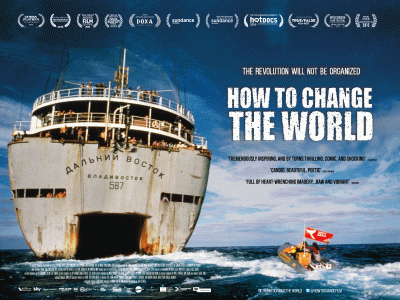
How to Change the World

Directed by Jerry Rothwell (2015)

Film Review

Māori TV showed How to Change the World last night. It relates the story of the 1971 founding of the international environmental group Greenpeace. Based on archival Greenpeace footage and retrospective interviews with its founders, the documentary makes it appear as if the organization founded itself by accident out of Vancouver’s strong anti-Vietnam war movement. During the late sixties and early seventies, the Canadian city was a magnet for young American expatriates fleeing the draft.

The accidental pairing of eco-freaks with antiwar activists in a sea protest to block a nuclear test on the Aleutian island of Amitchitka led them to coin a name – Greenpeace – representing both camps.

Bob Hunter, an environmental reporter for the Vancouver Sun, went along on that first protest in his journalistic role. When the popular uproar generated by that first protest resulted in the shutdown of the Amitchka nuclear test site, he resigned from his newspaper job to spearhead the Greenpeace Save the Whales campaign. His genius lay in creating media “mind bombs” with spectacular footage that instantly riveted popular attention.

The documentary replays the original footage from a confrontation with a Soviet whaling ship off the California coast. It’s graphically cruel and bloody and definitely unsuitable for children’s viewing.

The founders allowed the name Greenpeace to be freely borrowed by environmental groups all over the world. Which, as with most grassroots organizations, led to significant growing pains. Hunter made a number of unpopular decisions without consulting the rest of the group. One of the most contentious was his decision to accept the CIA ‘s offer of free fuel and intelligence an the location of Soviet whaling vessels.