This is What Democracy Looks Like

2014 marks the fifteenth anniversary of the Battle of Seattle, the week of protests in November-December 1999 that shut down the World Trade Organization (WTO) Third Ministerial Round. Also known as the Doha Round, the intention of these negotiations was to significantly expand the power of multinational corporations to challenge democratically enacted labor, environmental and health and safety laws.

Opening ceremonies had to be canceled on November 30, when seventy to one hundred thousand global protestors stormed downtown Seattle and hundreds of activists chained themselves to cement pipes to block delegates’ access to the Paramount Theater. The police riot which ensued was our first encounter with the police militarization that would characterize the new millennium. Rather than simply arresting them, Seattle police beat, tear gassed and shot rubber bullets at peaceful protestors, journalists and passersby alike.*

Organizing Began in January 1999

I still lived in Seattle in 1999 and participated in the local organizing. We began in January 1999 when Mike Dolan, Public Citizen’s national field organizer, called the first planning meeting at the Seattle Labor Temple. Dolan continued to visit Seattle for monthly meetings, as well as coordinating organizing efforts in Los Angeles, San Francisco, New York, Washington DC and other major US cities.

The biggest challenge in organizing the anti-WTO protest was that hardly any Americans had heard of the WTO in 1999, much less recognized the immense power Clinton was handing to private corporations with the North American Free Trade Act (NAFTA) and the Global Agreement on Tariffs and Trade, the treaty that created the WTO in 1994.

With 100,000 activists descending on Seattle, it became necessary to set up a home stay network to provide them with accommodation. I hosted seven activists in my home, two each from Los Angeles and Alaska, and three from the Mendocino County Rainforest Action Network.

The IFG Teach-In

The week started Friday night November 26, when 3,000+ of us packed into Seattle’s Symphony Hall for a two day teach-in organized by the International Forum on Globalization. World famous anti-globalization activists (including Indian anti-GMO activist Vendana Shiva, Malaysian economist and journalist Martin Khor, Canadian water activist Maude Barlow, Canadian environmentalist David Suzuki, French farmer activist Jose Bove, Ghanaian farmer activist Tete Hormeku, anti-sweatshop organizer Kevin Danaher and Owens Wiwa, brother of executed Nigerian environmental activist Ken Saro-Wiwa) each gave twenty minute presentations, followed by questions and small group discussion at the Seattle Art Museum across the street.

Maria Galaradin recorded all the presentations and has many of them archived at TUC Radio

On November 27-29, there were a series of small non-confrontational protest actions organized by specific interest groups. On November 28, I participated in a protest march to the Cargill grain elevator at the port to protest the corporate takeover of global food production by large companies such as Cargill and Monsanto. It was led by representatives of the Zapatistas, Via Campesino and the US National Family Farm Coalition.

Protest organizers had scheduled the main protest, involving fifty thousands global trade unionists and tens of thousands of farm and environmental activists for November 30, the day WTO negotiations were meant to start. We had planned three days of workshops and small localized protests for December 1-3.

Mayor Paul Schell Declares Martial Law

All this changed when Mayor Paul Schell declared martial law and made it illegal to carry anti-WTO signs, wear anti-WTO buttons, chant anti-WTO slogans or carry anti-WTO leaflets into downtown Seattle. Angered by the unprovoked police violence and suspension of our first amendment rights, organizers cancelled all previously scheduled events. Instead we held daily spontaneously organized marches into downtown Seattle – in direct defiance of Schell’s suspension of the Constitution.

Both of the videos below were produced in 2000. The first, Trade Off, by documentary filmmaker Shaya Mercer, focuses mainly on Dolan, his organizing strategy and the wide range of international organizers and groups who helped make the protest possible.

The second video This is What Democracy Looks like was produced by Seattle Independent Media Center, which would spawn the birth of the global IndyMedia network. This film focuses more on the militarized police violence against peaceful protestors and the role of the week long protests in convincing third world WTO delegates to reject the draconian demands of the US and its first world allies.

Obama Resorts to Secret Treaties

Despite numerous attempts by the Bush and Obama administrations, the Doha Round of negotiations was never revived – thanks to the staunch stance of third world delegates.

Obama’s solution has been to try to introduce the same draconian corporate protections through two secret treaties, the Transpacific Partnership Agreement (TPPA) and the Transatlantic Trade and Investment Partnership (TTIP). Negotiations for both treaties are being held in total secret. Although 600 corporations have been allowed to see (and write) the both of them, members of Congress and national parliaments are forbidden to see either treaty until they’re signed. Several sections of the TPPA draft have been leaked by Wikileaks. See New Zealand Kicks Off Global Protest Against TPPA

Obama is lobbying for fast track authority on TPPA. Under fast track, the Senate would be forced to vote the treaty up or down without debating its provisions. Congressional Democrats defeated Obama’s efforts to win fast track on TPPA earlier this year. Recently, however, the President expressed confidence a new pro-business Republican Congress will grant him this authority in 2015.


*Seattle Chief of Police Norm Stamper resigned one week after the WTO protests. He subsequently apologized, in 2009, for excessive and inappropriate use of force by Seattle police. In 2007, a federal jury ruled the city of Seattle was liable for arresting protesters without probable cause, a violation of their constitutional rights. As a result the city awarded a $1 million settlement to the 600+ activists arrested during the 1999 protests.
**The Zapatistas are a Mexican international liberation army founded in 1994 in reaction to the North American Free Trade Act (1994). They control several autonomous areas in rural Chiapas.
***Via Campesina is an international movement which coordinates peasant organizations of small and middle-scale producers, agricultural workers, rural women, and indigenous communities.
One Man, One Cow, One Planet

one man

One Man, One Cow, One Planet

by Thomas Burstyn (2007)

Film Review

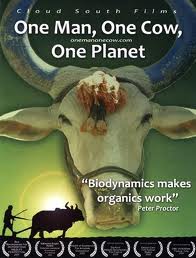
Contrary to constant corporate media propaganda, it isn’t food scarcity that causes world hunger. As Thomas Burstyn so ably demonstrates in this documentary, the four main causes of world hunger are trade liberalization, industrial agriculture, military dominance and genetic engineering.

Nowhere is this more painfully evident than in India. Industrial agriculture, cleverly branded as the Green Revolution, first hit India in the 1960s. Thanks to intense pressure from the World Bank, the International Monetary Fund (IMF) and western lenders, the Indian government sought to enter the global economic market by pressuring farmers to switch to chemically maintained monoculture crops for export.

Farmers were promised that investing in chemical fertilizers, pesticides and herbicides – as well as flood irrigation – would substantially increase their yields. It never happened. After three decades, the Green Revolution’s primary accomplishments were to render India’s soils infertile by killing off essential soil organisms, deplete their water resources and leave hundreds of thousands of rural farmers virtually destitute.

In the late 1990s, the giant multinational corporation Monsanto rode to the rescue by saturating the Indian countryside with their GMO seeds, which they guaranteed would restore yields and reduce hunger. Sadly, the yields they promised never materialized. Their supposedly pest resistant Bt cotton was supposed to reduce farmers’ need for pesticide. However owing to its failure to control India’s main cotton pest, the pink boll worm, it required even more pesticide than natural cotton.

Yields were never enough to cover the purchase of new seed every year, along with chemical fertilizers, pesticides and herbicides. Farmers merely sank deeper and deeper into debt and hundreds of thousands committed suicide.

Enter Peter Proctor

Over the past five decades, New Zealander Peter Proctor, has been instrumental in reversing this trend, by helping to establish an Indian food sovereignty network based on biodynamic agriculture. The basic principle of food sovereignty is that people, rather than corporations and governments, have a natural right to control what they grow and what they eat.

Proctor is considered the modern father of biodynamic farming. The latter is an approach to organic farming first started a hundred years ago by Rudolph Steiner, and Austrian philosopher, social reformer and architect. It shares many features in common with permaculture (see Roadmap to Redesigning Civilization) and biointensive agriculture (see Farming Without Machines).

Cow dung and compost, which form the humus essential to soil fertility, are cornerstones of biodynamic agriculture. In general, Indian farmers are more receptive than westerners to biodynamic methods, as they share the same reverence for cow dung as Steiner, Proctor and other biodynamic practitioners.

Proctor and his followers rely on Steiner’s original ritualistic practices (based on planetary forces) in preparing the dung, which inoculates the soil with essential soil organisms. They also religiously follow the moon planting cycles advocated by Steiner.

Pest Control in Biodynamic Agriculture

Pest control is far easier with biodynamic methods. Healthy soil is the most important pest deterrent, as pests are far less likely to attack healthy plants. Replacing monoculture crops with diversified and companion planting also greatly reduces pest infestation. Other pest control methods include liquid manure, ground quartz (silica)*, and biological deterrents (eg ladybugs).

Environmental and Economic Sustainability

In addition to strengthening the social fabric of India’s rural communities, the food sovereignty network Proctor helped to start has improved their economic sustainability. By saving and sharing seed, cow dung and compost, they reduce the cost of their inputs to zero and cut their water requirement by 50% (humus increases the water retention capacity of soil).

In addition to substantially higher yields, organic produce sells for a slightly higher price in India due to its health benefits.

With their improved economic standing, many of India’s biodynamic farmers can afford school fees and are sending their children to school for the first time.

My favorite part of the film is where Proctor’s wife blames the horrible decisions politicians make on the crap food they eat.

The film has been removed from YouTube for copyright reasons but can be rented from Amazon for $1.99 at this link: One Man, One Cow, One Planet

The stunning Indian scenery alone is well worth the price.


*Also known as diatomaceous earth, silica destroys pests by cutting them up with its microscopic razor sharp edges.

Capitalism Works for Me – True or False?

Capitalism Works for Me is a public art exhibit Steve Lambert created in 2011. It’s been touring internationally for the last three years. The first video is a brief cameo of the Capitalism Works for Me exhibit in Times Square.

In the second video, Lambert discusses his inspiration for the project, Slovenian philosopher Slavoj Žižek’s observation that people find it easier to contemplate the end of human existence than the end of capitalism.

Lambert also talks about the erroneous tendency to equate capitalism and civilization and the false assumption that ending capitalism is comparable to ending civilization.

He hopes Capitalism Works for Me will help to challenge this assumption.


Vote now:

Vermont Excludes Insurance Companies from Health Care

single payer

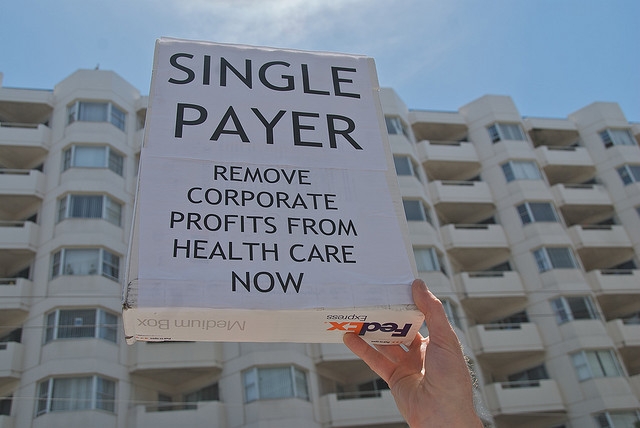
In 2011, the Vermont legislature enacted Act 48, which replaces private health insurance with a state-funded health care plan covering all Vermont residents. Governor Peter Shumlin, concerned about major flaws in Obamacare, made Green Mountain Care, the centerpiece of his 2010 gubernatorial campaign. In Vermont, as in the rest of the industrialized world, health care is viewed as a basic human right. Green Mountain Care is slated to become operational in 2017.

Like a growing number of Americans, Schumlin feels Obama’s Affordable Health Care Act (ACA) is financially unworkable. Instead of eliminating private insurance companies that suck out  25-33% of every health care dollar for profit and administrative expense* – it guarantees them generous government subsidies.

The US is the only country in the world which allows for-profit insurance companies to insert themselves into the doctor-patient relationship by dictating the types and amount of treatment that will be allowed. Because they allow insurance and drug companies to transform health care into a profit-making commodity, Americans pay twice as much for health care than any other country. Meanwhile they enjoy much poorer health than most of the industrialized world.

In part due to skyrocketing insurance costs under Obamacare (premiums for young adults have nearly doubled), millions of low income Americans remain uninsured. The Congressional Budget estimates that 36 million people will be uninsured in 2015, 30 million in 2016 and 31 million in 2024.

Meanwhile all Americans find the private insurance plans they are required to to buy, under penalty of law, cover far less than Obama originally promised. With the high cost of premiums, deductibles and copayments, they pay more and more of their health care bill themselves.  It doesn’t help that insurance companies are extremely devious about what they do and don’t cover. As many doctors and patients are discovering, the default setting for many health plans is to deny payment.

Green Mountain Care

In 2011 Harvard economist William Hsaio estimated that removing private insurance companies from the health care equation, as stipulated under Vermont’s Act 48, would save $4.3 billion over four years – enough to cover the uninsured, offer better coverage than insurance companies and still have more than a billion dollars left over.

Under Green Mountain Care, a combination of income and payroll taxes (details to be released in January 2015) will replace the $1.9 billion in health insurance premiums Vermonters currently pay. Residents covered by federal plans, such as Medicare, Medicaid, the VA and programs for active duty military personnel would continue to receive coverage through those plans. However, for the sake of administrative efficiency, both Medicare and Medicaid would be streamlined into Green Mountain Care’s unified claims administrative system.

Vermont would be the first state to guarantee health coverage for all its residents, regardless of income. As Michael Ollove notes in Vermont is Single Payer Trailblazer, they were also the first state to constitutionally ban slavery and mandate public funding for universal education, the first to introduce civil unions for same-sex couples and the first to allow gay marriage.


*Obscene CEO salaries figure prominently in this “administrative” expense. In 2013 the CEOs of the 11 largest for-profit insurance companies received compensation packages totaling more than $125 million.

photo credit: Steve Rhodes via photopin cc

The Dream of a Stateless Society

Engines of Domination
(2014)

Film Review

In Engines of Domination, filmmaker Justin Jezewski and author Mark Corske lay out a historical and philosophical argument for anarchism – a stateless society people run themselves via direct democracy.

They begin by comparing class society to sheep herding. The latter began around 10,000 BC. Class society began around 5,000 BC when institutions of power (initially kings and priests and later nations and corporations) began domesticating people as well as plants and animals. The goal of this kind of domestication is to capture the energy of an entire community. Initially chattel slavery was the primary mechanism employed to domesticate human beings.

Since no one agrees voluntarily to being treated this way, this has to be done through a combination of force and deception.  The methods employed were developed over centuries through a process of trial and error. “Engines of domination” are the historical institutions that make this domination possible and which keep it in place.

Land Confiscation

The process begins with the confiscation of communal land by force (this happened to Europeans via the Enclosure Acts between 1500 and 1850), forcing the inhabitants to work for the ruling elite by depriving them of the ability to feed themselves. In Corske’s view, this denial of life support is a fundamental act of violence.

Maintaining control of confiscated land requires a command structure, i.e. a monarchy or its equivalent, the rule of law and weapons. Without weapons, domination over other human beings is impossible. Finally the ruling elite creates upper and ruling classes and provides them a range of privileges for keeping the working class in line.

Deception and Thought Control

This is the true structure of modern society. However it has to be concealed via deception and thought control. The working class vastly outnumbers the elite, and human beings would never submit to forced labor voluntarily. Prior to 200 years ago, this thought control was disseminated via state religion (it still is in Israel and Muslim countries). In so-called western democracies, it’s disseminated via compulsory public education and the mass media.

Replacing the Engines of Domination with the Engines of Liberation

At present, the very biosphere that supports human life is being destroyed by a ruling elite whose sole focus is to amass more wealth. The only way to halt this ecological destruction, according to Corske , is to abolish political power, central authority and the institutions that support it. The engines of domination must be replaced by engines of liberation. This may seem like an impossible task, but this is because we are all conditioned to accept our captivity, much like domesticated animals who stay in the cage or pasture even when the door or gate is opened.

Corske believes we must employ the same trial and error process to walk back the layers of institutional domination that enslave us. Although the ruling elite is intensively organized, we have both superior numbers and human nature on our side. Contrary to contemporary mythology, human beings are basically freedom loving and incline towards cooperation rather than violence towards our fellow human beings.

Building a mass movement to take advantage of our superior numbers is essential. Corske feels the best way to do this is to organize for specific reforms with the ultimate goal of abolishing central authority.

This short documentary is based on Mark Corske’s book Engines of Domination, published in 2013.

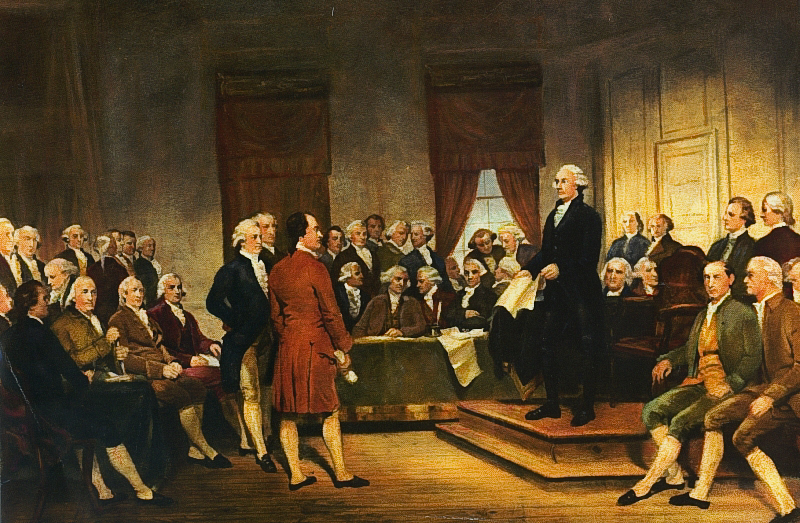
The Case for An Article V Convention

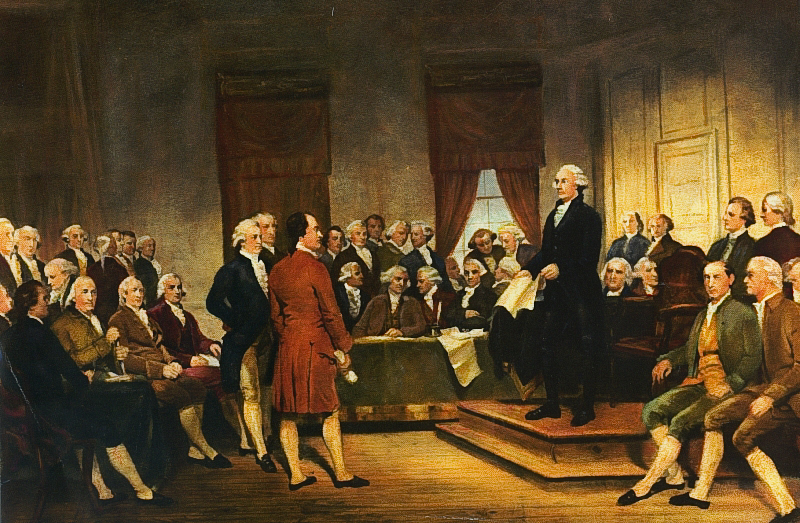
Washington_Constitutional_Convention_1787


Guest post by John de Herrera

Today, as happens once or twice a week, a blog post or news item appears on the Internet examining the Article V Convention. Below it are the same comments Americans have been making about a convention for over half a century: that it’s dangerous, that with the way politics are played today such an assembly would be nothing more than an exercise in special interests gutting protections originally put in place of, by, and for the people.

Many today understand the necessity for our society to build consensus about what’s wrong (in order to do something about it), but few understand the function and utility of a convention. Nothing stays perfect forever, politics are dynamic, things change, and a scan of political sites makes clear consensus is that governance is off track. The question is, how do we address it?

A quick read of Article V (a single sentence) shows that upon the application of 2/3 of the states Congress shall call “a convention for proposing amendments….”The leading national group Friends of the Article V Convention has done an audit of Congressional Records (themselves part of the Constitution, as the Constitution mandates that both houses keep records). They show that not only have 34 states cast the requisite number of applications to initiate the call, but indeed 49 have cast over 750 applications.

In other words the states have satisfied the clause. Congress simply ignores its obligation to count them, all the while two or three new ones arrive each new session.

The reason the 113th Congress is allowed to disobey the law is because the people are unaware and/or fear a convention. So long as this state of affairs exists, Congress can simply ignore the record while looking busy with a bunch of partisan and divisive nonsense, i.e. politics as usual.

90% Disapprove of Congress

What’s more powerful, the right to complain about government, or the right to reform it? Clearly one right is more powerful. Indeed it’s the right that makes an American citizen who and what they are – a member of a society with the power to alter or abolish what it dislikes about government. You’ll find very few Americans who want to abolish government, the three branches – legislative, executive, and judicial. No, the vast majority want to keep what we have, but address how it currently operates.

Opinion polls show that 90%+ of Americans disapprove of Congress, a statistic that’s been trending for over a decade. When the institution established to represent the will of the People is disapproved by 90%, it’s self-evident it’s time for them to exercise their right to alter what they dislike. History teaches that if not, forces of corruption will alter it against our wishes, and some argue that’s already occurring due to corporations acting as citizens. This status quo of politics has resulted in government drowned in private money, where laws/loopholes go to the highest bidders, written by lobbyists, signed off on by members of Congress, and disliked by the People.

The Provisions of Article V

In the event Congress becomes unresponsive to the needs of the people a convention of the states considers amendment proposals. Proposals voted up by 2/3 of state delegations are then sent back to the people at large for ratification by 3/4. In other words, the functions of proposal and ratification are two separate functions. The fear of a convention comes from the perception that proposal and ratification are both done at the convention, when the former is done by delegates, and the latter by the people.

Seventy-five percent of Americans today are not going to suggest we chuck the Constitution and try to start over. But they are highly like to support the reversal of Supreme Court doctrines regarding speech and personhood, even, perhaps, public financing of elections.

Forcing Congress to Act

There are a number of things about American history that politicians do not talk about, not because they don’t want to, but because they can’t, but because doing so would alter how we citizens see and think about our government. On the flip side, if enough of us become cognizant and desirous of reform, politicians will have no choice but to comply.

A paper put out by the Congressional Research Service (subsequently updated multiple times, most recently April 2014) says as much about the Article V Convention – that if enough Americans want it Congress will have to call one. That the paper has been updated since it was first delivered to Congress is significant: it means there is movement in the halls of power. Congress may not be talking about it, but they are clearly aware of growing interest in Article V. And the negative and false myths surrounding it.

American Citizen or Global Citizen

Even if you’re not American, it’s important to understand and educate yourself about this issue. Unless we start talking about a different Earth, a different global order, a different USA, and a different Constitution, there is no other way out for humanity. In this sense, an Article V Convention is unique. Once called, it sets off a natural progression of events that will deliver us from the inevitable catastrophe of corporate governance.

How’s that? Because a convention allows for humans to find common ground past the gridlock of corporate politicians. Believe it or not, the vast majority want to throw off this long train of abuse and ecological negligence. Everyone has an idea of what changes are necessary. Yet until we all come to the table, nobody is going anywhere.

It’s time to raise consciousness. It’s time for non-Americans call on Americans to exercise their right to a convention; it’s time Americans call on Congress to count the applications on record. Until the count is made nothing can happen. We don’t have all the time in the world to make it so.

Congressional Research Service: http://www.fas.org/sgp/crs/misc/R42592.pdf

Friends of the Article V Convention: http://www.foavc.org

John De Herrera is a writer/artist/activist who lives and works in Santa Barbara, California. He is a former founding member of Friends of the Article Five Convention. You can email him at john@alipes.org.

Photo credit Wikimedia Commons

America’s Fukushima?


 diablocanyon

Bye Bye California

Whistleblower Michael Peck, a senior member of the Nuclear Regulatory Commission (NRC), is calling for the Diablo Canyon nuclear reactor to be shut down — pending an assessment of its ability to withstand a major earthquake. Peck, who was Diablo Canyon’s lead inspector for five years, asserts the NRC isn’t applying its own safety rules for the plant’s operation. Unlike other federal whistleblowers, who Obama and the FBI are busy locking up, Peck is participating in an NRC review process that permits employees to appeal a superior’s ruling.

Located on the Pacific Coast halfway between Los Angeles and San Francisco, Diablo Canyon is California’s last nuclear power plant. It’s located adjacent to four seismic faults, the Shoreline, Hosgri, Los Oso and San Luis Bay. The Shoreline fault was only recently discovered; the Hosgri, located three miles from the plant, is the largest and most dangerous. It was discovered in the 1970s, after construction on Diablo Canyon was nearly complete. According to Peck, a 2011 Pacific Gas and Electric (PG& E) seismic study indicates all four faults are capable of producing significantly more “peak ground acceleration” (75% more in the case of San Luis Bay) than previously believed.

Citing these findings, Peck concludes that Diablo Canyon, based on the NRC’s own safety standards, lacks justification to continue operating. He’s asking the NRC to shut it down until PG&E can demonstrate that its piping, cooling and other systems can withstand higher stress levels than called for in its original design.

In 2012 when the NRC ruled Diablo Canyon could continue operating without reassessing its seismic safety, Peck filed a formal objection. In it he called for PG&E to be cited for violating safety standards. When his supervisors overruled him, he filed a second objection, triggering the current review.

Dave Lockbaum, from Union of Concerned Scientists, supports Peck’s position. He has researched four decades of records when the NRC, and its predecessor the Atomic Energy Commission (AEC), faced similar situations. In all prior cases, the NRC/AEC disallowed nuclear facilities to operate with similar unresolved earthquake protection issues. For example, in March 1979—two weeks prior to the Three Mile Island accident—the NRC ordered a handful of nuclear power reactors to shut down and remain shut down until earthquake analysis and protection concerns were corrected.

Diablo Canyon Up for Re-licensing

Diablo Canyon is currently licensed to operate until 2025. In 2009, PG&E applied for a 20 year license extension. The re-licensing process was suspended immediately following the 2011 Fukushima disaster. Japan’s magnitude 8.9 earthquake, which was far larger than believed possible, knocked out Fukushima’s power and cooling systems, causing three core meltdowns. This led the NRC to require US nuclear power plants to re-evaluate seismic risks. These reports are due by March 2015.

Friends of the Earth has petitioned the NRC  to intervene in the Diablo Canyon’s re-licensing proceedings.

According to FOE senior adviser Damon Moglen of Friends of the Earth: “It’s now clear that Diablo Canyon could never get a license to be built at its current Central Coast site. The NRC must consider this seismic data as part of public licensing hearings.”

A Question of Magnitude

Predictably PGE, via their spokesperson Blair Jones, disagrees. Jones maintains the NRC has “exhaustively analyzed” earthquake threats for Diablo Canyon and demonstrated it’s seismically safe. According to Jones, the core issue involving earthquake ground motions was resolved forty years ago with seismic retrofitting (Diablo Canyon was originally designed to withstand a 6.75 earthquake – with the upgrade it can supposedly withstand a 7.5 earthquake). The obvious assumption being that none of the four faults surround Diablo Canyon could cause a 7.6 magnitude or higher earthquake.

PG&E’s position is understandable, as nuclear power plants aren’t cost effective to begin with. They only become profitable with massive taxpayer subsidies. If the NRC requires quire them to retrofit Diablo Canyon to current earthquake standards, a permanent shutdown is highly likely. In 1976, the Humbolt Bay nuclear power plant in northern California, which was within 3,000 yards of three faults, was shut down to reinforce its ability to withstand possible earthquakes. Retrofitting it became more difficult and costly than projected and it never re-opened.

Our Non-regulating Regulatory Agencies

A Fukushima-style earthquake and meltdown at Diablo Canyon could wipe out agriculture in California and parts of the Midwest for centuries. Yet like many federal regulatory agencies, the NRC is more concerned about protecting PG&E’s bottom line than the health, safety and food security of the American public.

Michael Peck, who holds a doctorate in nuclear engineering is presently a senior instructor at NRC’s Technical Training Center in Tennessee.

photo credit: NRCgov via photopin cc

The Social Change Movement is Larger than You Think

blessed unrest

Blessed Unrest: How the Largest Social Movement in History is Restoring Grace, Justice, and Beauty to the World

Paul Hawken
Google Authors (2007)

Film Review

In the following video, social entrepreneur Paul Hawken discusses Blessed Unrest, his book about trying to count the millions of local social change groups around the world. After several years of research, he concluded there were 1-2 million of them. They involve 100-200 million people and focus around three broad categories: social justice, human rights and ecological restoration. What they all have in common are their efforts to disperse a pathological concentration of power in a wealthy elite.

Hawken asserts this massive movement is virtually invisible because it’s solution-focused, rather than ideological. We’re accustomed to movements in which a charismatic white male leader founds a centrally-based organization and endeavors to expand it outwards to the grassroots. The movement Hawken refers started as small widely dispersed independent groups which are beginning to coalesce into networks.

He believes this diverse non-centralized movement had its origins in the anti-slavery movement. The past 1,000 years, in Hawken’s view, has been dominated by a system in which political power is based on privilege. With the abolitionist movement, which started as small local groups in England and the US, society began moving towards a system in which political power is based on community.

The high point of the video is where he scrolls through a screen shot listing the millions of groups. He asserts it would take more than four weeks to read through them all.

He predicted the number of social change groups, which is growing fast, would reach five million by 2013.

The Illusion of Technique

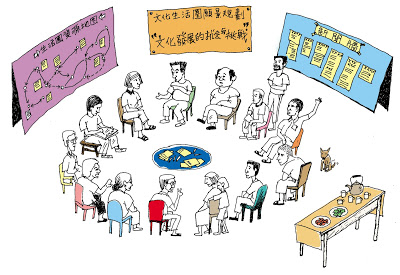
OST_meetingAn OST Meeting

Community: The Structure of Belonging

By Peter Brock

Berret-Koehler Publishers, Inc (2008)

Book Review – Part II

By focusing on six essential “conversations,”* Brock is extremely prescriptive in his approach to forming groups. He seems to believe this artificial structure is necessary to keep the group from replicating patriarchal patterns in broader society. Based on 33+ years of grassroots organizing, I disagree. Provided they are properly facilitated, I have a lot of confidence in the ability of small groups to evolve spontaneously without replicating what happens in a corporate boardroom. I’m also extremely fed up with liberal academics and their obsession with technique.

In my mind, the artificial structure Brock imposes is counterproductive. Despite claiming to erase artificial distinctions between group leaders and members, he does the exact opposite. He gives group leaders immense power by setting up an expectation they will pose questions and members will answer them. I also see a risk – given the intrusive nature of the questions – that the community group will become a therapy group.

He justifies the need for a “possibility conversation” to prevent groups from focusing on about problems and complaints – which he feels causes them to behave like corporate boards and start setting up visions, goals and targets. Based on 30+ years of organizing of experience, I can guarantee this behavior isn’t automatic – not if there are working class people in the room.

He argues that the “ownership conversation” is designed to keep the group conversation focused inside the room. He maintains too many community groups focus on issues and people outside the room, which he claims are beyond beyond their control.

Again I strongly disagree. Most of the community groups I’ve worked with have (very successfully) focused on external problems, such as blocking the construction of an LNG (liquid national gas) terminal at Port Taranaki and forcing our local council to remove the fluoride from our drinking water. As far as I’m concerned, Brock’s “ownership conversation” is just a new twist on neoconservative ideological propaganda linking “rights” with “responsibilities” and “freedom” with “accountability.” In my view, the only way to win rights and freedom is by fighting for them – all the media hype linking rights and freedom to responsibility and accountability is designed to conceal this reality.

Personally, I much prefer Open Space Technology (OST), an older more established approach to creating self-organized groups. In OST, the facilitator’s role is strictly limited to a type of facilitation in which they “hold a space” for participants to self-organize, rather than managing or directing the conversations.**

I have to give Brock credit for using the “dissent conversation” to circumvent the strong tendency of self-organized groups to punish dissent. Despite some strong reservations about the intrusive nature of some of the questions, I feel the “dissent conversation” is the most valuable aspect of his approach. This has always been one of the main drawback of OST: its tendency to reward consensus and punish dissent.


*Brock’s six conversations include the “invitation” and the possibility, ownership, dissent, commitment and gift conversations. Each of the five conversations is presented as a series of questions.

1. The invitation names the possibility (eg The Possibility of a Safe Cincinnati) which is the reason for convening the group. It deliberately refrains from advocating for a particular issue or viewpoint and tries to bring people into the same room that don’t normally associate together.

2. The possibility conversation asks the following questions

  • What is the crossroads where you find yourself at this stage of your life or work or in the project around which we are assembled?
  • What declaration of possibility can you make that has the power to transform the community and inspire you?

3. The ownership conversation asks:

  • •How valuable an experience (or project or community) do you plan for this to be?
  • How much risk are you willing to take?
  • How much do you plan to participate?
  • To what extent are you invested of the well-being of the whole?
  • What I have I done to contribute to the very thing I complain about or want to change.
  • What is the story about this community or organization that you hear yourself telling the most often?
  • What are the payoffs you receive from holding on to this story?
  • What is your attachment to this story costing you?

4. The dissent conversation asks

  • What doubts and reservations do you have?
  • What is the no or refusal that you keep postponing
  • What have you said yes to that you no longer mean?
  • What resentment do you hold that no one knows about?
  • What forgiveness are you withholding?

5. The commitment conversation asks

  • What promises am I willing to make?
  • What measures have meaning to me?
  • What price am I willing to pay?
  • What is the cost to others for me to keep my commitments or to fail in my commitments?
  • What is the promise I’m willing to make that constitutes a risk or major shift for me?

6. The gift conversation asks:

  • What is the gift you still hold back?
  • What is something about you that no one knows?
  • What gratitude do you hold that has gone unexpressed?
  • What have others in this room done, in this gathering, that has touched you.

**OST is similar to Brock’s approach in that 1) it starts with a broad, open invitation articulating the purpose of the meeting 2) participants sit in a circle and 3) it places heavy emphasis on small group work. However in OST members set the agenda themselves by proposing a bulletin board of issues and moving into small groups to develop these issues through further discussion.

photo credit: Askavusa Open Space Technology (follow link to learn more about OST)

How Communities Awaken

community

Community: The Structure of Belonging

By Peter Brock

Berret-Koehler Publishers, Inc (2008)

Book Review – Part I

“How Communities Awaken” is the title of a master class I’m taking through a local Maori social services agency. Our main textbook is Peter Brock’s Community: The Structure of Belonging. We meet every two weeks to do small group work around six “conversations” Brock prescribes as essential to transforming fragmented communities.

Peter Brock is one of a growing number of community strategists dedicated to reducing alienation and apathy by getting people more involved in their communities. In Community: the Structure of Belonging, he maintains that 1) our collective loss of power in contemporary society is a direct result of the breakdown of our communities, 2) the only way to regain this power is to restore citizen engagement in community life and 3) most groups and agencies designed to relive “political suffering” (i.e. poverty, inequality, unemployment and the multiple crises involving housing, education transportation, drug abuse, binge drinking, family violence and at-risk youth) fail because they buy into the patriarchal consumer model imposed on us by wider society.

Brock asserts that the consumer society causes most people to see themselves as passive consumers rather than engaged citizens – that this causes them to see their political and community leaders as delivering a product, with their own role limited to critiquing the product. The purpose of this book is to lay out specific strategies to lift us out of our role as passive consumers of government.

While I partially agree with premises two and three, I totally disagree with premise one. I find to hard to ignore substantial evidence that Wall Street Banksters, the Koch brothers, the Walton family (who own WalMart) and other corporate players have colluded to deliberately strip us of this power. Brock makes absolutely no mention of this. In fact, he dismisses activists who complain about “external” causes of powerlessness as playing the “blame game,” which he describes as a “delightful escape from the unbearable burden of being accountable.”*

I‘m also concerned by his glaring omission of the role the corporate public relations industry plays in constantly bombarding us with fearful, competitive, individualistic and pro-consumption messaging (see The Science of Thought Control).

In my view, this constant barrage of propaganda and disinformation – and the pernicious passivity and apathy resulting from it – is the main obstacle we face to organizing against corporate fascism. That being said, I strongly agree with Brock’s view that the only way to overcome this passivity and apathy is by re-engaging in the community groups and activities – both political and non-political – that our parents and grandparents enjoyed.

I haven’t found New Zealand that much different than the US in this regard. Although there are huge advantages to not living in a military empire (see The Sacrifices of Empire), most New Zealanders seem to be trapped in the same cycle of consumption, debt and overwork. Like Americans, they are depressed, anxious, apathetic and disengaged from community life and the political process. Voluntarism has declined steeply, particularly among young people, and a growing number of Kiwis don’t vote.**


*Turnout remains much better here than in the US. In NZ 77% is considered a poor turnout. In the US 60% is considered a good turnout.
** Brock’s equally dismissive of organized protest and “speaking truth to power,” which he belittles as a “complaint session in evening clothes.” He adds, “Any time we act in reaction, even to evil, we are giving power to what we are in reaction to.” I can agree that it’s more effective to focus on building positive institutions than reacting to negative ones. However we are all trained, as part of our indoctrination, to blame ourselves if for our personal, social and financial failures. The only way I know to get people to quit blaming themselves for the misery they experience in corporate society is to demonstrate that their so-called “personal” problems have a social and political cause.
To be continued with a critique of the specific strategies Brock proposes.