Are Women Better at Getting Out of Poverty?

Solar Mamas: Why Poverty? (2012)

Directed by Mona Eldaief and Nehane Nonjaim

Film Review

Solar Mamas is about the Barefoot College in Rajastan India and the struggles of a Jordanian woman to overcome the sexist attitudes of her husband and other men in her Bedouin village.

The Barefoot College is a non-governmental organization which has training rural women from the developing world to become solar engineers since 1997. The program serves the dual purpose of electrifying poor rural villages and helping these villages out of poverty. After completing a six month training program, the women return to their home countries to train other women in solar installation.

The documentary concerns the first two women selected by the Jordanian Minister of the Environment to attend the Barefoot College. The women come from a village of 300 where all the adults are “unemployed” and the women do all the work (collecting firewood, doing laundry, cooking, cleaning and looking after children). Women with young children receive welfare benefits, which is why the Jordanian government is keen to subsidize their attendance at the Barefoot College.

As the Jordanian women speak no English, their training is based on hands-on assembly experience, aided by a book of color-coded circuit diagrams. Both women are illiterate, as it’s considered shame for Bedouin girls to remain in school past age ten.

Are Women Better at Getting Out of Poverty?

The film focuses on the younger of the two women, who’s forced to discontinue her training after her husband threatens to divorce her and take her children away. Rafea’s mother is caring for her four children during her absence. The husband threatens to take them to another village to be raised by his first wife (he has two).

Rafea returns, tearfully. A month later, despite her mother’s opposition and continuing threats from her husband, she overcomes her fear of her husband and returns to India to complete her solar training.

Towards the end of the film, the Minister of the Environment explains why the Jordanian government only selects women for solar training: they can’t count on men (who often have other wives) to remain in their home village.

If Rafea’s village is anything to go by, I suspect the real reason is that the women develop a stronger worth ethic in looking after their children. The men, in contrast, are bone idle and lay around on mattresses all day.

Below is a presentation by Bunker Roy, founder of the Barefoot College, about its history:
Latin America: Wall Street’s Worse Nightmare

Eyes Wide Open: A Journey Through Today’s South America

Pascal Dupont (2009)

Spanish with English subtitles

Film Review

Eyes Wide Open was intended as a sequel to the late (deceased April 13, 2015) Eduardo Galeano’s 1973 book Open Veins of Latin America: Five Centuries of the Pillage of a Continent. It was Galeano’s book that former Venezuelan president Hugo Chavez presented to newly elected president Barack Obama in 2009. According to Galeano, the entire history of Latin American is based on the stripping of the continent’s resources by Europe and the US. It started with gold and silver, followed by tin, copper, rubber, sugar, salt peter, cocoa, coffee, guano and bananas. This grotesque asset stripping was accomplished mainly through the brutal suppression and exploitation of its (majority) indigenous population.

Eyes Wide Open mainly concerns Latin America’s rejection of US neoliberalism and neo-colonialism, with the recent election of “leftist” leaders in eight countries (Brazil, Ecuador, Venezuela, Bolivia, Paraguay, Argentina, Chile and Uruguay). The filmmakers visit four of them (Brazil, Bolivia, Venezuela and Ecuador), to ascertain whether their new presidents have kept their promise to bring about true economic democracy. Interviews with grassroots leaders are interspersed with with a variety of media footage and commentary by Galeano.

The documentary also discusses the Bolivarian Alliance of the America’s the eight countries formed and its defeat, in 2005, of the Free Trade of the Americas treaty George W Bush tried to foist on them.

Lula Sells Out to Cargill

The filmmakers are highly critical of former Brazilian president Luiz Inácio Lula da Silva (Lula) for reneging on his promise to redistribute elite land holdings to landless peasants. Instead he sold out to the giant agrobusiness Cargill, authorizing generous government subsidies to help them establish vast GMO soy plantations in Brazil’s Amazon basin.

Evo Nationalizes Bolivia’s Oil and Gas Industry

Bolivia’s first indigenous president Evo Morales, who came to power in 2006 as a direct result of Bolivia’s water wars,* has a far better track record. The documentary details his decision to nationalize Bolivia’s oil and gas industry and use the income to fund government pensions for the elderly, free education and safer working conditions for Bolivian tin miners. Evo also re-nationalized the tin mines, which had been privatized, and rehired all the miners who had been laid off.

Multinational oil companies (mainly Exxon, Shell and Total) owned 60% of Bolivia’s fossil fuel industry, and the US ambassador (ie CIA) colluded with the Bolivian opposition to block Evo’s land reforms in the rich eastern provinces. In 2008, provincial police gunned down a peaceful peasant protest demanding the land they had been promised. Evo responded by expelling the US ambassador.

Bureaucracy and Corruption in Venezuela

The segment on Venezuela begins with the massive popular protest that defeated the attempted US coup against Chavez in 2002. It also includes a lengthy segment on Chavez’s housing reforms, profiling one of the female housing activists he put in charge of overseeing the replacement of a barrio full of tin shacks with a modern apartment complex.

Venezuela’s land reform efforts weren’t nearly as successful as Bolivia’s, which filmmakers blame on bureaucracy and corruption within the Chavez government.

Constituent Assembly Writes New Constitution in Ecuador

Ecuador’s president Rafael Correa is presented in a much more favorable light. Eyes Wide Open focuses mainly on his decision to call a constituent assembly to write a new constitution. The latter would recognize, for the first time, the multiracial, multiethnic and multicultural basis of Ecuadorean society. This new constitution would also be the first in the world to recognize the rights of nature.


*Bolivia’s water wars were a series of protests that took place in Cochabamba, Bolivia in 1999-2000, over the privatization (resulting in massive price hikes) of the city’s municipal water supply. In 2003-2005, similar protests broke out over the privatization of Bolivia’s natural gas supply. The protests eventually led President Sánchez de Lozada to step down and flee to Miami.

Living the Revolution

Solidarity4All (S4A) co-founder Christos Giovanopoulos is presently touring the US in his effort to grow the international solidarity movement supporting Greek workers. S4A is a collective that facilitates the development of grassroots solidarity structures emerging in response to the humanitarian crisis caused by Greece’s deep austerity cuts. It grew out of the Greek Indignados movement that formed alongside the Spanish Indignados* movement in July 2011. Both would serve to inspire the international Occupy movement that first formed on Wall Street in September 2011.

As of January 2015, there were self-governing 360 solidarity structures, representing 30% of the Greek population. The list includes social pharmacies, social medical clinics, social kitchens, social grocery stores, time banks,* a social collective of mental professionals, olive oil producers who share olive oil and the “potato movement,” where farmers cut out supermarkets and middlemen by trading directly with consumers.

All initiatives are non-hierarchical and hold weekly assemblies where decisions are made. The role of S4A is to serve as a centralized network for information, tools, and skills sharing and to build an international solidarity movement to support Greek workers and to inspire similar grassroots self-governing structures in other countries.

Although most S4A members support the left-wing party Syriza, the two are totally separate organizations. S4A chiefly derives its power from its ability to provide humanitarian services can’t deliver due to the Greek financial crisis. Nevertheless Syriza directly supports S4A by requiring each of their MPs (members of parliament) to donate 10% of their salary.

An International Movement

Already hundreds of international trade unions, community, environmental and immigration groups have signed on to the Solidarity4All movement. Ironically most are in Germany, whose government has been the most staunch in forcing debt repayments and austerity cuts on the Greek people. At present Giovanopoulos is seeking to build S4A chapters in New York, Seattle, Chicago, San Francisco, Oakland and Baltimore.

In the following video, Giovanopoulos speaks to the importance of a strong grassroots movement to counteract the pressure the EU and IMF are putting on Syriza. This is especially urgent owing to the inability of the current Greek government to address the humanitarian crisis. Thanks to Solidarity4All, the immediate needs of workers continue to be addressed. If a Grexit does occur, this will also provide a framework for Greece to look after itself – instead of relying on foreign funders.

For more information, check out the English S4A website at Greece Solidarity

Individuals and groups can join S4A at Join us


*Los Indignados is a grassroots Spanish anti-austerity movement that first captured public attention in July 2011 through massive demonstrations in which they occupied public squares and spaces. An estimated 6.5– 8 million Spaniards have participated in these events.
**A time bank is a mutual credit system in which members earn credits for helping other members and spend them for other services.
***Syriza is a left wing political party that came to power in January 2015 based on a pledge to end the austerity cuts forced on Greece (as a condition of further bailout funds) by the European Central Bank and the International Monetary Fund (IMF).
****Grexit refers to the potential exit of Greece from the eurozone monetary union, owing to its inability to repay its public debt.

Bernie Sanders Introduces Robin Hood Tax

bernie sanders

On May 19th presidential candidate Bernie Sanders joined with National Nurses United (NNU) and the US Students Association to announce his introduction of two Senate bills, the Robin Hood Tax and the College for All Act.

The Robin Hood Tax, a type of financial transaction tax, would enact a 0.5 percent tax on most stock transactions, and a lesser tax on bond and derivative trades. The Robin Hood Tax would raise about $300 billion per year. Sanders, NNU and the Students Association propose using these funds to provide free tuition at every public college and university in the United States and to slash interest rates on existing student loans.

The College for All Act would eliminate undergraduate tuition by requiring the federal government to cover 67% of college costs ($47 billion each year) and states to cover the remaining 33% ($23 billion). Sanders and NNU propose using the remaining funds to guarantee health coverage to all US residents by expanding Medicare. See Doctors Group Hails Medicare For All Bill

As of 2014,  40 million Americans had student loan debt. According to USA Today, US student loan debt amounts to more than  $1.2 trillion. (See Student Loans are Forever)

More than forty countries, including Britain, Germany and China, already have a financial transaction tax on risky financial transactions.

Minnesota representative Keith Ellison (Democratic Farmer Labor Party) has introduced a similar Robin Hood Tax bill HR1464 in the House.

photo credit: Bernie Sanders considers his reply via photopin (license)

The Steady State Economy Movement

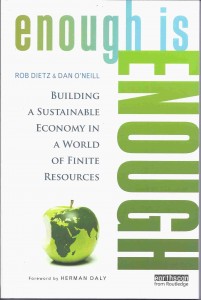
Dietz_ONeill_Enough_is_Enough-201x300

Enough is Enough

Rob Dietz and Dan O’Neill (2014)

Free PDF download at steadystate.org/

Book Review

Enough is Enough is the report of the world’s first Steady State Economy Conference in June 2010. The concept derives from Herman Daly’s 1977 book Steady State Economy, published five years after the Club of Rome’s infamous Limits to Growth.

The 2010 conference was organized around two basic premises: 1) that the drive for unlimited economic growth is making the planet uninhabitable and 2) that transformation to a steady state economy is essential if we’re to have any hope of preserving the human species.

Enough is Enough begins by outlining why unlimited growth is impossible on a finite planet with finite resources. It goes on to define a steady state economy as having four key features: it’s sustainable, it provides for fair distribution of resources, it provides for efficient allocation of resources (i.e. it doesn’t rely solely on the free market in situations where the market can’t allocate resources efficiently) and it provides a high quality of life for everyone.

The authors focus on four basic steps essential in the transformation from a growth-based to a steady state economy:

1. An agreement to limit resource use – renewable resources (eg forests, fisheries) are harvested no faster than they can regenerated and non-renewable resources (eg fossil fuels) are consumed no faster than the wastes they produce can be recycled. There are a number of possible policy tools for making this happen: an outright ban (similar to current fishing bans), ecological taxation (eg carbon taxes or oil extraction taxes similar to Alaska’s petroleum tax), cap and trade (sets an overall cap and auctions off permits to pollute or mine up to that cap) and cap and share (sets an overall cap and distributes free permits to pollute or mine among all citizens).

2. Population stabilization – through non-coercive population policies that balance immigration and emigration and provide incentives to reduce family size. Examples include increasing access to birth control and education and full equality for women.

3. Inequality is reduced through policies that encourage worker cooperatives, employee ownership, shareholder participation, gender balance in positions of power, a Universal Basic Income (see The Case for Unconditional Basic Income), a cap on pay differentials between workers and management and progressive taxation schemes.

4. Monetary reform – in addition to prohibiting banks from creating money out of thin air and transferring the power to create money to a public authority, there needs to be more promotion of local currencies to stimulate local economies.

5. New progress indicators – substituting something similar to the Human Progress Indicator (HPI), which measures environmental and human well being, for Gross Domestic Product (GDP), which merely measures money.

6. Commitment to full employment – we need to use automation to eliminate onerous and unemployment work, rather than eliminating jobs, as well as shortening the work week (in conjunction with a UBI) to enable more people to have jobs.

7. New attitudes towards business and production – we need to incentivize businesses to achieve “right” sized profits that are large enough to guarantee a company’s economy viability but not so large they exceed its ecological allowance.

8. Global cooperation over resource use – we need to agree all trading partners wind down growth simultaneously. Otherwise steady state economies could experience significant trade disadvantages.

9. New consumer behavior – we need to promote new values that emphasize the positive aspects of a steady state economy (community connectedness, friendship and creativity) over the competitive individualism, hedonism, status and achievement that are emphasized in a growth economy.

10. Engaging politicians and the media (which will be the hardest) – by doing more research and analysis of the steady state model, creating forums to engage the public, politicians, policy makers and academics and to working for small changes at the local community level.
Rob Dietz is the European director of the Center for the Advancement of the Steady State Economy (CASSE). More information about CASSE at http://steadystate.org/

In the video below O’Neill talks about their book.


Washington Activists Seek Carbon Tax

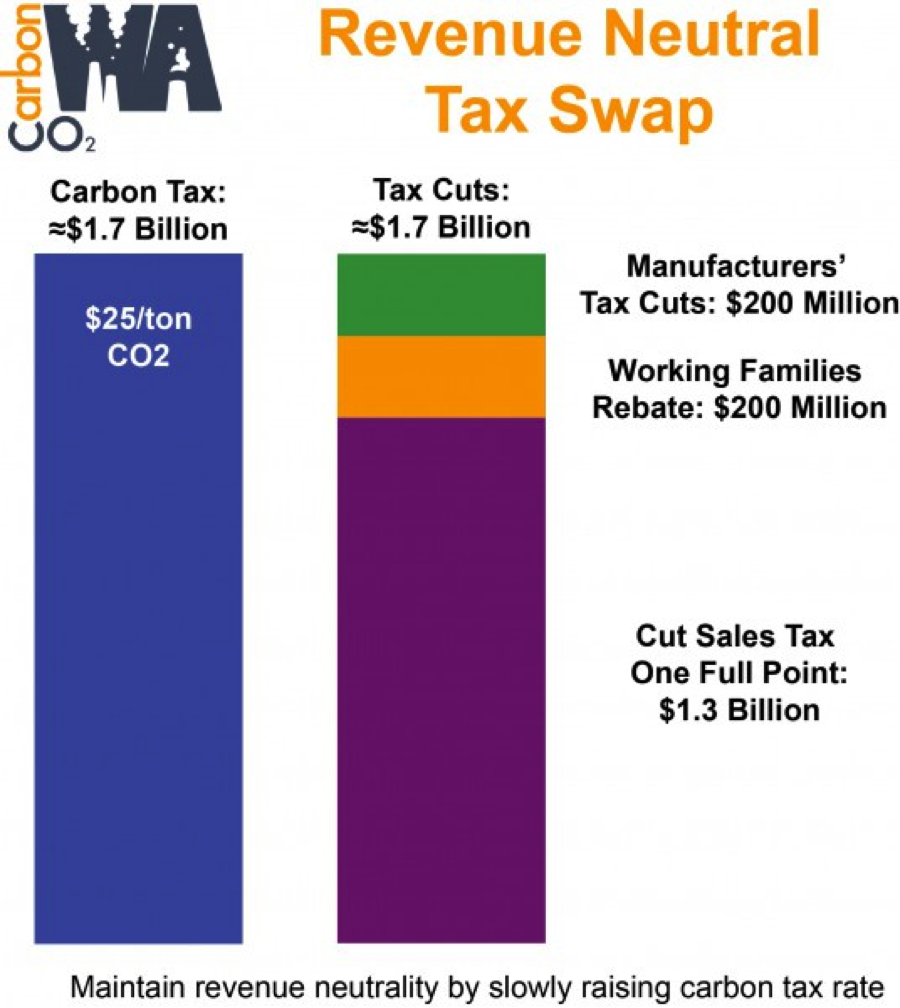
CarbonWA-tax-swap

Carbon Washington (CarbonWA) is a citizens’ coalition seeking to enact a statewide carbon tax through a citizens’ initiative.* I-732 would incrementally institute a tax of on all fossil fuels consumed in Washington State. The revenue raised would be used to cut the state sales tax by 1%, to eliminate the Business and Occupations (B&O) tax on manufacturing and to fund the Working Families Rebate (a program the state legislature created in 2008 but never funded).

British Columbia’s Carbon Tax

I-732 is modeled after a carbon tax British Columbia (BC) introduced in 2008, which has received lavish praise from the (pro-corporate) Economist. Prior to its enactment, business warned the carbon tax would increase costs and slow the economy, while the left-leaning New Democratic Party (NDP) warned it would hurt the poor. Both were wrong.

Because the funds raised by BC’s carbon tax are used to cut income taxes (for individuals and businesses), it has been as beneficial for the British Columbia economy as for the environment. In a way, this makes a lot of sense. Taxing people for working and adding wealth to the economy is one of the biggest drags on economic growth there is. It makes a lot more sense to tax activities you want to discourage, such as polluting the atmosphere.

BC also implemented their carbon tax incrementally. The new tax was initially set at C$10 ($10) per tonne of carbon-dioxide emissions, rising by increments of C$5 per year to C$30 in 2012. At present this translate into a 7 cent per litre tax (approximately 25 cents per gallon) on gasoline.

As predicted, the carbon tax has proved as beneficial  for the economy as the environment. Since 2008, per capita fuel consumption in British Columbia has dropped by 16%, which contrasts with an increase of 3% in the rest of Canada. The province now has the lowest income tax rate in Canada and one of the lowest corporate tax rates in North America. Meanwhile per capita GDP continues to outperform other provinces. BC also enjoys lower jobless rates. Thus it’s no wonder it remains extremely popular, supported by 64% of BC residents.

How I-732 Will Work

Under I-732, the state will collect a tax on all fossil fuels sold or used within Washington State. This will include fossil fuels sold or used for air travel, motor vehicles boats, and electrical generation. (19% of Washington’s electricity is renewable, generated by hydropower). The tax rate will start at 15 dollars per metric ton of carbon dioxide as of July 1, 2017, increasing to 25 dollars per metric ton as of July 1, 2018, with automatic increases thereafter by 3 ½ percent plus inflation.

This tax swap will take place over two years. B&O tax on manufacturers will be eliminated in full the first year. The state sales tax will be reduced by ½ percentage point per year over two years. The Working Families Rebate will phase in from 15% of the federal EITC (Earned Income Tax Credit) in the first year to 25% of the federal EITC in the second year and beyond.

Halving US Carbon Emissions

Carbon Washington executive committee member Yoram Bauman hopes Washington will serve as a model for other states. According to Bauman, CO2 emissions could be halved if all fifty states adopted similar a similar carbon tax.

More information at www.carbonwa.org


*I-732 is an initiative to legislature. If Carbon Washington collects enough signatures to qualify, the 2016 legislature has a choice of enacting it into law, enacting substitute legislation or placing it on the 2016 ballot.

Obama Loses Senate Vote on TPP(A)

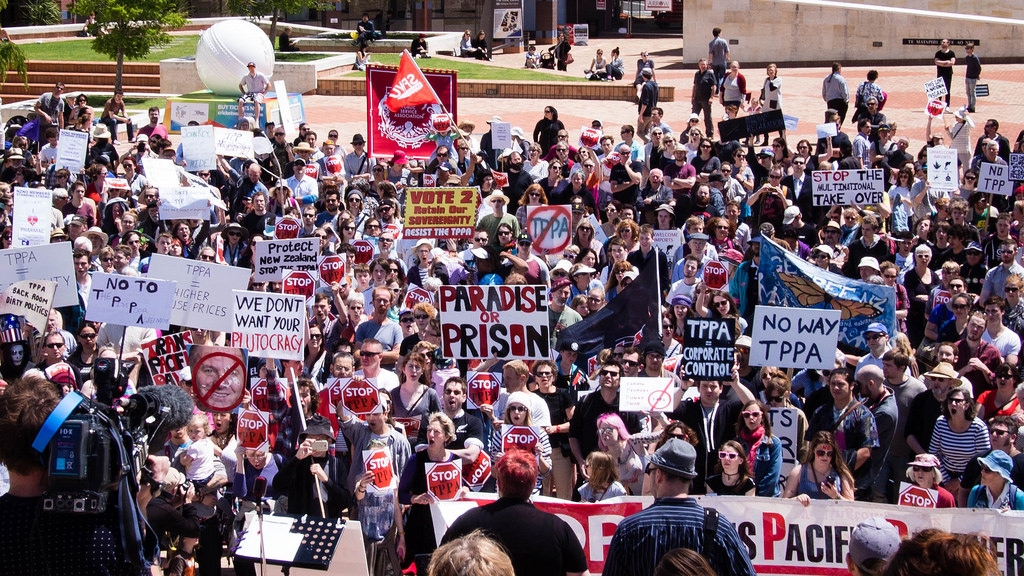
tppa protest

Wellington anti-TPPA protest Nov 2014

Yet another victory for our side. The tide seems to be turning against corporate America.

Today the Guardian reported that Tuesday’s 52-45 senate vote shut down further discussion of the Transpacific Partnership Agreement. Owing to the threat of filibuster, this procedural vote required at least 60 “ayes” in order to let the Senate host discussions on whether or not to give the president “fast track” authority.* Failure to reach that threshold puts the future of the TPP(A) in jeopardy.

The proposal was defeated by Democrats wanting to add measures to protect US workers and prevent currency manipulation.

Most analysts agree that the eleven other countries negotiating TPP(A) are unlikely to agree to the treaty unless they know the US Senate will approve it without modification.

Many also believe the setback spells an end to any chance the US will sign up to the TPP(A) before the next US presidential election in late-2016.

According to the Guardian, TPPA opponents have been emboldened by the growing influence of liberal senators Elizabeth Warren and Bernie Sanders and were joined by all but one Senate Democrat in voting against moving forward with TPP.

Only one Democrat, Senator Tom Carper of Delaware, backed the measure. Pro-trade Oregon Senator Ron Wyden, who championed the fast track measure in committee, changed his vote to “no.” He’s insisting that fast track be bundled together with three other trade bills, including one that would impose import duties on countries that manipulate their currencies for unfair trade advantage.

TPP is a secret treaty being negotiated behind closed doors without input from the public or elected representatives. Documents released by Wikileaks in March revealed the TPP(A) has a clause known as Investor State Dispute Settlement (ISDS). It means if local or national governments enact legislation for greater environmental protections, health regulations or rules to assist local businesses – anything that interferes with foreign corporations’ profits – the corporations can sue them in secret tribunals run by corporate lawyers.

Here in New Zealand, we are especially concerned about a clause in the leaked text that would allow pharmaceutical companies to sue us for using generic drugs (in preference to brand named drugs) in our National Health Service. We’re also concerned the TPP(A) would enable Monsanto to sue us over laws that prohibit farmers from planting GMO crops.

Besides the US and New Zealand, the other 10 countries involved in TPP(A) negotiations are Australia, Brunei, Canada, Chile, Japan, Malaysia, Mexico Peru, Singapore, the and Vietnam.

Read more here


*With “fast track” authority, the Senate would be forced to vote a bill approving TPP(A) up or down without amending it.

A Zaptista “Seminar” in Chiapas*

Digital Camera

Digital Camera

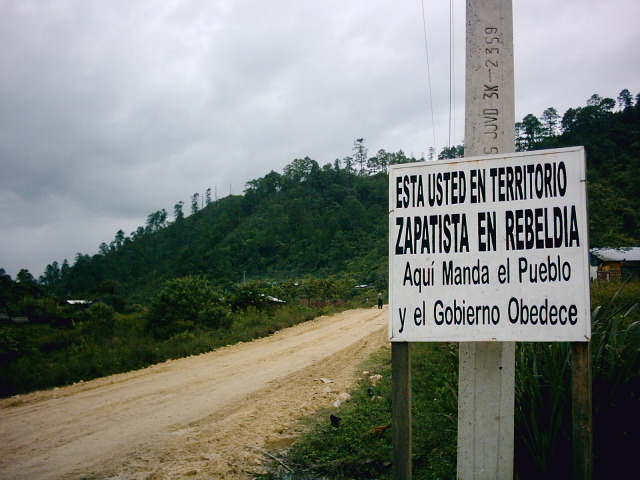
Sign indicating the entrance of Zapatista rebel territory. “You are in Zapatista territory in rebellion. Here the people command and the government obeys”.

Reblogged from Libya 360

While the front pages and TV news reports in Mexico are full of accounts of ghastly levels of corruption and violence that would have boggled the imagination of the most jaded pulp fiction writer, in every corner of the country there are spaces where “you breathe a different air,” as the saying is here.

On the outskirts of San Cristobal de las Casas, famed colonial center of the southern state of Chiapas, on the wooded campus of the Indigenous Center for Comprehensive Training (Spanish acronym: CIDECI – follow the link to learn more about this remarkable alternative university) over a thousand people from all over Mexico and beyond are attending a weeklong seminar “Critical Thinking Confronting the Capitalist Hydra.” It was conceived and organized by the Zapatistas, the Chiapas-based armed insurgency that has converted itself into one of the most extraordinary experiments in regional autonomy and self-sufficiency in the history of social movements in Latin America. Along with masked members of the Zapatista army, rural peasant farmers, high school and college students, activists, teachers, artists’ collectives, members of various social and political formations like the National Indigenous Congress (Spanish acronym: CNI) are spending the week listening to a wide-ranging number of presenters from Mexico and abroad with expertise in key areas where the “hydra” now dominates: finance, government, agriculture, social welfare, communications, race and gender relations, science and technology.

And, true to the comprehensive vision of human discourse that is modern day zapatismo, they are also hearing from poets, artists, writers, historians, philosophers. The attendees pack the seats of the large auditorium and spill into the corridors and outside into the shaded walkways that surround it, using all the various ways we now have of capturing information, with an avidness and level of impassioned curiosity that would warm the heart of any college professor used to declaiming to a bored and distracted student body.

The analysis so far has been relatively concordant and not surprising: a litany of the human and ecological disaster that capitalism has wrought (not just in Mexico, but of course that is the primary focus here). The Spanish word “despojo,” which has only a much weaker equivalent in English, “dispossession,” recurs in so many presentations that it is clearly seen as one of the most fundamental characteristics of the system. “To be stripped violently of everything that sustains you” would be closer to the real meaning of this word. That is the key experience of capitalism’s innumerable losers: the mass of humans without power or privilege, and the living world.

Read more here: original article

Photo credit: “Zapatista sign” by Paolo Massa (‘phauly’) – Flickr. Licensed under CC BY-SA 2.0 via Wikimedia Commons

How Radical Architects are Transforming the Planet

Radical Architecture

Al Jazeera (2014)

Film Review

Rebel Architecture is a six-part Al Jazeera documentary series about architects who are using their skills to serve the public good rather than wealthy corporations.

Part 1 is about a Spanish architects collective that works with activist collectives loosely connected with Spain’s anti-austerity movement. Thanks to the Spanish government’s severe austerity measures and public service cuts, activist collectives have assumed major responsibility for social welfare. Occupation of public and abandoned spaces is a key tactic. The role of the architects collective is to help activists construct safe buildings in these spaces from cheap and recycled materials. In most cases the structures are unpermitted and technically illegal.

Part 2 is about Pakistan’s first woman architect and her role in helping poor Pakistani communities devastated by floods and earthquakes to rebuild flood and earthquake proof homes as cheaply as possible. Unsurprisingly she discovered that traditional building materials, such as mud bricks, lime and bamboo, are a key to the solution.

Part 3 is about an Israeli architect in the West Bank who studies the “intersection” between architecture and violence. He gives a fascinating presentation describing how the Israeli government uses architecture as a weapon against the Palestinians. This includes the deliberate layout of Israeli settlements in such a way that they strangulate Palestinian communities. And the deliberate use of bulldozers in dense urban communities as an instrument of war.

Part 4 is about Nigerian architect and urbanist Kunle Adeyemi, who works with illegal floating communities to design and build (unpermitted) floating schools and community centers.

Part 5 is about the Vietnamese architect Va Tron Nghia, who has dedicated his life to creating more green spaces in Ho Chi Minh city and building cheap durable homes for peasant farmers in the Mekong Delta. Owing to recurrent flooding, typical Delta homes last only three to four years. The film shows Nghia and local residents building a $4,000 bamboo house for a family of four.

Part 6 (my favorite) is about a pedreiro (Portuguese for stone mason) in Rocinha, the largest favella in South America – located in Rio De Janeiro. All the housing in Rocinha, population 180,000, is unpermitted and illegal. The Brazilian government turns a blind eye to all this illegal building because they need the cheap labor and have no resources to build public housing. This last segment shows how Rocinha residents organized to demand a sewage system to replace the open sewer in their streets. Instead the Brazilian government built a cable car for the benefit of tourists attending the 2014 Brazilian World Cup and the 2016 Brazilian Olympics. It was largely angry Rocinha residents who instigated the mass protests before and during the World Cup. Though the protests were widely reported in the corporate media, there was no mention of Rocinha residents’ ongoing struggle to remove the sewer of human excrement from their streets.


Anonymous: A Global Force to be Reckoned With

We are Legion: The Story of the Hactivists.

Brian Knoppenberger (2012)

Film Review

We are Legion lays out the history of Anonymous, the leaderless global network of Internet activists who can shut down and/or hack the website of virtually any government or corporation. In June 2011, sixteen members of this anonymous network became publicly  known after the FBI arrested them for attacking the websites of Paypal, Mastercard and Amazon for their refusal to process Wikileaks donations.

I was quite surprised to learn that the origins of Anonymous were totally apolitical. The hacker culture that led to the formation of Anonymous originally grew out of MIT prank culture. The MIT student body’s IRL (in-real-life) pranks preceded their online pranking. I visited the MIT campus for my daughter’s graduation, and the tour she gave me include a history of some of the more clever pranks, eg the Volkswagen MIT’s model railroad club put on the roof of the administration building.

Interest in online pranks and hacking led to the formation of online hacking groups, such as Cult of the Dead Cow, LOPHT and Electronic Disturbance Theater. It was in these groups hackers learned how to launch distributed denial of service (DDoS) attacks. The goal of a DDoS attack is to shut down a website by having tens of thousands of people link to it simultaneously.

Over time these early groups morphed into 4Chan, an image-based bulletin board where people used their anonymity to post the vilest and most disgusting images, comments and memes they could think of. The primary goal was to think up new ways of offending people. This included creative trolling and hacking of mainstream websites, often by plastering them with pornographic images.

4Chan Becomes Political

4Chan’s first political target was Hal Turner, a Neo-Nazi Internet radio producer. The techniques used against Turner included DDoS attacks, delivering hundreds of pizzas and industrial pallets to his home, signing him up for escort services, posting phony Craigslist ads in his name and hacking his email account.

By 2008, this weird international network of Internet pranksters numbered in the millions, and they took in their first major political target: the Church of Scientology. Their run-in with the Scientologists stemmed from a ludicrous promotional video Tom Cruise made for YouTube, which they posted to tens of thousands of websites. This, in turn, generated a barrage of threats from the Church’s legal team. The Scientologists have a long history of threatening journalists and educators who try to investigate their cult-like activities.

4Chan retaliated by tying up the Scientology hotline with prank calls and DDoS’ing their website. They also disseminated a simple, open source (free) computer game called Low Orbit Ion Canon which enabled each of their members to link to the Scientology website 800,000 times.

Anonymous is Born

On January 21, 2008, 4Chan activists launched their first video under the name of Anonymous. It called for mass protests at all worldwide Scientology offices. Protestors were instructed to bring no weapons and cover their faces to keep from being identified. The choice of the Guy Fawkes Mask (from the 2006 film V for Vendetta) was a lucky accident.

guy fawkes mask

The protests started in Sydney, Adelaide, Perth and Melbourne. Eventually several hundred people turned out in every major city in the world. As it was the first time any of them had met offline, teen 4Chan nerds were astonished at the number of female and older activists in their midst.

Operation Avenge Assange

More online Anonymous protests followed, culminating in Operation Avenge Assange in December 2010. Following Wikileaks’ release of more than 100,000 secret US diplomatic cables, Paypal, Amazon and Mastercard tried to cripple them by suspending financial services to their website. Anonymous responded by DDoS’ing and shutting down the websites of Paypal, Amazon and Mastercard.

In February 2011, Anonymous provided assistance to Tunisian and Egyptian activists whose governments were trying to suppress their Internet access.

Following the Arab Spring protests, the formation of Lulz Sec caused a split in the Anonymous membership. Lulz Sec hactivists were into stealing credit card numbers and other personal information for malicious purposes. Other Anonymous members strongly believed their hactivism should only be a force for good.

In June 2011, 16 Anonymous members became visible for the first time when the FBI arrested them** for their role in Operation Avenge Assange. These and many nameless Anonymous members would go on to play a major role in the September 2011 Occupy protests.


*See Britain’s Famous Anarchist Superhero
**In 2014, the thirteen with outstanding charges pleaded guilty to misdemeanors and received maximum sentences of one year probation and $5600 restitution. See The Paypal 14

photo credit: Behind the Mask – Guy Fawkes 02 via photopin (license)