Europe’s Co-op Movement

Together: How Cooperatives Show Resilience to the Crisis

CECOP/CICOPA Europe  (2012)

Film Review

Together examines how the cooperative movement enabled tens of thousands of European workers to survive the 2008 downturn. As of 2012, there were 1.5 million co-op workers in Europe. The filmmakers interview workers from French, Polish, Italian and Spanish worker cooperatives. All agree that the traditional capitalist model – in which a financial group loots an enterprise for a few years and abandons it – is obsolete because it inevitably predisposes to financial crisis.

In France, workers converted 150 failed businesses to cooperatives between 2008 and 2012. The first co-op featured is a foundry workers converted with the help of a French organization that specializes in this type of conversion.

The Polish example is a bottling plant that survived Poland’s transformation to a “free market economy” in the 1990s. There were many so-called worker cooperatives in communist Poland, but they were controlled by the state, rather than workers themselves.

The Italian example features the “social cooperatives” enabled by Law 381 in 1991. These are worker-run public-private ventures that provide social services and work integration schemes for the disadvantaged. Italy has a total of 10,000 social cooperatives, and they increased, rather than decreased, staff following the 2008 downturn.

The documentary also showcases the world-famous Mondragon Cooperative Corporation in the Basque region of Spain. Mondragon, which was first started in 1943, is actually a consortium of 100 worker-owned businesses. Ninety-four are located outside of Spain.

Mondragon workers believe they survived the 2008 downturn due to their heavy emphasis on research and worker upskilling. They’re especially proud of the Mondragon electric car project. After the global economic crash, 500 Mondragon workers moved to a new co-op when their original work area shut down.

How a Few Rich Bastards Hijacked the US Constitution

Local Community Self Government

Excellent talk by Thomas Linzey, executive director of the Community Environmental Legal Defense Fund.

Highlights for me included the hidden history of the US Constitution, including the secret meetings George Washington and others held at Mt Vernon and elsewhere prior to the formal Constitutional Convention.

The goal of the Constitutional Convention, according to Linzey, was to create a framework in which property and commerce rights would take precedence over the local self-government. Even at the time, observers maintained that constitutional government was totally inconsistent with democratic government.

He goes on to explain historical court rulings that give corporations more rights than local government, as well as outlining the great work of the Community Environmental Legal Defense Fund in helping local communities battle corporations that threaten their health and safety with fracking, factory hog farms, toxic sludge, aquifer mining (by bottled water companies) and other environmental destructive enterprises.

I was particularly interested to hear about movements that are amending state constitutions to restore the right of local self government, as well as a national group fighting for a US Constitutional amendment that guarantees the right of local self-government.

Because I have a really slow connection, I had difficulty playing the embedded video.

People can also see the presentation at
https://marioncommunityrights.wordpress.com/tag/thomas-linzey/

Resisting Monsanto’s Occupation of Hawaii

Aina: That Which Feeds Us

Living Ancestors (2015)

Film Review

Aina is a short documentary about the Waipa Foundation, an organization run by native Hawaiians to restore traditional farming practices to Kauai (Hawaii). The group’s primary focus is to encourage a return to traditional organic farming practices. At the moment their main goal is the taro plant, a traditional staple, by giving the poi (the underground corm of the taro plant) away free to community members. They’re also working to reduce obesity by encouraging a return to the traditional diet (fish, pork, greens and poi).

Prior to seeing the film, I had no idea the extent to which the Hawaiian islands have been “occupied” by Monsanto and other multinational corporations engaged in GMO research. One of the group’s biggest concerns is the massive amount of Roundup, a known carcinogen and neurotoxin, sprayed adjacent to schools. In one highly publicized incident, 50 children had to be hospitalized following exposure to Roundup.

The Waipa Foundation is intent on returning Kauai (Hawaii) to 100% sustainability in food and energy production. With a present population of 1.2 million, the state imports 90% of its food and energy. One hundred years ago, one million Hawaiians lived in abundance without importing anything.


The Prison Show

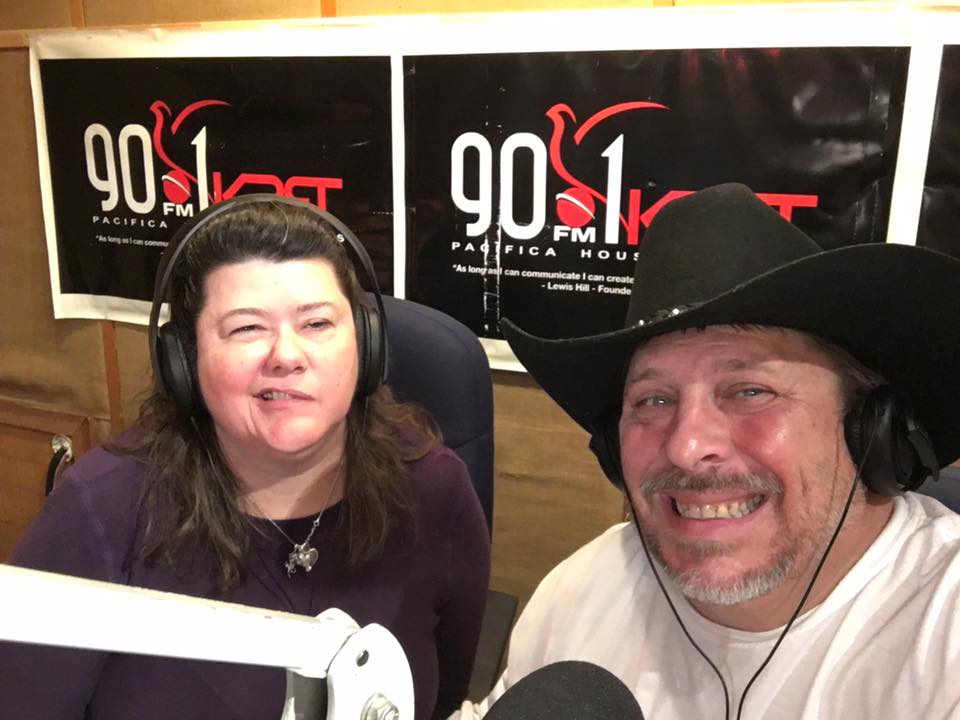
prison show wilvin carter

prison show deedee mullins david collingsworth

According to their Facebook page, “The Prison Show” is a live radio program airing Fridays at 9pm Central Time on KPFT FM 90.1 Houston, streaming at www.kpft.org

Ex-con and gay activist Ray Hill founded The Prison Show on Houston’s KPFT 90.1 FM in 1980. Although the target audience is inmates in Texas state and federal prisons, including death row, prisoners worldwide listen to it on-line.

The current Prison Show gang is a motley crew of ex-offenders, teachers, professors, lawyers, chaplains, activists, ex-politicos, male and female who see the error in the current prison system and the “worth in the American people lost but not forgotten still inside.”

In addition to the regular staff, counts on a number of expert guests who discuss subjects like prison health care, legal issues and the death penalty.

The Prison Show uses the first hour to discuss issues of interest to convicts. The second session is a call-in session where friends and family and addressed their loved ones behind bars.

With the largest prison population in the world (over two million), I guess it makes sense for US prisoners to have their own radio show.

Voice of America (the CIA radio station) has a great video of the KPFT studio during a Prison show broadcast at the following link (it can’t be embedded on WordPress).

http://www.voanews.com/media/video/1950618.html

Bolivia’s Evades NSA Spying through Citizens Internet

Rebel Geeks – The Citizens Network

Al Jazeera (2015)

Film Review

Rebel Geeks is an Al Jazeera documentary about the hackers and activists who make up the Bolivian Campaign for Technological Sovereignty.

Besides paying horrendous fees to US servers and software manufacturers for one of the slowest Internet, the Bolivian government is angry about continually being hacked and spied on by the US government.

At present only 40% of the Bolivian population can afford the Internet service based in Miami. The goal of the technological sovereignty campaign is to make their homemade internet service available free to all citizens.

Their server is called barriohack.net and they already offer homemade platforms like El Mapa (comparable to Google Map), Backpack (comparable to Google Drive) and Chateamos (comparable to Twitter).

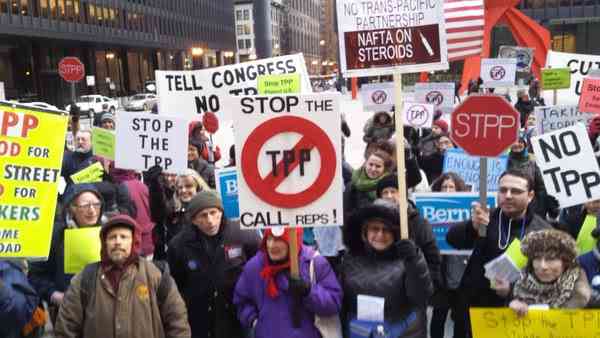
Chicago – ‘TPP is Betrayal’ Action

Anti-TPPA Protestors Shut Down Central Auckland

I and eleven other New Plymouth protesters have just returned from shutting down central Auckland during the TPPA signing yesterday.

While 15,000+ protesters marched down Queens Street, 1500 of us engaged in roving blockades shutting down all the streets leading into Central Auckland for four hours. The streets were deserted as we occupied key intersections and boogied to reggae music. It was surreal – reclaiming the streets for a giant street party. Several hundred blockaders briefly shut down the freeway and the Harbour Bridge.

The public response has been phenomenal with hundreds of new activists joining our movement to block TPPA ratification.


Here’s the coverage from RT:


Arkansas’s Unlikely Environmental Activists

The Natural State of America

Written and produced by Brian Campbell (2010)

Film Review

The Natural State of America is an inspiring documentary about an unlikely group of Arkansas environmental activists who take on their rural electric cooperative for spraying toxic herbicide in the Ozark highlands.

The Newton County Wildlife Association (NCWA) was first formed back in the 1970s, when they took on the US Forest Service over their plan to spray Agent Orange to destroy hardwood Ozark forest to benefit private timber interests seeking to replace it with quick growing pine.

Their success in obtaining a court injunction against the Forest Service inspired environmental activists in Washington and Oregon to undertake similar campaigns – resulting in an ban on domestic Agent Orange use in 1978.

A few years later the NWCA blocked the Army Corps of Engineers from damming the Buffalo River.

In recent years, the NWCA has joined with the Organic Growers Association and back-to-the-land homesteaders to protest a 2006 decision by the Carroll Electric Cooperative to spray toxic herbicides without consulting their membership.

Prior to watching this film, I was unacquainted with the pristine natural beauty of the Ozark region or the wealth of medicinal herbs found nowhere else in North America. I was also intrigued by the unusual personal profiles of the activists and their intimate knowledge of the geology and natural history of the region.

That being said, the film’s soundtrack was the high point for me. I’m pretty passionate about blue grass.


*Agent Orange is an equal mixture of 2,4,5-T and 2,4-D that was used by the US military to defoliate the jungle during the Vietnam War. Thousands of GIs who were exposed to it developed cancer, autoimmune and neurological disease and other health problems and have seen major birth defects in their children, grandchildren and great-grandchildren. In 2014, the EPA generated major controversy by approving a new Dow herbicide containing a combination of 2,4-D and glyphosate (Roundup) EPA approves new 2,4-D blend

The Movement to Dismantle Industrial Agriculture

Growing Change

Directed by Simon Cunich (2011)

Film Review

Growing Change is an Australian documentary about Latin America’s food sovereignty movement and the deliberate campaign by Venezuela and other left leaning governments to extract themselves from the US-run system of industrial agriculture.

The film begins by quoting from a 2008 study by the UN Environment Programme called Agriculture at a Crossroads: International assessment of Agricultural Knowledge, Science and Technology.

This study concludes that industrial agriculture can’t produce enough food to feed 9 billion people.* Although it cites a number of reasons for this conclusion, the documentary highlights two of the most important: oil depletion (industrial agriculture requires 66 barrels of oil per year to feed one person) and the destruction of topsoil through repeated use of pesticides, herbicides and fungicides that kill living organisms responsible for soil fertility. In part due to urbanization, the world has lost 25% of their productive farmland over the last 25 years.

Food Sovereignty in Venezuela

Using Venezuela as an example, Growing Change demonstrates how industrial agriculture increases world hunger, with foreign corporations driving peasant farmers off their lands and destroying local farmers’ livelihoods through cheap food imports.

As Venezuela expanded oil production to become the world’s largest oil exporter (in 1950), ruling elites allowed the country’s agricultural system to collapse. Forced to leave their land (either by direct expropriation or inability to compete with cheap food imports), farmers flooded into the slums of Caracas and other Venezuelan cities. Meanwhile with all the oil profits going to ruling elites and their US backers, mass unemployment and poverty left the majority of the population with no money to buy food.

Things came to a head in 1989 with the massive Caracasa uprising, in which the Venezuela army shot 3,000 protesters.

Venezuelan Reforms Led by Grassroots

For me, the chief value of this film was learning that most of the reforms Hugo Chavez implemented were driven – not by Chavez himself – but by well-organized peasant and workers groups. Moreover it was clearly the power of their organizing that brought him to power in 1998.

Between 1998 and 2008, Chavez used oil revenues to reduce the prevalence of malnutrition from 21% to 6%. His land reform program redistributed 6 million acres of vacant land to 250,000 families. Working through community councils and self-governing cooperatives, the new occupants put most of this land into organic production. Chavez also heavily subsidized organic urban farms on vacant city land, free meals at work sites and community centers and a 40% reduction in the cost of imported food for the poorest families..


*World population is predicted to reach 9 billion by 2050.
**Unless they had illegally expropriated the land, landowners were compensated at fair market value for undeveloped land the Chavez government confiscated.

Hitting Private Prisons Where it Hurts: Prison Divestment

divest

Divesting from the Prison Industrial Complex

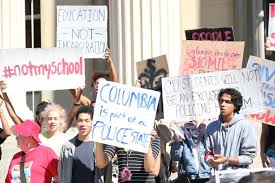
The National Prison Divestment Campaign has been in the news the last few weeks, after the University of California became the second US college to sell their shares in private prison companies.

Founded by Enlace* in May 2011, the National Prison Divestment Campaign consists of a coalition of over 150 grassroots organizations, worker centers, unions, and other nonprofits. Over the past four years, this coalition has won numerous victories, such as the recent divestments of SCOPIA, Amica Mutual Insurance, and DSM Netherlands, and the implementation of a investment policy for the City of Portland, OR, that will prevent the city from ever investing in private prisons.

The National Prison Divestment Campaign focuses primarily on two companies: Corrections Corporation of America (CCA) and Geo Group (GEO). These companies have a history of buying politicians and using lobbying for policies that criminalize immigrants and people of color. One example of this policy is the latest federal budget, which proposes a record allocation of $2.9 billion for the Department of Homeland Security to imprison 34,000 people on any given day. Meanwhile, legislatures at every level of government are cutting budgets for essential services like public education and healthcare.

In June, Columbia University became the first US college to divest from private prisons. This entailed dumping 220,00 shares in G4S, the world’s largest private security firm, as well as its shares in CCA. On December 29, the University of California joined them, selling $30 million $30 million of CCA and GEO stock.

African American lawyer and activist Michelle Alexander describes the infamous school-to-prison pipeline endured by minority families in The New Jim Crow. The US has the highest prison population in the world. The vast majority are African Americans and Hispanics, locked away for victimless crimes such as drug possession. As Alexander ably documents police disproportionately enforce these crimes in minority communities, where effective legal representation is virtually non-existent.


*Enlace is a strategic alliance of low-wage worker centers, unions, and community organizations in Mexico and in the U.S.