Fake News vs Junk Food News

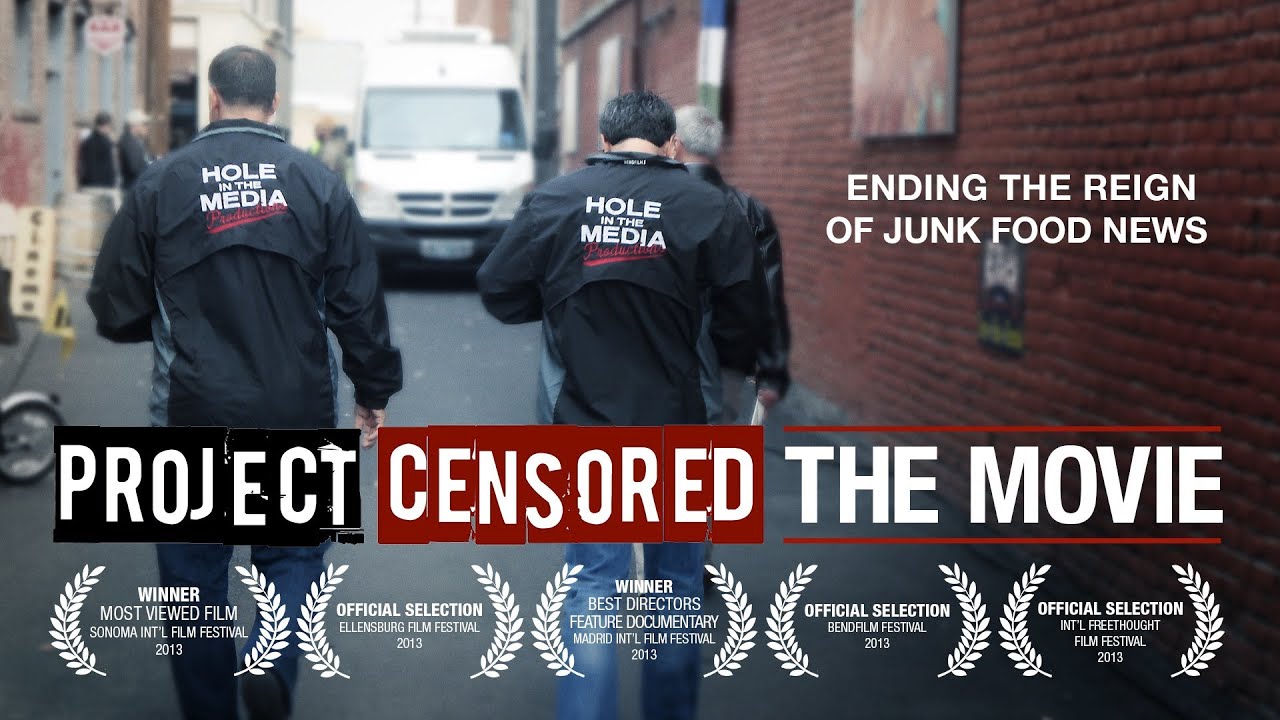
Project Censored the Movie: Ending the Reign of Junk Food News

Directed by Chris Oscar and Doug Hecker (2013)

Film Review

This documentary explores the history of Project Censored, as well as its importance in the current political climate. Started in 1976, the project is run by Sonoma State University faculty and students. The atrocious mainstream media coverage of Watergate was the original impetus for the project. Media collusion in failing to cover the break-in to Democratic headquarters allowed Nixon to win a landslide victory despite a scandal that ultimately forced him to resign.

Each year Sonoma State students research censored news stories, and faculty, community advisors, and prominent journalists and commentators vote on the 25 most important stories. The best 25 are published in an annual compendium. In 2000, Project Censored was opened to affiliate university programs across the US.

The film features a number of prominent media critics, including the late Howard Zinn, Michael Parenti, Noam Chomsky, Kevin Danaher, Greg Palast, Oliver Stone, John Perkins (author Confessions of an Economic Hitman), and Milos Foreman (directed One Flew Over the Cuckoo’s Nest).

The filmmakers emphasize the disastrous effects of handing the mainstream media over to monopoly corporations. Because the latter use it chiefly to promote their other financial interests (eg defense contractor GE owns NBC), most of what passes for news is either titillating entertainment or pure government or Wall Street propaganda. A Project Censored faculty member cites a recent study revealing only 24 seconds of an average 30-minute news broadcast covers real issues affecting viewers.

Most media critics agree that the de facto repeal of the Bill of Rights (especially the right to habeas corpus) and the most important censored story of the last decade.*

The most important censored story of 2012 was the high suicide rate (higher than combatant deaths) of returning Iraqi veterans. The most important censored story of 2007 was the massive genocide in Congo, where 80% of the coltan used in cellphones, computers, and missiles originates.


*Bond the virtual appeal of the 1st, 4th, 5th, and 6th amendments, the filmmakers detail additional evidence the US government (as of 2013) was already preparing to declare martial law: by placing US troops on standby to enter US cities, increasing the size and number of large detention centers, and enacting laws enabling asset seizure of antiwar protestors, banning pro bono legal representation, etc.

The film can be viewed free at https://www.filmsforaction.org/watch/project-censored-the-movie/

Hidden History: The 1989 US Invasion of Panama

Invasion

(Spanish with English subtitles)

Directed by Abner Benaim (2014)

Film Review

This is a Panamanian documentary about the 1989 US invasion of Panama killing an estimated 1,000 civilians.

In addition to reenacting aspects of the invasion, the filmmakers interview a range of people affected by it, including residents of low income areas of Panama City shelled and firebombed by US forces, Noriega aids who arranged for him to seek sanctuary in the Vatican embassy, a former staff person from the embassy, and wealthy Panamanians who supported the invasion.

The most moving accounts are those of civilians whose family members were killed or seriously injured in the US assault. Most US and Panamanian young people have little knowledge of the invasion because it isn’t taught in school. Low income Panamanians over 40 supported Noriega’s nationalist ambitions and opposed the US invasion. Wealthier residents accepted the US pretext of ridding the country of a corrupt dictator. Most people interviewed were fully aware of Noriega’s longstanding collaboration with the CIA and DEA in their drug running operations.

Despite their political opposition to the invasion, many low income Panama City residents used the chaos it generated to massively loot the city’s retail outlets.

For me, the high point of the film was seeing the massive speakers (the size of a pickup bed) the US military used to psychologically torture Vatican embassy personnel with loud, non-stop heavy metal music.


Oregon’s 1994 Death with Dignity Law

How to Die in Oregon

Directed by Peter D Richardson (2011)

Film Review

On September 19, the End of Life Choice Act referendum will be on the ballot in New Zealand. This documentary profiles Oregon’s 1994 Death with Dignity law (enacted by citizens initiated referendum). The latter permits doctors to prescribe a lethal quantity of barbiturates to allow terminal patients to end their lives. Unlike doctor-assisted suicide, patients must be able to self-administer the lethal cocktail. In 1994, Oregon, Switzerland, and the Netherlands were the only jurisdictions that allowed terminal patients to end their lives. As of 2011, a surprisingly small number of Oregon patients had taken their lives under the law.

The film profiles three terminally ill individuals who have secured lethal barbiturate prescriptions after satisfying specific medical criteria and the trained patient advocates who offer reassurance and counseling to all patients in the program. The filmmakers follow one patient and his family through the entire process.

They also interview opponents of right-to-die laws. The most concerning argument against them is the possibility a budget-strapped state will offer state sanctioned suicide as an alternative to expensive treatment regimes and good palliative care. In fact one Oregon patient shows filmmakers a letter from the Oregon Health Plan denying him a second round of chemotherapy and offering assisted suicide as a possible alternative.*

The film also profiles a Washington State woman campaigning for Washington State’s Death with Dignity referendum (approved in 2008), after watching her husband suffer horribly with terminal brain cancer.


*When he goes public with the letter, the OHP decides to allow the chemotherapy.

Anyone with a public library card can view the full film free on Kanopy. Type “Kanopy” and the name of your library into your search engine.

George Washington Carver: An Uncommon Life

George Washington Carver: An Uncommon Life

PBS (2020)

Film Review

This is an intriguing documentary about the highly controversial African American George Washington Carver. The latter has come under heavy criticism from anti-Jim Crow activists (starting with W.E.B Dubois 1868-1963) for his failure to challenge the institution of racism.

I should note that two of the corporate financial interests that sponsored the making of this film (DuPont and Alliance Energy) have appalling record when it comes to acknowledging any kind of racial or social justice. Thus I suspect the history they portray may be somewhat “sanitized.”

I  myself knew almost nothing about Carver’s life prior to watching this film. Born into slavery in 1864, Carver and his mother were illegally abducted when he was only a few months old and resold to an Arkansas plantation owner. The family’s former slave master Moses Carver traveled to Arkansas to retrieve the family.

Because George Washington’s mother had disappeared, Moses and his wife raised him and his older brother as their own children. The brother helped Moses around the farm, and George Washington, who was sickly, stayed in the house and learned cooking, knitting, sewing, and other womanly skills.

At 12, a Black family adopted him to enable him to attend a black school eight miles away. His adoptive mother was a midwife and folk healer.

After high school, he applied to Simpson College in Indianola Ohio to study painting. Concerned Carver couldn’t make a living as an artist, his art teacher encouraged him to transfer to Iowa State  Agricultural College. After completing his bachelor’s and master’s degree, he became the first African American on the faculty of Iowa State University. While there, he became close friends with three successive US Secretaries of Agriculture, including Henry Wallace, who served as Vice President under Roosevelt.

In 1896 Booker T Washington (also attacked by DuBois for being an accommodationist) invited him to start a department of agriculture at Tuskegee University in Alabama. Despite a substantial pay cut, Carver, hoping to improve the miserable lives of Alabama’s black sharecroppers, accepted.

In addition to working in his chemistry lab and teaching classes, Carver assisted thousands of Black sharecropper to improve their yields. Because only 1/5 of 5 million sharecroppers owned their on land, sharecropping and tenant farming were essentially an extension of slavery. (See Sharecropping: The Hidden History)

The biggest contribution Carver made was to teach sharecroppers to diversity away from cotton, which was depleting their soil. He also taught them to replenish their soil with organic fertilizers and with crop rotation involving legumes and sweet potatoes. He particularly encouraged them to grow peanuts, a legume with extremely high nutritional value.

During his lifetime, Carver discovered 300 products farmers could make from peanuts, including peanut butter.

Never marrying, Carver (who counted Henry Ford, FDR and Edison among his circle of friends) lived alone in a dorm room and rarely socialized.


The Law that Makes Taxpayers Liable for All Vaccine Injuries

1986: The Act

Directed by Dr Andy Wakefield (2020)

Film Review

1986: The Act, Dr Andy Wakefield’s* sequel to Vaxxed was just released last week. The price to rent the 2 1/2 hour film is steep – $US12.99. Some may want to wait until the price comes down. People can rent the film at https://7thchakrafilms.com/home-page

This documentary, simply, is a history of the 1986 US National Vaccine Injury Act. This legislation guarantees pharmaceutical companies totally immunity from liability for adverse reactions to vaccines by transferring the liability to US taxpayers. It also creates a special vaccine court to decide on the merit of the hundreds of disabled children who file claims every year. President Reagan (a strong opponent of big government) threatened to veto the bill. However he caved in and signed the law when Wyeth threatened to withdraw the Pertussis vaccine from the DPT (trivalent diphtheria, pertussis, tetanus vaccine).

The history of vaccine injury in the US is long, complicated and politically corrupt. I guess I shouldn’t be surprised to learn the CIA was directly involved in suppressing public information about adverse vaccine side effects owing to some bizarre Cold War competition with the Soviets over vaccine supremacy (???).

It was largely due to CIA interference that 63 million Americans were injected with the cancer-causing SV40 between 1955-63 and thousands of children suffered from acute encephalopathy following inoculation with the cellular pertussis vaccine.** Available in other countries in 1981, the acellular pertussis vaccine wouldn’t be mandated for use in US infants until 1996. CIA interference is also implicated in the failure of the FDA to shut down polio vaccine production at Cutter Laboratories in 1954, after an NIH researcher discovered their vaccine contained live (as opposed to inactivated polio vaccine). Eventually 40,000 children would develop polio from the Cutter vaccine, 164 would experience paralysis and 10 would die.

1986 wasn’t the first year the US government assumed liability for vaccine injuries. In 1976 a swine flu vaccine was rushed to market with inadequate testing after four soldiers contracted swine flu at Fort Dix. When the insurance industry refused to issue liability insurance, the federal government assumed liability. In this case, 200 people caught swine flu with one death. In contrast the the vaccine caused 58 deaths, 532 cases of paralysis, and thousands of lawsuits against the US government.

The 1986 law provides that claims must be filed within three years of learning of the vaccine injury (especially onerous given most parents have never heard of the vaccine court). Hearings are closed to the public, have no discovery process and are run by a special master (as opposed to a judge). The Act initially included a table of recognized injuries (developed by the CDC) which were automatically compensated. In the beginning,  regressive encepalopathy (in which seizures and autism are often a major outcome) was an on table condition, which meant 95% of autism/seizure cases received compensation.

After the incidence of autism began to skyrocket in the early 1990s, Clinton’s Secretary of Health and Human Services removed regressive encephalopathy and many other common vaccine injuries from the CDC table. This, in turn, forced parents to prove a direct link between the vaccine and their child’s disability, which is extremely difficult as most of the research is suppressed.

The most serious downstream effect of the total immunity 1986 Act granted pharmaceutical companies is the removal of any incentive on their part to study (and guarantee) the long term safety of their vaccines.


*The mainstream media continues to crucify Wakefield for his supposedly fraudulent 1998 Lancet paper. This article probably gives the best legal synopsis of the fraudulent case Big Pharma’s concocted against him (https://www.ageofautism.com/2020/03/why-we-cannot-believe-brian-deer-about-andrew-wakefield.html).

**In 1976, the FDA commissioned a study (which was suppressed) revealing that 1 in 300 children receiving cellular pertussis vaccine developed generalized seizures, and 1 in 214 developed other serious neurological reactions.


Psychodelics and Plant Medicine

Psyched Out: Documentary on Psychodelics and Plant Medicine

Directed by Giovani Bartolomeo (2018)

Film Review

The first video below is a documentary based mainly on the work of the late Terrence McKenna, a US ethnobotanist who was one of the first to investigate the healing effects of psychodelic plants. The film also features contemporary psychodelics advocates Dr Gabor Mate and British author and journalist Graham Hancock. The second video concerns a bank robber who was trained as an ayahuasca* shaman by a fellow prisoner.

Psyched Out begins by tracing the history of psychodelic use in healing and religious ceremonies. DMT (N,N-Dimethyltryptamine) was widely used by ancient Egyptians. McKenna believes Moses was under the influence of DMT when the burning bush spoke to him. He also suggests the forbidden fruit Adam and Eve ate in the Garden of Eden was actually the amanita mushroom. He also also sees a fundamental role for psylocybin in the supercharged evolution of the human brain occurring 15,000 – 20,000 years ago.

Between 3,000 – 1,500 BC, the use of psychodelics in healing and religious ceremonies occurred in all major civilizations. It ended in Western civilization in the 4th century AD with the Roman emperor Constantine’s formalization of the Catholic Church as a political body. Beginning with European colonization in the 15th century, psychodelics were banned nearly everywhere in the world.

McKenna and others believe the early church banned psychodelics because their role in expanding consciousness (ie these plants make people aware of their unconscious processes) leads people to question their fundamental beliefs about authority and their role in society.

For me the most interesting part of the film were the testimonials given by three patients who took ayahuasca and experienced total remission of longstanding opiate addiction, panic disorder/insomnia, and incapacitating scleroderma.**

I was also intrigued to learn of important discoveries and inventions directly related to psychodelic use, including the DNA double helix, the polymerase chain reaction, and several of Steve Jobs’ innovative Apple products.


*Ayahuasca is a hallucinatory tea made from a plant and vine containing DMT.

** Scleroderma is a group of autoimmune diseases that may result in changes to the skin, blood vessels, muscles, and internal organs. The disease can be either localized to the skin or involve both skin and other organs.

Kentucky Ayahuasca Episode 7

Vice (2019)

Film Review

I normally hate reality TV, but that was before I watched Kentucky Ayahuasca. Steve Hupp offers two-day Ayahuasca ceremonies with his wife and two apprentice therapist With 15 years experience, he boasts an 80% success rate for refractory PTSD, depression, and addiction and bipolar disorders.

Although, as a Schedule 1 drug, ayahuasca is illegal in the US, Native Americans are allowed to use it in religious ceremonies. Hupp calls his church the Aya Quest Native American church.

Readers can view the entire Kentucky Ayahuasca series at

https://video.vice.com/en_us/show/kentucky-ayahuasca

Hidden History: The Japanese Bombing of Australia

Croker Island Exodus

Directed by Stephen McGregor (2011)

Film Review

Prior to watching this documentary, I had no idea Japanese bombers attacked northern Australia 97 times during World War II.* This film reenacts the evacuation of 95 Aboriginal children from Croker Island during the bombing. Members of the “Stolen Generation,” the mixed race children were forcibly removed from their mothers to be raised in Christian missionary schools. Claiming the practice would facilitate assimilation, the Australian government continued to kidnap mixed race children until 1970.

The filmmakers also interview three of the surviving children as they reminisce about their separation from their families and their 42 day journey from Croker Island to Sydney.

Darwin was evacuated (except for essential services) in 1941, shortly before the first Japanese bombing raid. The three missionary sisters running the Croker Island school had the option to evacuate but chose to remain with their students.

Once Darwin was evacuated, the school ceased to receive food shipments from the Australian mainland. This left the sisters and children no choice but to evacuate. They traveled to Barclay Point in Queensland by naval frigate. From there two trucks drove them 50 kilometers through the tropical rainforest to Oenpelli. Because the trucks kept having breakdowns, most of the children ended up walking.

From Oenpelli, they walked barefoot 344 kilometers to the army base in Pine Creek. With limited provisions, they relied on bush water holes and wild water grass (wild sugar cane) for water and supplemented their bread and butter will lizards and wild berries.

At Pine Creek they were put on a train to Sydney. The army built two portable shelters for them on a mission homestead one-half hour south of Sydney.

In 1946, 63 of them chose to return to Coker Island. They remained there until age 16, when they went to Darwin to look for work. In 2011, when this film was made, only 12 evacuees were still living. The film ends with an extremely moving reunion they held with the last surviving missionary sister.


*Between February 1942 and November 1943, during the Pacific War of World War II, the Australian mainland, domestic airspace, offshore islands and coastal shipping were attacked at least 97 times by aircraft from the Imperial Japanese Navy Air Force and Imperial Japanese Army Air Force. These attacks came in various forms; from large-scale raids by medium bombers, to torpedo attacks on ships, and to strafing runs by fighters.

In the first and deadliest set of attacks, 242 aircraft hit Darwin on the morning of 19 February 1942. Killing at least 235 people and causing immense damage, the attacks made hundreds of people homeless and resulted in the abandonment of Darwin as a major naval base.

The film can be viewed free at the Maori TV website:

https://www.maoritelevision.com/shows/sunday-documentaries/S01E001/croker-island-exodus

A History of the Medieval Plague

Did Plague Really Cause Black Death?

Dr Dorsey Armstrong

Film Review

This film is actually a (free) 24-lecture course on the “Black Death,” a plague epidemic that recurred over approximately 300 years in medieval Europe. Given the COVID19 pandemic, the topic is of particular interest in 2020. The lecturer is Purdue Associate Professor of English and medieval literature Dr Dorsey Armstrong.

Personally I found the first nine lectures riveting. They become somewhat repetitive from lecture 10 on. I also highly recommend lecture 21, which covers the growing political-economic power experienced by the medieval peasantry (particularly women) with the loss of approximately 50% of Europe’s population to plague. Both Ciompi’s Rebellion (1378-1382) in Florence and the Peasants Revolt (1381) in England are discussed in extensive detail.

Despite my medical training, I had very little knowledge of plague prior to watching this series. I had no idea the disease first appeared in the 6th century in the Eastern Roman Empire and was considered pivotal in the ultimate fall of Rome.

I was also unaware that medieval plague appeared in three discrete forms, leading some modern scientists to speculate it may represent three distinct illnesses:

  • Bubonic plague – characterized by “buboes” (severely inflamed lymph nodes). It had the lowest mortality rate (approximately 20%) and couldn’t be transmitted to other human beings unless the buboes were lanced. It could only be transmitted through flea bites of infected rats.
  • Pneumonic plague – plague pneumonia, in which patients coughed up blood and easily transmitted it to other people. The mortality rate was nearly 100%.
  • Septicemic plague – a hemorrhagic fever (like Ebola) resulting from Disseminated Intravascular Coagulation (DIC), a condition in which a patient’s blood can’t clot and they bleed from all their orifices and into subcutaneous tissues. Non-transmissible to other humans, it was 100% fatal.

The plague recurred in Europe 15 times, every decade or so. The last European outbreak ended in 1676. It would take 300 years for the continent to return to its pre-plague population of 150 million.

Yersinia pestis, the organism believed responsible for medieval plague, was first identified in 1896 in an epidemic occurring in India and China.

There are still periodic plague outbreaks in Asia and the Southwestern US. The disease responds well to antibiotics if recognized in time. Because it’s so rare, doctors sometimes misdiagnose it, and there are still deaths.

Anyone with a public library card can watch the course free on Kanopy. Type “Kanopy” and the name of your library into the search engine.


Operation Paperclip: The Secret Intelligence Program that Brought Nazi Scientists to the US

Operation Paperclip

Annie Jacobsen (2014)

Film Review

This video is a lecture by Annie Jacobsen about her 2014 book Operation Paper Clip. In her talk, she mentions two classified Pentagon programs “Operation Alsace” and “Operation Paperclip.” Alsace, under the command of Colonel Boris Pash, was sent to the German front in the final days of the war. There it undertook a detailed investigation of Germany’s Atomic, Biological, and Chemical weapons programs. Renamed operation Paperclip following Germany’s surrender, the program arranged for 1600 Nazi scientists to be secretly repatriated to the US to work for the Pentagon and various weapons industries.

As all were documented war criminals, they were secretly smuggled out of Germany to avoid being tried for war crimes at Nuremberg. In some cases, their crimes consisted of inhumane treatment of the Jewish slaves who staffed their weapons programs, in others for their medical experiments on concentration camp inmates with lethal biological and chemical agents.

Some of the key war criminals Jacobsen mentions include

  • Otto Niemeyer – worked directly under Goehring in the Luftwaffe and created the Stealth Bomber for the US Air Force.
  • Celebrated rocket scientist Werner von Braun – (along with 100 of von Braun’s V2 rockets)  to White Sands Missile Range in New Mexico.
  • Walter Dornberger – after working directly under Himler, he came to the US to found Bell Aircraft.
  • Otto Ambros (Hitler’s favorite chemist) – co-inventor of Sarin gas and synthetic rubber, who later ran slave labor complex at Auschwitz. In the US, served as an advisor to Dow Chemical and the US Army Chemical Corp.


The Evolution of Legalized Slavery in the US Prison System

13th

Directed by Av DuVernay (2016)

Film Review

This documentary is a thoughtful exploration of the crucial role of the 13th amendment played in the president mass incarceration of African Americans, who currently provide captive labor for major Wall Street corporations for pennies a day. Featuring such luminaries as Van Jones, Angela Davis, Michelle Alexander, retired Black Congressional Caucus member Charles Rangel, and former (Republican) House Speaker Newt Gingrich*, the film highlights major landmarks in the evolution of the US prison industrial complex.

According to filmmakers, the 13th amendment was the most significant in that it essentially preserved slavery as “punishment for a crime.” Having lost their four million strong slave labor force, Southern states facing economic collapse, were quick to adopt “convict leasing” systems. In this way former slaves arrested for minor crimes such as loitering and vagrancy (ie failure to carry a letter certifying employment), could be leased to plantations, mines, and developing industries.

Likewise the 2015 release of D W Griffith’s Birth of a Nation was instrumental in the emerging mythology of black criminality. The overtly racist films glamorizes the Klu Klux Klan, while implanting the fiction in the public mind of an irresistible African American desire to rape white women. KKK cross burning was another fiction Griffith invented, which the terrorist organization subsequently adopted. .

The film’s release, which greatly increased KKK membership, also triggered thousands of lynchings between World War I and World War II. This state sanction terrorism against Southern Blacks, rather than economic privation, would be the main driver of northward African American migration in the early 20th century.

The film also recounts Nixon’s “Southern strategy,” in which he used subtle “war on drugs,” “law and order,” and “tough on crime” rhetoric to appeal to Southern Democrats’ unease with the civil rights movement – thus persuading them to vote Republican.

Reagan, in turn, would provide the legislation and funding to prosecute the war on drugs, significantly ramping up the arrest and conviction of low income minorities for victimless crimes such as marijuana and crack cocaine possession.

The film attributes most responsibility for the America’s obscene incarceration rate (2 million+ and growing) to Bill Clinton and his 1994 Omnibus Crime Bill. The latter significantly increased the militarization and numbers of cops on the street. Clinton also heavily promoted “three strikes you’re out” and minimum mandatory sentencing laws that have massively increased the US prison census.


*Newt Gingrich: “No one who is white understands the difficulty of being Black in the US.”