Gore Vidal: The United States of Amnesia

Gore Vidal: The United States of Amnesia

Directed by Nicholas Wrathall (2013)

Film Review

This film is dedicated to the memory of US dissident and iconoclast Gore Vidal, who died at 87 in 2012. Born to privilege, Vidal was one of the few Eastern- Washington DC elite to turn against his class. His maternal great-grandfather Thomas Pryor Gore was a long serving US Senator and his mother married into the Auchincloss* family, resulting in close ties to the Kennedy family.

Vidal spent three years in the Pacific during World War II before being invalided out for rheumatoid arthritis. He published his first novel at 19.

After Vidal was blackballed by the mainstream media (the New York Times and Washington Post refused to review his books) for publishing the first American novel explaining the mechanics of gay sex, he moved to Hollywood to write TV and movie scripts. He would receive a thank you letter from Alfred Kinsey, who also worked to demystify homosexual in his bestselling Kinsey Reports in the 1950s.

Vidal counted Paul and Joanne Newman, Tennessee Williams, William Faulkner, and Eleanor Roosevelt (she worked for his Congressional campaign in the 1960s) among his friend. He spent most of his life in Italy until the death of his lifelong companion Howard Austen. Too disabled to live on his own, Vidal returned to the US.

Most of Vidal’s novels concern the deep US government corruption that dates back to the founding fathers. His seven-book series Narratives of Empire exposes much hidden history surrounding the first 250 years of US empire building.

Although the series ends with Franklin D Roosevelt (who Vidal believes was complicit in the Pearl Harbor bombing), he has been equally critical of presidents who succeeded FDR. In the film he blasts Truman, Kennedy, Carter, Reagan, and George W Bush:

  • Truman – for being the first US president to (unconstitutionally) launch a universal draft in peacetime.
  • Kennedy – for his belligerent foreign policy (Vidal disputes claims by assassination scholars that JFK intended to withdraw US troops from Vietnam) and his failure to use his popularity to champion genuine domestic reform.
  • Reagan for being a mindless puppet of the corporate elite.
  • Bush Jr – for stealing the presidency in 2000 and 2004* and for launching illegal and unwinnable wars in Iraq and Afghanistan.

My favorite parts of the film relate to Vidal’s friendship with the last Soviet premier Mikhail Gorbachev.


*Vidal’s mother was Hugh D Auchincloss’s second wife and Janet Lee Bouvier (Jackie Kennedy’s mother) his third.

**Vidal refers to the book What Went Wrong in Ohio by Congressman John Conyers on Ohio voting irregularities in the 2004 election. The New York Times and other major media outlets refuse to review the book.
 

Hidden History: US Empire Building in China and the South Pacific

The Coming War on China

Directed by John Pilger (2016)

Film Review

Two things I’ve learned over the years about John Pilger films are 1) there’s virtually no link between the film’s title and its content 2) they all include include considerable hidden history not taught in public schools. .

The main focus of this documentary is US empire building in the Pacific and its disastrous effect on US-China relations.

A good third of the film concerns the US annexation of the Marshall islands following World War II, followed by the cynical US government decisions to use residents (referred to as “savages” in classified documents) as radiation guinea pigs in atmospheric nuclear tests. .

After bombing some of the islands daily for 12 years, residents were forcibly returned to Rongelap despite dangerously high water and soil radiation levels. The US government then subjected them to repeated scans and blood tests to assess their response to the irradiated food they were eating.

As more and more developed cancer and produced offspring with birth defects, they begged the US government to move them. When the Americans declined, they appealed to Greenpeace International, which deployed the Rainbow Warrior to move them to an uncontaminated island in 1985.

The Marshall Islands are also home to the Ronald Reagan Ballistic Missile Defense Site. The latter forms part of a ring of strategic nuclear bases surrounding and aimed at China. This “noose” includes bases in Okinawa Japan (which are strongly opposed by local residents), South Korea, the Philippines and Australia.

Much of the film concerns the US occupation of China prior to the 1949 revolution (which I was totally unaware of), in large part to protect a thriving opium trade that was second only to slavery in providing capital wealth to the US corporate elite.*

The film also totally debunks common myths the US government promotes to justify their encirclement of China.

Myth 1: China aims to replace the US as the primary global empire.

Fact check: China has no interest in “converting” foreigners to their way of life as the US does. They simply refuse to be economically or politically controlled by US interests, like so-called US allies are. In Western Europe, for example, countries with nominal independence are forbidden to pursue foreign policy contrary to US interests.

Myth 2: Mao was an implacable enemy of the West.

Fact check: Mao Zedong secretly sought to establish diplomatic relations with Roosevelt, Truman and Eisenhower. After State Department officials who delivered Mao’s messages were fired as traitors, there was no on left in the State Department who could speak Mandarin.

Myth 3: China has a capitalist economy.

Fact check: China has a free market economy. According to Pilger, they reject the “capitalist” label because their billionaires aren’t permitted to influence or control  government operations as happens in the US.

*Roosevelt derived his wealth from his maternal grandfather Warren Delano, dubbed the US opium king. Former Secretary of State John Foster Dulles derived his wealth from his great grandfather’s opium smuggling. All the Eastern Ivy League universities were founded with opium money.


Hidden History: The 2014 Revolution in Burkina Faso

Burkinabé Rising: The Art of Resistance in Bukina Faso

Directed by Lara Lee (2017)

Film Review

Burkinabé Rising is about the 2014 revolution in Burkina Faso which overthrew dictator Blaise Compaoré after 27 years in power. To the best of my knowledge the event received no coverage whatsoever in the Western media. The vast majority of Americans have never even heard of Burkina Faso. I confess I first discovered the west African country when I  heard their music performed at Womad* in 2000.

Burkina Faso is bordered by Mali, Niger, Benin, Togo, Ghana, and Ivory Coast. It has a population of 20 million (four times the size of New Zealand). They received their independence from France in 1960.

The primary focus of the film is the historical use of art (music, modern dance, hip hop, visual arts, slam poetry, drama, and traditional masks and mud hut architecture) to raise revolutionary consciousness among young Bukinabé.

Music and dance have been especially successful in evading censorship while  preserving the memory of revolutionary leader Thomas Sankara and investigative journalist Norbert Zonga. Both were assassinated by Compaoré  and his family (Sankara in 1987 and Zonga in 1998).

The use of art in preparing the Bukinabé for full self-government has continued since Compaoré’s ouster in 2014. The role of women, the breadwinners of two-thirds of the country’s households, is of prime importance. At present several grassroots campaigns focus on women’s literacy and the education of girls, as well as the participation of women in civic organization.

There’s also a major emphasis on reviving indigenous languages and reducing food imports by banning GMOs and returning to traditional organic agriculture.


*Womad (World of Music, Arts and Dance) is an international arts festival celebrating the world’s many forms of music, arts and dance. My local city New Plymouth hosts Womad every March.

Rwanda: Story of a Genocide Foretold

Rwanda: Story of a Genocide Foretold

Directed by Michael Sztanke (2019)

Film Review

This documentary is about recent declassified evidence that reveals French complicity in the 1994 Rwanda genocide.

Although Rwanda is a former Belgian colony, France provided military “support” from the early nineties an an effort to “de-anglicize” central Africa. Viewing military presence in Rwanda as an entry point to Zaire (now Democratic Republic of Congo) with its wealth of diamonds, gold, and rare earth minerals, they offered weapons and “military advisors.” Many of the latter assumed operational command over Rwandan troops.

Meanwhile, owing to systematic persecution by the Hutu-led government, many minority Tutsis fled to Uganda where they formed the Rwanda Patriotic Front (RPF) led by current president Paul Kagame. The role of French forces was to assist the Hutu government in repelling the RPF.

In 1991, French general Jean Varret warned his superiors that machine guns and artillery they were supplying Rwanda police were being used in ruthless pogroms against Tutsi civilians. The French government responded by forcing him to resign.

The genocidal attacks against the Tutsis escalated in February 1994, following the assassination of Rwandan president Juvénal Habyarimana (which was blamed on the Tutsis). The next two months saw the daily slaughter of roughly 10,000 Tutsis and moderate Hutus. In response in April 1994, a UN mandate authorized the deployment of 2,500 French troops to Rwanda as peacekeepers.

Known as Operation Turquoise, the French peacekeeping mission turned a blind eye to the continuing genocide (which they referred to “reciprocal massacres”) until July 1994, when the RPF began their final military advance to topple the Hutu government. At that point the French set up a series of refugee camps in southern Rwanda. Their alleged purpose was to protect Tutsi victims, but they were also used to facilitate the escape (to Zaire, Togo, Gabon and France) of Hutu government officials and militia from the advancing RPF.

In this way, seven out of 21 ministers managed to escape although four were later convicted for war crimes by the International Criminal Court. Three are still living quiet undisturbed lives in France.**


*The Belgians created significant ethnic strife in Rwanda by limiting appointments in the colonial government to minority Tutsis. This would engender significant backlash from Hutus when they assumed majority control following independence in 1962.

**Following a 2017 Rwandan government indictment against French generals implicated in the genocide, French president Macron agreed to open the archives to public inspection:  https://www.telegraph.co.uk/news/2019/04/05/france-throw-open-archives-rwanda-genocide-clarify-role-25-years/


Hidden History: The 21 Korean War POWs Who Defected to China


They Chose China

Directed by Shui-Bo-Wong (2006)

Film Review

This documentary is about 21 US Korean War POWs who chose not to repatriate to the US when the Korean armistice was signed in 1953. Initially there were 23. The first two returned to the US in the early fifties, where they were court martialed and given 10 and 20 year prison sentences.

For the most part, the US media echoed Senator Joseph McCarthy’s view that the 21 who remained in China were Communist traitors. However in a 1954 interview about their reasons for defecting, most cited their opposition to imperialist wars or to McCarthy’s witch hunt against US political dissidents, which they equated with fascism.

The 21 were also clearly influenced by their extremely positive treatment during their three years in captivity. The Chinese who ran the North Korean POW camps allowed them to have American food, as well as encouraging them to organize football, baseball and soccer games.

On arriving in China, they were given a choice between working in a factory, joining a collective farm or attending university. Most would leave China prior to 1966, when Mao launched his brutal Cultural Revolution. In giving their reasons for repatriating, some talked of a changing political climate that was less tolerant of foreigners. Other cited concerns about the 1956 Soviet invasion of Hungary.

Three of the US defectors are profiled in this film:

Clarence Adams – an African American from Memphis who enlisted in 1947 to escape a gang of white supremacist cops who had targeted him. His main reason for defecting to China was to escape white terrorism, as well as economic opportunities denied to him in the US. After spending several hears at university, he worked as a translator in Beijing and broadcast propaganda speeches directed at Black soldiers in Vietnam.

David Hawkins – in a 1957 60 Minutes interview (following his return to the US), he asserts the US had no business invading a country (Korea) that posed no threat to them militarily.* He also strongly advocates for the US to recognize China (the US officially recognized China in 1972 during Nixon’s first term).

James Veneris – the only defector profiled in the film who remained in China, as a factory worker, until his death in 2004.


*See See Hidden History: The US Wars Against Japan, Korea and Vietnam and The Long US War Against the Third World

This film can be viewed free at https://topdocumentaryfilms.com/they-chose-china/


An American in Mao’s Cultural Revolution

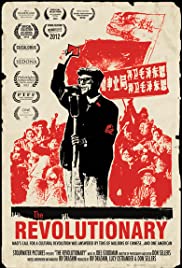
The Revolutionary: An American in Mao’s Cultural Revolution

Directed by Irv Drasnin, Lucy Ostrander and Don Sellers (2012)

Film Review

This documentary concerns the late Sidney Rittenberg, the only US citizen ever to join the Chinese Communist Party during the tenure of Mao Tse Tung

Rittenberg, active in the Southern union and civil rights movement during the early forties, was drafted in 1941 and trained in Mandarin by the US military. He was deployed to China in 1945 and served briefly as a UN observer following the Japanese surrender in August 1945.

In 1946, the Chinese Communist Party invited him to remain in China to serve as a “bridge” between the Chinese revolution and the Western world. Fearful of becoming too dependent on the Soviet Union, Mao was eager to establish good relations with the US.

After Stalin denounced him as a spy in 1949, the Chinese imprisonment him for six years (without trial) in solitary confinement. During the first year of his imprisonment, he was offered the option of returning to the US or remaining in prison under relaxed conditions allowing him full access to books and writing materials. Rittenberg, who believed that Mao’s revolution offered genuine freedom and democracy for China’s brutally oppressed poor, chose to remain in prison.

Following Stalin’s death he was released with a full apology. With his party membership restored, he was offered a prestigious position at Radio Beijing running the English language section. As a high level Communist Party official, he also enjoyed a life of privilege, with access to a chauffeur, hot water, and higher pay than Mao.

The most interesting part of the film concerns Rittenberg’s experience with three momentous programs Mao launched to counter pro-capitalist* forces in his government (the 1956 Let a Hundred Flowers Bloom campaign, the 1958-62 Great Leap Forward and the 1966-76 Cultural Revolution).

During Let a Hundred Flowers Bloom, Chinese intellectuals were encouraged to criticize government policies they felt weren’t working. While Mao accepted suggestions for improving existing policies, he came down hard on intellectuals (many lost their jobs or were imprisoned) who expressed outright oppositions to his policies.

During the Great Leap Forward, Mao first established vast rural communes that provided free food for all Chinese citizens, and then pulled most of the farmers off the communes to develop local steel and copper foundries. The loss of production would result in a massive famine in which 25-35 million people would die.

The famine-related deaths resulted in heavy criticism of Mao among the party leadership. The Cultural Revolution he launched in 1966 was intended to purge the Party leadership of his critics. The program consisted mainly of empowering youthful Red Brigade members to act as police, judge, and jury of authority figures  they perceived as counter-revolutionary (or simply disliked). Mao simultaneously ordered the police and army to stand back, while the Red Guards brutally assaulted, tortured, and killed people they singled out. During the Cultural Revolution, many intellectuals and academics were also detained without trial and either sent to prisons, labor camps, or agricultural communes.

Erroneously believing the Cultural Revolution was a true democratic rebellion, Rittenberg, became involved in a rebel group at Radio Beijing. Initially Jiang Qing, Mao’s wife and notorious Gang of Four member, encouraged his efforts. However in 1968 when he began criticizing the lack of democratic process, he found himself back in prison in solitary confinement.

He would be released shorty after Mao’s death in 1976. He and his family returned to the US in 1980, where he and his wife started new careers again in adult education. As China increasingly opened up to US investment, both embarked on lucrative careers as consultants to major Wall Street companies.

Rittenberg died August 24, 2019.


*The strength of the pro-capitalist movement Mao was struggling with becomes apparent from the speed with which China abandoned communism for industrial capitalism following his death. See How China’s Peasant Lost Collective Farming and Gained Urban Poverty

People with a public library card can see the documentary free on Kanopy. Type “Kanopy” and the name of your library into your search engine to register.

Hidden History: How China’s Peasants Lost Collective Farming and Gained Urban Poverty

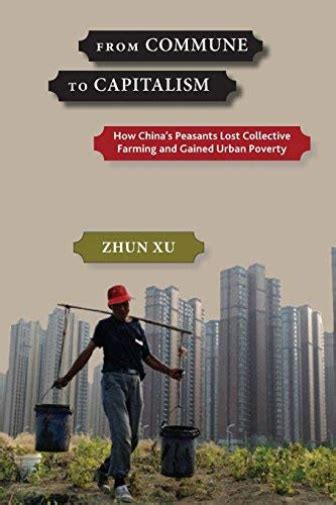
From Commune to Capitalism: How China’s Peasants Lost Collective Farming and Gained Urban Poverty

By Zhun Xu

Monthly Review Press (2018)

Book Review

The purpose of this book is to dispel common Chinese Communist Party (CCP) myths about the rapid privatization of Chinese collective farms following Mao Tse Tung’s death in 1976. For me, the most interesting section concerns Mao’s decision to collectivize Chinese agriculture (which occurred more than nine years after he assumed power in 1949). It becomes clear that throughout his tenure as president, Mao was in constant conflict with a strong anti-socialist faction of the CCP that supported full adoption of capitalism in China. Prior to reading this book, I had no idea that Mao’s disastrous Cultural Revolution (1966-1976) was a last ditch effort to rid his government of his pro-capitalist enemies. Following Mao’s death, his pro-capitalist successor Deng Xiaoping lost no time in privatizing all China’s collective farms and industry.

Xu mainly focuses on three common myths promoted by the current CCP. The first myth is that Chinese collective farms suffered from gross inefficiency and that productivity improved when collectives were dissolved and replaced with small family farms. The second myth blames this inefficiency on laziness and work avoidance, which the CCP alleges was common on collective farms. The third maintains that rural peasants initiated decollectivization spontaneously from the grassroots because they were dissatisfied with collective farming.

Myth 1: Citing detailed crop records and peasant interviews, Xu makes a compelling case that productivity declined significantly following the neoliberal* reforms (including decollectivization) the CCP implemented in the 1980s. The economic advantage of collective agriculture of small privately held family plots is that it enable rural peasants to pool their resources to mechanize their farms, set up irrigation schemes and invest in high yield hybrid crops and chemical fertilizers. Many small farmers lost access to machines and irrigation schemes following decollectivization. In fact many were left landless when cadres* and party bureaucrats seized the best land for themselves. Peasants who were left landless were forced to migrate to the cities, where they contributed to a large surplus labor pool. The latter put great pressure on urban workers who resisted privatization of state-owned industries. At present, the CCP is seeking to increase agricultural productivity by consolidating remaining family farms into large industrial scale land holdings (ie driving even more peasants off their land).

Myth 2: Work avoidance was relatively rare under Chinese collective farming, except where there was significant “stratification.” Most collectives employed a system in which members’ reimbursement was directly linked to the number of work points they accumulated. However in “stratified” collectives, the cadres running the farm abused their authority (by shirking work themselves, trading cushy work assignments for sexual favors, and punishing personal enemies with heavier work duties). This drastically impacted morale and initiative of many of the peasants under them.

Myth 3: Evidence is clear from the interviews Xu conducted that decollectivization was forcibly imposed by the CCP. Xu estimates that 30% of rural peasants supported privatization of the collectives, 30% strongly opposed it, and 40% were indifferent.

The good new is that China is having the same reaction to the failures of neoliberalism as the rest of the world (eg extreme poverty and inequality). Xu describes a renewed interest in Marxism in Chinese academic and activist circles.


*Neoliberalism is a school of economic thought popularized by Ronald Reagan and Margaret Thatcher that promotes privatization of public industries and services, fiscal austerity, deregulation, free trade, and greatly reduced government spending.

**The Cadres were officials appointed by the CCP to run the collective farms, either because of their role in the Revolution or strong links to party officials.

Was the Iron Curtain a US Psyops?

1949: One Year, Two Germanies

DW (1919)

Film Review

I found this documentary intriguing mainly because it contradicts nearly all the brainwashing I received in public school at the height of the anti-Soviet Cold War. Among other new facts I learned

  1. In the early post war period, there were socialist and communist Germans fleeing the Western zones (occupied by US, UK, and French military), as there were anti-Communists fleeing East Germany.*
  2. The Soviets and East Germans vigorously campaigned for a unified Germany, with Berlin as capitol. They were opposed by Western allies determined to create a separate West German state (presumably for the same reason the US insisted on creating two Koreas and two Vietnams – ie to enhance US control over the region).
  3. The East German Socialist Unity Party invited West German members to their first party conference, which was primarily concerned with lingering German antisemitism, ultra-nationalism and fascism.
  4. The East Germans blockaded trade to West Berlin (in the Eastern zone), when despite vigorous Soviet and East German opposition, the Allied occupiers created a separate West German currency (that threatened to collapse the East German economy). The blockade was lifted once West Germany adopted a constitution and elected a Parliament, president, and chancellor.**

*German communists and socialists were terrified of the new government of Allied occupied Germany, mainly owing to the brutal persecution they had received under the Third Reich (eg arrest, torture, extrajudicial assassination, and imprisonment in concentration camps).

**The Allies used the blockade to score a major propaganda coup, instituting an “airlift” of food and other consumer goods to West Berlin (with the implication that the East German government was depriving them of food and other necessities).


Hidden History: The Swiss Eugenics Laws

Au Nom de de l’Ordre Morale (In the Name of Morale Order)

Directed by Bruno Joucea and Romain Russo (2015)

French with English subtitles

Film Review

This is a French documentary about the post-World War II Swiss eugenics program. Switzerland was forced to end the program in 1981, after signing the European Convention on Human Rights. Under the program, tens of thousands of victims were imprisoned, lost custody of their children, or underwent forced sterilization for “immoral” behavior inconsistent with Swiss national values.

Those imprisoned (many teenagers who became pregnant out of wedlock) were classified as “administrative prisoners.” Imprisoned alongside convicted criminals, by 1967 they made up half the prison population. Unlike their fellow inmates, they had no set release date.

Children removed from their families were institutionalized in 40 Catholic orphanages, where they were half starved and physically tortured by nuns and sexually abused by priests.

Between 15,000 and 20,000 were still alive when this film was released in 2015. In 2014, they successfully organized a national referendum calling for an official investigation and the right to access their personal records.

The documentary features the heart breaking stories of two women imprisoned for teen pregnancies during the 1960s and two men and one woman removed from their biological parents.

The last forced sterilization occurred in 1977.

On Roosting Chickens: A History of US Empire

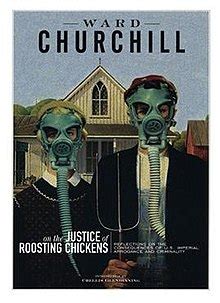
On the Justice of Roosting Chickens: Reflections on the Consequences of U.S. Imperial Arrogance and Criminality

by Ward Churchill

AK Press (2003)

Book Review

With the massive evidence compiled by the 9-11 Truth movement over the last two decades,* the book’s original premise has ceased to be relevant in 2020. Long time American Indian activist Ward Churchill took the title of this book from his infamous 2001 essay “On the Justice of Roosting Chickens.”  In the latter (and in Chapter 1), Churchill argues that the 9-11 attacks were a natural and unavoidable consequence of unlawful US foreign policy. The essay would lead to his dismissal from the University of Colorado-Boulder in 2017.

By the time this book was published in 2003, both Thierry Meyssan (The Big Lie) and Nafeez Ahmed (The War on Truth) had published books questioning the official version of 9-11. As of February 2002, there was also a thriving 9-11 Unanswered Questions movement, which would be the precursor to 9-11. I’m a little surprised Churchill would have no knowledge of activists who were already challenging the official story in 2003.

That being said, the book’s second and third chapters are invaluable. Chapter 2 compiles all US military actions from 1776 on. Chapter three documents all known US violations of international law dating from the 1945 founding of the United Nations.

After 1947, this list includes the use of CIA interventions to overthrow lawful governments:

  • US invasion and occupation of sovereign Native American territories – 46
  • US military actions against US civilians during protests, rebellions, riots, and strikes (including WACO, Ruby Ridge, and the 1999 anti-WTO protests in Seattle) – 23
  • US troop deployment to put down slave revolts: 5
  • US military actions against
    • North Africa – 15
    • Mexico (excluding the US-Mexican War, which forced Mexico to give up have its territory) – 29
    • France (including 1961 attempted assassination of DeGaulle) – 4
    • Spain (excluding Spanish American War) – 6
    • Cuba (following Spanish American War) – 5
    • Canada – 1 (1837 border clash)
    • Pacific Island (excluding Hawai’i and Philippines) – 5
    • Greece – 3
    • South America – 19
    • China (excluding participating in civil war against Mao) – 15
    • Sub-Saharan Africa – 8
    • Turkey – 2
    • Central America – 19
    • Japan (prior to World War II) -3
    • Korea (prior to World War II) – 33
    • Hawai’i – 3
    • Haiti (prior to deposing Prime Minister Aristide in 1991) – 4
    • Philippines – 4
    • Dominican Republic -5
    • Cuba (prior to Cuban revolution – incursions following the Bay of Pigs are too numerous to count) – 2
    • USSR – 2
    • Greenland/Iceland – 1 each
    • Italy – 1
    • Iran (prior to 1953 CIA coup) – 1
    • Albania – 1
    • Syria – 1 (failed CIA coup in 1956)
    • Indonesia – 2
    • Cyprus – 1
    • Lebanon – 2
    • Grenada – 1
    • Australia – 1

Chapter 3 is a chronological history of UN Security Council and General Assembly resolutions condemning the US. It includes censures  for using napalm and Agent Orange in Vietnam, for using torture and the death penalty in US prisons, for their refusal to support the UN declaration for the elimination of racism, for their illegal blockade against Cuba, and for their illegal invasions of Angola, Panama and Nicaragua.

The chapter also includes countless Security Council and General Assembly resolutions condemning South Africa (not only for Apartheid but for the illegal invasion and occupation of Namibia and Angola) and Israel (for their illegal occupation of Palestine and the Golan Heights, their illegal invasion and 20+ year occupation of Lebanon, and their illegal deployment of nuclear weapons).

Here Churchill also covers Clinton’s illegal war against Yugoslavia, debunking most of the pro-war propaganda about alleged Serbian genocides. And finally the illegal 1972 CIA coup against democratically elected Australian prime minister Gough Whitlam (after he withdrew Australian troops from Vietnam). I was unaware prior to reading this book that John Kerr,** the Australian governor general responsible for removing Whitlam from office was a long time CIA asset.


*See https://stuartbramhall.wordpress.com/2020/02/13/making-sense-of-9-11/

**In Australia and New Zealand, the Governor General is appointed by the British monarch and technically has the authority to overrule Parliament. See https://www.theguardian.com/commentisfree/2014/oct/23/gough-whitlam-1975-coup-ended-australian-independence