Africa’s Hidden History

All Watched Over By Machines of Loving Grace*

Directed by Adam Curtis

BBC (2011)

Part 3

Film Review

The basic theme of the final video is this series is a bit unclear. Curtis seems to imply, based on flimsy and subjective evidence, that western liberals who provide humanitarian and developmental assistance to third world countries only make their living situation worse.

The main focus of Part 3 is the civil wars in Congo and Rwanda over valuable mineral resources coveted by multinational corporations. There’s a particular emphasis on coltan, a rare earth mineral essential in the manufacture of computers, play stations and smartphones.

The CIA Coup Against Lamumba

The film traces the history of the Congo back to 1960 when it first gained independence from Belgium. In 1961, after the Congo’s first president Patrice Lamumba allied himself with the USSR, the US and Belgium instigated a coup to remove him from power and had him murdered. Fearful that Congo’s rich mineral wealth would fall into Soviet hands, they replaced him with the brutal pro-western dictator Mobutu Sese Seko.

The Belgian Role in Rwanda Genocide

Curtis traces Rwandan history from their first episode of genocide, engineered by their Belgian rulers in 1959. Fearful that the Rwandans, like other colonized Africans, would demand independence, the Belgians deliberately instigated ethnic conflict by issuing mandatory race cards and promoting the myth that the Tutsis (which Belgium made colonial administrators) were a superior race that had migrated to Rwanda from ancient Egypt. Meanwhile Belgian aid workers encouraged oppressed Hutus (who comprised 85% of the population) to revolt. After three years of bloody civil war, Belgium granted Rwanda independence in 1962.

In 1994, the Hutus seized control of the Rwandan government and deliberately exterminated nearly a million Tsutsis. Hundreds of thousands of refugees fled across the border into Congo, where the UN and western aid agencies set up refugee camps. Curtis maintains it was a mistake to set up refugee camps because there were Hutu assassins hiding among the refugees. Armed conflict between Tsutsis and Hutus spread to rebel armies seeking to overthrow Mobutu. Hoping to win a piece of Congo’s mineral wealth, Zimbabwe, Angola, Chad, Namibia, Uganda and Libya all dispatched troops to support the rebels. Leaving more than five million dead, the civil war would continue until 2003.

I find it a bit puzzling that Curtis blames the UN and humanitarian organizations for fanning the flames of the Congo’s civil war. Surely most, if not all of the blame lies with the multinationals behind Mobotu’s dictatorship.

The Selfish Gene

Curtis interweaves his discussion of Congo and Rwandan history with relevant scientific research that endeavored to prove that humans are complex computer-like machines.

In 1967, population geneticist George Price allegedly proved that human beings were soft machines run by on board computers (i.e. DNA). A corollary of this hypothesis was that human beings commit murder and genocide because of a “selfish gene” which genetically programs us to hate a kill people who are genetically unrelated to us.

Price worked closely with evolutionary biologist Bill Hamilton who, based on his research, argued against providing medical treatment when people get sick because this causes genetically inferior people to survive and reproduce.

Dian Fossey’s Mountain Gorillas

A third narrative describes the work of primate ethnologist Dian Fossey who was studying Congo’s mountain gorillas during the decade-long civil war. My favorite scene depicts British naturalist David Attenborough stretched out on top of one of Fossey’s gorillas as they share a moment of relaxed contemplation.

*Title of 1967 monograph distributed free by California cybernetics enthusiast Richard Brautigan. Available for $400 from Abe Books

http://vimeo.com/73561591

Ecosystems, Cybernetics and the Club of Rome

All Watched Over By Machines of Loving Grace*

Adam Curtis

BBC (2011)

Part 2

Film Review

Part 2 in this series discusses how utopian ideas about computers led the scientific community to promote a totally erroneous model of natural ecosystems.

The term ecosystem was first defined by ecologist Arthur Tansley. He mistakenly believed that ecosystems work just like computers – that all of nature is linked through organized networks that self-regulate by means of feedback loops. As ecology became the predominant scientific discipline of the early seventies, he and his colleagues went so far as to portray these interconnected networks as electrical circuits. Meanwhile Silicon Valley computer engineers, heavily influenced by Ayn Rand’s radical individualism (earlier post), as well as this erroneous view of ecosystems, made a deliberate decision in 1968 to focus on personal computer technology rather than mainframe computers.

The work of Tansley and his colleagues would be totally discredited by new data that would emerge demonstrating were chaotic and unpredictable and tended towards wild fluctuations that never returned to an equilibrium point. Like many scientists, the early ecologists had oversimplified and distorted the data they collected to fit their model of nature as a self regulating system.

The Rise of Cybernetics

Meanwhile the scientific community’s fascination with computers would also give rise to the field of cybernetics, which looks at society as if human beings were a vast interconnected system of machines. Buckminster Fuller, inventor of the geodesic dome, was a strong proponent of this systems-oriented view of both nature and society. A strong egalitarian, Bucky envisioned a society (which he referred to as Spaceship Earth) that did away with authoritarian hierarchies and allowed people to live together as equal members of a closed system that would self-regulate – as a spacecraft does.

In the early seventies, disillusioned by the failure of the anti-Vietnam War, a half million young Americans left the cities to start experimental non-hierarchical communes in the countryside. It would be the largest mass migration in US history. Their goal was to create egalitarian communities in which people sacrificed their individuality for the benefit of the system.

Most of these communes would fail. Curtis blames their failure, without any real evidence, on a rigid absence of structure that allowed stronger and more dominant personalities to dominate and bully weaker ones. He likens the failure of the commune movement to the failed Color Revolutions* of the 1990s – which left Eastern European countries even more corrupt and unequal.

He seems to be making the case that egalitarian societies are impossible, which I strongly question. In my view the Color Revolutions failed for the same reason as the 2011 Arab Spring revolutions: because they were instigated, organized and funded by the CIA, State Department (and George Soros in the case of Eastern Europe) for the purpose of installing new governments favorable to US corporate interests.**

Enter the Club of Rome***

Two additional outcomes of the new field of ecology would be the formation, in 1968, of the elite roundtable group the Club of Rome and the first international environmental conference in Stockholm in 1972.

In 1972 the Club of Rome commissioned a study based on the theory that all human and natural activity was merely a vast interconnected system of feedback loops. The MIT computer scientists they hired developed a complex computer model based on the best population, resource, industrial production, agricultural production and pollution data. Their modeling, which the Club of Rome published in their 1973 bestseller The End of Growth, predicted major economic and environmental collapse in the first decade of the 21st century. The book maintained that the only way to prevent environmental and economic collapse was for western societies to give up their fixation with continuous economic growth.

The European left became extremely concerned that growth restriction would lock the ruling elite (who ran the Club of Rome) into their existing positions of privilege and power. They launched major protests against The End of Growth. They argued the proper role of the environmental movement should be to end the greed of political elites. That being said, the computer modeling on which the book is based predicted the 2008 economic collapse.


* Title of 1967 monograph distributed free by California cybernetics enthusiast Richard Brautigan. Available for $400 from Abe Books
**Serbia Otpor (Resistance) Revolution (2000), Georgia Rose Revolution (2003), Ukraine Orange Revolution (2004) and Kirghizistan Cotton Revolution (2005) – see The CIA Role in the Arab Spring

***The early Club of Rome was financed by corporate oligarch David Rockefeller, the Congress for Cultural Freedom (see  and the Ford Foundation. The two latter entities are well known conduits for CIA funding (see CIA-funded Foundations)


Ayn Rand, Alan Greenapan and the 2008 Crash

I’ve just discovered another exciting series of documentaries by Adam Curtis

All Watched Over By Machines of Loving Grace*

Adam Curtis

BBC (2011)

Part I

Film Review

Despite its deceptive title, this BBC documentary is about Ayn Rand and her immense influence over Silicon Valley and Rand devotee Alan Greenspan.

Prior to seeing the film, I had no idea about the cult following Rand inspired in the computer geniuses who flocked to Silicon Valley in the late sixties. Believing they could create a new kind of democracy by combining Rand’s radical individualism with computer technology, they set up Ayn Rand reading groups and named their children after her. They were convinced that linking computers in vast self-regulated networks would do away with the need for politicians and authoritarian hierarchies. However instead of decentralizing power, as they envisioned, the computer revolution only further concentrated the power of wealthy elites.

Rand called her underlying philosophy “objectivism” and disseminated it through her novels and a close-knit group of devotees. It was a philosophy of selfishness. She believed it was in the best interest of humanity for everyone to pursue their own rational self interest, unimpeded by religion or morality. She maintained that altruism was especially destructive, as it interfered with happiness and freedom.

Rand Devotee Alan Greenspan

Former Federal Reserve chair Alan Greenspan was an early member of Rand’s Collective, the small select group that met weekly to hear chapters of her newest novel. He married a fellow Collective member and remained fiercely loyal to Rand even after her sexual jealousy broke up the group.

After cunningly convincing one of her strongest supporters to follow his own self-interest by having an affair with her, she somehow persuaded his wife (also a Collective member) to commit the sin of altruism by agreeing to it. When he continued to follow his own self interest by becoming romantically involved with a younger woman, Rand brutally attacked him (verbally and physically) and ordered him out of the Collective.

The Most Powerful Man in the World

After becoming Federal Reserve chairman in 1987, Greenspan became the most powerful man in the world.** In 1993, he somehow persuade the newly elected Bill Clinton to cut taxes instead of restoring the social programs Reagan and Bush had cut (as he promised during his campaign). Greenpan argued this would cause markets to boom, enabling Clinton to repay the sizable federal debt he inherited from Reagan and Bush.

So Clinton cut social programs even further. Markets boomed, as Greenspan predicted, but not because of tax cuts. The real cause was an enormous credit bubble by massive Wall Street lending to unstable Southeast Asian markets. All the Wall Street banks erroneously believed that feedback loops in their computer networks would protect them by allowing them to hedge (bet against) their risky loans.

Greenspan Recognizes His Error

By 1996, even Greenspan could see that productivity wasn’t increasing despite the massive increase in profits. He tried to warn Congress that stocks were overvalued in his December 1996 “rational exuberance” speech.*** The corporate media crucified him and he recanted, acknowledging that computers might be increasing productivity he ways he couldn’t decipher.

Robert Rubin Launches Indonesian Coup

The credit bubble Wall Street created in Southeast Asia led Thailand, Malaysia, South Korea and Indonesia built thousands of homes and commercial buildings that couldn’t be sold. In 1997, the bubble burst. Clinton, who was busy being impeached over Monica Lewinsky, was powerless to act. He allowed his Treasury Secretary, former Goldman Sachs executive Robert Rubin, to take over his Southeast Asia policy. Rubin, in turn, organized an attempted coup against Indonesian president Suharto for refusing to accept an IMF bailout.

Faced with massive civil unrest, Suharto eventually accepted the bailout and the structural adjustment conditions the IMF imposed (massive cuts in government spending on food subsidies and other social services, throwing millions of people out of worked). As typically happens, the IMF bailouts went to pay off the Wall Street banks. While the IMF-imposed austerity cuts (helped along by currency trader George Soros) led the currencies of all four countries to collapse. Residents of Thailand, Malaysia, South Korea and Indonesia were plunged into abject poverty comparable to the Great Depression of the 1930s.

China Escapes from Wall Street Domination

The most important outgrowth of the 1997-98 Southeast Asia economic crisis was a major shift in Chinese economic policy. Determined to remove themselves from Wall Street domination, China’s leaders devalued their currency, flooded the US with cheap consumer goods and used their profits to finance growing US indebtedness by buying US Treasury bonds.

In the mean time, Greenspan cut interest rates to near zero percent and the US was flooded with trillions of dollars of cheap (borrowed) money. Wall Street, in turn, recycled these funds as subprime loans to the third world population in American ghettos.

Again believing computers would keep them safe, Wall Street banks created the largest credit bubble in history. When it burst in 2008 Wall Street, as usual, got bailed out. This time Americans paid for the bailout, as they were plunged into widereaching soul-crunching misery.

The documentary features fascinating archival interviews with Rand and members of her Collective.


* Title of 1967 monograph distributed free by California cybernetics enthusiast Richard Brautigan. Available for $400 from Abe Books
**On reflection, it seems a great pity Rand didn’t have the affair with Greenspan. We could have been spared the 2008 economic crash.

***”How do we know when irrational exuberance has unduly escalated asset values, which then become subject to unexpected and prolonged contractions as they have in Japan over the past decade?”


http://vimeo.com/38724174

The History of CIA-Funded Foundations

who paid the piper

Who Paid the Piper: The Cultural Cold War1

by Frances Stoner Saunders

Granta Publications (1999)


Book Review

Who Paid the Piper: The Cultural Cold War is about the covert “cultural” propaganda the CIA carried out between 1950 and 1967. The Congress for Cultural Freedom, the centerpiece of this operation, had offices in 35 countries, published over 20 magazines, held art exhibitions and provided major financial support for American artists, poets, authors and playwrights. Its primary purpose was to “nudge” the intelligentsia of Western Europe away from Marxism and communism towards a more accommodating view of US interests.

At the end of World War II, Europeans tended to view the US as “a culturally barren nation of gum chewing, Chevy driving, Dupont-sheathed Philistines.” To counteract this stigma, Truman issued an appendix to executive order NSC-4A, directing the CIA director to undertake covert psychological activities in support of American anti-Communist policies.

As Saunders details, this strategy included CIA support for both US and foreign Non-Communist Left (NCL) organizations, trade unions who agreed to weed out “dangerous radicals” and leftist intellectuals. The rationale was to create and support “parallel” organizations to provide an alternative to Communist groups over which the CIA had no control.

A strong advocate of this approach was “liberal” Kennedy adviser and biographer Arthur Schlesinger, a long time member of the Congress for Cultural Freedom. He was one of the few non non-CIA employees Congress members who knew the CIA was running it. Schlesinger also sat on the executive committee of Radio Free Europe, which the CIA set up in 1950.

Without Budgetary Limits or Oversight

Over the next two decades the CIA acted as a de facto ministry of culture, pumping millions of dollars into the Congress for Cultural Freedom. The Congress had no budgetary limits and was accountable to no one for the way they spent their money.

Via the this front organization, the CIA built the reputations of numerous American composers by funding European premiers of their work. Among the most prominent were Samuel Barber, Leonard Bernstein, George Gershwin, Menotti and Aaron Copeland.

They also financed European performances of American plays, in essence solidifying the careers of Lillian Hellman, Eugene O’Neill, Thorton Wilder, Tennessee Williams, William Saroyan, Clifford Odets, and John Steinbeck.

And paid for the European distribution of American books, by authors such as Louisa May Alcott, Faulkner, Hemingway, James Thurber, Edith Wharton, Thomas Wolfe, T.S. Eliot and socialists Norman Cousins and Carl Sandburg.

The Wall Street Families Who Started the CIA

Who Paid the Piper focuses heavily on the personalities of the men who founded the Office for Strategic Services (OSS), which in 1947 would evolve into the CIA. Nearly all were from wealthy Ivy League and Wall Street families who attended the same cocktail parties and sent their kids to the same prep schools. They automatically identified the “American way” with the privileges of their class, including a well-rounded classical education. During this period, it was fairly common for high level CIA officers to edit literary magazines, as well as publishing poetry and fiction and writing book reviews for the New York Times.

The Rise of CIA-Funded Foundations

Although Tom Braden, director of the CIA’s International Operations Division (IOD), ran the Congress, on paper it appeared to drive its funding from “pass-through” foundations. The best known foundations serving as a conduit for covert CIA funds were (are?) the Ford Foundation, the Rockefeller Foundation, the Kaplan Foundation, the Whitney Trust and the Farfield Foundation. Many of these foundations set up separate administrative units to handle CIA pass through money and collaborate with them on specific projects.

Arthur Schlesinger sat on the board of Farfield Foundation, as did William van den Heuvel, another prominent liberal close to the Kennedy family (and father of Katherine van den Heuvel editor of the “left leaning” Nation magazine).

C. D. Jackson, long time managing director of Time-Life International was another high profile Congress member.2 The Congress also assigned a full time CIA operative to Paramount pictures. His role was to edit and reject scripts that portrayed the US in an unfavorable light.

Tom Braden Goes Public

In 1966, details of the CIA role in the Congress for Cultural Freedom were leaked to the radical zine Ramparts and ended up as a New York Times expose. A few months later Braden, who left the CIA in 1956, published a confessional in the Saturday Evening Post. In “I’m Glad the CIA is Immoral,” he brags about all the reporters and trade unions on the CIA payroll when he ran the OID.

A growing body of research indicates that the CIA continues to fund the Non-Communist Left. Based on the work of Sherman Skolnick, Bob Feldman, Brian Salter and others who research the 990A tax returns of so-called “liberal” foundations, CIA pass-through foundations are clearly alive and well.

Frequently referred to as “Left Gatekeeping Foundations,” they fund numerous so-called “alternative” media outlets. This may be why the Nation, Democracy Now, FAIR and similar outlets that rely on pass-through founding categorically refuse to cover the 9-11 Truth movement or the clear government role in the assassinations of the Kennedy brothers and Martin Luther King.


1The book was published in the US under the title The Cultural Cold War: The CIA and the World of Arts and Letters. The CIA has posted a review of the US edition on website
2In 1953-54, Jackson was instrumental in establishing the Bilderberg Group. In 1963 he purchased the Zapruder film of the JFK assassination and kept it out of the public domain by locking it in a Time-Life vault for 15 years.

In the following video, liberal feminist Gloria Steinem discusses the funding she received from the CIA for her work:

Originally posted at Veterans Today

Portrait of a Pathological Killer

tilikum

Classic PTSD in an orca (killer whale)

Blackfish
Gabriela Cowperthwaite (2013)

Film Review

Blackfish is a psychological study of a 33 year old orca whale who performs at SeaWorld in Orlando, Florida.

Despite their fearsome nickname (“killer whales”), orcas don’t eat people. They have diverse diets, with individual populations preferring fish, marine mammals and even other whale species.

In the wild they have a reputation for approaching human beings with friendliness and curiosity. Even in captivity, their demeanor towards their trainers is generally docile and friendly.

Over the course of 20 years, Tilikum has killed three people, two trainers and a member of the public who sneaked into his pen after hours. As Blackfish documents, this is on top of several near death incidents in which trainers were seriously injured. Viewers will be particularly impressed that the murders were premeditated. Tilikum exhibits clear planning and malicious cunning in all of his attacks. If he were human, he would be charged with first degree murder.

The film offers an accurate and convincing account of the severe psychological trauma Tilikum and other orcas endure in captivity, where their lifespan is foreshortened by 75 years. The film combines testimonials from whale hunters and researchers, OSHA (Occupational Safety and Health Agency) experts and lawyers and SeaWorld executives to give a glimpse of the close net clan groupings orcas form in the wild and the severe trauma they experience when they are captured to perform at SeaWorld.

There are three particularly heart wrenching scenes where SeaWorld management forcibly separates orca mothers from their calves – against the advice of their trainers.

I have always strongly suspected orcas were more intelligent than human beings. Based on the events described in this documentary, they are clearly more intelligent than the people who run SeaWorld.

OSHA’s successful prosecution of SeaWorld in 2011 resulted in a $75,000 fine and a ruling requiring SeaWorld to install physical barriers between orcas and their trainers. Unbelievably SeaWorld appealed the ruling, fearing their ticket take would suffer if trainers ceased to interact with the orcas in the water.

In April 2014, the Court of Appeals upheld the OSHA ban.

At present, there is an international campaign to pressure SeaWorld to allow Tilikum to participate in a stepwise ocean release program. You can sign the petition here: http://www.freetillynow.org/


http://www.dailymotion.com/video/x1iepl4_blackfish-find-out-what-really-happens-at-seaworld_animals

The Earliest Recorded Direct Democracy

This is the first of four posts about experiments in direct democracy, where ordinary people assume responsibility for running society. The first, over 4,000 years old, is a recorded account of early Frisian society prior to the Roman conquest of Gaul in 52 BC. Imperial Rome dismissed the Frisians and other Germanic tribes as barbarians for the same reason Europeans dismissed Native Americans as savages: because they owned the land communally and rejected authoritarian governance.

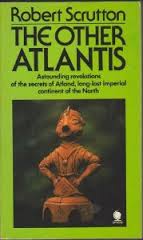
the other atlantis

The Other Atlantis

By Robert Sutton (Neville Spearman Limited 1977)

Book Review

The Other Atlantis concerns an extremely controversial manuscript called the Oera Linda Book (OLB). It concerns the ancient history of the Frisians, a Dutch ethnic group. The OLB was dismissed as a hoax almost immediately after its publication in 1872. During the 1930s, Heinrich Himmler and Nazi occultists heavily promoted the book, believing it support their theories of racial purity and an Aryan master race. This would make the OLB even more controversial. For decades, it was illegal in the Netherlands to even quote from the Oera Linda Book.

The OLB purports to be the history of a lost seafaring island civilization northeast of Scotland. Called Aldland or Atland, it was destroyed by a unknown geological cataclysm in 2092 BC. The writings contained in the OLB were recorded between 559 BC and 803 AD by the descendants of Frisian refugees who settled in Denmark and the Low Countries (Netherlands, Belgium and Luxemburg). The early chapters of the OLB derive primarily from wall inscriptions preserving the history and religious laws of ancient Atland.

For eleven centuries, successive generations of a Frisian family recopied the manuscript in the original runic* script. In 1256 Hiddo Over de Linda copied it on new cotton paper imported from Spain. It remained the exclusive property of the Over de Linda family until 1867, when shipwright Cornelius Over de Linden allowed a Frisian scholar to translate it into modern Frisian. In 1872, it was published in Dutch and English.

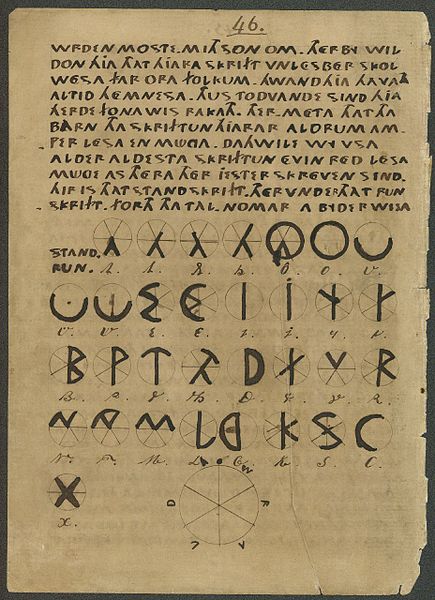
435px-Manuscript_Thet_Oera_Linda_Bok,_pagina_48From p46 of the OLB explaining how runic script derives from the 6 spokes in a wheel

The debate over its authenticity continues to the present day. Most online OLB sites are in Dutch, though I found one in English at Speculative History – Oera Linda Book

Is the Oera Linda Book a Forgery?

If OLB is a forgery, it’s an extremely ingenious one. As yet, no one has identified the presumptive forger or forgers. They would have to have a detailed knowledge, not only of ancient Frisian and runic script, but of ancient paper and ink making, Frisian oral history, ancient maps depicting an ice-free Antarctica and Arctic Circle, and Mediterranean, Indian, and South American pre-history. Additionally they would need to have foreknowledge of archeological finds that wouldn’t occur for another hundred years.

The book was dismissed as a forgery almost immediately after its 1872 publication. I suspect this relates to a bias Europeans inherited from the Romans that non-hierarchical societies are incapable of advanced civilization.

The only substantive evidence against its authenticity was a spurious allegation that the paper dated from the 19th century and was produced by machine. These claims were soundly dismissed in the forward to the second edition by the original translator. He establishes (quite convincingly, in my view) that the paper and ink are handmade and consistent with paper and ink produced prior to the 1300s.

Carbon dating would be the conclusive test of the age of the paper the OLB is printed on. Either this hasn’t happened or the results are being suppressed. As one commenter points out at the Speculative History site, evidence that the paper was produced more recently than 1256 in no way negates the OLB’s authenticity. It seems highly likely that one or members of the Over de Linda family made copies of the 1256 manuscript to ensure its preservation.

How Atland was Governed

Sutton clearly supports the authenticity of the OLB, and provides plentiful archeological and historical data supporting the ancient history it lays out.

In Atland political rule was matriarchical because women “were the informed conscience of more practically and physically inclined men.”** Priestly virgins served under a eeramoeder (earth- mother), who was the overall chief of the Burgtmaagden (bourough-maids). The eeramoeder was democratically chosen by the people she ruled and could be banished or put to death for abusing her power.

All land and forests were owned in common, except for a small plot of land behind each home. Individuals from prohibited from accumulating possession and power that would enable them to control others. Atland was operated as a democratic welfare state where the sick and disabled were looked after. Government was financed by a sales tax charged on merchants at a central marketplace.

Oral Histories Recorded in OLB

Some of the intriguing oral histories laid down in the OLB include those of

• a Frisian explorer named Inka who sailed across the Atlantic and founded the Inca dynasty in Peru (around 2000 BC)
• a Frisian adventurer named, who was later deified as the Norse god Odin or Woden.
• a Frisian sea king named Neef-Teunis (cousin Teunis) who led a colony of Frisians to settle in Phoenicia in 2000 BC. He, too, would be deified as the Greek and Roman god Neptune.
• a Frisian explorer and philosopher named Minno who introduced Frisian civilization to the island of Crete in 1100 BC. He would found a dynasty of kings who took the name Minos.
• a Frisian princess named Min-Erva Nylhellenia who founded the Greek city of Athens in 1250 BC. She, too, would be deified as the Greek and Roman goddess Minerva.
• the banishment of Atland citizens who defied religious laws to a penal colony Westland, the ancient name for the British Isles.
• The use by Alexander the Great of Punjab settlers of Frisian origin to build ships to aid in the conquest of India.

*Runic scripts were those used by Germanic peoples to record written language prior to their conversion to Christianity, when they adopted Roman script.
**Sounds pretty good to me

People can access an English translation of The Oera Linda Book here

I would like to acknowledge fellow Green Party member Dawn Bowen for making me aware of this fascinating book.

38 States Call for Constitutional Convention


Washington_Constitutional_Convention_1787

Can Red and Blue States Unite to Save Democracy?

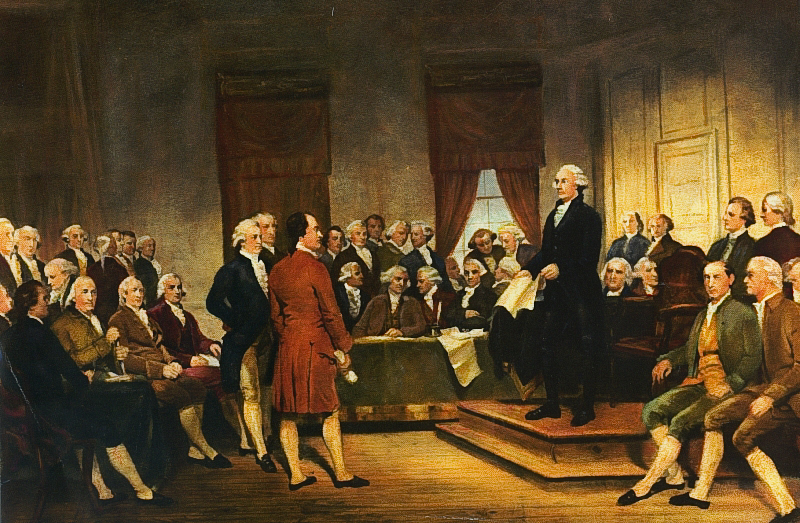
One news item receiving virtually no corporate media attention is that thirty-eight state legislatures have officially requested a constitutional convention under Article V of the US Constitution. There has only been one constitutional convention – the first – in 1787. Article V requires Congress to call a constitutional convention if 2/3 of (34) states request one.

Most, but not all the resolutions are from red states calling for a balanced budget amendment. However two blue states, California and Vermont, have requested a constitutional convention to end corporate personhood and restrict corporate funding for elections.

Tallying the numbers is a bit complicated. According to the Congressional Record, forty-nine states* have requested constitutional conventions. Eleven of these forty-nine states later rescinded their requests.

ALEC Seeks to Restrict Delegate Freedom

Forbes Magazine argues you also have to subtract the states which have passed a delegate limitation act. This would prohibit delegates from considering any amendments other than those requested by their state.

The American Legislative Exchange Council (ALEC), the lobby group founded and funded by the billionaire Koch brothers, is very keen to see all states pass a delegate limitation act and have even drafted model legislation.

ALEC and the corporations they represent believe the delegates to a constitutional convention must be closely controlled to prevent a runaway convention from passing amendments unfriendly to corporate interests – e.g. an amendment ending corporate personhood and limiting the ability of corporations to overrule state and municipal laws. Three states (Georgia, Indiana and Florida) have passed delegate limitation legislation. Another seven states (Idaho, Michigan, New Hampshire, Oklahoma, South Dakota, Virginia, and Wisconsin) are considering it.

Using a Balanced Budget Amendment to Abolish the Fed

Clearly ALEC is calling for a balanced budget amendment in the hope it will force the federal government to cut spending for Social Security, Medicare and other social programs. This strategy could backfire if it leads to a debate on abolishing the Federal Reserve and stripping private banks of their power to create money.

Eliminating federal debt will be extremely difficult, if not impossible without scrapping a system in which nearly all our money is produced as debt (i.e. loans by private banks). There’s growing grassroots support on both the right and the left to abolish the Fed (see James  Corbett’s excellent documentary explaining how banks create money out of thin air.) A constitutional convention could be the ideal scenario to make this happen.

Why Red and Blue States Need to Work Together

red and blue states

California and Vermont are only the first of many blue states in the Move to Amend coalition seeking a constitutional convention to end corporate personhood. The vital question here is whether red states seeking a balanced budget amendment will be open to talking to blue states seeking to limit the de facto ability of corporations to overturn state and municipal laws.

The corporate media has been extremely cagey of late about magnifying the distrust and enmity between the two camps. I find this quite sad as there are many issues on which the so-called “extreme” right and left agree, like ending NSA spying, ending the wars in the Middle East, abolishing the Fed, restoring civil liberties guaranteed under the Bill of Rights, ending the President’s abuse of executive power and curtailing the power of the corporate oligarchy.

I think it’s a very good sign that a non-partisan group called Friends of the Article V Convention is keeping count of the states. There has been some talk the Friends may file suit if Congress fails to set wheels in motion for a constitutional convention.

States Seek Broad Range of Amendments

In addition to requesting a constitutional convention to pass amendmentss calling for a balanced federal budget and an end to corporate personhood, various state petitions seek amendments to limit federal income taxes, to begin negotiations for a world federation (i.e. one world government), to change apportionment for the Electoral College and the House of Representatives, to increase federal revenue sharing, to end federal interference in school management, to guarantee a right to life, to end unfunded federal mandates, to end judicial taxing power, to establish term limits for federal office holders and to restrict new laws to a single subject.

There are a few more I would add to this list, including constitutional amendments abolishing the Electoral College, restoring Posse Comitatus and limiting the ability of the President to rule via executive order. I’m sure readers have their own personal favorites.

*The 49 states which have formally requested a constitutional convention:

  • Alabama: balanced budget, June 2011
  • Alaska: federal fiscal restraints and term limits, April 2014
  • Arizona: ending judicial taxing power, Mar 1996, rescinded 2003
  • Arkansas: right to life amendment, May 1977
  • California: abolish corporate personhood, June 2014
  • Colorado: unfunded federal mandates, June 1992
  • Connecticut: prohibit interstate income tax, May 1958
  • Delaware: balanced budget amendment, Feb 1976
  • Florida: balanced budget, term limits, limit laws to 1 subject, April 2014
  • Georgia: balanced budget, Feb 2014
  • Idaho: limit income tax, April 1989, rescinded 1999
  • Illinois: increase federal revenue sharing, June 1976
  • Indiana: right to life, balanced budget, 1977, 1979
  • Iowa: balanced budget, June 1979
  • Kansas: balanced budget, May 1978
  • Kentucky: change apportionment for House, Oct 1965
  • Louisiana: balanced budget, May 2014
  • Maine: limit income tax, April 1941
  • Maryland: right to life, Jan 1977
  • Massachusetts: right to life, 1977
  • Michigan: balanced budget, Nov 2013
  • Minnesota: change apportionment for House, May 1965
  • Mississippi: right to life, Feb 1979
  • Missouri: unfunded federal mandates, Mar 1993
  • Montana: change apportionment for Electoral College, Mar 1973, rescinded 2007
  • Nebraska: balanced budget, April 2010
  • Nevada: right to life, unfunded federal mandates, June 1979
  • New Hampshire: balanced budget, May 2012
  • New Jersey: right to life, April 1977
  • New Mexico: balanced budget, Feb 1979
  • New York: federal interference with school management, Oct 1972
  • North Carolina: balanced budget, Feb 1979
  • North Dakota: end judicial taxing power, Mar 1996
  • Ohio: balanced budget, Nov 2013
  • Oklahoma: change apportionment for Electoral College, May 1965, rescinded 2009
  • Oregon: balanced budget, Feb 1979, rescinded 1999
  • Pennsylvania: balanced budget, Feb 1979
  • Rhode Island: right to life, May 1977
  • South Carolina: balanced budged Feb 1979, rescinded 2004
  • South Dakota: unfunded federal mandates, rescinded 2010
  • Tennessee: balanced budget, April 2014
  • Texas: balanced budget, Mar 1979
  • Utah: right to life, rescinded 2001
  • Vermont: corporate personhood, April 2014
  • Virginia, change apportionment for House, May 1964, rescinded 2004
  • Washington: change apportionment for House, Mar 1963
  • West Virginia: increase federal revenue sharing, Jan 1971, rescinded 2001
  • Wisconsin: change apportionment for Electoral College, Mar 1963
  • Wyoming: change apportionment for House, mode of amending constitution, Feb 1963, rescinded 2009

Photo credit Wikimedia Commons

Also posted in Veterans Today

The Corporate/CIA Role in the Rise of Fundamentalism

thy will be done

Thy Will Be Done: The Conquest of the Amazon: Nelson Rockefeller and Evangelism in the Age of Oil

By Gerard Colby and Charlotte Dennett

1995 Harper Collins

I recently picked up this book again – after reading it when it first came out nearly 20 years ago. Charlotte Dennett, one of the authors, got a of media attention prior to Obama’s election in 2008, due to her her efforts to bring murder charges against George W. Bush.

Thy Will Be Done lays out the systematic economic colonization of the Amazon Basin by US corporate interests (led by Nelson Rockefeller) and the CIA – and their unscrupulous use of fundamentalist missionaries and Bible translators to indoctrinate and displace indigenous tribes who stood in the way of clear cutting for agriculture and oil and mineral extraction.

As CIA-liaison during the Eisenhower administration, Rockefeller developed close and enduring relationships at the CIA. This would lead to an ongoing collaboration in opening up Central and South America – and Southeast Asia – to U.S. corporate interests.

In addition to examining the Rockefeller/CIA campaign to introduce fundamentalist Christianity to the native tribes of Central and South America, this 960-page book also catalogs, in extensive detail, the full range of illegal CIA activities (and direct or indirect involvement of Rockefeller and the Rockefeller Foundation) under Eisenhower, Kennedy, Johnson, Nixon, Ford and Carter.

The book also chronicles the CIA role in installing brutal genocidal dictatorships in Guatemala and El Salvador.

The material presented is from presidential libraries, declassified documents and Congressional. It’s meticulously referenced and features a comprehensive index.


How Big Money Controls the White House

prezpuppetry_DV

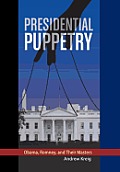
Presidential Puppetry: Obama, Romney and Their Masters

by Andrew Kreig (Eagle View Books 2013)

Book Review

Presidential Puppetry is a comprehensive expose of the wealthy corporate interests who are the real power behind the federal government. Kreig orients his book around Obama and Romney, the major presidential candidates in the 2012 elections. However in discussing Mitt Romney’s hidden ties to the financial oligarchy, he also explores the Bush family’s Wall Street connections, the history and structure of the Mormon Church (especially as it relates to corporate America) and Karl Rove’s role in orchestrating Republican dirty tricks and voting fraud. Presidential Puppetry is meticulously researched and sourced, with a 17 page bibliography and 110 pages of footnotes and references.

Kreig, a lawyer and respected Washington DC journalist, takes the 2012 presidential debates as his point of departure, noting the deliberate secrecy of both candidates around their personal background. This deliberate secrecy should have been a campaign issue. Yet neither raised it in the debates – there seemed to be a gentleman’s agreement not to do so. Kreig is also scathingly critical of the mainstream media’s failure to challenge either the secrecy or corrupt corporate influences it concealed.

Obama Was Groomed

For his part, Obama refused to release any of his university transcripts, as well as having his passport records secretly scrubbed at the State Department. According to Kreig, this refusal to release educational records is unprecedented, especially for a candidate with virtually no public record of their political background or views. Kreig believes there are two reasons for Obama’s secrecy about his records from Occidental College, Columbia University and Harvard Law School. The first was to conceal his early links to the CIA, via a CIA front organization he worked for called Business International Corporation (BIC). The second was to hide his early “grooming” for political office by Zbigniew Brzesinski and possibly other members of Bilderberg, the Council on Foreign Relations (CFR) and the Trilateral Commission. All three are secretive round table groups that allow wealthy financial elites access to major public officials.

By tracing the background of the Bush, Carter, Clinton and Reagan presidencies, Kreig makes a very compelling case that the ruling elite selects and grooms individuals it offers up to us as presidential candidates. What’s more, of our past five presidents, only George W Bush has no documented history of working for US intelligence. Krieg alleges Reagan secretly passed information to the FBI about Hollywood leftists, Bush senior performed various services for the CIA as founder and director of Zapata Oil Company, and Clinton informed on anti-Vietnam War protestors as a Rhodes Scholar at Oxford.

Romney’s Cayman Island Tax Shelters

Romney’s big secret was his tax returns. It’s standard for presidential candidates to release ten years of returns. What the Republican candidate sought to conceal, according to Kreig, was systematic tax avoidance that included a Swiss bank account and tax shelters in the Cayman Islands. Both the Democrats and the corporate media failed in their duty to the public by refusing to bring any of this to light.

Broken Campaign Promises and a Trail of Bodies

Kreig goes on to examine Obama’s first term in light of his hidden history. The American people thought they were voting for a progressive community organizer but ended up with someone even more pro-Wall Street and pro-war than his Republican predecessor.

The most disturbing aspect of the book relates to cases Kreig details in which both Republican and Democratic insiders have tried to expose corporate interference with specific federal office holders. Largely owing to the refusal of the corporate media to support these whistleblowers, many have ended up dead under suspicious circumstances or in prison on trumped up charges.

Kreig tries to finish on an optimistic note by reminding us of all the brave independent journalists (on whose work Presidential Puppetry is based) whose investigative work is beginning to give us a true picture of how our so-called democracy really works. He encourages people (I assume he means whistleblowers) to send him tips (i.e. leaks) via his Justice Integrity Project website.

A recent post there is a moving tribute to the late John Judge, past president of the Coalition on Political Assassinations. The latter archives and promotes scholarly research offering alternatives to official accounts of the JFK assassination and other high profile political deaths, including those of Robert Kennedy, Malcolm X and the Rev. Martin Luther King Jr.

Originally published in Dissident Voice

The History and Politics of Food Preservation

salt

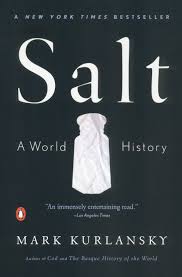
Salt: A World History

by Mark Kurlansky (2002 Penguin Books)

Book Review

Salt: A World History is a detailed chronology of the role the salt trade has played in human history. Prior to the 20th century, salt’s role in food preservation made it vital to all commercial trade. The mining and manufacture of sodium chloride has also be essential in gunpowder production, silver mining and more than 100 other industrial processes.

In addition to providing a comprehensive review of global technological refinements in salt mining, extraction and manufacture, this book also provides a detailed history (including recipes) of the dietary habits of pre-industrial societies. This part of the book should be of particular interest to sustainability and holistic health activists seeking out traditional methods of food fermentation and preservation as an alternative to processed food. Owing to a new diet I started six months ago to treat a Clostridium difficile infection (see The Care and Feeding of Intestinal Bacteria), fermenting veggies from my garden has become a core part of my daily routine.

Sodium Deficiency and the Rise of Salt Mining

Archeological evidence suggests that plant domestication and the rise of agriculture 10,000 years ago led to a sodium deficiency not present in the diets of hunter gatherer societies. That the agricultural revolution forced our early ancestors seek out surface salt deposits (i.e. salt licks), like other large mammals.

The earliest known salt works are found in Chinese archeological sites dating back to 6,000 BC. Like the rest of Southeast Asia, the Chinese used salt to ferment (pickle) fish, soybeans and other vegetables. The ancient Egyptians were the first to trade preserved foods with other cultures. In the third century BC, they traded salted fish with the Phoenicians for cedar, glass and purple dye from seashells.

Salted fish, olives and other vegetables were also a mainstay of early Greek and Roman diets. After the Romans conquered the Celts in northern Europe, they also adopted the Celtic practice of using salt to preserve ham and other meat. Archeologists have discovered elaborate Celtic salt mines in northern Germany dating from the Roman conquest.

The Basques*, the first to develop commercial whaling (670 AD), also manufactured salt to preserve whale meat. After discovering massive schools of cod in the North Atlantic, Vikings from Scandinavia settled the Ardour River just north of the Basque provinces. For the next few centuries, the Basques salted this cod and dominated the cod trade with the rest of Europe.

Control of the salt and codfish trade would trigger numerous European wars over the next few centuries – with England gaining exclusive control of the Newfoundland fishing grounds in 1759.

Salt in the New World

The history of the Americas is also one of constant warfare over salt. The Aztecs controlled their salt routes through military conquest and exacted a salt tribute from their subjects. The arrival of the Spanish in South and Central America significantly increased demand for salt. The Spanish conquistadors required salt to raise beef and dairy cattle, as well as for tanning hides and separating metallic silver from silver ore.

Control of the salt trade and salt taxes also figure prominently in the American Revolutionary War, the French Revolution and Ghandi’s movement to end British rule in India.

The Decline of the Salt Trade

Thanks to the advent of industrial scale canning, refrigeration and fast freezing technology, the salt trade lost its global importance in the early 20th century. Fermented foods still play an important role in many Asian and a few European cultures – both for health reasons and for their importance to cultural identity.

*The Basque people are an indigenous, non Indo-European people who currently inhabit a region in the Pyrenees straddling France and Spain. DNA evidence suggests they have inhabited the area for roughly 7,000 years.