Suppose They Gave a War and No One Came?

Christmas_Truce_1914_IWM_HU_35801

The 2014 Christmas Truce

2014 year marks the 100th anniversary of the Christmas truce during World War I. On December 25, 1914, two-thirds of the Western Front (roughly 100,000 British and German troops) spontaneously exited their trenches to exchange chocolate, cigarettes, brandy rum and souvenirs. They took photos of themselves together, played football (soccer) and shared gripes about the war and their superior officers. In some areas, the truce continued for days.

Short truces between British and German units dated from early November 1914, when static trench warfare began. The close proximity of trench lines made it easy for opposing armies to shout greetings to each other. It seems to have been the most common method for arranging informal truces during to attend to the wounded and collect the dead for burials. Several British soldiers recalled instances of Germans asking about the outcome of important football matches.

This 1981 BBC documentary features interviews with two British veterans of the Christmas truce. One vet describes how his unit pre-scheduled a second truce on New Year’s Day because the Germans wanted to see how the pictures turned out. Because they traded caps and jackets, it’s impossible to distinguish the opposing armies in the photo above.

High Command Livid

Soldiers naturally wrote home to their families about the impromptu truce. The British high command was livid when the New York Times broke the story on December 31, 1914.

Over the next three Christmases they issued strict orders that any troops who fraternized with German soldiers would be court martialed for treason. Despite the dire warnings, a few British troops participated in spontaneous celebrations with German soldiers in December 1915.

The German Revolution that Ended World War I

Thanks to the Christmas truce, soldiers on both sides made the shocking realization they had more in common with each other than with their superior officers – despite the intense propaganda they were fed by their respective governments. In 1918, a longer better organized mutiny would force the German Kaiser to surrender to the Allies.

Mainstream history textbooks go on at length about the 1917 Russian revolution that ended Russian participation in World War I. They rarely mention that the revolution spread to Germany the following year. A combination of revolutionary fervor and severe food and fuel shortages would lead to a series of three mutinies by German sailors.

During the third mutiny, on Oct 29, sailors stationed in the port city Kiel organized armed demonstrations that spread throughout the fleet and docks. By November 3, the entire city was controlled by a revolutionary council. Success at Kiel led to huge demonstrations across Germany. Within days, scores of German towns were controlled by councils of workers, soldiers, and sailors.

Kiel, Novemberrevolution, Matrosenaufmarsch

As Neil Faulkner writes in 1918 How the War Ended, the revolution reached Berlin by November 9:

Hundreds of thousands were on the streets. The city was awash with red flags and socialist banners. The anti-war revolutionary socialist Karl Liebknecht addressed the crowds from the balcony of the imperial palace and proclaimed a ‘socialist republic’ and ‘world revolution.’

Once the popular uprising reached the German capitol, Kaiser Wilhelm would have no choice but to surrender to Allied forces on November 11.

Berlin, 750-Jahr-Feier, Festumzug, "Karl Liebknecht"

Photos from Wikimedia Commons

Also posted at Veterans Today
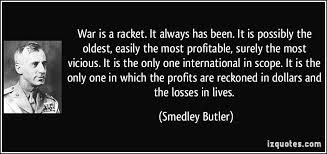
War is a Racket

war is a racket

War is a Racket

by Major General Smedley Butler (1933)

Book Review

Published in 1933 by retired Marine Major General Smedley Butler, War is a Racket is a historic expose of the role of Wall Street profiteering in instigating war.

The book begins with the startling statistic that World War I created 21,000 new millionaires and billionaires. President Woodrow Wilson borrowed (from Wall Street banks) the $50+ billion to pay for World War I, increasing the national debt from $1 billion to $52 billion. Of this amount, $16 billion was pure profit. Butler lists specific companies, starting with Du Pont and US Steel, and the obscene profits they made from World War I.

He also deplores the systematic inefficiency and fraud that caused the War Department to pay two to three times the retail charge for equipment such as saddles and mosquito nets that had no possible use in a modern European war. This was on top of millions spent on poorly crafted wooden ships that sank when put to sea and airplanes that were technologically obsolete by the time they were delivered.

Wilson had been elected to his second term based on a campaign promise to keep the US out of the Great War. War is a Racket also discusses his secret White House meeting with a European commission that caused him to reverse himself. After informing Wilson the allies were losing the war, they warned that they couldn’t repay the $5-6 billion they owed American bankers, manufacturers and munitions makers if they were defeated.

Butler maintains the real reason the US entered the war was to protect these Wall Street interests. Obviously this isn’t what Wilson and his Committee on Public Information (run by Edward Bernays, the father of public relations) told the American people. They would be barraged with incessant propaganda about the Germans being monstrous barbarians and the Great War being the war to end all wars because it would make the world safe for democracy.


War is a Racket: free PDF

Major General Smedley Butler is best known for foiling the 1933 Bankers’ Putsch. This was a failed military coup, instigated by America’s leading bankers and industrialists, to remove Roosevelt from office and replace him with a Mussolini-style dictatorship. Butler, who was recruited to lead the coup, blew the whistle to the House McCormick-Dirkson Committee. They responded by launching a cover-up. Details of the Bankers’ Putsch only became public knowledge in 1967, when journalist John Spivac uncovered the committee’s secret notes.

The Dream of a Stateless Society

Engines of Domination
(2014)

Film Review

In Engines of Domination, filmmaker Justin Jezewski and author Mark Corske lay out a historical and philosophical argument for anarchism – a stateless society people run themselves via direct democracy.

They begin by comparing class society to sheep herding. The latter began around 10,000 BC. Class society began around 5,000 BC when institutions of power (initially kings and priests and later nations and corporations) began domesticating people as well as plants and animals. The goal of this kind of domestication is to capture the energy of an entire community. Initially chattel slavery was the primary mechanism employed to domesticate human beings.

Since no one agrees voluntarily to being treated this way, this has to be done through a combination of force and deception.  The methods employed were developed over centuries through a process of trial and error. “Engines of domination” are the historical institutions that make this domination possible and which keep it in place.

Land Confiscation

The process begins with the confiscation of communal land by force (this happened to Europeans via the Enclosure Acts between 1500 and 1850), forcing the inhabitants to work for the ruling elite by depriving them of the ability to feed themselves. In Corske’s view, this denial of life support is a fundamental act of violence.

Maintaining control of confiscated land requires a command structure, i.e. a monarchy or its equivalent, the rule of law and weapons. Without weapons, domination over other human beings is impossible. Finally the ruling elite creates upper and ruling classes and provides them a range of privileges for keeping the working class in line.

Deception and Thought Control

This is the true structure of modern society. However it has to be concealed via deception and thought control. The working class vastly outnumbers the elite, and human beings would never submit to forced labor voluntarily. Prior to 200 years ago, this thought control was disseminated via state religion (it still is in Israel and Muslim countries). In so-called western democracies, it’s disseminated via compulsory public education and the mass media.

Replacing the Engines of Domination with the Engines of Liberation

At present, the very biosphere that supports human life is being destroyed by a ruling elite whose sole focus is to amass more wealth. The only way to halt this ecological destruction, according to Corske , is to abolish political power, central authority and the institutions that support it. The engines of domination must be replaced by engines of liberation. This may seem like an impossible task, but this is because we are all conditioned to accept our captivity, much like domesticated animals who stay in the cage or pasture even when the door or gate is opened.

Corske believes we must employ the same trial and error process to walk back the layers of institutional domination that enslave us. Although the ruling elite is intensively organized, we have both superior numbers and human nature on our side. Contrary to contemporary mythology, human beings are basically freedom loving and incline towards cooperation rather than violence towards our fellow human beings.

Building a mass movement to take advantage of our superior numbers is essential. Corske feels the best way to do this is to organize for specific reforms with the ultimate goal of abolishing central authority.

This short documentary is based on Mark Corske’s book Engines of Domination, published in 2013.

The Art and Science of State Terrorism

state terrorism

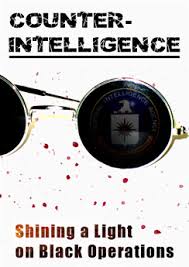
Part 4 of Counter-intelligence: Shining a Light on Black Operations

“Necrophilous” is Part 4 of a five part documentary by Scott Noble called Counter-Intelligence: Shining a Light on Black Operations.

In Part 4, filmmaker Scott Noble examines the sadistic fixation of the National Security State with death, pain and permanent injury of individuals and groups whose democratic yearnings conflict with the financial interests of US corporations. He likens this fixation to the psychopathology that motivates serial killers.

Necophilous is defined as having an abnormal fascination with death and the dead. Part 4 begins by examining the decision, in 1945, to drop two atomic bombs on Japan.

A nuclear bomb deliberately targets civilians, a war crime under the Geneva Convention. Truman’s claim that nuking Japan spared GIs the bloodshed of a land invasions turns out to be completely bogus.

He already knew the Japanese were on the verge of surrendering. In fact Secretary of War Henry Stimson was afraid the Japanese would surrender before the US got the chance to deploy atomic weapons – which were mainly intended to terrorize the Soviet Union.

The School of the Americas

Exhibit two is the School of the Americas (SOA), founded in 1946 at Fort Benning Georgia. More than 60,000 soldiers and police from US client states have trained in counter-insurgency techniques (aka state terrorism) at SOA. The use of deaths squads who disappear and assassinate pesky intellectuals, educators, labor leaders and human rights advocates figures prominently in the SOA curriculum.

The CIA-installed Guatemalan dictatorship first used it in the 1950s. After the CIA itself used it during Operation Phoenix in Vietnam, it would be replicated by US-backed regimes of terror throughout Latin America. The same “men in black” reappeared in Bush’s campaign to terrorize Afghans and Iraqis who resisted US occupation.

Aided by Kubark, the official CIA torture manual, the instructors at SOA are also the world’s leading experts in torture. The only purpose of torture is to induce fear and compliance in a hostile population. Despite its role in inducing false confessions, it never produces meaningful intelligence. This is confirmed by decades of research.

Total War and the War on Terror

A final form of American state terrorism is “Total War,” in which civilians are deliberately targeted for extermination.

US dedication to Total War predates the Geneva Convention that declared it a war crime. It dates back to the near total extermination of the Native Americans, followed by the mass slaughter of the Philippine population during US occupation (1898-1946), Vietnamese civilians during the Vietnam War, Clinton’s deliberate bombing of essential Iraqi infrastructure in 1991 and the use of white phosphorus and depleted uranium against civilians during the second invasion of Iraq in 2003.

In fact the War on Terror is really a War OF Terror, aimed at expanding the US empire to include seven Middle East and North African (MENA) countries: Iraq, Libya, Sudan, Somalia, Syria, Lebanon and Iran.*

As Noble ably documents, plans for the American conquest of the above seven countries first crystallized in 1979 under Carter’s National Security Adviser Zbigniew Brzezinski. A fundamental aspect of this campaign has been covert US support for Islamic fundamentalism – the self-same “terrorists” we are fighting in the so-called War on Terror – in Saudi Arabia, Egypt, Palestine, Afghanistan, Syria and elsewhere.

“Necrophilous” concludes by examining evidence that 9-11 was most likely an engineered false flag operation to justify the decades-long war that would be required to establish a permanent military presence in the Middle East and North Africa. The military build-up for the invasion of Afghanistan began months before the so-called “attack” on the Twin Towers.


*Retired General Wesley Clark first revealed the existence of this campaign to conquer the Middle East and North Africa during a Democracy Now interview in 2007

photo credit: Kurt and Sybilla via photopin cc

Counter-intelligence: Shining a Light on Black Operations
Scott Noble
Metanoia Films (2013)

Also posted on Veterans Today

The History and Purpose of False Flag Operations

chavez

Part 3 of Counter-Intelligence: Shining a Light on Black Operations

“The Strategy of Tension” is Part 3 of a five part documentary by Scott Noble called Counter-intelligence: Shining a Light on Black Operations. In it, filmmaker Scott Noble offers a textbook examination of the use of “false flag operations” to manipulate public opinion and our elected representatives.

While “white” propaganda is openly acknowledged by the country that disseminates it (e.g. Voice of America), with “black” propaganda the state sponsor is hidden. A false flag operation is an extreme form of black propaganda (usually involving murder) which is falsely blamed on an enemy.

The CIA has a long history of planting bombs and creating mayhem to achieve specific political objectives. In 1953, CIA operatives posed as communists to plant bombs and threaten Iranians opposed to democratically elected people who didn’t support Mohammad Mossadegh. The instability this created laid the groundwork for a military coup that removed Mossadegh from power and replaced him with the fascist US-friendly despot Shah Mohammad Reza Pahlavi.

In a 2002 false flag operation, members of the opposition shot and killed their own protestors and blamed it on the Venezuelan military. They then used this atrocity to justify the CIA-sponsored coup against Chavez. This false flag was exposed when it came out that a video condemning the event was filmed before it actually occurred.

Operation Gladio

Most of Part 3 concerns Operation Gladio, an extensive network coordinated by the CIA, MI6 (British intelligence) and NATO, which orchestrated numerous false flag bombings, kidnappings and mass shootings throughout Europe between 1945 and the early nineties. By blaming the bombings and other terrorist acts on leftists and communists, the mission of Gladio was to discredit left leaning parties and to install repressive governments that were more friendly to US interests.

In Italy, Gladio was linked to the Masonic P2 (Propaganda Duo) Lodge, the mafia and Italian bankers, industrialists and fascists. In 1978, Gladio operatives kidnapped Italian prime minister Aldo Moro and murdered him. This was just after he went against Henry Kissinger’s warning not to incorporate the Italian communist party into his coalition government.

In Belgium, Gladio operatives pursued a strategy of storming supermarkets and mowing down shoppers with machine guns. By posing as leftists, they hoped to generate support for a right wing government that would agree to house American nuclear missiles on Belgian soil.

A Common Pretext for War

False flag events are also a common strategy for instigating war. In 1931, the Japanese blew up their own railroad and blamed it on Manchurian dissidents to justify the invasion of Manchuria. Eight years later, Hitler staged a false flag attack on a Polish radio station to justify the invasion of Poland.

Some false flag events are totally fictitious – the enemy is merely accused of an atrocity which hasn’t actually occurred. The best example is the so-called Gulf of Tonkin incident in 1964, in which the Johnson administration accused the North Vietnamese of torpedoing the USS Maddox. Johnson used this non-event to justify a full scale land invasion of Vietnam.

That’s Just a Conspiracy Theory

Whistleblowers, researchers, historians and journalists who expose false flag events are commonly accused of indulging in conspiracy theories. The implication is that only people who are mentally unbalanced or grossly misinformed have any interest in exposing historical events that have been purged from the public record. According to Noble, this is a remarkably effective tactic for suppressing public discussion of government misconduct.

Counter-intelligence: Shining a Light on Black Operations
Scott Noble
Metanoia Films (2013)

photo credit: ¡Que comunismo! via photopin cc

Also posted at Veterans Today

The CIA Role in Narcotics Trafficking

 peter dale scott

Part 2 of Counter-intelligence: Shining a Light on Black Operations

“Deep state” is Part 2 of a five part documentary by Scott Noble called Counter-Intelligence: Shining a Light on Black Operations. Historian and former diplomat Peter Dale Scott coined the term Deep State to describe the shadow government that operates outside our so-called democratic institutions to service the needs of America’s wealthy elite.

This episode focuses on close historical links between the Mafia and CIA and the role of narcotics trafficking in all major CIA covert operations. CIA drug trafficking serves two main purposes. In addition to providing off the books (not reportable to Congress) income for clandestine operations, it’s also a source of ready-made criminal networks. The latter are valuable as a conduits for weapons delivery to CIA mercenaries and as lethal enforcers of corporate interests against labor and human rights activists.

Scott, who is interviewed at length, stresses the instrumental role of the CIA in ALL global narcotics trafficking. The converse is also true. Citing the French Connection (centered in Marseilles) and the Golden Triangle (in Southeast Asia) as prime examples, he makes the case that all major narcotics hubs collapse following CIA withdrawal from the region.

“Deep State” also shines a light on current drug operations in Afghanistan and Columbia. At present Afghanistan is the world’s leading heroin producer,  a direct result of CIA involvement in the region. Colombia, in turn is the world’s largest purveyor of cocaine, thanks to the CIA decision to use Colombia to “block the spread” of communism from Cuba to the rest of Latin America.

According to filmmaker Scott Noble,  all major Wall Street banks have engaged in laundering profits from illicit narcotics. Illegal drugs are America’s third biggest commodity, with the wealthy elite siphoning off the vast majority of drug profits. They also rake in immense profits from the prison industrial complex, a growth industry that owes its existence to the so-called War on Drugs. Wells Fargo and other Wall Street banks are major investors in the prison privatization industry.

Counter-intelligence: Shining a Light on Black Operations
Scott Noble
Metanoia Films (2013)
photo credit: jimforest via photopin cc
Also posted at Veterans Today

Counter-intelligence: Shining a Light on Black Operations

counter-intelligence

Part 1 The Company (aka the CIA)

Counter-intelligence is a five-part documentary examining the history, structure and function of America’s National Security State. The latter is a secretive, quasi-legal bureaucracy whose primary purpose is to enforce the will of the wealthy elite without interference by elected representatives. Laying out the series like a college course, filmmaker Scott Noble reveals the mechanism by which this invisible shadow government exercises near total control over US foreign and domestic policy. Part 1 discusses the CIA, the Joint Services Operation Command and the NSA

Noble defines “black operations” as illegal clandestine operations that are carried out without Congressional oversight or accountability. The National Security Act President Harry Truman signed in 1947 made covert operations the responsibility of the Central Intelligence Group, which wouldn’t become part of the CIA until the 1950s. .

Truman appointed a number of Wall Street bankers and lawyers to run covert operations. Their foreign trade experience (especially with fascist countries) supposedly made them “experts” in foreign relations. Traditionally top CIA officials have been recruited from the children of Wall Street elites at Harvard, Yale and other Ivy League universities.

Yale’s secretive Skull and Bones society has been a particularly fertile ground for recruiting CIA officers. The requirement for new Skull and Bones members to commit an illegal act (usually grave robbing) prepares them for the illegal covert operations they will carry out for the CIA.

Plausible Deniability

“The Company” emphasizes the role of private foundations and contractors (mercenaries) in concealing  the CIA’s role in assassinations, foreign coups and drug trafficking. The CIA funded the 2002 against Venezuelan president Hugo Chavez by funneling millions of dollars through the National Endowment for Democracy (NED). This made it possible for the Bush administration to deny they played any role whatsoever in the coup.

Unlimited Budgets

A major feature of the National Security State is the total absence of oversight or accountability to any elected branch of government. Budgets are virtually unlimited, and there is no requirement for agencies that engage in black operations to report how they spend their funding.

The Joint Services Operation Command (JSOC) is a prime example. The JSOC, which technically falls under Pentagon, receives even less oversight than the CIA. JSOC has a 75 billion dollar budget and employs 200,000 covert operatives, many of them mercenaries. Noble believes the JSOC is a major culprit in trillions that have gone missing from the Pentagon budget.

Owing to its total lack of oversight or accountability, the JSOC is free to contract with a scumbag company like DynCorps, despite their collaboration with the Serbian mafia in sex trafficking – or the sex parties, involving little boys, they throw for Afghan officials.

The National Security Administration (NSA) enjoys even less fiscal accountability. The NSA, which has more operatives than the CIA and FBI combined (40,000), had an $11.6 billion budget in 2012. It also has its own film festival, ski club and yacht club.

CIA Domestic Spying

Noble concludes by touching on the CIA’s repeated and ongoing violation of the federal law prohibiting them from engaging in domestic covert operations. He briefly discusses Operation Chaos (a 1967-73 covert operation against anti-Vietnam war and civil rights activists), MK-Ultra (a 1957-73 project involving mind control experimentation on unwitting Americans) and Operation Mockingbird (a 1950-ongoing operation in which the CIA “recruits” journalists to present the Company in a favorable light).

Counter-intelligence: Shining a Light on Black OperationsScott Noble
Metanoia Films (2013)
Also posted at Veterans Today

How Prostitutes and Ex-Slaves Saved Us from the Protestant Work Ethic

a renegade history

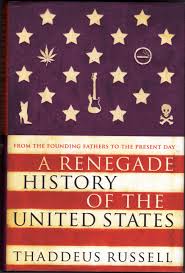
A Renegade History of the United States

by Thaddeus Russell

2010 Free Press

Book Review

I absolutely adored A Renegade History of the United States. Historian Thadeus Russell offers a totally unique but compelling perspective on the expansion of personal liberty in the US and other English speaking countries.

Unlike Zinn’s The People’s History of the United states and similar “working class” histories, Russell argues that that most of the person freedoms we enjoy aren’t the result of political movements. In his view they originated from the refusal of renegades, degenerates and discontents to accept the puritanical work ethic the founding fathers tried to foist on us. In other words, we should thank America’s drunkards, prostitutes, pirates, slackers, “shiftless” slaves and juvenile delinquents for the unprecedented levels of personal freedom Americans enjoy.

Parts of Russell’s book really surprised me, especially where he describes the uptight, repressed social conservatives (including Martin Luther King) who led American campaigns for abolition, women’s suffrage, labor rights and civil rights. Despite their high profile campaigns for specific legal “rights,” the leaders of these movements expended enormous time and energy trying to correct the “inappropriate” behavior of the masses they claimed to represent.

The Role of Prostitutes and Ex-Slaves

The unquestioned heroes of A Renegade History of the United States are prostitutes and ex-slaves. In the 19th century the only women who owned property, had sex outside of marriage, performed or received oral sex, used birth control, wore make-up, perfume or stylish clothes were prostitutes. In fact, it was prostitutes who won these and other rights that modern American women take for granted. When women were barred from most jobs and wives had no legal right to own property, prostitutes, especially in the Wild West became so wealthy that they funded crucial irrigation and road building projects. Likewise when most states banned birth control in the early 1800s, prostitutes continued to provide a market for contraceptives that stimulated production and distribution.

The importance of slaves and their descendents in the expansion of personal freedom relates to the tenacious manner in which they preserved a culture characterized by sensuous music, rhythms and dancing in a culture that condemned these activities as depraved and harmful to the work ethic.

Following the Civil War, there was a strong expectation that slaves would renounce these pleasurable pastimes and embrace the work ethic as good American citizens. Many eagerly embraced the discipline and self-denial emancipation demanded of them. Most didn’t.

In 1865 Congress confronted this dilemma by creating the Freedman’s Bureau to train ex-slaves how to become “good citizens.” Most enrolled eagerly, thinking they would be taught to read and write. Instead the classes focused on the ideals the founding fathers had promoted – frugality, self-denial and most importantly a love of work, even poorly paid work, as a source of virtue.

Russell cites letters and interviews with ex-slaves who saw no point in being free if it meant they had to work harder than a slave did. Many northerners, who acquired southern plantations cheaply during Reconstruction, complained that ex-slaves made terrible workers. Not only did they come and go as they pleased, but they demanded days off and refused to work in inclement weather. Many ex-slaves also resisted pressure to adopt legal norms of marriage.

Martin Luther King’s Campaign Against Un-Christian and Un-American Blacks

For me, the most interesting section of A Renegade History of the United States is the chapter about Martin Luther King and his little known campaign to persuade so-called “bad niggers” to embrace the puritan work ethic and cult of responsibility and sexless self-sacrifice that has characterized the dominant American culture.

In 1957, Reverend King launched three projects simultaneously: the Southern Christian Leadership Conference (SCLC), to coordinate a nonviolent campaign to desegregate buses across the South, the Campaign for Citizenship to campaign for voting rights and a church-based campaign to rid African Americans of what King referred to as “un-Christian” and “un-American” habits. In 1957 he delivered a series of sermons condemning blacks who led “tragic lives of pleasure and riotous living” (see Problems of Personality Integration).

In 1958 he wrote articles in Ebony and published his first book, Stride Towards Freedom, in which he claimed black poverty was as much due to laziness and a lack of discipline and morality, as to institutional racism. He also condemned rock and roll.

The Role of Violence in the Civil Rights Movement

Russell also weighs in on what “diversity of tactics” debate that ultimately split the Occupy movement. He lays out compelling evidence that 1) only a tiny minority of southern blacks participated in King’s nonviolent movement and 2) it was “bad niggers” and violence, rather than King’s nonviolent campaign, that won the first major civil rights victories in 1963.

British and American War Crimes During World War II

hellstrom

Hellstrom: the Death of Nazi Germany 1944-47  

by Thomas Goodrich

Aberdeen Books (2010)

 Book Review


The victor always writes history. Only German war crimes were prosecuted at Nuremberg. British and American war crimes were whitewashed out of history. If not for Kurt Vonnegut’s best selling 1969 novel Slaughterhouse Five, Americans would have no knowledge of the deliberate targeting of civilians in the firebombing of Dresden.

Hellstrom: the Death of Nazi Germany 1944-47 is a meticulously researched encyclopedia of Allied war crimes during World War II. In it, historian Thomas Goodrich carefully compiles statements of scores of eyewitnesses, including Allied pilots and war correspondence about US, British and Russian atrocities against German civilians and POWs during and after the war.

A Deliberate Campaign of Terror Bombing

Dresden wasn’t the only German city subjected to carpet firebombing aimed at terrorizing civilians. Based mainly on victim and pilot statements, Goodrich details the deliberate firebombing (with phosphorus-based incendiary bombs) that occurred in Hamburg, Berlin, Nuremberg, cologne, Daimstat, Pforzheen and Wurzburg. The allies also firebombed three Swiss cities, another war crime, as Switzerland was a “neutral” country with no identifiable military targets.

Goodrich mainly focuses on Dresden, one of the last German cities to be firebombed. Many residents believed it would be spared, owing to its culture treasures and role as a hospital city for injured civilians. Dresden had no defense installation, major factories or air defenses. Owing to the absence of anti-aircraft weapons, the Allied bombers could fly low enough to target fleeing civilians and hospitals designated with a large red cross on their roof. The Red Cross later estimated that the Dresden massacre killed 300,000 – 400,000 civilians.

Prior to Dresden, the American pilots, unlike the British Royal Air Force (RAF) deliberately refrained from targeting. At Dresden, this changed, with Americans planes deliberately targeting civilians who survived the initial firestorm.

Eisenhower Deliberately Circumvents Geneva Convention

Like Bush II, Eisenhower deliberated created a new category of prisoners called Disarmed Enemy Forces (DEF), so he wouldn’t be bound by the Geneva Convention regarding treatment of Prisoners of War (POWs).

His treatment of POWs worsened following the May 8, 1945 armistice with Germany, as he no longer feared German retaliation against American POWs. In all, 800,000 German POWS died in French and US POW camps after the war ended the armistice. This contrasts with German treatment of Allied POWs, which followed the Geneva Convention 99% of the time.

The book contains victim statements from German POWS held in outdoor pens where they were drenched by continuous rain and fed 1/10 of a K ration three or for days a week. Eisenhower denied the Red Cross access to POW camps, as well as prohibiting them from supplying German prisoners food. The British, US and French military also used German POWs as slave labor, despite formal Red Cross protests that this, too, violated the Geneva Convention.

Forcible Repatriation of Soviet Dissidents

In addition to the maltreatment of POWs, the Allies honored a commitment they made at Yalta to repatriate one million Soviet dissidents (including White Russians who fought the Bolsheviks in 1917) to the USSR. This included 4,000 Soviet dissidents in the US who were forcibly repatriated. Stalin, in turn, summarily executed them or sent them to slave labor camps.

The Brutal Allied Occupation

The treatment of German civilians and POWs by invading forces varied. On both the eastern and western fronts, experienced front line troops tended to be the most civilized. They reasoned that good treatment would make the Germans in the next village more likely to surrender. The rear guard tended to be far less experienced and more inclined to engage in rape, gang rape, looting and torture. Stalin refused to sign the Geneva Convention, and Russian troops were particularly feared for their savagery.

During the occupation, Eisenhower and Truman deliberately engineered a famine in the Allied sectors (US, British and French) of Germany. The massive carpet bombing had totally destroyed the food infrastructure and millions of German civilians starved as they tried to survive on boiled grass and roots. Truman outlawed private food relief to Germany until the Pope, former president Herbert Hoover and numerous high profile senators and journalists objected to the Truman’s policy of deliberately starving the German civilian population. In all, far more Germans died in the first two years of peace than had died in six years of war.

The Allies also carried out a particularly brutal regime of “de-Nazification” in which German adults (including prominent anti-Nazis) were arbitrarily arrested and tortured until they confessed to being members of the Nazi Party.

The treatment of German civilians would improve in 1947, as the Cold War gained momentum and Truman recognized Germany’s importance as a bulwark against the Soviet Union.

Dresden9photo credit: Dresden bombing

Also posted in Veterans Today

Confronting Gandhi’s Racism

In the following brief video, Indian activist Arundati Roy challenges the way the global elite has repackaged Mohandas Gandhi as a hero to be worshiped and adored. She delivered her talk shortly after the publication of The Doctor and the Saint, a book length introduction to a new edition of The Annihilation of Caste. The latter was written in 1936 by Dalit (aka Untouchable) lawyer and activist Dr Bhimrao Ambedkar. Gandhi bitterly fought Ambedkar and his ideas during his lifetime. This, according to Roy, was based on Gandhi’s entrenched beliefs about racial superiority, both towards Dalits and black South Africans.

Under Hindu’s rigid caste system a Dalit is limited (by virtue of birth) to occupations regarded as ritually impure, such as those involving leatherwork, butchering, or removal of rubbish, animal carcasses, and waste. Because these activities are considered polluting and contagious, by tradition Dalits are banned from full participation in Hindu social life. Discrimination against Dalits is still prevalent in rural India, as regards access to eating places, schools, temples and water sources.

Prior to the 1900s, hundreds of thousands of Dalits escaped their caste roles by leaving the Hindu religion and converting to Islam or Christianity. With the move towards representative government that occurred in the early twentieth century, an upper caste Hindu reform movement formed to ensure that India’s fourteen million Dalits (about one quarter of India’s population) remained outside the political process.

Gandhi, a member of the higher Banias caste, was part of this Hindu reform movement. He specifically opposed the movement started in 1904 to guarantee Dalits access to education. In the following video, Roy reads what he wrote about the Dalits he encountered during his time in South Africa (1893-1914):

“Whether they are Hindus or Mohammadans, they are absolutely without any moral or religious instruction worth a name; they are not learned enough. Plus thus they are adapting to yield to the slightest temptation to tell a lie. After sometime lying with them became a habit and disease. They would be lying without any reason, without any proper, prospect of bettering themselves materially in deep whom knowing what they are doing. They reach a stage in life when the moral faculties has completely collapsed owing to neglect.”

Gandhi launched his first non violent civil rights campaign in South Africa to protest the treatment of Indian immigrants as second class citizens. In 1906, he took the side of the British government when they declared war against the Zulu Nation in Natal and encouraged Indians to enlist with the British. Here are his views on Kaffirs [black South Africans) following his first arrest for civil disobedience:

“We were all prepared for hardships, but not quite for this experience. We could understand not being classed with the Whites, but to be placed on the same level with the Natives seemed to be too much to put up with. I then felt that Indians had launched our passive resistance too soon. Here was further proof that the obnoxious law was meant to emasculate the Indians…Apart from whether or not this implies degradation, I must say it is rather dangerous. Kaffirs as a rule are uncivilized—the convicts even more so. They are troublesome, very dirty and live almost like animals and scavengers.”

Roy goes on to describe the caste system in modern day India, where caste has merged with capitalism so that higher caste Hindus control all the major corporations and media outlets. Dalits continue to experience major discrimination and oppression, in both rural and urban areas. According to India’s National Crime Bureau, a crime is committed against Dalit by non Dalit in every sixty minutes. Every day four Dalit women are raped by upper caste men. Every week thirteen Dalits are murdered and six are kidnapped. In most cases, these crimes go unpunished.

Roy also points out that the Indian military is deployed on a daily basis to enforce the supremacy of upper caste Hindus:

“From 1947, whether the Kashmir, Mizoram, Manipur, Nagaland, Telangana, Punjab, Goa, every day of the year, the Indian Army is fighting its own people. And who are the people? Think about it. Muslims, Christians, Sikhs, Adivasis, Dalits.”