A Classic Case of Greenwashing

Silence of the Pandas

Wilfred Huisman (2011)

Film Review

Greenwashing (def) – a form of spin in which green PR or green marketing is deceptively used to promote the perception that an organization’s products, aims or policies are environmentally friendly.

Silence of the Pandas is about the World Wildlife Fund (WWF) – the world’s largest conservation organization – and their open collaboration with Monsanto, palm oil manufacturers and other multinational corporations that are systematically destroying wildlife habit.

WWF solicits millions in donations every year based on the image it projects of protecting endangered animals, such as the panda and the tiger. In reality, the WWF, under the leadership of the British royal family and other members of the British aristocracy, forms lucrative “partnerships” with corporations seeking to greenwash their image.

Through these toxic partnerships, WWF is facilitating, rather than preventing, the destruction of rainforests and wildlife habitat. It also actively promotes the removal of indigenous populations (in India, Indonesia, South America and Papua New Guinea) from their rainforest habitat. As an example, WWF has collaborated with the Indian government to displace one million Adabzi from their tribal homelands to expand a WWF ecotourism venture. The habitat destruction stemming from this venture is rapidly depleting tiger populations rather than increasing them.

In Indonesia, WWF partners with the palm oil giant Wiemar to raze native rainforests and replace them with extensive palm oil plantations. In many cases the Indonesian government has illegally leased land to Wiemar. The land belongs to indigenous farmers whose ancestors planted the tropical forest gardens destroyed to make way for palm oil.

In Argentina WWF, in partnership with Monsanto, has brought the country to the verge of ecological collapse by destroying natural forest and pampas and replacing them with a GM soy desert the size of Germany.

As one of their vice presidents openly demonstrates in the film, WWF is a strong proponent of genetic engineering. In return for a sizable donation, in 2010 the group awarded Monsanto a seal of product sustainability for their GM soy seed.

I first became concerned about the activities off the WWF in the mid-nineties when I learned that they had allowed their parks to be used as training bases for the Hutu militants responsible for the Rwandan genocide. The film makes brief mention of the secret mercenary army WWF assembled from British special forces and South African (apartheid) security personnel. The alleged purpose of these mercenaries was to assassinate poachers who were endangering elephant and rhinoceros populations.

The pro-African website Nairaland tells a very different story.

Under the guise of protecting endangered species, such as the elephant, the rhinoceros and the tiger, WWF “park rangers” carry out assassinations and other attacks against so-called “poachers” who in many instances turn out to be local patriotic political leaders or farmers who refuse to abandon their land and their food production to the WWF’s land confiscation programs.

The Elite Cabal Behind the JFK Assassination

JFK to 911: Everything is a Rich Man’s Trick

Francis Richard Connolly (2014)

Film Review

This lengthy documentary explores how a handful of super rich American, British and Dutch fascists used their consolidated wealth and power to secretly manipulate the course of modern history. Connolly presents a coherent, well-documented examination of the American robber baron families who financed the rise of Nazi Germany and secretly plotted and financed the JFK assassination. His reconstruction of November 1963 Dealey Plaza events is based on the collected work of reputable assassination researchers, which he lists in the credits.

Introducing the Robber Barons

The film begins with the rise of key monopoly capitalists in the early 20th century: E H Harriman, who borrowed money from the Rothschild banks to create his railroad monopoly; John Rockefeller, who Harriman assisted in creating an oil monopoly; and J P Morgan who borrowed from the Rothschilds to create a banking monopoly. After World War I, these elite families would be joined by the Colgate family, the Birdseye family, the Dupont family and members of the British and Dutch royal families to create a fascist government in Germany as a bulwark against Soviet Bolshevism. Connolly carefully traces how these elite families, using Allen and John Foster Dulles and George Herbert Walker and Prescott Bush as their political henchman, assisted Germany in paying their war reparations and acquiring a dazzling arsenal of tanks, bombers and advanced weapons that would eventually be used against American GIs.

Immediately following World War II, the same families used CIA Director Allen Dulles and Congressman Richard Nixon to enable Nazi spies and scientists they had brought to power to secretly emigrate to the US to join the CIA and the US aerospace program.

Fifteen years later, these families, along with key Dallas oilmen and defense contractors and Mafia bosses the FBI and CIA enlisted during World War II, conspired to assassinate President John F Kennedy. Among the politicians who assisted them were Richard Nixon, George Herbert Walker Bush, J Edgar Hoover and Lyndon Johnson.

Follow the Money

In describing the motivation behind the JFK assassination, Connally begins with the gathering of high level co-conspirators at the home of Dallas oil mogul Clint Murchison on November 21, 1963 (the night before the assassination). We know who attended thanks to LBJ’s former mistress Madeline Duncan Brown. The corporate bigwigs were there because Kennedy threatened the fascist CIA-Wall Street empire they had built and because they stood to incur major financial losses from two Kennedy policy directives: to withdraw US military advisors from Vietnam and to end the oil depletion allowance.

The politicians were there because of historic ties with the fascist CIA-Wall Street nexus and because two risked losing their careers if Kennedy remained in office. LBJ was on the verge of going to prison for aiding and abetting the criminal activities of Billie Sol Estes.* Former FBI Director Hoover was on the verge of being forced out because the Kennedys had photos of him engaged in homosexual activities with his lover Clyde Tolson.

Mafia boss Carlos Marcello was there because he felt Kennedy had betrayed a promise his father Joe Kennedy had made to protect the Mob.

The Ambush in Dealey Plaza

Connolly’s dramatic reenactment of the ambush in Dealey Plaza (starts at 1:38) is the most exciting section of the film. Based on eye witness testimony, he identifies each of eight snipers by name and US intelligence role. Altogether sixteen shots were fired in four stages.

He also offers the first plausible explanation I’ve seen for the assassination of Dallas police officer J D Tippett, a well-known JFK look-alike. Connolly also identifies the CIA mortician who did post-mortem surgery on Tippett to make his wounds consistent with the official version of the assassination, the two coffins that flew to Washington DC on Air Force Two and the switch that occurred at Bethesda Naval Hospital.


*Billie Sol Estes was an American financier best known for his friendship with Senator (and future president) Lyndon Johnson and the business scandal that sent him to jail for fraud multiple times

The Origin of Poverty

Poor Us: An Animated of Poverty

Ben Lewis (2012)

Film Review

This documentary divides the history of poverty into six broad areas: pre-civilization, “early civilization” (8000 – 800 BC), Greece and Rome (800 BC – 400 AD), the Middle Ages (400 – 1500), European colonial era (1500 -1850) and industrial civilization (1850 – present). The use of animation is surprisingly effective in painting an overview of the lifestyles typical of these different periods.

Prior to the agricultural revolution that marked the advent of civilization, no one was poor. In a hunter-gatherer society, very little work is required to procure adequate food and water. Leisure time is plentiful. The downside of being a hunter gatherer is that life is very precarious and there’s was no way of planning for sudden climate change and other natural events that periodically wipe out the food supply.

During early civilization, everyone was poor except for rich kings and priests who ran everything. There were repeated famines and the average life expectancy was 35 years.

Greek civilization produced historians and philosophers who, for the first time, tried to identify the causes of poverty. They concluded that poverty was essential to civilization because it induces people to work.

The concept of charity first arose in the early Middle Ages and is a key component of all the world religions, which emerged during this period.

The film maintains that all modern poverty results from plunder and force, mainly at the hands of European colonizers. In the early 1500s, Europe was much poorer than contemporaneous civilizations in China, Africa and the Americans. In medieval China, for example, the government was responsible for flood control and vast granaries that fed the entire population during famines.

Europeans systematically plundered and destroyed the advanced pre-European civilizations in China, Africa and North and South America. Then the European elite used this wealth and power to drive their own peasants off their communally farmed lands. Those who didn’t end up in jail or the workhouse, ended up in squalid city slums and worked in early factories.

Prior to the industrial revolution, 90% of the world lived in extreme poverty. By 1948, this percentage had dropped to 50%. By the 1970s, it was down to 15%. At present most extreme poverty is in third world countries that have been systematically exploited by the industrial North for their resources and cheap labor.

The film features a number of economic analysts with differing perspectives on why industrialization caused the rate of extreme poverty to drop. Most agree it was a combination of fossil fuel-based technology and successful revolutionary and union activity which allowed workers to keep a bigger share of the wealth they produce.

Over the last few decades, the relative weakness of grassroots movements has led to significant increase in poverty within the supposedly wealthy industrialized countries.

The Innate Sloth and Indolence of the Working Class

Invention

The Invention of Capitalism: Classical Political Economy and the Secret History of Primitive Accumulation

By Michael Perelman
Duke University Press (2000)

Download Free PDF

The Invention of Capitalism is about the origin of an economic concept known as “primitive accumulation.” Marx defined primitive accumulation as the process by which precapitalist modes of production, such as feudalism and chattel slavery, are transformed into the capitalist mode of production. Using the term somewhat differently, Perelman describes it as the brutal process by which government denies peasants the means of subsistence to force them into wage labor.

Tracing the rise of capitalism in the 18th and 19th century, the Invention of Capitalism also studies the origin of the concept in the work of classical economists, such as Adam Smith, Ricardo and Malthus.

Forcing Workers to Accept Wage Labor

Nearly all the 18th century economists and social philosophers seem to agree that workers never voluntarily accept wage labor so long they have alternative means of providing for themselves. They all acknowledge, either directly or indirectly, that it’s natural for human beings to prefer “self-provisioning,” in which they own or rent a piece of land to produce their own food, clothing, fuel and other necessities. In addition to allowing them more control over their work, there is more leisure time associated with this lifestyle, as well as strong community ties that disappear with wage labor. Unless brutal force must be applied to strip people of the ability to provide for themselves, they never voluntarily agree to wage labor.

In Britain, “primitive accumulation” was largely accomplished through the Enclosure Acts, the Poor Laws and the Game Laws. The Enclosure Acts drove peasants off large tracts of land they had farmed communally for thousands of years; the Poor Laws forced disposed peasants into poorhouses and workhouses; and the Game Acts denied them the right to hunt (ie poach) or gather berries, firewood etc on unoccupied land.

Capitalism developed more slowly in Scotland, France, Italy, Spain and the British colonies, where the ruling elite was less savage in stripping the peasantry of access to land. These regions enjoyed a long transition in which factory workers performed wage labor and self-provisioning simultaneously, by raising crops and chickens and engaging in spinning and other crafts in their leisure time.

The Innate Sloth and Indolence of Workers

As Perelman quite ably demonstrates, most classical economists gloss over the brutal force required to establish a successful capitalist economic system. A few of the lesser known political economists (Perelman focuses in Sir James Steuart, one of Adam Smith’s rivals) are honest about need for laws that prevent workers from self-provisioning. They blame the need for such laws on an innate tendency towards “sloth and indolence” in workers and peasants (and indigenous peoples).

Perelman devotes special attention to the Scottish economist Adam Smith and The Wealth of Nations, as well as the political economists and social philosophers who influenced Smith’s work. He also explores attitudes toward primitive accumulation in the work of Marx, Benjamin Franklin, Lenin and Mao Tse Tung. The forceful primitive accumulation that industrialized the Soviet Union and Communist China occurred much more rapidly than in Western Europe or North America. This makes the Soviet and Chinese process appear much more savage. However a close look at British history suggests they were far more brutal, especially in Ireland and the colonies, than either the Chinese or Soviets.

Yields Drop Under Commercial Agriculture

The part of the book I found most interesting concerns the drop in crop yields that occurred with the shift from labor intensive “spade labor” to commercial agriculture employing horse driven plows and eventually farm machinery. This corresponds closely with modern research showing that plowing reduces yields by destroying soil fertility. Then, as now, it’s clear that the goal of commercial agriculture isn’t to produce more food but to extract more profit from other people’s work.

A Return to Self-Provisioning

Perelman’s research seems especially significant in the face of growing unemployment and part time and casual labor. A growing number of unemployed and part time workers use their enforced leisure time to plant veggie gardens, collect rainwater, preserve their own food and make their own clothes and cleaning and beauty products. In other words, the cycle of primitive accumulation is being reversed, as more and more people leave formal employment and return to self-provisioning.

The Coming Collapse

Surviving Progress

Harold Crooks and Mathieu Roy (2011)

Film Review

Surviving Progress is based on Canadian Ronald Wright’s 2004 book A Short History of Progress and takes up where the book leaves off. The book’s main focus is the collapse of historic civilizations due to dangerous technological innovation. It introduces the term (originally coined by German economist Walter Kramer) “progress trap,” to designate technological innovations that have dangerous and unforeseen unintended consequences. An example used in both the book and the film is the case of the wooly mammoth – how new Stone Age techniques that vastly improved efficiency caused the species to become extinct.

The film, in contrast, focuses on our present “progress trap,” and the biological determinants that cause civilizations to produce progress traps. It features a broad range of experts in addition to Wright, including psychologists, geneticists, primatologist Jane Goodell, environmentalist David Suzuki, economist Michael Hudson and astrophysicist Stephen Hawking.

The filmmakers start from the premise that humanity has entered a final progress trap. In the past when civilizations collapsed, homo sapiens simply moved on and started new ones somewhere else. Our present civilization covers the entire planet, and this is no longer possible. The technologies we’ve devised over 200 years have become so ecologically destructive the coming collapse could easily spell the extinction of our species.

The case the Stephen Hawking, the psychologists, geneticists put forward is that our Stone Age brains are incapable of dealing appropriately with advanced technology – that the only conceivable way to prevent collapse is through some kind of human genetic engineering. I have a major problem with any hypothesis that blames the failure of capitalist civilization on human nature. In my experience, it’s not human nature that makes people into greedy, individualistic sociopaths, but an economic system that rewards people for being greedy and competitive and punishes them for being compassionate.

I also had a problem with the way the filmmakers left out half of humanity by designating male competitive behaviors as typical of the entire human species. As geneticist Bryan Sykes argue in Adam’s Curse, the Stone Age reptilian traits described in the documentary are extremely rare in human females (and most males for that matter). In fact, it’s extremely rare for women to commit violent crimes, become tyrants or start wars. (I will post a review of Adam’s Curse later in the week).

I found economist Michael Hudson’s contributions far more valuable. He talks about the role oligarchy, extreme inequality and ecological destruction in causing past civilizations to collapse. He gives the example of Rome, in which confiscation of public land by aristocrats led to rapid overgrazing and topsoil depletion. Two hundred years later Rome collapsed, owing to their inability to feed their empire.

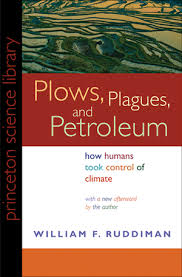
Plows, Plagues and Petroleum

plows plagues and petroleum

Plows, Plagues and Petroleum: How Humans Took Control of Climate

By W F Ruddiman

Princeton University Press (2010)

Book Review

In Plows, Plagues and Petroleum, paleoclimatologist W F Ruddiman makes the argument that the human species began interfering with climate – by increasing CO2 emissions – long before they began burning fossil fuels during the industrial revolution. After studying millions of years of ice core records, Ruddiman concludes that agricultural activities that began roughly 10,000 years ago increased atmospheric CO2 sufficiently to reduce planetary cooling and reduce a long overdue ice age.

Ruddiman’s book carefully traces the domestication of local plants and animals that occurred simultaneously in Mesopotamia, China, Africa and the Americas between 8,500 and 4,000 BC. Plant and animal domestication was accompanied by large scale clearing of forest land for fields and pasture. This massive loss of trees was accompanied by a big increase in atmospheric CO2.

Ruddiman has always been curious about periodic drops in CO2 concentrations that began around 540 AD. Theorizing that these dips correlated with temporary declines in global population, he examined historical records for evidence of wars, famines and pandemics that might have wiped out large numbers of people. What he discovered was a close link between infectious epidemics and declines in CO2 concentrations, as forests reclaimed large swaths of agricultural land.

The first epidemic in the recorded history was an outbreak of bubonic plague in the Roman Empire in 540 AD. By 590 AD, it had wiped out 40% of Mediterranean Europe. European plague outbreaks continued to occur every ten to fifteen years until 749, when a long plague-free period was accompanied by a rebound in population growth, deforestation and atmospheric CO2. By 1089, virtually all of Europe was deforested.

An even more severe plague pandemic occurred in the mid-1300s, wiping out a third of Europe (25 million people). In some cities, mortality rates were as high as 70%. The resulting labor shortage gave serfs who survived immense bargaining power. As they moved from estate to estate seeking good working conditions, they began to be treated as tenant farmers rather than slaves.

There were new plague outbreaks, accompanied by reduced atmospheric CO2, in the mid-1500s and mid-1600s.

The large pre-industrial drop in CO2 emissions occurred with what Ruddiman refers to as the North American pandemic (1500-1750. This was caused by the arrival of Europeans – who Ruddiman describes as flea infested, lice ridden peoples who shunned bathing – with a host of illnesses (smallpox, influenza, hepatitis, diphtheria, measles, mumps, whopping cough, scarlet fever, cholera and plague) to which native populations had no immunity. This was in addition to untold numbers of natives slaughtered by Europeans.

Prior to the arrival of Europeans, the population of North America was estimated between 50-60 million. Ninety percent (50 million) would die over the next 250 years. This amounted to 10% of the global population. Nearly all their agricultural settlements were reclaimed by forest, resulting in the third and largest pre-industrial drop in atmospheric CO2.

Download a free PDF of this book at Plows, Plagues and Petroleum

Climate Change Throughout History

forecast

Forecast: The Consequences of Climate Change, from the Amazon to the Arctic, from Darfur to Napa Valley

by Stephan Faris

Henry Holt (2009)

Book Review

Forecast is about historic and present day political, economic and health consequences of extreme climate disruption.

Farr begins by unpacking the Sudan civil war that began in Darfur in 2003. He makes a convincing case that decreased rainfall and desertification led to a bloody land war d between nomadic Arab camel herders and African farmers. He disputes that the conflict arose out of ethnic and religious differences, as the two groups shared the region harmoniously for hundreds of years until the climate changed.

He goes on to discuss studies comparing ice core findings to historical records. They conclude that all major European wars and Chinese dynastic changes followed major climate change.

Arctic Territorial Disputes

At the present time, the melting of Arctic sea ice has led to major border conflicts between countries eager to exploit the region’s vast mineral wealth. Tension is particularly high between Russian and Norway, Canada and Denmark and Canada and the US (over the border between the Yukon and Alaska). The opening of the Northwest Passage* to navigation for the first time in 2007 has led to an ongoing dispute whether these waters are Canadian territory or an international right of way, as claimed by the US.

International Alert predicts that forty-four countries are at risk of conflict (mainly over water rights) due to climate change. At the top of the list are India, Pakistan, China, Iran, Indonesia, Algeria, Nigeria, Somalia, Bolivia, Columbia, Peru and Bosnia and Herzegovina.

Emergence of Epidemics

Faris’s section on the health consequences of climate change discusses the major epidemics that have emerged due to warmer, wetter weather patterns. This includes a big increase in malaria in Brazil and Mexico; in hantavirus, West Nile virus and Lyme disease in the US; ebola in Africa and in plague in Kazakhstan and India.

Ice core findings suggest the medieval Black Death (plague) in Europe was also triggered by climate change.

The Effect of Native American Genocide

The most interesting section of the book argues than human beings have been altering the climate, through deforestation, livestock husbandry and population explosions since the agricultural revolution. Climate scientists believe major deforestation in Europe started 7,500-8,000 years ago. Atmospheric carbon concentrations reached a peak during the Roman period and took a big dip (most likely due to depopulation) after Rome collapsed. They began to rise again in 1000 AD. Their sharp decline in 1500 coincided with a Little Ice Age characterized by brutally cold winters.

Faris agrees with William Ruddiman (Plows, Plagues and Petroleum: How Humans Took Control of Climate) who believes this steep drop stemmed from the decimation of Native American agricultural settlements (from genocide, smallpox, typhus, cholera and measles, diseases to which they had no immunity) in North and South America. Over two centuries, their population dropped from 50-60 million (one tenth of the global population) to five million. As they disappeared, forests and jungles, particularly in the Amazon, reclaimed the fields they had cleared for cultivation.


*The Northwest Passage is a sea through the Arctic Ocean, along the northern coast of North America via waterways through the Canadian Arctic Archipelago. It decreases the transit time from the Atlantic to the Pacific Ocean (compared to the Panama Canal) by four days.

1941: The Year Slavery Finally Ended

Slavery by Another Name

PBS (2012)

Film Review

This shocking documentary reveals how virtual slavery persisted in the South for 80 years after the Civil War and the enactment of the 13th amendment. This involuntary servitude, based on Jim Crow laws and illegal debt slavery, allowed Southern factories, railroads, mines and plantations to use former slaves as a captive workforce. Prior to 1941, the federal government largely turned a blind to these activities, owing to the economic importance of free labor in the industrialization of the South.

When the Civil War ended in 1865, Congress imposed a period of radical Reconstruction on the South. Enforced by federal troops, it ensured that newly freed slaves enjoyed the right to vote and other civil liberties they were guaranteed under the 13th, 14th and 15th amendment.* The 1500 or so black politicians elected to Reconstruction governments established the first free public schools (for white and black students) in the South.

Jim Crow Laws and Convict Labor

Reconstruction ended in 1875. When a pro-Southern majority took over Congress, control of Southern states and communities reverted to the wealthy elite which had run the slave plantations. Thanks to a loophole in the 13th amendment (see below), all the former slave states quickly established a system to lease convict labor to private companies and plantations. The Jim Crow laws they passed made blacks subject to arrest for petty misdemeanors, such as walking along the railroad tracks, speaking in a loud voice in front of white women, spitting, loitering and vagrancy (all blacks were required to carry proof of employment at all times).

Following their arrest, Southern prisons hired these men (one-third were boys under 16) out to plantations and private companies for $9 a month. Small towns would conduct large police sweeps at cotton picking time or when coal companies were recruit miners.

Working conditions were far worse than under slavery. Companies had no incentive to keep black workers healthy and safe – workers who died were easily replaced. Death rates, especially in the coal mines, were extremely high – roughly 30-40% per year.

Debt Slavery

Even more Southern blacks were enslaved through illegal debt peonage schemes, which used real and fictitious debts to force them into involuntary servitude. This was based on a totally corrupt legal system in which unscrupulous law enforcement officers collaborated with bent magistrates and justices of the peace. Deputy sheriffs would take blacks into custody, claiming they owed them money. Without a shred of proof, their magistrate friends would throw them in jail. The same deputies would then “buy” and resell them at a profit to private companies and plantation owners.

In the early 1900s a federal grand jury investigated Alabama for debt peonage, illegal under federal law, and returned a number of indictments. Although most were dropped, two of the worst offenders sentenced to federal prison. Concerned about potential ramifications for American industry (the world’s largest corporation US Steel owned the Birmingham coal mine that employed convict and debt-based labor), President Teddy Roosevelt pardoned both of them.

Sharecropping Also Illegal Under Federal Law

Sharecropping was another form of illegal debt peonage. Forced to borrow their living expenses from plantation owners who charged 50-90% interest, sharecroppers had no hope of ever repaying their debts. Worse still, state law prohibited them from leaving the plantation with unpaid debt. Those who tried were arrested and brought back.

The Early Role of the NAACP

All this began to change in the early 1900s with the steady migration of Southern blacks to the North, as well as the creation of the National Association for the Advancement of Colored People in 1909. The latter actively campaigned for anti-lynching laws, as well as stronger enforcement of federal laws banning debt peonage and convict leasing to private entities.

Progress was incredibly slow. By the early 1930s, there were still 4.8 million blacks in the South. Most were caught up in some form of involuntary servitude.

It would the Japanese bombing of Pearl Harbor in December for Franklin Roosevelt to mandate aggressive prosecution in all cases of involuntary servitude. His primary concern was that Japan would seize on America’s horrific treatment of African Americans for propaganda purposes.


*13th amendment: “Neither slavery nor involuntary servitude, except as a punishment for crime whereof the party shall have been duly convicted, shall exist within the United States, or any place subject to their jurisdiction.”
14th amendment: (Sec 1): “All persons born or naturalized in the United States, and subject to the jurisdiction thereof, are citizens of the United States and of the State wherein they reside. No State shall make or enforce any law which shall abridge the privileges or immunities of citizens of the United States; nor shall any State deprive any person of life, liberty, or property, without due process of law; nor deny to any person within its jurisdiction the equal protection of the laws.”
15th amendment (Sec 1) “The right of citizens of the United States to vote shall not be denied or abridged by the United States or by any State on account of race, color, or previous condition of servitude.”

The Real Story of Tahir Square

El Maidan (The Square)

(Arabic with English subtitles)

Johane Nohaim (2014)

Film Review

The Square, based largely on amateur and cellphone footage, presents an activist prospective of the 2011 Arab Spring uprising that has been totally omitted from western media coverage. It delineates an early split between Muslim Brotherhood and Christian and moderate Muslim activists that occurred long before Muslim Brotherhood leader Mohammed Morsi became president in June 2012.

The clear view of the filmmakers is that the Muslim Brotherhood, who were latecomers to the Tahrir Square protests, co-opted the uprising and used it to negotiate a secret deal with the Egyptian military. Whether US and British intelligence, long time supporters of the Muslim Brotherhood, played some role in this process isn’t addressed.* Once the agreement was sealed, Muslim Brotherhood activists withdrew from the square. This left more moderate protestors to be beaten up and killed by police thugs and the Egyptian military.

Filmmakers interview original organizers of the Tahrir Square occupation who deeply regret their decision to abandon the occupation when Mubarak stepped down in February 2011. They some failed to register that he was merely a figurehead – that the Egyptian army continued to rule with totalitarian powers. As one observes wistfully, “It was a big mistake leaving the square before the power was in our hands.”

Before watching this film, I had no idea the occupation of Tahrir Square continued during the lead-up to the so-called “free and fair” elections of 2012 – as did the beatings and murder of youth activists, Christians and moderate Muslims struggling to maintain the occupation.

Although the Muslim Brotherhood only represents a minority of Egyptian society, their Peace and Justice Party won a majority of parliamentary seats in February 2012 because they were the only organized opposition party. Non-Brotherhood activists largely boycotted the June 2012 presidential elections, in which Morsi and a former Mubarak henchman were the only two choices. They continued to protest in Tahrir Square, which the Egyptian police and military staged murderous attacks on peaceful on them with weapons provided by the US and Egypt’s Persian Gulf allies.

Morsi Grants Himself Dictatorial Powers

Efforts to retake Tahrir Square continued after Morsi took power and granted himself dictatorial powers far beyond those Mubarak enjoyed. In February 2012, protestors finally succeeded in reoccupying Tahrir Square. The protests swelled, as they had in 2011, when Morsi ordered police to fire live ammunition against peaceful protestors.

The 2013 Military Coup

On June 30 2013, organizers called for an open-ended general strike with the demand that Morsi step down and new elections be called. In Cairo alone, more than two million participated, the largest global protest in history. When the Muslim Brotherhood organized a sit-in counter demonstration, Gen Abdel Fatah el-Sisi massacred scores of Brotherhood protestors, arrested Morsi and called new elections.

Released in January 2014, the film ends before the May 2014 election, in which the Muslim Brotherhood Freedom and Justice Party was forbidden to participate. Approximately half the Egyptian population participated, with el-Sisi receiving 96 percent of the votes cast. Egypt’s state of emergency continues. According to the Egyptian Center for Economic and Social Rights, more than 41,000 people have been arrested in a sweeping crackdown against Islamists, secular activists, protesters, students and journalists – while protestors shot and killed by Egyptian authorities number in the hundreds.

*Ahmed Bensaada and others have also written at length regarding the CIA/State Dept role in infiltrating and shaping what Egypt’s so-called “color revolution”: The CIA Role in the Arab Spring

http://www.dailymotion.com/video/x1th9vf_al-maidan-the-square-documentary_shortfilms

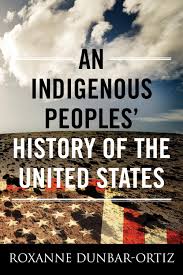
Shoot Everything that Moves: Native American Genocide and the US Tradition of Civilian Atrocities

an indigenous peoples history

An Indigenous Peoples’ History of the United States

Roxanne Dunbar-Ortiz (Beacon Press 2014)

Book Review

I loved this book. It helped me make sense, finally, of the barbaric viciousness of US military policy. The drone wars, torture, sexual assault, civilian massacres and deliberate targeting of women and children all clearly have their origin in the genocidal wars against Native Americans. There is an unbroken continuity, embedded in the mindset of US military officers, between the so-called Indian Wars and the US invasion and occupation of Mexico, the Philippines, Korea, Vietnam, Afghanistan and Iraq.

An Indigenous Peoples’ History of the United States is a book about total war, also known as “irregular warfare” and “counterinsurgency,” a uniquely American scorched earth form of warfare that was first perfected during the British colonization of Northern Ireland. Ulster Scots-Irish settlers brought it to the New World, migrating in the hundreds of thousands in the early eighteenth century. From the beginning, it was primarily Scots-Irish settlers who illegally squatted on unceded Indigenous lands. These were typically soldier-settlers who killed Indigenous farmers and destroyed their towns. They would become the mainstay of the colonies’ early militia movement, as well as forming the bulk of Washington’s revolutionary army.

Native historian Roxanne Dunbar-Ortiz organizes this book around three broad themes: the US role as a Covenant Nation, the Doctrine of Discovery and the uniquely North American concept of genocidal extermination as a legitimate form of warfare.

Correcting the Historical Record

The author begins by correcting centuries of lies and distortions about life in North America prior to European colonization – starting with the number of inhabitants. Archeological evidence indicates the Indigenous population of North American was closer to 40 million than the 1-2 million claimed in most official textbooks. This Over a period of 200 years, this number was reduced to a current Indigenous population of approximately 3 million.

Far from being naked savages, these 40 million lived in advanced sovereign nations comparable to the Mayan, Aztec and Incan civilization in Central and South America. These nations and city-states had extensive road networks and trade relationships and benefited from advanced agricultural techniques (which included irrigation), arts and sciences, and sophisticated systems of government, theologies and philosophies. Unlike other early civilizations, they didn’t domesticate animals. Rather they managed wild herds by deliberately creating food-rich forest parks to attract them. For this reason, they were also free of zoogenic diseases, such as small pox, influenza, measles, etc. that animal domestication introduced into other civilizations. .

By the 12th century, the Mississippi Valley was dominated by a number of large city states, including one (Cahokia) which had a population (40,000) larger than London (14,000) at the same period.

Covenant Nations and the Doctrine of Discovery

All these civilizations were destroyed by European settlers and armies who believed their Christian God had promised North America to them. Sound familiar? According to Dunbar-Ortiz, the US, like Israel and apartheid South Africa, is a Covenant Nation. In all three, the political elite justified the total subjugation, displacement and extermination of the original inhabitants based on a so-called Covenant with their God.

Although it was primarily Protestant English and Scots-Irish settlers who instigated and led the genocidal wars against Indigenous North Americans, legally they used a series of 15th century papal bulls, collectively referred to as the Doctrine of Discovery, as legal justification for their actions. These declare that European nations acquire title to any land they “discover” in Africa, Asia or the Americas – that Indigenous inhabitants lose their natural right to their land once Europeans arrive and claim it. The US Supreme Court upheld the Doctrine of Discovery in 1823.

A State of Perpetual War

Dunbar-Ortiz also carefully documents that the US has been continuously at war ever since their 200-year war against the Indigenous nations. Washington’s revolutionary army directed as much force against Native American resistors as against British troops. Until the 1800s, Indigenous populations exceeded that of the settlers. When the colonial leadership failed in defeating Indigenous warriors by force of arms, they resorted to killing their women and children.

In addition to providing a detailed description of all the battles, unprovoked massacres and forced dislocations of Indigenous Americans, Dunbar-Ortiz provides detailed background on numerous other US wars commonly omitted from textbooks. For example the two Barbary Wars (1801-05 and 1815-16). In 1801 President Thomas Jefferson dispatched the Marines to invade Tripoli* (Libya) because their ruler was exacting fees from US merchant ships that entered their territorial waters.

Between 1798-1827, the US engaged in 21 other foreign military interventions, including Cuba, Latin America and Greece. Between 1831-1896, they engaged in 71 overseas interventions on all continents except Antarctica. Between 1898 and 1919, they engaged in forty overseas military interventions.

I particularly enjoyed the section about the US war on Mexico (which abolished slavery on gaining independence in 1821) and the US desire to extend the slave-plantation system westward. Following the US-Mexico War (1846-1848), the US annexed half of Mexico, which would become the states of Texas, California, Utah, New Mexico, Nevada, Arizona and Colorado. Violent conflict over whether these new states would be free or slave states would ultimately trigger the Civil War.


*This is the origin of the first line of the Marine hymn: “From the halls of Montezuma (referring to the US invasion of Mexico) to the shores of Tripoli.”