The Unauthorized Biography of Barack Obama

unauthorized biography

The Unauthorized Biography of Barack H Obama

by Webster Tarpley

Progressive Press (2008)

Download free PDF

Book Review

Published in the lead-up to the 2008 election, Tarpley’s unauthorized biography of candidate Obama makes some uncanny predictions about his administration’s pro-corporate and pro-war policies. While some aspects of the book are purely speculative – namely those related to Obama’s psychological make-up – Tarpley raises important concerns about Obama’s background which still haven’t received the public attention they deserve.

Tarpley was one of the very first to publicize the extensive links Obama’s family had with the CIA, as well as his early grooming for the presidency – starting at Columbia University under the tutelage of Carter National Security Advisor Zbigniew Bzrezinski.

Obama’s CIA Career

Following his graduation from Harvard Law School, Obama himself went to work for a CIA front company called Business International Corporation (the New York Times exposed BIC as a CIA front company on 12/27/77). Tarpley cites former Students for a Democratic Society (SDS) leader Carl Oglesby (writing in Ravens in the Storm) that BIC’s main goal was to infiltrate student and leftist groups.

After leaving BIC, Obama became a civil rights lawyer and so-called “community organizer.” In actuality, he served on the board of a number of “progressive” foundations like the Chicago Annenberg Challenge (CAC). Tarpley, who examines the funding and specific activities of these foundations, questions the genuineness of their progressive credentials. All the evidence suggests they actually played a “gatekeeper” or “counterinsurgency” function similar to the programs McGeorge Bundy pioneered as head of the Ford Foundation.

Obama and the Agenda to Privatize Chicago Schools

In fact CAC itself, where Obama was a board member for six years (three years as chair), appears to have replicated Bundy’s 19968 strategy to pit minority boards (in Chicago they were called Local School Councils) against the New York City teachers unions. As Tarpley discovered, the campaign to give LSC’s the power to fire teachers and school principals was championed – not by grassroots minorities – but by business interests headed by Thomas Ayers.

Ayers, by coincidence, happens to be the father of Obama’s pal the former Weather Underground “terrorist” Bill Ayers. Ayers senior has impeccable corporate credentials, which include heading Commonwealth Edison for seven years in the seventies and serving on the board of General Dynamics, Searle, Chico Pacific, Zenith, Northwest Industries, First National Bank of Chicago and the Chicago Tribute.

This may possibly explain his son Bill’s “magical ability” to secure foundation funding. Ayers wrote the grant to secure Annenberg funding for CAC, and he credits himself as one of its co-founders.

By Obama’s own admission, the project on which CAC spent $100 million was unsuccessful in improving the education achievement of black students. What the CAC did accomplish, very successfully, was to drive a wedge between minority parents and the teachers unions, when they could have united to block extensive federal and state education cutbacks. It also threw Chicago schools into such chaos they became ripe for school privatization efforts (ie creation of private Charter schools), championed by the same elite business lobby that pushed through the 1988 School Reform Act. The latter created the LSCs, which ultimately laid the groundwork for former White House staffer Ron Emanuel to close 49 Chicago public schools in favor of private charter schools.

Bill Ayers: the Bomb Making Terrorist

As Tarpley points out, this raises the tricky question of how Bill Ayers transformed himself from a bomb making terrorist to a tenured Professor of education at the University of Illinois-Chicago and a pre-eminent education reformer. Tarpley and others allege the Weather Underground was actually a US intelligence creation, formed with the specific objective of infiltrating and shutting down SDS. This view is substantiated by FBI documents that came to light in 1973 reveling the role of agent provocateurs in instigating much of the violence attributed to the Weathermen – evidence Ayers used to have his own weapons and bomb-making charges dismissed.

Considerable circumstantial evidence supports these allegations. First is the striking “coincidence” that many of the Weather Underground leadership were, like Ayers, the sons and daughters of wealthy members of the corporate elite. Second is the report of former SDS members that the Weathermen, who did no fundraising to speak of, appeared to have unlimited funds to spend on organizing and military-style training. Third are their classic (successful) Cointelpro-style schemes to undermine. And last is the troubling question of how Bill Ayers can openly brag about his terrorist activities in his 2002 book Fugitive Days – and instead of the facing the death penalty for conspiracy to commit murder, enjoy status and privilege as a tenured professor of education.
How Big Oil Dictates US Foreign Policy

The Secret of the Seven Sisters

Al Jazeera English (2013)

Film Review

Despite its length, this documentary should be compulsory viewing. Everyone with an IQ over 90 should see it at least once before they die. It was only in viewing this film that I fully grasped the insane, oil-inspired military aggression in the third world and the US fascination with despotic dictators.

The video below is actually an 8-part series shown over successive nights on Al Jazeera-English. I’ve summarized the highlights of each of the eight parts so you can fast forward to specific segments that interest you.

0.00 – 23.26

Part 1 takes viewers from the founding of the secret Seven Sisters oil cartel in 1928 to the creation of the competing Organization of Petroleum Exporting Countries (OPEC) in 1960. The latter is made up of oil producing countries that have nationalized their oil industries.*

The film begins by describing the secret (illegal) cartel formed in 1928 by the Anglo-Persian Oil Company (which became British Petroleum), Standard Oil (which became Exxon) and Royal Dutch Shell. The goal was to end the cutthroat competition that was eating into profits. At a secret meeting in Scotland the three companies agreed to an orderly division of global production zones, as well as a process for fixing oil prices.

Later Mobil, Gulf, Texico and Chevron would join these three oil giants. The existence of the cartel remained secret until the 1950s, when it became known as the Seven Sisters.

This segment describes the totalitarian control BP exercised over Iran until 1951. A strike for higher wages led to a national uprising that overthrew the Shah and resulted in the democratic election of Mohammad Mosadegh as president. When the latter threatened to nationalize Iran’s oil industry, the British government requested CIA assistance to overthrow Mosadegh and restore the Shah to the throne. In return, the US government won the right for American oil companies to join BP in exploiting Iran’s oil resources.

In July 1956 after Egyptian president Nasser nationalized the Suez Canal (the main route for transporting Middle East oil to Europe), Britain, France and Israel declared war on Egypt. Nasser responded to an aerial bombing campaign by using concrete bunkers to blockade all Suez traffic. For once, the US and USSR collaborated to pressure the three aggressors to withdraw their forces and restore the transit of oil tankers through the canal.

23.26 – 46.00

Part 2 traces how the rise of OPEC worked to gradually erode the dominance of the Seven sisters – with violent repercussions.

In 1972 Saddam Hussein nationalized Iraq’s oil industry, with technical and military support from the Soviets and the French.

By October 1973, when Israel’s Arab neighbors launched the Yum Kippur War, OPEC members controlled 60% of the global oil supply. This enabled them to launch an oil embargo against the US in retaliation for their support of Israel in the 1973 conflict.

In 1978 Iran’s Ayatollah Khomeini, living in exile in Paris, called for a workers strike in the Iranian oil industry that caused a total shutdown of oil production. This, in turn, led the US to abandon their longtime support of the Shah and his secret police. The result was a national uprising, the forced exile of the Shah, the return of Ayatollah and the nationalization of Iran’s oil industry.

Determined to regain American corporate control of Iran’s oil industry, the US government backed Saddam Hussein’s invasion of Iraq in 1980. The sudden onset of peace in 1988 led to a period of “overproduction” and a dangerous drop in oil prices. In response, George Bush senior, whose Zapata oil company had made a fortune via offshore drilling in Kuwait, openly encouraged Saddam Hussein (through ambassador April Glaspie) to invade Kuwait. This would create a pretext for the first US invasion of Iraq in 1991.

In May 2001 (20 months before the US invasion), a secret energy task force headed by former oil executives Dick Cheney and Condoleezza Rice, drew up a plan whereby Exxon, Shell and BP would divide up US occupied Iraq into eight oil extraction zones.

48.00 – 61.00

Part 3 describes the decision by the Seven Sisters to open up Africa to increasing oil exploitation due to their gradual loss of control over Middle East oil.

In 1970, Colonel Omar Gaddafi led a coup against a corrupt Libyan monarchy that was allowing the Seven Sisters to pay 12 cents a barrel in royalties to extract high quality Libyan oil. Gaddafi immediately nationalized the oil industry, raised oil prices 33% and used the funds to finance generous public services for the Libyan world and to fund freedom fighters all over the world (including the Palestinians).

This section also traces the history of the French oil companies ELF and Total in Nigeria. After Algeria won independence from France in 1971, they nationalized their oil industry, and ELF began exploiting oil resources in Nigeria, Chad, Congo, Cameroon, and Angola, where they financed guerrillas and despotic regimes and participated in bribery and embezzlement schemes that massively increased the international indebtedness of these countries. In 2003 the CEO of ELF was sentenced to prison and the company was bought out by Total.

61.00 – 95.00

Part 4 covers the role of the Seven Sisters in stoking Sudan’s civil war (most of Sudan’s oil comes from South Sudan) and the role of Shell Oil Company in Nigeria’s trial and execution of environmental activist Ken Saro-Wiwa.

95.00 – 118.00

Part 5 traces the longstanding battle between Russia and the US oil industry over control of the Baku oilfields on the Caspian Sea. It begins with Lenin’s capture of the oilfields in 1920. Hitler’s primary reason for attacking the USSR in 1941 was to gain control over Baku.

This section also details how a US-Saudi conspiracy to flood the market with oil in the late eighties (dropping the global oil price to $13) ultimately led to the Soviet collapse in 1989. At the time revenue from oil sales was the Soviet’s sole source of foreign currency.

118.00 – 142.00

Part 6 concerns the role of the color revolutions in Georgia, Armenia and Azerbaijan in keeping Caspian Sea oil out of Russian hands and under the control of US oil companies.

It briefly discusses the US role in Boris Yeltsin’s coup against the Russian parliament and his privatization of the Russian oil industry on behalf of the Seven sisters and a handful of Russian oligarchs (Putin has subsequently re-nationalized Russia’s oil industry).

142.00 -165.00

Part 7 discusses the concept of Peak Oil and the current dispute between the Iraqi Kurds and the Iraqi government over the control of the Bakr oil terminal near Bazra. At present it’s illegal for the Kurds to export their own oil. Eighty-five percent of Iraqi oil is processed at the Bakr oil terminal and Iraqi Kurdistan on receives 17% of this revenue.

165.00 – 190.00

Part 8 is about the Seven Sisters exploitation of Mexican and Venezuelan oil prior to the election of Hugo Chavez as president. It also summarizes that status of the countries (Saudi Arabia, Russia, Iran, Venezuela, Brazil, and Malaysia) that have nationalized their oil industry. At present these countries control one-third of oil and gas production, and more than one-third of oil reserves. Despite their role in instigating western military aggression, the influence of the Seven Sisters continues to declines.

At present they control 10% of oil production and only 3% of oil reserves. Their monopoly on exploration, drilling and refining technology gives them disproportionate control over the industry.


*Algeria, Angola, Ecuador, Iran, Iraq, Kuwait, Libya, Nigeria, Qatar, Saudi Arabia, the United Arab Emirates, and Venezuela

What They Won’t Tell Us About China’s Economy

China Rises: Getting Rich

New York Times Documentary (2013)

Film Review

“How China Backs Its Enormous Economic Success”

China Rises purports to uncover the secret of China’s phenomenal economic success. It traces the massive migration of rural peasants into scores of newly fabricated cities and industrial centers. Of the thousands of new factories springing up over the last thirty years, half are privately owned and half are state owned enterprises. Most manufacture consumer goods (clothes, electronic gadgets, shoes, textiles, heavy appliances, household goods, toys, watches) for export.

The filmmakers attribute China’s economic miracle to their newfound openness to private enterprise and their ridiculously low wages. At the time the documentary was made, the average Chinese wage was 60 cents an hour for a 12 hour day. By the end of last year, this had increased to $1.69 an hour Rising Chinese Wages

Most of the film focuses on the lavish lifestyles of China’s most famous self-made millionaires. There are also several interviews with rural peasants who have migrated to China’s designer cities to work. Most are extremely grateful for the opportunity to earn money to lift their families out of extreme poverty. Women, however, tend to be sad about being separated from their children – their earnings aren’t sufficient to bring them to the city, so they are cared for by grandparents in the rural villages.

The film also features segments about China’s emerging middle class learning to pamper themselves and China’s rampant knock-off industry, specializing in counterfeit luxury items, fake birth control pills, fake antibiotics and even fake milk powder. The latter caused 54,000 Chinese babies to be hospitalized (six died) in 2008.

Ignoring the Real Reason for China’s Stellar Growth

What I find most significant about this video is what it leaves out. In fact, it totally ignores the main impetus for China’s phenomenal growth – namely a monetary policy that doesn’t rely on borrowing money from private banks.

As of February 2014, China had only borrowed a total of $US 823 billion from foreign banks – about  9% of GDP. In contrast, the debt the US owes to private banks is 101.5% of GDP.

Unlike most western economies, 90% of the loans used to finance businesses and government services originate from China’s government-run central bank.* Bloomberg’s refers to it as “Chinese-style” quantitative easing, ie the Chinese government is creating the money out of thin air, rather than borrowing it from private banks (and paying them interest to create it out of thin air).

This differs from US-style quantitative easing in that the Chinese government spends the money they create directly into the economy instead of handing it over to private banks.

Despite Obama’s recent attacks on China for “weakening their currency,” neither the President nor the corporate effort make any effort to explain exactly how the Chinese are doing this. The explanation is actually fairly simple: pumping more yuan/renminbi into the Chinese economy causes inflation and weakens the currency’s value in relation to other global currencies.

The corporate media glosses over these details because they don’t really want Americans to understand where US dollars come from – that 97% of the dollars in circulation are created by banks out of thin air and loaned to us at interest. Or that depending on private banks to create and control our money supply is a big reason for our current economic crisis. See Stripping Banks of Their Power to Issue Money

They especially don’t want us to realize there’s an alternative – government-issued currency by a government owned central bank – nor that it’s working miracles for the Chinese economy.


*Contrary to popular belief, the US central bank, aka the Federal Reserve, is a consortium of private banks overseen by a government appointed director (Janet Yellen).

A 1991 BBC Documentary About Donald Trump

Trump: What’s the Deal?

BBC (1991)

Film Review

Trump: What the Deal?  is a 1991 documentary about Donald Trumps early life. It’s been suppressed for 24 years owing to his threats to sue the BBC

Even back in 1988, Trump was known as the “people’s billionaire.” According to the filmmakers, this was largely due to shrewd marketing by his press agent (all the rich had press agents during the 1980s – it was fashionable to be ostentatiously wealthy).

According to the documentary, Trump has an ugly history of classic sociopathy, which includes “truthful hyperbole” (his own term for bending the truth), collaborating with mobsters, known criminals and notorious Mafia attorney Roy Cohn to score questionable tax abatements from New York City officials, cheat contract workers out of payment, conceal asbestos contamination and illegally harass and evict tenants (even after the court ordered him not to).

The film debunks Trump’s claim of being a self-made billionaire. He inherited his wealth from his father. According to Forbes magazine he’s been in bankruptcy court five times (most recently in 2014). He’s notorious for using borrowed money (often in the form of junk bonds) to finance real estate developments and filing for bankruptcy protection when he can’t meet debt repayments.

Privatization and the Theft of the Commons

Catastroika

by Aris Chatzistefanou and Katerina Kitidi

Film Review

Catastroika is a Greek documentary on neoliberalism, with a specific focus on the privatization of publicly owned resources. Although it makes no mention of historian Richard Linebaugh, its depiction of the neoliberal privatization movement provides an elegant illustration of the ongoing theft of the Commons (see Stop Thief: the Theft of the Commons).

After a brief overview of the University of Chicago economists (championed by Milton Friedman) who first put neoliberal theory into practice during the Pinochet dictatorship, the documentary tracks the wholesale privatization of Russia’s state owned industries after the 1993 coup by Boris Yeltsin, in which he illegally ordered dissolution of the Russian parliament (see The Rise of Putin and the Fall of the Oligarchs).

The fire sale of state assets to oligarchs and western bankers would virtually destroy the Russian economy, throwing millions of people into extreme poverty and reducing average life expectancy by ten years.

The Privatization of East Germany

With German reunification in 1990, East Germany would be the third major target for massive privatization. According to German economists interviewed in the film, the process amounted to an “acquisition” of East Germany by West German bankers. The West German government set up an agency called Treuhand to buy up state owned East German businesses at the rate of ten to fifteen a day – a total of 8,500 businesses in four years. The process, undertaken with virtually no oversight, predictably resulted in massive chaos and fraud. Many well-performing East Germany companies were dissolved for the simple reason they competed with West German businesses. Three million (out of 4.5 million) East German workers lost their jobs, which East Germany’s GDP shrank by 30%.

Using Debt to Compel Compliance

With the gradual demise of the world’s dictatorships during the 1990s, debt, rather than brute force, became the main mechanism to compel people to give up their publicly funded assets. At present, most of the focus is on Greece.

Current EU Commission Jean-Claude Juncker holds up Treuhand (which incurred a 250 million euro debt German taxpayers are still paying off) as a model for the Greek Asset Development Fund. The latter has been steadily selling off (at bargain basement prices) Greek railroads and municipal power and water systems.

The Dismal Track Record of Privatized Utilities

The filmmakers end the film by highlighting the disastrous outcome of Britain’s decision to privatize its railroads in 1993, the city of Paris decision to privatize its water service in the 1980s (it’s recently been re-municipalized due to massive public unrest – like privatized water systems in Bolivia, Ecuador and Argentina) and California’s experiment with electricity deregulation in the 1990s (leading to the Enron scandal).*


*The Enron scandal involved massive securities fraud and a deliberate conspiracy by power companies to withhold power to drive up electricity prices.

How Slaveholders Received the Biggest Bailout in British History

Britain’s Forgotten Slave Owners

BBC (2015)

Film Review

Britain’s Forgotten Slave Owners is about the $20 million (present equivalent $17 billion) pound bailout the British paid to ex-slaveholders in 1834 when they abolished slavery. The documentary is based on University College London research into the British Slave Compensation Commission archive. The latter lists each of 46,000 British slaveholders who claimed compensation for “loss of property” when they were forced to free their slaves.

The 1834 law banning slavery didn’t apply to US slaves, as the US was no longer a British colony. It only applied to 800,000 slaves in the Caribbean and other British colonies. The archive lists the name of each slaveholder, the number of slaves they freed and the amount of compensation they received. It was the largest government bailout in British history.

Of the 800,000 slaves, approximately half were owned by 6,000 absentee slave owners, who lived in Britain and paid plantations managers to run their plantations. Many were industrial barons who used the wealth they amassed through slavery to establish major banks, railroads and shipping companies. Many were women, widows who inherited slaves from their husbands, or lower middle class merchants who only owned one or two slaves. A few were ex-slaves, the mixed raced descendents of plantation owners who raped female slaves. Thirty-seven were members of the House of Lords; about half that number Members of Parliament. A few were abolitionists who had rejected the pro-slavery claim that slaves were property.

Too Big to Fail

Part 1 describes the formation of British slave colonies in Barbados, Jamaica and other Caribbean islands and the massive wealth creation that enabled the slave industry to run the British economy for two centuries.

Part 2 discusses the abolition movement led by William Wilberforce, which led Britain to ban the slave trade in 1807, and the massive popular campaign leading to total abolition in 1834. The pro-slavery lobby used the same argument as banks used to justify the 2008 bailout: slaveholders were deeply indebted and without the bailout the British credit system would have collapsed.

The University College London has digitalized the Slave Compensation Commission archive to enable people of British heritage to search whether they have ancestors who owned slaves:

https://www.ucl.ac.uk/lbs/

A search of my surname Bramhall turned up no hits. This doesn’t surprise me as the Bramhalls in England were persecuted Catholics.

A search of my paternal grandmother’s maiden name (Gallagher) turns up one hit: William Gallagher, who received 46 pounds 15 shillings for one slave in Cape of Good Hope.

A search of her mother’s maiden name (Fitzgibbon) also turns up one hit: Rebecca Fitzgibbon, who received 73 pounds 1 shilling and 2 pence for two slaves in Honduras.


Forgotten History: the Theft of the Commons

stop thief

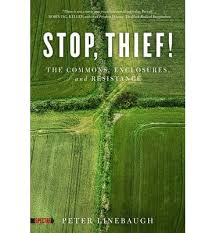
Stop Thief: the Commons Enclosures and Resistance

by Peter Linebaugh (2014)

Book Review

Free download at https://libcom.org/library/stop-thief-commons-enclosures-resistances

Occasionally you come across a book that totally turns your worldview on its head. This book is definitely one of them.

Stop Thief is about the loss of the Commons through enclosures,* which author Peter Linebaugh maintains is the essence of capitalism. Until 200 years ago, communally owned moors and forests were fundamental to all human civilization. In Europe, the Commons included specific customary rights, including gleaning, grazing rights, and access to the forest for medicines and wood for fuel, housing and tools. These rights had been guaranteed for thousands of years (they’re mentioned in both the Old and New Testament) and were codified in the Magna Carta and the Charter of the Forest. Thanks to the Commons, which provided for the basic subsistence needs of the population, there was virtually no crime as we know it and no extreme poverty.

In the essays in Stop Thief, Linebaugh details 800 years of enclosures, as well as the popular riots and rebellions that have resisted them. In doing so, he establishes a clear continuity between the organized resistance against European enclosure and the work of great revolutionary thinkers, such as Karl Marx, Thomas Paine, William Morris and Edward Thompson

According to Linebaugh, the European enclosure acts didn’t just enclose (privatize) moors and forests, but they enclosed handicrafts as factories, community markets as shops and women as units of reproduction who ceased to have a legal persona (women who resisted enclosure were burned and/or tortured as witches).

Enclosure: A Global Phenomenon

Enclosures, which occurred worldwide thanks to European colonization, began in the 13th century with peaks in the 15-16th century, the 18th-19th century and the 21th century. The latter have resulted in the theft of pensions and homes by banks, the privatization (and destruction) of the environment, the capture of health care by insurance companies and current attempts to privatize (enclose) the Internet. In other words, the essence of capitalism is dispossession, ie theft.

In Europe, enclosure mainly took the form of imprisonment and the privatization of communal land. In the 18th century, enclosure was accompanied by a prison building spree and the creation of a “civilian” police force, as well as massive emigration to European colonies. Commoners who persisted in claiming their customary rights were criminalized and either hanged (for minor crimes such as stealing firewood or a loaf of bread) or imprisoned.

Resistance to Enclosure Has Been Continuous

The resistance to enclosures, especially in England and Germany, was more or less continuous. Over 800 years, peasants blocked privatization of their communal land by petitioning, fence breaking, stoning officials for posting enclosure notices, riots and organized rebellion. Despite continuousl military occupation, it took 17 years to drive the peasants out and fully privatize Otmoor.

The Peasants Revolt of 1381, the Ketts Rebellion of 1549, the formation of Levellers, Ranters and Diggers movements that would culminate in the English Civil War in 1649, and the formation of the Luddites in the late 18th century were all part of the popular resistance to enclosures.

Marx and the Theft of Wood

Marx refers to the process by which the ruling elite encloses the Commons, depriving common people of the means of subsistence (aka the means of production), as primitive accumulation. Linebaugh traces how Marx’s interest in political economy was directly influenced by coming of age as the Moselle region in Germany was being enclosed. His very first essays on “Debates of Law and the Theft of Wood” expressed outrage at the appropriation of local forests by rich burgermeisters and the criminalization of customary wood gathering.

I also really enjoyed the essays on Tom Paine, which discuss his upbringing as the Norfolk commons was being enclosed and his critical influence in the Irish and French revolution. His essays and books calling for the restoration of the Commons are rarely discussed in American history textbooks.


*Enclosure is the legal (usually violent) process by which common people are driven off communal land to enable it to be fenced off as private property.
**The Charter of the Forest is a charter originally sealed by King Henry III under the regency of William Marshall, 1st Earl of Pembroke. A companion document to the Magna Carta, it re-established rights of access to the royal forest that had been eroded by William the Conqueror and his heirs.

The War Crimes of Bill Clinton

The Weight of Chains

Boris Malagurski (2010)

Film Review

The deliberate demonization of the Serbian people by the Clinton administration has been a special interest ever since I cared for Serbian PTSD victims in the mid-nineties. At the time there were rumors the US was after oil in the Caspian basin. Until I saw this documentary, I was unaware of the bloodthirsty ruthlessness of US policy in Yugoslavia. Nor that Clinton, like his successors George W Bush and Barack Obama, was guilty of war crimes. The film also sheds important light on current US policy in Ukraine.

The Weight of Chains is about the deliberate break-up of Yugoslavia in the 80s and 90s to enable its transformation into a US colony, like Iraq and Afghanistan. The cover story blaming Serbian barbarism for the conflagration in Bosnia and Kosovo was pure fabrication by the Clinton administration and US media.

Under Marshall Tito (1943-1980), Yugoslavia enjoyed an ethnically diverse society in which Muslim Turks, Croatians, Serbians, Hungarians, Albanians and other ethnic minorities lived side by side and intermarried. It was a very prosperous nation, thanks to a mixed economy that combined central economic planning with private enterprise, worker cooperatives and a generous welfare state. Tito, who stubbornly resisted Russian pressure to join the Soviet bloc, was one of the founders of the non-aligned movement.*

Enter the NED

Shortly after Tito’s death in 1980, President Reagan signed a secret memorandum declaring his intention to transform Yugoslavia into a “market economy” (translation: US colony for Wall Street investors). The first salvo in this campaign was to send in the CIA-funded National Endowment for Democracy (NED), to finance pro-US opposition groups, journalists, trade unionists and the G17. The latter was a group of World Bank economists who seized control of the Yugoslavian economy by inducing corrupt officials to enter into unpayable loans. By the late 1980s, the G17 had imposed deep cuts on all social services and forced 1,100 industries into bankruptcy. Those that weren’t totally wiped out were sold to foreign investors at rock bottom prices.

Thanks to these austerity cuts, by 1990 Yugoslavia’s unemployment rate had soared to 20%. When the government appealed to the US for debt relief, Bush senior cut off all aid to Yugoslavia. Under US pressure, the IMF only agreed to fund right wing ultranationalist groups in six autonomous regions (Croatia, Serbia, Slovenia, Montenegro, Kosovo, Bosnia) – provided they declared independence from Yugoslavia. The Bush senior administration also illegally supplied arms to Croatian fascists who would seize control of Croatia and the Muslim Bosniaks who controlled Bosnia.

Accordingly Slovenia and Croatia declared independence in 1992 and Bosnia in 1992.

US-Inspired Ethnic Cleansing

Despite constant denunciation of the Serbian people (as fascist thugs) by the Clinton administration and Senator Joe Biden, the real culprits were fascist American thugs. In 1995, the Clinton administration financed and armed the Croatian government to carry out the largest act of ethnic cleansing in history in the Serbian enclave of Krajinia. Thanks to the American-inspired Operation Storm, 2,000 Serbs were killed and 250,000 were driven from their homes over a period of 84 hours. One of my patients, whose sister was massacred during Operation Storm, only survived because his Muslim neighbors hid him and his children from the Croatian army.

The Weight of Chains also deconstructs the alleged Serb atrocities committed at Srebrenica (where equal numbers of Serbs and Muslims died), which the US would use to justify NATO intervention.

Enter Osama bin Laden

Following Serbian independence, Clinton armed and trained the terrorist Kosovo Liberation Army,** with the assistance of Osama bin Laden and heroin-trafficking Mujahideen from Afghanistan. The President’s chief motivation was to further destabilize Serbia to open it up to US investment.

When Slobodan Milosevic refused to sign a peace agreement accepting US occupation of Serbia, Clinton committed further violations of international law by using NATO aircraft to bomb Serbian civilians and deliberately target civilian infrastructure that included power grids, schools, hospitals and water filtration plants.

Enter George Soros

Following Milosevic’s surrender in June 1999, the World Bank immediately sent in an army of World Bank lawyers to privatize Serbia’s most valuable state-owned assets. Soros and his cronies were particularly keen on getting the Trercha mining interest into western hands, with its rich coal, copper, zinc, cadmium, gold and silver resources.

The film concludes by examining the dire economic consequences (ie massive debt, industry closure and joblessness) for Eastern European countries whose business elites opt to join the EU and NATO. For example, the EU forced the Czech Republic to close their sugar industry because it was more profitable to import Cuban sugar. While the French destroyed the Hungarian vineyards by dumping cheap wine into their market, forcing Hungarian wine growers to sell their vineyards to English investors at bargain basement prices. After Slovenia joined the EU in 2004, they experienced massive layoffs after most of their factories were privatized and moved overseas. In 2009, Croatia (like Greece) was forced to start selling their islands to pay off their debt.

*The Non-Aligned Movement is a group of states which aren’t formally aligned with or against any specific power bloc.
**Kosovo is a disputed territory within Serbia in which ethnic Albanians make up 80-90% of the population.

The Real Cause of the Revolutionary War: Preserving Slavery

The Counter-Revolution of 1776: Black Resistance and the Origins of the United States of America

Professor Gerald Horne

In this lecture about his 2014 book, African American history professor Gerald Horne exposes important events that triggered the so-called War of Independence. He makes a compelling case that the decision of the 13 colonies to declare independence in 1776 was a direct result of George III’s 1775 decision to establish all-black Ethiopian regiments to fight colonial regiments in Virginia (the colony that produced Thomas Jefferson, George Washington and other high profile members of the independence movement). Odd, isn’t it, that white historians neglect to mention this important fact in our high school textbooks?

According to Horne, there was a clear precedent for arming African troops in North America. In the 18th century, both the French (who occupied Quebec) and the Spanish (who occupied Florida) armed escaped slaves to attack the English colonies. Collaboration between the armed Africans and black slaves led to several major slave revolts in the 18th century. Two of the most important were the 1712 slave uprising in Manhattan (backed by the French) and the  1739 Stono’s Revolt in South Carolina (led by a coalition of Spanish armed Africans from St. Augustine Florida and Portuguese-speaking slaves from Angola).

Horne also believes the timing of the 1776 “War of Independence” also related to Britain’s decision to abolish slavery in 1772 – and fears King George would extend the ban on slavery to the 13 colonies.

In summing up, Horne traces how this willingness to go to war over the diabolical (but immensely profitable) institution of slavery would shape the ruthlessly greedy and mean-spirited character of the American nation. Unlike the US, Canada, which never adopted slavery nor fought two wars to preserve it, has made a genuine effort to look after its poor and underprivileged. Horne gives the example of the universal single payer health system.

Horne believes this hidden history also accounts for the special persecution of the descendents of slaves, as opposed to non-US natives with black skin.

There is a very long introduction. The actual talk starts at 9:24.

Latin America: Five Centuries of Pillage

open veins of latin america

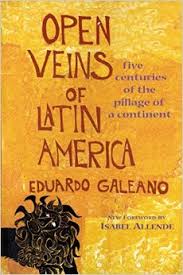
Open Veins of Latin America: Five Centuries of the Pillage of a Continent

Eduardo Galeano (translated by Cedric Belfrade)

Monthly Review Press (1973, 1999)

Download free PDF: Open Veins of Latin America

Open Veins of Latin America is about the brutal rape of Latin America and its people that commenced from the first point of contact with Columbus in 1453. The 1999 edition includes an addendum Galeano wrote in 1977. It discusses the rise of the pseudo-populist Peron in Argentina, the CIA coupe in Chile in 1973 and the barbarous Pinochet regime.

For me, the main benefit of reading this book was appreciating my overall ignorance of Latin American history. For example, I had no idea that Latin America was an economic colony of England even before they gained political independence from Spain. According to Galeano, this came about due to Spain’s failure to develop a manufacturing base. He blames this in part on the Hapsburgs’ (the Austrian Hapsburgs ruled Spain from 1516-1700) destruction of the Spanish economy by flooding it with cheap textiles, leathers and metal goods and in part on Spain’s misguided decision to expel all their Jews, Arabs and Flemish protestants. The latter would cause Spain to lose most of their artisans, capital and manufacturing entrepreneurs, many of whom ended up in England.

Mass Genocide in Latin America

I was already aware of the genocide the Spanish committed against indigenous Latin Americans, but I had no idea how massive it was. Most were killed through forced labor in the gold and silver mines (through starvation and mercury poisoning), though large numbers died from exposure to new European diseases. Many native women killed their children and committed suicide to keep them out of the mines.

When Columbus first landed at Hispaniola, there were an estimated 70 million indigenous people in Latin America. One-hundred-fifty years later, this number had dropped to 3.5 million. The slaughter continues to the present day (through severe malnutrition and associated medical conditions) at an annual rate comparable to three Hiroshimas. The main cause, according to Galeano, is foreign-controlled expropriation of agricultural land for mining and cash crop exports. In 1973 when this book was published, Latin America produced less food per capita than they did prior to World War II.

Brazil Relied on African Slaves

In Brazil, which was colonized by the Portuguese, gold wasn’t discovered until the 18th century – it wasn’t on display, as in the Aztec, Mayan and Incan civilizations Spain destroyed. Because there was no pre-existing civilization (ie ready source of slaves) in Brazil, the Portuguese had to buy black slaves from the English to exploit the gold mines.

The Switch to Minerals and Cash Crops

Country by country, Galeano traces how English, Spanish and Portuguese bankers and traders began by depleting all the gold and silver. They then subsidized local aristocracies to transfer their slave labor (and later starvation wage labor) to the production of sugar, rubber, cotton, coffee, cacao, steel, tin, sodium nitrate fertilizer, meat, fruit, iron, tin and copper for export.

Why Countries with the Richest Resources End Up the Poorest

The most interesting section of the book explores why European settlement led to a very different outcome in Latin America than in North America. In Galeano’s view, the reasons are threefold 1) Latin America started off with a much richer resource base (ie gold and silver) for Europe to exploit 2) unlike North America, Latin America provided a dense civilized population, ripe for exploitation as slaves and 3) except for cotton, North America produced no exotic products Europe couldn’t produce for themselves.

Galeano makes the case that economic “development” in Latin America was very similar to the southern US prior to the Civil War. He points out various ways in which the North essentially colonized the South, reinforcing the view Paul Craig Roberts expresses in a recent essay that the Civil War wasn’t about freeing slaves – but about “tariffs and northern economic imperialism.”