A Novel About Jim Crow

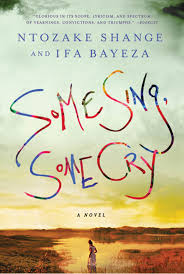
some singSome Sing, Some Cry

By Ntozake Shangi and Ifa Bayeza

St Martin’s Press (2010)

Book Review

Some Sing, Some Cry is a novel tracing seven generations of a fictional African American family from slavery to the election of Barack Obama. The authors are sisters and the first half of the book is based on family oral history.

The novel’s matriarch originates from on an island off the coast of South Carolina and takes the name of a prominent plantation owner who has fathered children by both her mother and herself. The family are forced off their land when Reconstruction ends, migrating to Charleston.

The first half of the book is the strongest, with its poignant depiction of family members being stripped of their newly won freedoms as Jim Crow laws ban them from most occupations. To a large extent, the plot revolves around complex prejudices within the African American community against family members with darker skin. In one instance, the plantation owner kidnaps an light-complected male child and raises him as his heir. In another a “bright-skinned” uncle passes as Irish to evade trade union rules that ban Negroes.

The novel’s main focus is the role newly freed slaves played in the development of modern American music. The reader gets the strong sense that many Mayfield family members turned to working in minstrel shows, music halls and clubs when Jim Crow laws banned them from other occupations.

The sections dealing with the great northern migration, Harlem renaissance and birth of ragtime and jazz are also quite riveting. I came away with a totally new insight into the African American origin of the dance crazes of the “roaring twenties,” eg the “Charleston” and the “Black Bottom.”

This was also my first exposure to the extreme discrimination African American soldiers faced during World War I. Unlike white troops, they weren’t issued gas masks. Forced to improvise, they covered their faces with urine soaked rags to protect themselves against mustard gas.

The US Colonization of Latin America

The War On Democracy

Directed by John Pilger (2007)

Film Review

The War Against Democracy is about the US colonization of Latin America, specifically the role of the CIA and the US military in systematically overthrowing democratically elected governments in Central and South America. In each case, the US installs hand picked right wing dictators who forcibly expel indigenous peasants from their land and privatize publicly owned assets and resources for the benefit of US corporations.

Australian filmmaker John Pilger begins by focusing on the US war against Venezuela’s democratically elected government, carefully debunking Washington and media lies depicting former president Hugo Chavez as a communist dictator. In addition to tracing the massive popular movement that brought Chavez to power, the documentary also features dramatic footage of the failed US-sponsored 2002 coup.

Pilger also highlights the 1954 coup in Guatemala, the 1973 coup in Chile and the Bolivian revolution that overturned Bolivia’s right wing government and bring the country’s first indigenous president (Evo Morales) to power in 2003.

Pilger’s interviews with former CIA agents who helped orchestrate some of these coups are priceless.


Explosive Testimony in Sirhan/RFK Assassination Parole Hearing

Robert Kennedy with Paul Schrade. (photo: unknown)

By Paul Schrade, Reader Supported News

11 February 16


Full text of Paul Schrade’s prepared remarks for delivery at Sirhan Sirhan’s February 10th Parole Suitability Hearing. Transcription provided by Brad Johnson, Concept Producer for Rob Beemer, Interesting Stuff Entertainment, Los Angeles (Rob accompanied Paul Schrade to yesterday’s Sirhan parole hearing, acting as Mr. Schrade’s support person).

Update, 02/11/16: A California parole panel late yesterday denied Sirhan Sirhan’s parole application for a 15th time.

ood Morning, Gentlemen:

I am Paul Schrade of Los Angeles. I am 91 years old. And back when I was 43, I was among six persons shot at the old Ambassador Hotel in Los Angeles at just after Midnight on June 5th, 1968.

I was shot along with Senator Robert F. Kennedy, who had just won California’s Democratic Primary Election for the Presidency of the United States. Five of us survived our wounds. And as history knows, Senator Kennedy was fatally wounded.

I am here to speak for myself, a shooting victim, and to bear witness for my friend, Bob Kennedy.

Kennedy was a man of justice. But, so far, justice has not been served in this case. And I feel obliged as both a shooting victim and as an American to speak out about this – and to honor the memory of the greatest American I’ve ever known, Robert Francis Kennedy.

Sirhan Bishara Sirhan was originally scheduled for release in 1984 but, after intense political pressure, his parole date was rescinded and he has since been denied 14 times.

In order for you to make an accurate determination of Sirhan Sirhan’s parole, you need to know my feelings on this case and the full picture of what actually happened.

Sirhan, I forgive you.

The evidence clearly shows you were not the gunman who shot Robert Kennedy. There is clear evidence of a second gunman in that kitchen pantry who shot Robert Kennedy. One of the bullets – the fatal bullet – struck Bob in the back of the head. Two bullets struck Bob literally in his back. A fourth bullet struck the back of his coat’s upper right seam and passed harmlessly through his coat. I believe all four of those bullets were fired from a second gunman standing behind Bob. You were never behind Bob, nor was Bob’s back ever exposed to you.

Indeed, Sirhan, the evidence not only shows that you did not shoot Robert Kennedy but it shows that you could not have shot Robert Kennedy.

Gentlemen, the evidence clearly shows that Sirhan Sirhan could not and did not shoot Senator Bob Kennedy.

Several days ago, I made sure that several documents were submitted to this board for you to review. If you have not done so as yet, I would ask you to please review them very carefully during your deliberation. I will be glad to re-submit these documents to you, here today.

I believe, after you review these documents, that it should become clear to you that Sirhan Sirhan did not shoot – and could not have shot – Robert Kennedy. What I am saying to you is that Sirhan himself was a victim.

Obviously there was someone else there in that pantry also firing a gun. While Sirhan was standing in front of Bob Kennedy and his shots were creating a distraction, the other shooter secretly fired at the senator from behind and fatally wounded him. Bob died 25 hours later.

Gentlemen, I believe you should grant Sirhan Sirhan parole. And I ask you to do that today.

Along with what Sirhan’s lawyers have submitted to you, the following are the documents that I made sure were submitted to you and which should also be factored into your decision today.

First, I want to show you this. It’s a letter written in 2012 by my good friend, Robert F. Kennedy Junior. Bobby wrote this letter to Eric Holder, who was then the Attorney General of the United States. In his letter to Mr. Holder, Bobby requests that federal authorities examine the Pruszynski Recording, the only known audio recording made of his father’s assassination at the Ambassador Hotel. The recording was uncovered in 2004 at the California State Archives by CNN International senior writer Brad Johnson.

This next document is a federal court declaration from audio expert Philip Van Praag, who Johnson recruited to analyze the Pruszynski Recording.

In this document, Van Praag declares that his analysis of the recording concludes that two guns were fired in the Robert Kennedy shooting.

Van Praag found a total of 13 gunshots in the Pruszynski Recording. Sirhan’s one and only gun at the crime scene held no more than eight bullets and Sirhan had no opportunity to reload it.

Van Praag also found what he calls “double-shots” – meaning two gunshots fired so close together that they could not both have come from Sirhan’s Iver Johnson Cadet revolver. Van Praag actually found two sets of these “double-shots.”

Additionally, he found that five of the 13 gunshots featured a unique audio resonance characteristic that could not have been produced by Sirhan’s gun model, meaning those five shots were fired from a second gun of a different make.

Van Praag further found that those five gunshots were fired in a direction heading away from Pruszynski’s microphone. Since the microphone was about 40 feet west of the Kennedy shooting, those five shots were fired in an eastward direction, which was opposite the westward direction that Sirhan is known to have fired his eight-shot Iver Johnson Cadet.

These documents are statements from two witnesses to the Robert Kennedy shooting, both of them assistant maître d’s for the Ambassador Hotel. These two men, Karl Uecker and Edward Minasian, escorted Robert Kennedy into the kitchen pantry immediately after the Senator delivered his victory speech in a hotel ballroom for having won the California Primary. Both Uecker and Minasian say Sirhan was in front of Bob Kennedy as the Senator walked toward Sirhan, meaning that Bob and Sirhan were facing each other. Both witnesses say Sirhan was still in front of Bob as Sirhan fired his gun. And both say that after Sirhan fired his first two shots, Uecker quickly pushed Sirhan against a steam table, placing Sirhan in a headlock while grabbing hold of Sirhan’s firing arm, forcing the tip of Sirhan’s gun to point away from where Bob Kennedy was and causing Sirhan to fire blindly his remaining six bullets.

In other words, Sirhan only had full control of his gun at the beginning, when he fired his first two shots, one of which hit me. Sirhan had no opportunity to fire four precisely-placed, point-blank bullets into the back of Bob Kennedy’s head or body while he was pinned against that steam table and while he and Bob were facing each other.

This document is the official Robert Kennedy autopsy report summary. It shows that all bullets directed at Senator Kennedy were fired from behind him at point-blank range. As the autopsy states, and as these drawings show, the bullets traveled from back-to-front at steep upward trajectories. One bullet struck Senator Kennedy at the back of the head, two bullets at the right rear armpit and a fourth bullet at the right rear shoulder of his jacket, which passed harmlessly through his jacket.

Again, Sirhan’s bullets could not have struck the back of Bob Kennedy’s head or the back of his body or the back of his jacket’s right shoulder, as the autopsy clear shows took place, because Sirhan was never in a position to administer any of those four Kennedy shots. The prosecution never placed Sirhan in that location and position.

These are documents from the Los Angeles Police Department that reveal LAPD misconduct in the police investigation of the Robert Kennedy murder. They detail evidence that was destroyed while Sirhan’s appeal was still pending as well as a photograph that was acknowledged by the LAPD to be “effective rebuttal” but was withheld from the defense team.

Indeed, the LAPD and L.A. County District Attorney knew two hours after the shooting of Senator Kennedy that he was shot by a second gunman and they had conclusive evidence that Sirhan could not – and did not – do it. The official record shows that the prosecution at Sirhan’s trial never had one witness – and had no physical nor ballistic evidence – to prove Sirhan shot Bob Kennedy. Evidence locked up for 20 years shows that the LAPD destroyed physical evidence and hid ballistic evidence exonerating Sirhan – and covered up conclusive evidence that a second gunman fatally wounded Robert Kennedy.

This document is a memo written by Criminalist Larry Baggett, who investigated the Robert Kennedy shooting for the LAPD. The Baggett memo states that the bullets that hit Senator Kennedy and William Weisel, another shooting victim in the pantry, were not fired from the same gun. The memo also states that the bullet that traveled upward through Bob Kennedy’s body and into his neck was not fired from Sirhan’s revolver. Such a finding would be proof that Sirhan did not shoot Robert Kennedy.

Mr. Deputy District Attorney, based on all of this information and more, I ask that you inform Los Angeles County District Attorney Jackie Lacey that I am formally requesting her to order a new investigation of the Robert F. Kennedy assassination. I will also be making the same request of Los Angeles Police Chief Charlie Beck.

Please note, Mr. Deputy District Attorney, that I am using the word “new” here. I am not requesting that the old investigation simply be re-opened. For that would only lead to the same old wrong conclusions. I am requesting a new investigation so that after nearly 50 years, justice finally can be served for me as a shooting victim; for the four other shooting victims who also survived their wounds; for Bob Kennedy who did not survive his wounds because his were the most grievously suffered in that kitchen pantry; for the people of the United States who Bob loved so much and had hoped to lead, just as his brother, President John F. Kennedy, had led only a few years before; and of course for justice, to which Bob Kennedy devoted his life.

Furthermore, Mr. Deputy District Attorney, I ask that you please also tell the District Attorney, Ms. Lacey, that I would appreciate the opportunity to personally meet with her in Los Angeles at her earliest convenience. Would you please convey my message to her?

I hope you will consider all of the accurate details of this crime that I have presented in order for you to accurately determine Sirhan Sirhan’s eligibility for parole. If you do this the right way and the just way, I believe you will come to the same conclusion I have: that Sirhan should be released. If justice is not your aim, then of course you will not.

Again, Sirhan was originally scheduled for release in 1984 but after intense political pressure, his parole date was rescinded and he has since been denied 14 times.

The best example of this can be found in this statement of Los Angeles District Attorney John Van de Kamp.

Again, gentlemen, I believe you should grant Sirhan Sirhan parole. And I ask you to do that today in the name of Robert F. Kennedy and in the name of justice.

Thank you. That concludes my remarks.

World War I through Arab Eyes

Essential history I should have learned in high school but didn’t. I must have been absent that day. This documentary gives me a new understanding of how European colonial powers totally wrecked the Arab world – a process that continues to the current day.

World War I through Arab Eyes

Al Jazeera (2014)

Film Review

This is a three part documentary in which Tunisian journalist Malke Triki interviews European, Turkish and Arab journalists and surviving families about the role of Arab forces – on both sides – in World War I.

Part 1 concerns the forcible conscription of Muslim troops by both the Ottoman Empire and the Allies. Two-thirds of the soldiers who defeated England, Australian and New Zealand troops at Gallipoli weren’t Turkish, but Syrian, Lebanese, Jordanian, Iraqi and Palestinian. As these countries were still part of the Ottoman Empire, they were subject to a mandatory draft.

I was unaware that England and France, who had occupied large swathes of North Africa since the end of the 19th century, also forcibly conscripted Muslim troops. England forced more than 1.2 million Egyptians to fight for the Allied cause, while France forcibly drafted 100,000 Algerians, 80,000 Tunisians and 45,000 Moroccans.

The French were widely accused of using these colonial forces as cannon fodder to protect French soldiers.

Many colonial troops rebelled against being compelled to kill fellow Muslims. This, as well as their abominable treatment by Europeans, was the spark that inflamed the North African independence movements that arose after World War I.

Part 2 tells the story of the decline of the Ottoman Empire during the 19th century and the Ottoman-German relationship which led to their Treaty of Alliance in August 1914.

In 1830 the Ottoman Empire stretched from Mesopotamia (modern day Iraq) to the Red Sea and encompassed most of North Africa and the Balkans. It was under continual attack by European colonial powers. In the late 1800s, the British military seized Egypt and the French military Algeria, Tunisia and Morocco. In 1912, Italy seized Libya. In the 1912-13 Balkan Wars, the Empire lost its European territories.

This episode also describes the Ottoman leadership’s brutal suppression of Arab nationalism in the Middle East, particularly in Syria/Lebanon. In 1915, one third of the Lebanese population died of starvation and another third were permanently displaced when their villages were decimated.

It also provides important background on the Armenian genocide carried out by the Ottoman leadership in 1915-17.

Part 3 covers the secret Sykes-Picot agreement between Britain and France and the way the two imperial powers carved up the former Ottoman Empire between them, regardless of promises made to nationalist movements across the Arab world.

Despite the Egyptian Revolution and the Iraq Uprising, Arab subservience to Ottoman rule was replaced by a series of mandates across the region in which Britain and France seized control of the areas they prized most – to satisfy their own ambitions, interests and ultimately to gain access to region’s valuable oil resources.

World War I gave birth to the Turkish nationalist movement, which led to the founding of the modern Turkish state; and to Zionism, aided greatly by the Balfour Declaration of 1917.

Sirhan’s Parole Hearing is Perhaps Our Last Chance to Know the Truth

The forensic evidence establishes pretty clearly that Robert Kennedy’s alleged assassin wasn’t a lone nut gunman (to begin with there were too many bullets). So why is he still in prison after 48 years?

By Bill Simpich, Reader Supported News

08 February 16

Source: Reader Supported News

obby Kennedy was shot to death 48 years ago. Sirhan Sirhan, the man convicted for his murder, doesn’t remember anything about that night. But he does know things about the past. His parole hearing is February 10. What can he say?

If he had shown remorse, he might have been freed a long time ago. Arthur Bremer, the man who shot George Wallace, was freed several years ago. How can you show remorse if something is wrong with your mind?

(photo: Bettmann/Corbis)

After Bobby was shot, the Los Angeles coroner, Thomas Noguchi, conducted what has been called “the perfect autopsy.” Noguchi was praised by everyone. After a string of controversial assassinations, he couldn’t be too careful.

After ballistics tests, Noguchi concluded that the fatal shot was one inch away from the back of Bobby’s head. There was a problem. Everyone agreed that Sirhan shot him from the front, and never got anywhere that close. That meant there was a second gun.

There was another problem – too many bullets for one gun. Sirhan’s gun held eight rounds. Seven were removed from the victims alone. LAPD determined that an eighth bullet was embedded in the ceiling.

No one accounted for the bullet holes in the doorframe where RFK’s party had entered the pantry. Photographs taken by the FBI, LAPD, and AP show apparent bullet holes, which were circled and initialed. The story was that these were “ricochets.”

Two police officers depicted in the photos reported an actual bullet embedded in the wood of the center door frame. Hotel waiter Martin Patrusky said that police officers told him that they had dug two bullets out of the center divider. FBI agent William Bailey, in the pantry within hours of the shooting, said he could see the base of the bullet in the center divider.

(LAPD crime photo)

Why would law enforcement cover up this evidence? It goes back to a longstanding relationship between the LAPD and the CIA. The CIA had a big conflict of interest in the RFK case, as we will see. The investigating team, Special Unit Senator, was run by a former CIA officer and embedded with this conflict of interest.

Sirhan’s court-appointed lawyer was Grant Cooper. He had the biggest case of his life. But there was the biggest problem of all. Cooper was fatally compromised.

Cooper was on one of the defense teams in the Friar’s Club scandal case. One of the defendants was Johnny Roselli, a mobster deeply linked over the years to the death of JFK. The CIA had relied on Roselli to assassinate Fidel Castro during the early sixties, but he wasn’t able to get it done.

When Jack Kennedy was killed, the CIA went to great lengths to hide from the Warren Commission the plans to kill Castro. That was a door that the Agency wanted to keep shut. They knew it might lead to close scrutiny. Johnny Roselli was already trying to beat the rap with a little blackmail. He was letting high government officials know that “Kennedy tried to get to Castro, but Castro got to him first.” The Castro story didn’t go public until 1975.

Bobby wanted to solve Jack’s murder, but knew he’d need the powers of the Presidency in order to do it.

One day grand jury papers were found on Cooper’s desk at counsel table, possibly planted there, perhaps by Roselli himself. Release of grand jury documents without the permission of the court is a felony.

Cooper was looking at a possible indictment. He could have lost his license to practice law. The matter was left pending for the duration of the Sirhan trial.

Cooper was not about to be a hero. He convinced Sirhan to not challenge the events in the pantry. The door frames were not admitted into evidence. Cooper based Sirhan’s defense on “diminished capacity,” arguing simply that Sirhan’s mind was weak.

No one wanted to cut the man caught alive any slack. Sirhan got the death penalty, later reduced to life with the possibility of parole. The door frames were destroyed. Cooper got a $1000 fine.

But a lot can still be learned about what happened in the pantry. Modern day acoustics tests indicate thirteen shots. Who was Sirhan with in the weeks before the shooting? It is not too late to determine his accomplices, or how Sirhan lost parts of his memory.

In the last few years, Dr. Daniel Brown of Harvard Medical School spent over sixty hours with Sirhan trying to recover his memory of the shooting. Dr. Brown concluded Sirhan’s amnesia for events before and during the shooting was real. Brown’s findings were ignored by the parole board. Sirhan has a strong case for parole. No prison violations since 1972. An excellent work record.

Although the politicians finally seem to agree that it is time to drastically reduce the prison population, those eligible for parole have an incredibly difficult time getting out. Isn’t it time to release him, so we can put together the story for ourselves before it’s too late?

Sirhan’s next parole hearing is Wednesday, February 10. For more on the campaign for his release, visit www.sirhanbsirhan.com.

Planned Obsolescence: A Corporate Conspiracy

The Lightbulb Conspiracy

Directed by Cosima Dannoritzer (2010)

Film Review

The Lightbulb Conspiracy is about the history of planned obsolescence, ie deliberate strategies by multinational corporations to reduce the lifespan of common products to increase consumer demand.

The documentary traces the origin of planned obsolescence to 1920, when a secret cartel of lightbulb manufacturers agreed to reduce the lifespan of a lightbulb from 2,500 to 1,000 hours.

It describes a similar conspiracy by the textile industry to make nylon fibers less durable. The first nylon stockings never got runs in them. Manufacturers couldn’t take the risk that women would only buy two or three pairs in a lifetime.

The film also reveals Ipod’s “dirty little secret;” namely Apple’s coy scheme to power the Ipod with irreplaceable batteries that die after 18 months, as well as explaining the secret chip in printers that automatically disables them after a designated number of copies.

Like the victim in the film, about six months ago I started getting a message that my “ink reservoir” was full and I needed to return my printer for servicing. Of course we all know “servicing” cost three times as much as a new printer. Following the filmmaker’s advice, I easily found free software on the Internet that overrides this chip.

The Lightbulb Conspiracy ends by profiling some of the Cradle to Cradle* activists who are fighting back against planned obsolescence and taking active steps to reduce the mountain of electronic waste it creates.


*Cradle to cradle design is a zero waste approach to the design of products and systems. It models human industry on nature’s processes  – viewing materials as nutrients circulating in healthy, safe metabolisms.

Back when cars were a rarity, people ruled the streets

How the public relations industry engineered our brains and made the world safe for automobiles.

dec14_b01_driverlesscars__800x600_q85_crop

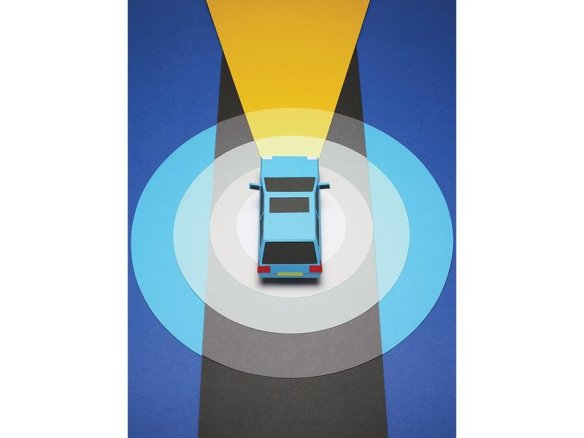
Middle-class families scooped up affordable and speedy Model Ts. As they began to race through the streets, they ran headlong into pedestrians—with lethal results. (illustration by Kyle Bean)

via Back when cars were a rarity, people ruled the streets.

 By Clive Thompson

Smithsonian Magazine | Subscribe
December 2014
When you visit any city in America today, it’s a sea of cars, with pedestrians dodging between the speeding autos. It’s almost hard to imagine now, but in the late 1890s, the situation was completely reversed. Pedestrians dominated the roads, and cars were the rare, tentative interlopers. Horse-drawn carriages and streetcars existed, but they were comparatively slow.
So pedestrians ruled. “The streets were absolutely black with people,” as one observer described the view in the nation’s capital. People strolled to and fro down the center of the avenue, pausing to buy snacks from vendors. They’d chat with friends or even “manicure your nails,” as one chamber of commerce wryly noted. And when they stepped off a sidewalk, they did it anywhere they pleased.

“They’d stride right into the street, casting little more than a glance around them…anywhere and at any angle,” as Peter D. Norton, a historian and author of Fighting Traffic: The Dawn of the Motor Age in the American City, tells me. “Boys of 10, 12 or 14 would be selling newspapers, delivering telegrams and running errands.” For children, streets were playgrounds.

At the turn of the century, motor vehicles were handmade, expensive toys of the rich, and widely regarded as rare and dangerous. When the first electric car emerged in Britain in the 19th century, the speed limit was set at four miles an hour so a man could run ahead with a flag, warning citizens of the oncoming menace, notes Tom Vanderbilt, author of Traffic: Why We Drive the Way We Do (And What It Says About Us).

Things changed dramatically in 1908 when Henry Ford released the first Model T. Suddenly a car was affordable, and a fast one, too: The Model T could zoom up to 45 miles an hour. Middle-class families scooped them up, mostly in cities, and as they began to race through the streets, they ran headlong into pedestrians—with lethal results. By 1925, auto accidents accounted for two-thirds of the entire death toll in cities with populations over 25,000.

An outcry arose, aimed squarely at drivers. The public regarded them as murderers. Walking in the streets? That was normal. Driving? Now that was aberrant—a crazy new form of selfish behavior.

“Nation Roused Against Motor Killings” read the headline of a typical New York Times story, decrying “the homicidal orgy of the motor car.” The editorial went on to quote a New York City traffic court magistrate, Bruce Cobb, who exhorted, “The slaughter cannot go on. The mangling and crushing cannot continue.” Editorial cartoons routinely showed a car piloted by the grim reaper, mowing down innocents.

When Milwaukee held a “safety week” poster competition, citizens sent in lurid designs of car accident victims. The winner was a drawing of a horrified woman holding the bloody corpse of her child. Children killed while playing in the streets were particularly mourned. They constituted one-third of all traffic deaths in 1925; half of them were killed on their home blocks. During New York’s 1922 “safety week” event, 10,000 children marched in the streets, 1,054 of them in a separate group symbolizing the number killed in accidents the previous year.

Drivers wrote their own letters to newspapers, pleading to be understood. “We are not a bunch of murderers and cutthroats,” one said. Yet they were indeed at the center of a fight that, clearly, could only have one winner. To whom should the streets belong?

***

By the early 1920s, anti-car sentiment was so high that carmakers and driver associations—who called themselves “motordom”—feared they would permanently lose the public.

You could see the damage in car sales, which slumped by 12 percent between 1923 and 1924, after years of steady increase. Worse, anti-car legislation loomed: Citizens and politicians were agitating for “speed governors” to limit how fast cars could go. “Gear them down to fifteen or twenty miles per hour,” as one letter-writer urged. Charles Hayes, president of the Chicago Motor Club, fretted that cities would impose “unbearable restrictions” on cars.

Hayes and his car-company colleagues decided to fight back. It was time to target not the behavior of cars—but the behavior of pedestrians. Motordom would have to persuade city people that, as Hayes argued, “the streets are made for vehicles to run upon”—and not for people to walk. If you got run over, it was your fault, not that of the motorist. Motordom began to mount a clever and witty public-relations campaign.

Their most brilliant stratagem: To popularize the term “jaywalker.” The term derived from “jay,” a derisive term for a country bumpkin. In the early 1920s, “jaywalker” wasn’t very well known. So pro-car forces actively promoted it, producing cards for Boy Scouts to hand out warning pedestrians to cross only at street corners. At a New York safety event, a man dressed like a hayseed was jokingly rear-ended over and over again by a Model T. In the 1922 Detroit safety week parade, the Packard Motor Car Company produced a huge tombstone float—except, as Norton notes, it now blamed the jaywalker, not the driver: “Erected to the Memory of Mr. J. Walker: He Stepped from the Curb Without Looking.”

May 13, 1985: the Day Philadelphia Dropped a Bomb on 61 Families

Let the Fire Burn

Directed by Jason Osder (2013)

Film Review

Let the Fire Burn is a documentary about the decision by the Philadelphia police to drop a bomb on the home of a radical African American group called MOVE. The resulting fire (which the police chose not to extinguish) killed eleven people (including five children) and destroyed 61 homes.

The film is drawn entirely from archival footage. About half is TV footage of the day-long police effort to forcibly evict the group and half testimony from the Special Philadelphia Investigation Commission. The latter found city officials and Philadelphia police guilty of “negligence,” though no criminal charges were filed.

Formed in 1972 as a Christian “back to nature” commune by John Africa, MOVE members took the same surname in honor of their ancestral homeland, wore their hair in dreadlocks, shunned technology, and promoted a diet of raw food.

Living together in a home in West Philadelphia, MOVE’s unorthodox lifestyle lead to conflicts with neighbors and clashes with the police. After a 1978 police raid resulted in the death of a MOVE infant, group members armed themselves as protection against further police violence. Later that year, officer James Ramp was killed in a shootout between police and MOVE members. Nine MOVE members were later convicted for this murder, although group members maintain Ramp was actually killed by friendly police fire.

In 1984, MOVE members set up in a new home on Osage Street in West Philadelphia. The following year after many complaints about loudspeaker broadcasts, as well as worries over health hazards, the city took action to evict the group by force.

After a daylong battle in which the police used teargas, water cannons and ultimately 10,000 rounds of ammunition in their efforts to evict MOVE members, authorities ordered military-grade explosives to be dropped on the house from a helicopter.

The most compelling scenes consist of testimony given by 13-year-old Birdie Africa, one of only two people to escape from the fire.

In the two days since I watched it, Let It Burn has been taken down from YouTube, but it can be rented from Amazon (for $3.99) or Netflix. See Zeitgeist Films for details.

Anarchism and the Spanish Civil War

last great cause

The Last Great Cause

V.G. Tenturini

Search Foundation (2010)

Book Review

The Last Great Cause is a virtual encyclopedia of Spanish political history, starting from the Napoleon’s invasion in 1808. Although I was chiefly interested in the history of Spanish anarcho-syndicalism, the book also provides a comprehensive overview of the fascist coup Franco launched in 1936, the International Brigades who fought (unsuccessfully) to save the second Spanish Republic, the so-called “transition” following Franco’s death in 1975 and more recently efforts by the crusading Spanish jurist Baltasar Garzon to achieve justice for tens of thousands of victims of the Franco regime.

Venturini begins by identifying unique features of 19th century Spanish society that provided fertile ground for a major anarchist movement. Among these were Spain’s failure to achieve industrial revolution (except in Catalonia), the absence of a Spanish middle class and strong separatist movements in Catalonia and the Basque region of Spain. Unlike socialism, which historically develops among middle class intellectuals, Spanish anarchism had its origin in the working class.

The Rise of Spanish Anarchism

In 1868, a group of disconnected generals led the first major effort to depose the Spanish monarchy. The same year, Mikhail Bakunin, known as the father of collective anarchism, sent his disciple Giuseppe Fanelli to Spain to organize Spanish farm laborers. Within five years, the number of anarchists in Spain totaled 50,000.

The resulting “glorious revolution” produced in the First Republic. It lasted eleven months before the monarchy was restored.

Spanish history between 1902 and 1929 was marked by profound political and economic turmoil. During the early 1900s, Spanish anarchists merged with the Syndicalist* movement. In 1911, they formed the CNT.** CNT membership grew from 14,000 to 700,000 by 1919. In 1917, the CNT joined forces with the UGT*** to stage the first general strike.

In 1929, continuing popular unrest would lead to Alfonzo XIII’s removal from power and the creation of the Second Republic in 1931.

The Forces Backing Franco’s Coup

From the outset, the Republic faced powerful opposition from the Catholic Church, the Spanish military, wealthy landholders and Spanish and European Banks. Spain was embroiled in virtual civil war from 1933 on, as the forces of reaction engaged armed thugs (as the Falange Espanola) to thwart governmental efforts to carry out land and other democratic reforms.

These forces of reaction also assisted in planning and implementing the fascist coup Franco launched in 1936. The Republic was at a clear disadvantage in resisting the coup, owing to the major support Franco received from fascist Germany and Italy and the covert support he received from Britain and the US.  According to Venturini, Britain, which had major business interests in Spain, directly aided Franco with intelligence and naval support. American oil companies also provided him with oil (while refusing to sell it to Spain’s legitimately elected government), and Ford and other US manufacturers supplied him with trucks.

The International Brigades

Venturini estimates 40,000-50,000 volunteers from 53 countries participated in the International brigades. When Franco captured Catalonia in January 1939 500,000 Republican soldiers and civilians fled across the border to France. Many of the anarchists joined the Maquis, where they played a vital role in liberating France from the Nazis.

Venturini emphasizes that no allied troops fought in the South of France – that these regions were liberated by the Resistance – in many instances before the liberation of Paris.


*Syndicalism is a type of economic system in which industries are owned and managed by the workers.
**CNT Confederación Nacional del Trabajo National Confederation of workers.
***The Unión General de Trabajadores (UGT, General Union of Workers) is a major Spanish trade union, historically affiliated with the Spanish Socialist Workers’ Party (PSOE).
****Rural guerrilla bands of French resistance fighters.

A History of British Anarchism

slow burning fuse

The Slow Burning Fuse: the Lost History of British Anarchists

by John Quail

Granada Publishing (1978)

A number of chapters are available free on-line at Libcom.org

Book Review

The Slow Burning Fuse is the first (and only?) textbook of British anarchism, a social movement that’s virtually invisible in mainstream British history books.

According to Quail, anarchism evolved out of the 1830-48 European revolutions.* He describes it as a reaction to the ease with which electoral reform and democratic socialism snuffed out popular desire for genuine revolution. Proudhon, Bakunin and Kropotkin were the primary architects of anarchist thought.

Although British anarchism never became the mass movement it did in France and Spain, it had a major influence on the British trade union movement and British socialism.

In the UK, anarchism grew out of the Chartist** and Radical*** clubs and their demands for an end to the aristocracy and the privilege of unearned income (enjoyed by the royal family and Church of England clergy), abolition of the House of Lords, home rule for Ireland and nationalization of major industries. The most vocal proponents were German, French and Russian refugees who fled to Britain (as Karl Marx did) following the passage of antisocialism legislation in their native countries. For many years, all German revolutionary and anarchist literature was produced in London.

British anarchism reached high points during significant periods of working class unrest (1889-94 and 1910-19). Its influence declined after 1920 for four main reasons:

1) Police infiltration and false flag events (the British police appear to be responsible for most of the major bombings attributed to British anarchists).
2) The incorporation of anarchist supporters into the fledgling Labour Party (aka Socialist Labour Party) which first assumed power in 1924
3) The absorption of anarchist supporters into the British communist party following the 1917 Bolshevik Revolution. News of Lenin’s brutal treatment of Russian anarchists was very slow to reach the UK. Initially most British anarchists jubilantly supported the Bolshevik Revolution.

In their heyday, British anarchists boasted an active membership (ie participating in street protests) of 4,000, although 7,000-8,000 subscribers bought their newspapers and magazines.

In the early twentieth century, members of the anarchist movement collaborated with socialists, suffragettes and trade union syndicalists in staging major strikes and mass

Anarchism experienced a brief resurgence during the Spanish Civil War (1936-39) and campaigned for British volunteers to join the International Brigades fighting Franco’s fascist coup.


*1830 revolutions

  • France
  • Belgium
  • Netherlands
  • Poland
  • Switzerland

1849 revolutions

  • Italy
  • France
  • Germany
  • Hungary
  • Galicia (Ukraine)
  • Switzerland
  • Poland
  • Ireland
  • Danubian principalities (Romania)
  • Schleswig (Denmark)

**Chartism was a working class movement between 1836 and 1848 with a principal aim of gaining political rights and influence for the working class.
***The Radicals were a parliamentary political grouping in the UK who helped to transform the Whigs into the Liberal Party