The Impermanence of Empire

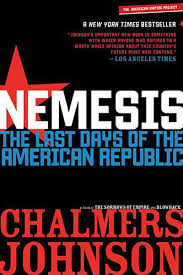
nemesis

Nemesis: The Last Days of the American Republic

By Chalmers Johnson

Henry Holt (2007)

Book Review

Available free as a mobi file (download Kindle for PCs free from Amazon) at libcom.org

The third and final volume in a trilogy, Nemesis is a study of the impermanence of empire. Johnson draws on detailed studies of the Roman and British Empire to make specific predictions about the ultimate fate of the US.

After taking inventory of some of the British Empire’s worst atrocities (the deliberate destruction of thriving civilizations in India and China, the extermination of the Tasmanians in Australia, the systemic genocide against the Kikuyu in Kenya*, the slaughter of 10,000 Sudanese and the genocidal Malaysian Emergency), the late Chalmers Johnson asserts that Britain surrendered their empire after World War II due to flagging domestic support for their administrative massacres in India.

Rome, in contrast, continued its imperial conquests and atrocities by imposing a brutal dictatorship at home. Citing the systematic revocation of civil liberties, Johnson theorizes that the US has opted to follow Rome’s example. He makes the uncanny prediction (in 2007) that there will be no change in US foreign policy, even after getting rid of Bush and Cheney.

As the average lifespan of a full fledged empire is 100 years, Johnson predicts the US empire will have collapsed by the 22nd century. He believes it will maintain the facade of democracy until bankruptcy overwhelms it.

According to Johnson, the loss of the US manufacturing base has forced the country into spending exorbitant sums on totally useless technology (his chapters on Star Wars SDI weapons are particularly illuminating) just to keep the economy afloat.

Aside from the secret budget devoted to covert CIA operations, which he enumerates in detail**, 40% of the Pentagon budget is secret – even from Congress.

The US government finally came out of the closet after 9-11 about being an empire. However they continue to be extremely secretive about the total number of countries they occupy. As of 2007, the official count was 737 bases in 130. However Johnson lists at least a dozen secret bases that are kept off the official list for political reasons.


*The so-called Mau Mau uprising.

**A partial listing of the democracies overthrown by the CIA and replaced with dictatorships:

  • Italy 1947-48
  • Iran 1953
  • Guatemala 1954
  • Indonesia 1957-58
  • Brazil 1961-64
  • Greece 1964-74
  • South Korea 1961-1987
  • Philippines continuously
  • Chile 1973

The Long US War Against the Third World

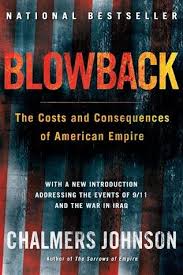
blowback

Blowback: the Costs and Consequences of American Empire

by Chalmers Johnson

Henry Holt and Company (2000)

Book Review

Free Epub and Kindle editions at libcom library

Blowback is a catalog of US military aggression since World War II. It focuses primarily on covert operations by the CIA and Pentagon “special forces – though many of these operations progressed to full blown military invasions, as in Vietnam, Laos and Cambodia.*

The late Chalmers Johnson, a Southeast Asia specialist, also devotes several chapters to the US military occupation of Japan and South Korea following World War II. He traces how the CIA installed war criminals to run Japan’s government and secretly funded single party rule (by the Liberal Democratic Party from 1949-63. He also examines the continuing (extremely unpopular) US occupation of Okinawa.

Prior to reading Blowback, I had no idea that South Korean troops were under US military command until 1994, a year after the Korean people successfully overthrew the last US-installed puppet dictator. The Korean people fought for decades to expel the US military, despite their mass protests and demonstrations being violently suppressed by the US-run Korean military.**

Johnson also explores the immense unpopularity of the 700+ military bases the US maintains around the world – in part for their horrible record of environmental contamination (which they refuse to remediate) and in part for the notorious criminality of the GIs they host. In the case of Okinawa, GIs commit crimes at the average rate of one per day, ranging from muggings, reckless driving resulting in serious injury or death, rape and murder. In nearly all cases the Japanese government is denied jurisdiction to prosecute and US military court martials result in little more than a slap on the wrist.

Johnson maintains it’s largely owing to this history of GI criminality that the US refuses to accept the jurisdiction of the International Criminal Court (ICC).


*A partial listing of major covert CIA interventions:

Iran 1953

Guatemala 1954

Cuba 1959 – present

Congo 1960

Brazil 1964

Indonesia 1965

Vietnam 1961-73

Cambodia 1961-73

Laos 1961-73

Greece 1961-74

Chile 1963

Afghanistan 1979 – present

El Salvador 1980 – present

Guatemala 1980 – present

Nicaragua 1980 – present

Iraq 1991 – present

**The US also supported the brutal regimes of the puppet dictators they installed in (partial list) Taiwan, Philippines, Cambodia, Indonesia, and Thailand.


Nixon’s Guaranteed Basic Income Proposal

nixon

Imagine my recent surprise on learning Republican president Richard Nixon, in 1968, was on the verge of enacting an unconditional income for all poor families. It would have guaranteed a family of four $1,600 a year, equivalent to roughly $10,000 in 2016. Here we have yet another historical event that’s been conveniently erased from US history books.

Nixon began by commissioning a study involving a little over 8,500 Americans in cities around the country. Researchers attempted to answer three questions: (1) Would people work significantly less with a guaranteed income? (2) Would the program cost too much? (3) Would it prove politically unfeasible?

Outcomes were surprisingly favorable. Hours of work decreased only slightly and allowed for an increase in other useful activities, such as searching for better jobs or working in the home. Among youth, almost all the reduced work hours were used for education. In New Jersey, the rate of high school graduation for participants rose thirty percent.

Polls showed that 90 percent of US newspapers were enthusiastic about unconditional income for poor families. The Chicago Sun Times called it “A Giant Leap Forward,” the Los Angeles Times “a bold new blueprint.” The National Council of Churches, the labor unions, and even the corporate sector were also all in favor.

In 1970 it seemed that the time for a basic income had well and truly arrived.

With 243 votes for and 155 against, the House of Representative approved President Nixon’s Family Assistance Plan (FAP) on April 16, 1970. Most expected the plan to pass the Senate, too, which was even more progressive than the House. Sadly the Senate killed it.

Writing in Jacobin,Rutger Bregman describes how Nixon adviser Martin Anderson cunningly scuttled Nixon’s guaranteed basic income proposal. A great admirer of libertarian philosopher Ayn Rand, Anderson widely circulated excerpts from sociologist Karl Polanyi’s 1944 book The Great Transformation. The latter describes a historical system similar to Nixon’s proposed basic income: the Speenhamland system enacted in 1795 to alleviate rural poverty in Britain.

In addition to summarizing a Royal Commission Report highlighting Speenhamland’s adverse effects  on both the poor and the community, Polyani cites prominent 19th century economists, such as Thomas Malthus, David Ricardo and Karl Marx, who all roundly condemned the Speenhamland experiment.

It now turns out the Royal Commission Report was based on flawed methodology and essentially fabricated.

Read more about Nixon’s guaranteed income plan, the Royal Commission Report and the devastating impact of dismantling Speenhamland and replacing it with the heinous 1834 Poor Law.


The Citizens Group that Blew Whistle on OKC Bombing

A Noble Lie

Directed by James Lane (2011)

Film Review

This documentary approaches the Oklahoma City bombing from a somewhat different angle, focusing on the citizens group that empaneled a grand jury to investigate Tim McVeigh’s accomplices, as well as his links to US intelligence. Oklahoma is one of the few states that allows citizens to convene their own grand jury.

The Oklahoma Bombing Investigation Committee was made up of Oklahoma City police and sheriff’s officers, bombing victims and their families, eyewitnesses and a supportive state legislator. Their findings showed clearly that at the time of the bombing McVeigh was still in the US Army (as indicated on his death certificate) and assigned to working with the FBI and ATF (Bureau of Alcohol, Tobacco, Firearms and Explosives) group PatCon to infiltrate militant right wing groups. The committee’s goal was to force Congress to investigate the FBI cover-up of the Oklahoma City bombing. When this failed, the published their findings two weeks prior to 9-11 in a book called The Final Report on the Bombing of the Alfred P Murrah Building.

A Noble Lie also zeroes in on the two eyewitnesses who were murdered as part of the FBI cover-up, the files the FBI and ATF removed from the Murrah federal building before they permitted search and rescue teams from entering the bomb site, and FBI memos obtained under the Freedom of Information Act about the involvement of McVeigh and various accomplices in PatCon. The latter was an undercover FBI operation to infiltrate right wing extremist groups.

This film also goes to great lengths to debunk the FBI claim that a truck bomb caused the Murrah Federal Building to collapse. Not only was the pattern of structural damage inconsistent with an external air blast, but a truck bomb (of the size claimed by the FBI) would have produced too much ammonia gas for rescuers to enter the building.

Independent forensic tests at an Air Force lab ascertained that the bombing had to result from explosive charges attached to one or more columns inside the building – exactly like the two bombs defused immediately after the blast. The activities of the Air Force bomb disposal squad were reported by numerous media outlets on the day.


*An Oklahoma sheriff got a tip off from Little Rock the day of the bombing that these records likely concerned the federal investigation into CIA drug running at the Mena Airport in Arkansas. Federal records related to the Whitewater investigation, another Clinton scandal, were also stored in the Murrah building and vanished the day of the bombing.


Was Oklahoma City the First 9-11?

The Secret Life of Timothy McVeigh

Corbett Report (2015)

Film Review

This documentary examines growing evidence that the “official” government version of the 1995 Oklahoma City bombing is a fiction, just like the official version of 9-11.  Corbett bases the film on the premise that McVeigh was involved in some questionably legal covert operation – based on the federal government’s refusal to unseal his defense records. Somehow McVeigh’s defense team managed to access classified documents they were prevented from releasing to the prosecution.

Prior to his execution, McVeigh informed  his sister (in a letter published by the New York Times), fellow defendant Terry Nichols  and death row cellmate Paul Hammer that he worked for a secret army operation that assisted the CIA in transporting drugs and carrying out covert assassinations. There have been numerous efforts to depose Nichols (currently serving 161 consecutive life sentences), but federal prison authorities are denying him access to his attorney.

Numerous journalists and former military and intelligence personnel believe that McVeigh was working for PatCon, a secret FBI team assigned to infiltrate the militia movement and radical right during the 1990s. Members of this team were tasked with infiltrating right wing groups and inciting them to commit violent acts that would justify their arrest. There is strong evidence that both the 1992 Ruby Ridge siege and the 1993 Waco siege were PatCon operations.

Many investigators also believe Andreas Strassmeyer, a German-born radical who tried to persuade various patriot groups to blow up federal buildings, was a PatCon operative. Although at least one eyewitness reported seeing him in the Murrah federal building, the FBI conveniently allowed him to escape to Germany before he could be interviewed.

The film also highlights other serious anomalies in the case against McVeigh, including

  • The FBI’s sudden decision, after two months, to call off the manhunt for John Doe #2 (McVeigh’s accomplice, identified by 24 witnesses and caught on surveillance footage).
  • The failure of the prosecution to show surveillance footage at trial that depicts the Ryder truck (alleged to contain a fertilizer bomb), McVeigh and John Doe #2 seconds before the explosion.
  • The FBI claim that they have lost the surveillance video.
  • A structural analysis showing an external truck bomb couldn’t possibly have caused the pattern of damage that occurred.
  • Multiple news reports that a bomb disposal squad deactivated a second and third bomb located inside the Murrah Federal Building.
  • A report by numerous ATF agents that they were tipped off not to come to work the day of the bombing.

McVeigh was found guilty in 1997 and executed in 2001.


The Hidden History of Big Oil

How Big Oil Conquered the World

Corbett Report (2016)

Film Review

This is an extremely gripping documentary about the hidden history of John D Rockefeller and the global oil cartel. Much of this history, including Rockefeller’s early background, the role of the “oilagarchy” in instigating World War I, Prohibition and their total domination of education, medicine, agriculture and finance has been systematically erased from US history books.

I found the beginning of the film, in which James Corbett talks about JD’s father William Avery Rockefeller, most revealing. Rockefeller senior was a notorious snake oil salesman (and cunning sociopath) who changed his name to Dr Bill Livingston to escape the clutches of the law for fraud, bigamy, rape and various other crimes.

The film traces Rockefeller junior’s entry into the oil drilling business in the 1850s with the formation of the Pennsylvania Rock Oil Company. From the very beginning of his career, JD demonstrated the same knack for treachery, deceit and fraud as his father – in dealings with both business partners and competitors.*

The invention of the internal combustion engine in the 1870s put Rockefeller in direct competition with the electric vehicle industry. Even the first electric cars (built in 1884) had a number of advantages over gas-powered cars. In 1900, they made up 28% of the US market. Thanks to the discovery of plentiful oil in Texas, Rockefeller easily flooded the market with cheap gasoline and put electric car makers out of business.

After World War I, he faced similar competition from ethanol-fueled cars (Henry Ford designed the Model T to run on either gasoline or alcohol produced from agricultural waste). Here Rockefeller and his corporate allies demolished their competition by conspiring to instigate a national anti-alcohol movement. The latter resulted in the enactment of Prohibition in 1919 and a total ban on alcohol. In a similar vein, after World War II the “oilagarchy” conspired with General Motors to acquire and shut down electrified public transport systems in at least a dozen cities.

Rockefeller’s transformation of medicine (by funding and acquiring control of medical schools) into a field dominated by synthetic petroleum-based pharmaceuticals is fairly well known. There is less public awareness that he played a similar role in shaping public education (especially the teaching of history) and the replacement of organic-based farming with industrial agriculture reliant on petrochemicals. Rockefeller played a similar role in secret meetings that resulted in the creation of the Federal Reserve, as did Rockefeller’s Chase Manhattan Bank in the creation of the World Bank and IMF.

Corbett also traces the creation of parallel oil monopolies in Europe by the Rothchilds, the Nobel family and the British and Dutch royal families. Germany posed a major threat to this global oil cartel with a treaty they signed with the Ottoman Empire to acquire a controlling interest in Iraqi oil development. The threatened competition with established European oil interests set wheels in motion for a British-led war against Germany (ie World War I).


* JD’s favorite motto: “Competition is a sin.”


The Private Spook Behind Iraq’s Death Squads

James Steele: America’s Mystery Man in Iraq

BBC (2013)

Film Review

The main purpose of this documentary is to expose the paramilitary death squads Dick Cheney and Donald Rumsfeld created in Iraq. Their ultimate was to suppress the Sunni insurgency which formed in early 2003 to oppose the US occupation.

The film goes a long way towards debunking the propaganda Bush and the corporate media dispensed to the American public that the US enemy in Iraq was an international terrorist organization called al Qaeda. The military force responsible for suicide bombings and roadside IEDs (improvised explosive devices) was actually a spontaneous uprising in response to the US invasion and occupation. It was largely organized by Sunni troops and public servants who served in Saddam Hussein’s government and were stripped of their occupations and careers by Bush’s disastrous de-Baathification program.

Cheney and Rumsfeld knew the guerrillas fighting the occupation represented a genuine insurrection. Determined to preserve their puppet Baghdad government at all costs, they called in James Steele, their foremost counterinsurgency expert. Steele, a retired military officer, had extensive experience creating and managing local paramilitary death squads in Vietnam and El Salvador.

In Iraq, Steele organized death squads out of Shia militias who had been brutally oppressed by Saddam Hussein and were eager for revenge. What resulted was a bloody civil war between Shia and Sunni-led fighters. The civil war was responsible for 3,000 deaths a day prior to the withdrawal of US troops in 2011.

The film starts by interviewing embassy and DEA officials who worked directly with Colonel Steele when he was running El Salvador’s paramilitary death squads out of the US embassy in San Salvador.  The preponderance of evidence suggests it was Steele who oversaw the massacre of 25,000 Salvadoran civilians and most likely the assassination of human rights advocate Archbishop Oscar Romero (in 1980 while he was saying mass) and the 1980 rape and murder of four American nuns (Jean Donovan, Dorothy Kazel, Maura Clark and Ita Ford).

Reportedly it was Cheney who recruited Steele to implement the “Salvadoran option” in Iraq. As an ex-military civilian, Steele’s official cover was “energy consultant.” Nevertheless the Iraq commanders who worked with him leave no doubt he was in charge of the specially trained 5,000-strong police commando group formed from Shia militias.

The filmmakers also interview a number of Iraqis who worked in Iraqi prisons and interrogation centers and directly witnessed the torture overseen by Steele. Several members of the Oregon National Guard (deployed to an Iraqi prison detail) were so horrified by one torture session they tried to intervene to stop it. When their military superiors ordered them to stand down and forget what they had seen, they went straight to a local Oregon newspaper. The resulting scandal would lead to the withdrawal of Steele, Coffman and Petraeus from Iraq and the sacking of Rumsfeld as Secretary of Defense.


https://vimeo.com/63900562

How European Banks Hijacked the Euro Monetary Union

Buy, Buy Europe

Pieter De Vos (2013)

Film Review

This is a five-part miniseries describing how European banks have hijacked the euro monetary union to vastly increase their wealth. The upcoming Brexit vote in Britain makes this a particularly relevant topic.

Part 1 A Bank Crisis a Week

The series begins by describing the history of the European monetary union. Built at the height of neoliberalism it adopted all the rhetoric of Ronald Reagan, Margaret Thatcher and Alan Greenspan promising that globalized capitalism and free markets would end economic crises, increase prosperity and end inequality.

What really happened is that creating the euro massively increased inequality between northern and southern Europe and between workers and the super rich.

In seeking to make European banks as strong and competitive as US and British banks, Eurozone leaders ceased regulating them. Wall Street is often blamed for the EU’s 2008 meltdown. In actuality, deregulated European banks were equally guilty of risky speculation in derivatives and subprime mortgages.

Following the 2008 economic crash, European banks required massive government bailouts to keep European economies from collapsing. Promised banking reforms to prevent a recurrence of 2008 never happened. And according to the IMF, the global banking system is even more unstable today as it was right before the meltdown.

Part 2 Austerity Till the Grave

The bailouts required to keep their banks (and economies) going virtually bankrupted all Eurozone governments. All borrowed deeply (from the global banking system they had just bailed out) to keep their governments going. As a condition of this borrowing, the banks required them to reduce their deficits via deep austerity cuts. To qualify for further loans, they all cut pensions and benefits and laid off public service workers.

This segment focuses on Spain, where workers are organizing to block evictions, and Greece, where unemployed parents are forced to drop their kids off at orphanages because they can’t get welfare benefits to support them.

Part 3 Tax Haven Europe

This segment begins by profiling the Greek shipping magnates who run the largest merchant fleet in the world and pay virtually no tax. Corporations and the super rich pay far less tax than working people in all the EU countries. This massive tax avoidance forces all European governments to acquire major debt to keep from collapsing.

The documentary offers the example of Belgium, where the average tax rate is 12.5% and the most profitable corporations pay only 5% of their earnings in tax.

The filmmakers maintain that workers create wealth, though I doubt most neoliberals would see it that way. In 1981 Europe, 74% of the wealth workers created was returned to them as wages and government benefits. By 2012 only 49% of this wealth was returned to them and the super rich claimed the rest.

Part 4 Bratwurst, Lederhosen and Minijobs.

This was the most eye-open segment for me. It exposes the punitive conditions imposed on German workers from 2000 with the goal of making German export industries more competitive. Under former chancellor Gerhart Schroeder, massive wage reductions were imposed on all German workers – something IMF chief Christine LaGarde likes to call “labor market reform.”

Among other labor “reforms,” were a massive increase in “minijobs” – low wage part-time temporary positions that pay an average of 400 ($US 448) euros a month. Given Germany’s high cost of living, both parents need to work 2-3 “minijobs” (if they can find them) to cover a family’s basic needs.

The result was truckloads of cheap German imports flooding into southern EU countries (Greece, Spain, Portugal and Italy), shutting down local industries that couldn’t compete.

In this way, Germany’s vicious attack on their own workers forced wages down in other EU countries. This, in turn, forced countries like Greece and Spain to borrow lots of money from German banks to keep their governments going.

Ironically Germany currently has the highest number of working poor (7 million) of all EU countries.

Part 5 What Kind of Europe Do We Want?

It’s vital for people to understand that the mantra EU governments repeat ad nauseum – that saving the euro is essential to strengthening the EU and restoring prosperity – is pure propaganda. Seven years of austerity is massively increasing deficits and debt by putting so many people out of work.

The truth is that the Eurozone has been hijacked by banks and multinational corporations who are determined to use trade agreements to lock member countries into austerity and statutory destruction of Europe’s proud tradition of democratic socialism.

The only solution is a public takeover of too-big-to fail banks. Continuing to bail them out, while allowing them to privatize all the profits, is simply legalized theft of public monies. And a yes vote on Brexit.


A British View of American History

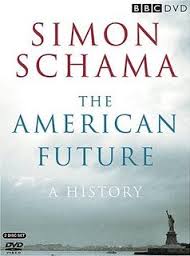
the american future

The American Future: A History from the Founding Fathers to Barack Obama.

Simon Schama

Random House (2008)

Book Review

Written for a British audience, The American Future attempts to define the quintessential American national character by tracing historical movements that have shaped US society. The five political movements Schama considers most important are 1) the gradual rise of a professional military officer class, 2) the role of evangelical religion in the movement to abolish slavery, 3) the brutal imperialist war against Mexico and the Philippines, 4) the forced displacement of the Cherokee and four other Native American nations under Andrew Jackson, and 5) the development of large scale irrigation in to open the Southwest desert area to agriculture.

For me the primary value of this book is all the historical gems Schama includes that you never learn about in high school. For example:

• The founding of West Point military academy with its Jeffersonian emphasis on philosophy and civil engineering, as opposed to military tactics. Jefferson believed a sound liberal education for US military officers would help ensure the US never went to war except to defend liberty. Congress consistently refused to fund a US military or naval academy until an undeclared war with France broke out in 1796.* Over a period of ten months, the French seized 300 US merchant vessels. When Congress eventually authorized funding for West Point, its primary purpose was to train the Army Corps of Engineers, who built the levees, bridges, damns, dykes and forts that enabled westward expansion. They also drained the swamp in Washington DC and built the Capitol and other important federal buildings.

• President Lyndon Johnson’s role, in 1964, in blocking the credentialing of Mississippi’s Freedom Democratic Party, led by Fannie Lou Hamer, after the Mississippi Democratic Party declared their support for the Republican candidate Barry Goldwater. This blatant white cronyism would provide major impetus to the growing black power movement.

• The profound religious intolerance that persisted in the US even after the 1780 adoption of the Bill of Rights guaranteeing separation of church and state. ** In Massachusetts, Sunday church attendance was compulsory until 1833 – until 1840, blasphemy could be punished by one year in prison, public whipping or the pillory. In Maryland Jews weren’t allowed to vote or hold office until the state passed the Jew Bill in 1820.

• Anti-immigrant feelings, especially against Germans, Irish, Mexicans and Chinese were so intense during the 19th century that there were frequent riots in which immigrants were lynched or had their homes set on fire. An 1855 riot in Louisville would have affected my great grandfather, whose family arrived in the area after immigrating from Germany in 1840.

• President Teddy Roosevelt’s 1902 National Reclamation Act, which led to the construction of 600 dams (including Grand Coulee and Hoover Dam) in thirty years. These would provide irrigation to millions of acres of desert in California and the Southwest. This project would include the diversion of the Colorado River to supply Southern California’s Imperial Valley, which supplies nearly half the fresh fruit and vegetables consumed by Americans, as well as Los Angeles, San Diego, Phoenix and parts of Mexico.


*Prior to reading this book, I had no idea the US and France had been at war (with each other).

**The early view of the Bill of Rights was that it only pertained to the federal government and didn’t apply to state law.

How Bill Clinton Tried to Privatize Social Security in 1998

In this presentation, author Thomas Franks talks about his recent book Hey Liberal, Listen Up: Or, What Ever Happened to the Party of the People. The focus of his latest book is the blue collar backlash that has resulted in the probable selection of fake populist Donald Trump as the 2016 Republican presidential candidate. Franks places the blame for this squarely on Democrats, owing to their abandonment of working people.

As Franks describes it, the pro-Wall Street swing of the Democratic Party is based on a very deliberate strategy by Bill Clinton and his supporters to “screw over” their traditional power base (ie African Americans and organized labor).  Clinton proudly justified this strategy with the observation, “they have nowhere else to go.”

Franks most shocking revelation is that Clinton took office in 1992 with a deliberate determination to repeal the New Deal. In 1997, he made a secret deal with Republican House Speaker Newt Gingrich to ram a bill through Congress privatizing Social Security (which Clinton mentions in his 1998 State of the Union address). Thanks to the Monica Lewinsky scandal, this bill never happened.