Lee Harvey Oswald: US Intelligence Operative

From Dallas to Raleigh: Lee Harvey Oswald and the Fingerprints of Intelligence

Allen City TV (2015)

Film Review

This presentation, featuring assassination researchers Grover Proctor and Jim Marrs, focuses on a fascinating chain of evidence shedding new light on “lone assassin” Lee Harvey Oswald’s role as a US intelligence operative. The new evidence revolves around the mysterious Raleigh North Caroline “cutout” named John Hurd, who Oswald attempted to call from the Dallas jail. Hurd first came to the attention of assassination researchers during the extensive 1978 investigation by the House Committee on Assassinations.

Proctor, who interviewed Hurd prior to his death, has assembled strong circumstantial evidence that Hurd was linked to the Naval Intelligence Unit in Nagshead North Carolina that trained recruits in the fifties and sixties to “defect” to the Soviet Union as double agents. Following his enlistment in the Marines at 17, Oswald underwent training at Nagshead and was initially deployed to Japan, where he had top secret clearance to monitor U2 spy plane flights over the Soviet Union. In 1959, he would “defect” to the Soviet Union in an attempt to fool the Russians into offering him a sensitive intelligence role. After the Russians failed to take the bait, the US repatriated him in 1961.

The second hour of the documentary, in which Jim Marrs comments on Proctor’s work, is the most illuminating. Marrs briefly sums up other compelling evidence linking Oswald to Naval Intelligence and the CIA, including his CIA 201 (employment) file and the Minox spy camera he had on his person at the time of his arrest. Marrs also refers to important evidence regarding Oswald’s intelligence activities in New Orleans – uncovered by New Orleans district attorney Jim Garrison ** and corroborated by Oswald’s former mistress Judyth Baker in  Lee and Me


*A “cutout” is an intermediary a undercover operative can safely contact in emergency situations without exposing the identity of their control (ie the official operative directing their intelligence activities).

**Jim Garrison was the only prosecutor to indict and try (in 1967) a prominent assassination co-conspirator named Clay Shaw. Shaw was ultimately acquitted owing to the CIA’s refusal to release records documenting his extensive history in intelligence (which would be released to the House Committee on Assassinations in 1978).
Hidden History: The War on Terror

Crossing the Rubicon: the Decline of the American Empire at the End of the Age of Oil

by Michael Ruppert

New Society Publishers (2004)

Book Review

I recently picked up Michael Ruppert’s Crossing the Rubicon for the first time in nearly 13 years. I’ve always admired Ruppert, who killed himself in April 2014. It was after hearing him present early evidence (in May 2002) about the role of Bush insiders in 9-11 that I made a decision to close my psychiatric practice and move to New Zealand.

In re-reading Rupert’s 617-page encyclopedia of Peak Oil, CIA narcotics trafficking and the foreign policy/intelligence background to the mother of all false flag operations, I’m totally amazed about the amount of evidence he had already collected in 2004. Nearly all his conclusions have been corroborated by other investigators. At the same time many of his findings, particularly regarding Clinton’s role in supporting the Taliban’s rise to power, don’t receive nearly enough attention in the 9-11 Truth community.

Ruppert links Clinton’s decision to put the Taliban in power in Afghanistan to the oil exploration he facilitated in the Caspian Sea basin by declaring war on Yugoslavia. Both Enron (see The Greedy Bastards who Gave us Enron and Bankrupted California) and Halliburton (Dick Cheney’s oil company) had deep commitments in Caspian Sea and Central Asian oil and gas companies. Both companies needed pipelines across Afghanistan to transport oil and gas to energy-hungry Pakistan, India and China. Building and maintaining said pipelines was totally impossible in a country that, following Soviet withdrawal, had become a failed state of feuding warlords.

According to Ruppert, in was Clinton’s intent to “pacify” Afghanistan by putting the totalitarian Taliban regime in power. Ruppert’s evidence for these assertions comes mainly from Congressional hearings called by Republican Congressman Dana Rohrabacker to challenge Clinton’s support for the Taliban. Ruppert also describes the two years (1999-2000) of 6+2 meetings (to plan the pipelines) between Taliban representatives, and the US, Russia, Pakistan, China, Iran, Uzbekistan, Tajikistan and Turkmenistan.

The Clinton administration suddenly reversed their position on the Taliban in 1999, after the results of exploratory Caspian Sea oil drilling revealed the limited deposits were too small to be commercially viable.

Ruppert goes on to present substantial evidence that the decision to go to war against the Taliban was made during the Clinton presidency – he first imposed economic sanctions against them in July 1999. Ruppert maintains this related less to the oil and gas lobby than to the banking/finance lobby, which had become addicted to drug profits from Afghan opium production. Following Soviet withdrawal, the CIA had worked with opium warlords to concentrate world opium production in Afghanistan. The loss of billions dollars of money laundering profits threatened to wreak major havoc with Wall Street and the US economy.

Ruppert, a five year veteran of the LAPD narcotics squad, devotes several chapters of Crossing the Rubicon to the CIA’s historic role in narcotics trafficking and the role of all major US banks and brokerage hoses in money laundering.

Ruppert also makes a strong case that planning for 9-11 began during the Clinton administration and that National Security Adviser Sandy Berger, Secretary of State Madeleine Albright, Energy Secretary Bill Richardson and NATO commander Wesley Clarke were party to the planning.

The Long US Government War Against Americans

The Cointelpro Papers: Documents from the FBI’s Secret Wars Against Dissent in the United States

by Ward Churchill* and Jim Vander Wall

South End Press (1990)

Free PDF: Cointelpro Papers

Book Review

As the authors describe, the FBI Cointelpro program first came to light in letters and memos seized when antiwar activists broke into an FBI field office in 1971 looking for draft cards. Using these and other documents obtained under the Freedom of Information Act, the authors make it clear that the FBI has infiltrated and sabotaged every major citizens group since 1945.

The Cointelpro papers should be required reading for high school graduation. It’s essential to realize that government wire tapping, stalking, covert break-ins and infiltration of community groups didn’t start in 2002 when these activities first became “legal” under the Patriot Act. In fact, it’s extremely well documented (by University of Wisconsin professor Alfred McCoy – see Spying on Americans: the Ugly History) that it first began during the US occupation of the Philippines in 1898-1901.

This book had great personal importance in my life. There are a number of parallels between Jean Seberg’s case (see below) and the FBI harassment I began experiencing in 1987 related to my work with two former Black Panthers.** Along with four other African American activists, they had occupied an abandoned Seattle school in 1985 to transform it into a community-controlled African American Heritage Building and Cultural Center.

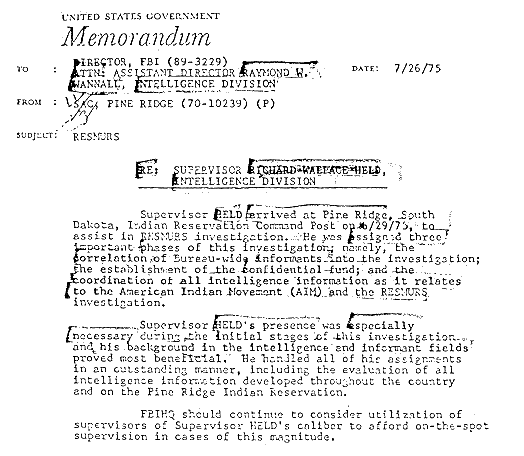
The section of Cointelpro Papers I found most illuminating describes the death squad activity that occurred on the Pine Ridge Sioux reservations during the 1970s – fifty-plus murders were never even investigated, much less prosecuted. Most Americans assume forced disappearances and extrajudicial assassinations only occur in Third World countries (thanks to the excellent CIA training their military officers receive at the School of the Americas in Fort Benning Georgia). Learning of scores of documented instances on US soil is extremely troubling.

The book also reproduces chilling FBI memos related to the coordinated FBI/police attack and murder of Chicago Black Panther leader Fred Hampton and the attempted murder of Los Angeles Black Panther leader Geronimo Pratt (who was subsequently imprisoned for 27 years on fictitious charges). The book goes on to recount to the brave refusal of Seattle mayor Wes Uhlman to consent to a similar FBI/police raid on the Black Panthers in Seattle (see The Mayor Who Said No to the Feds).

The saddest chapter describes the sadistic campaign of personal harassment Hoover undertook against actress Jean Seberg, a white actress who provided the Black Panthers with financial support. As a result of rumor campaigns and vicious gossip columns planted by the FBI, Seberg and her partner ultimately committed suicide.


*Ward Churchill is a well-known American Indian Movement (AIM) activist and former professor of ethnic studies at University of Colorado.

**Which I describe in my memoir The Most Revolutionary Act: Memoir of an American Refugee

The 1972 US Coup Against Australia

Hot Money and the Politics of Debt

RT Naylor

McGill-Queens University Press (2004)

Book Review

Hot Money is about the trillions of dollars of global financial activity that is never recorded in official economic statistics. Corporate money laundering of illegal narcotics profits is the form of “hot money” that gets the most publicity. However according to Naylor, it accounts for a relatively small proportion of “hot money” percolating through offshore banks and dummy corporations.

Most “hot money” starts out as funds generated via “legitimate” business which rich elites sebd offshore to avoid taxes or in anticipation of economic calamity or regime change. All the world’s most ruthless dictators stashed funds in Swiss banks or similar financial havens prior to being deposed.

A sizeable chunk of hot money is generated from other illegal enterprises, such as gun running, illegal arms deals, prostitution, phony charities and religious groups (eg Reverend Moon’s Unification Church and L Ron Hubbard’s Church of Scientology) and government agencies (eg CIA) who use “hot money” to finance coups and insurgencies.

For me, the high point of Hot Money  is the excellent history Naylor provides of the CIA role in the world heroin and cocaine trade, especially their move to make Afghanistan the major global supplier of heroin.

Nalylor also provides a detailed history about the role of the Vatican Bank as a “hot money” center, the rise and fall of Propaganda Due (P2), a secret collaboration between the CIA, Mafia and right wing Masonic lodges that infiltrated all aspects of Italian public life in the 1970s; the role of Nazi war criminals Klaus Barbie and Josef Mengele in setting up Latin American death squads and cocaine networks; the rise and fall of the two biggest CIA banks, Australia’s Nugan Hand Bank and the Bank of Commerce and Credit International;  and the importance of “hot money” in the Iran Contra scandal, in which the Reagan administration illegally sold weapons to Iran to finance the Contra war against Nicaragua.

The most shocking chapter describes the role of the Nugan Hand Bank in funding a bloodless coup US Naval Intelligence carried out against Australia in 1972 – to remove a prime minister whose political views were inconsistent with US interests. Most Americans are totally unaware of this heinous attack against a close US ally. I’ve only learned of it since moving to New Zealand (Australia is New Zealand’s closest neighbor).

The Robert Kennedy Assassination: Why the Official Story is a Fake

The Assassination of Robert Kennedy

Christopher Plumley (1992)

Film Review

This classic documentary from 1992 neatly summarizes a reasonably ironclad case that a second gunman, not Sirhan Sirhan, shot and killed Robert Kennedy in June 1968. It also reveals how the Los Angeles police (LAPD) systematically destroyed and suppressed evidence pointing to the true killer.

Filmmaker Christopher Plumley begins with the forensic and autopsy evidence. The latter shows clearly that the bullet killing Kennedy came from immediately (2-3 inches) behind, whereas Sirhan was in front of him. According to 76 eyewitnesses he was never closer than three feet to Kennedy. At the time if Sirhan’s, trial there were approximately 1,000 photos of the shooting, which the LAPD subsequently destroyed in a hospital incinerator.

Too Many Bullets

The “official” LAPD crime scene reconstruction shows eight bullets (Sirhan’s gun only held eight) hitting Kennedy three times and wounding five other victims. Both the FBI and the LAPD crime scene officer disputed the official reconstruction, based on eyewitness testimony, the autopsy report and bullet holes in the woodwork of the Ambassador Hotel pantry showing there had to be at least 12 bullets.

The autopsy alone proves Sirhan couldn’t have been the assassin. Instead of challenging the autopsy evidence at trial, his defense attorney (who seems to have been party to the conspiracy) advised him to plead diminished responsibility. To this day, Sirhan maintains he has no recollection whatsoever of the shooting.Neither the defense nor the prosecution presented any eyewitness testimony, which clearly would have exonerated the supposed deranged lone gunman.

Witness Coercion

LAPD browbeat and threatened several eyewitnesses who saw Sirhan together with another man and a woman in a polka dot dress. According to at least one witness, the woman claimed responsibility for the shooting as the couple fled the crime scene. Plumley plays a choice selection of a recorded polygraph examination of an ex-CIA polygraph specialist emotionally abusing her – as he tries to coerce her into change her story.

The CIA’s Project Artichoke

The most damaging evidence against Sirhan was a notebook in which he repeatedly scribbled nonsensical threats about killing Kennedy. The last ten minutes of the film looks at declassified evidence about the CIA’s Project Artichoke, a top secret program in which robot assassins were hypno-programed to commit murder and have no subsequent recollection of their actions.

This section features a 1974 audiotape made by Dr William Bryan Jr, who reportedly bragged about being the hypnotist who hypno-programed Sirhan. The psychologist who examined Sirhan in prison confirmed he had been hypno-programed. The latter was fired after seeking permission to deprogram him.


Breaking the Silence on 1965 CIA Coup (and Genocide) in Indonesia

The Look of Silence

Directed by Joshua Oppenheimer (2014)

Tuesday night, Maori TV showed Joshua Oppenheimer’s 2014 ground breaking documentary about the 1965 Indonesian genocide instigated by the CIA. The documentary is available at the Maori TV website for the next 2 weeks:  The Look of Silence

The clip below is a 2016 Al Jazeera interview with the filmmaker.

More than a million people were brutally killed after a 1965 CIA-backed military coup that overthrew Achmed Sukarno – who became Indonesia’s first president in 1945 after leading their battle for independence (from the Netherlands) for more than 20 years.

Genocide victims were accused of being communists, although most were union members, teachers, artists, intellectuals and landless farmers who opposed General Suharto’s new military dictatorship.

For the most part the killers have stayed in power, living alongside the survivors and the victims’ families who were threatened into silence. Fear and anti-communist rhetoric persist in Indonesia today.

For nearly 10 years, American filmmaker Joshua Oppenheimer researched and documented the atrocities.

He spoke to victims and their families as well as the perpetrators of the crimes, shedding light on Indonesia’s dark past and today’s impunity in his two films, The Look of Silence (2014) and The Act of Killing (2012).

His first film tells the story from the point of view of the killers – some of whom are celebrated as heroes in Indonesia today. The Look of Silence follows an optometrist, born two years after his brother was killed, as he confronts those responsible for his brother’s death.

George Seldes: Fighting the Corporate Takeover of the Press

Tell the Truth and Run: George Seldes and the American Press

Directed by Rick Goldsmith (1996)

Film Review

Tell the Truth and Run is a tribute to muckraking* journalist George Seldes, released shortly after his death at 104. It takes its title from a book Seldes published in 1952. It includes an extensive interview with Seldes at age 98, detailed biographical sketches and commentary by prominent activists, whistleblowers and media reformers (including Ralph Nader, Daniel Ellsberg and Ben Badikian, Victor Navksy and Jeff Cohen) who were influenced by his work.

Born in 1890, Seldes first became a reporter at 18, just as all major dailies were starting to rely on advertisers (instead of readers) for their funding base. As this occurred, investigative journalists seeking to expose government and corporate corruption began writing for the monthly magazines instead. Bankster JP Morgan and other industrial robber barons put an end to this by buying up all the monthly magazines.

Seldes quit his first job at the Pittsburgh Leader after the publisher spiked a story he wrote about the son of a department store magnate who raped a female staff member.

Following an eye opening stint in the US military press corps during World War I, Seldes became a foreign correspondent for the Chicago Tribune. He first ran into difficulty at that paper for exposing the violent and corrupt nature of Mussolini’s fascist regime – at a time when the US government and all the major newspapers were pro-Mussolini (owing to banker JP Morgan’s desire to refinance Italy’s World War I debt).

Seldes quit the Tribune in 1927 and published the first two of a series best selling books (You Can’t Print That and Can These Things Be?) based on all his material the Tribune refused to publish between 1918 and 1928.

Between 1940-1950 he put out the weekly newsletter In Fact: An Antidote to Falsehoods in the Daily Press. He would use the newsletter to expose the FBI role in spying on labor unions and  corporate media’s failure to report on 1940s research documenting health problems associated with smoking. He was also the first investigative journalist to expose the role of major Wall Street corporations in supporting Hitler’s rise to power.


* A term applied to American investigative reporters, novelists and critics of the Progressive Era (1890-1930)


How the US Uses War to Protect the Dollar

The Gods of Money

William Engdahl (2015)

The first video is a 2015 presentation by William Engdahl about his 2010 book The Gods of Money. It focuses on the use of US economic and military warfare to maintain the supremacy of the US dollar as the global reserve currency.

As his point of departure, he begins with the 1944 Bretton Woods agreement, in which the Allied powers agreed to use the gold-backed US dollar as the world’s reserve currency. In 1971 when Nixon was forced to end the gold standard,* the gold-backed US dollar was replaced by the “petrodollar.” According to Engdahl, it was so named because of a secret agreement the US made with Saudi Arabia – in return for a guarantee that OPEC would only trade oil in US dollars, the US guaranteed the Saudis unlimited military hardware.

In this way, oil importing nations (most of the world) were forced to retain substantial US dollar reserves. This was the only way they could provide their economies with a continuous supply of oil.

The petrodollar remained supreme until the mid-1980s, when the collapse of the US Savings and Loan industry (a pre-cursor of the 2007 banking collapse) raised concerns in Europe that the US was failing as a super power. Fearing the US economy was collapsing, they created the euro and the Eurozone, to prevent the Soviet Union or China from filling the power vacuum.

The financial warfare unit of the US treasury responded by feeding hedge fund manager and currency speculator George Soros secret information that enabled him to lead an attack on the British pound. This, in turn, destabilized the British economy to the point the UK no longer qualified to join the euro.

In 1997 the US Treasury and Soros made a a similar attack on economies of Southeast Asia (Thailand, South Korea, Indonesia, Hong Kong, Laos, Malaysia, Philippines) that attempted to use currencies other than the dollar as their reserve currencies.

In 2010, after the US government had run three years of $1 trillion deficits, China, Russia and Japan announced their intention of selling US Treasury bonds (which the US government sells to finance its debt) to increase their euro reserves. Concerned this placed the US dollar on the brink of catastrophic collapse, the US Treasury and Soros attacked the Euro directly by collapsing the Greek economy. The mechanism Soros used was to direct his hedge funds to dump the sovereign treasury bonds that financed Greek debt.** When the European Central Bank announced its commitment to a Greek bail-out, the US Treasury and Soros followed up with an attack on Irish, Spanish and Portuguese sovereign bonds.


*A US economic crisis led to massive foreign demand for US dollar redemption that threatened to deplete US gold reserves.

** The immediate effect of bondholders dumping Greek bonds raised interest rates on Greek debt to a level that threatened to bankrupt their government.


The second clip is a Guns and Butter radio interview with Engdahl. It focuses on a second area the Gods of Money covers, namely the long US battle to abolish their private central bank (aka the Federal Reserve) and end the ability of private banks to create money out of thin air (see How Banks Create Money Out of Thin Air).

After a brief explanation of fractional reserve banking, whereby 97% of our money is created by private banks, Engdahl traces the history of the First Bank of the United States, created by Alexander Hamilton in 1791. The latter was the first US central bank, 80% owned by private (mostly Rothschild-controlled) banks in the City of London and 20% owned by the US government. President James Madison’s refusal to renew the bank’s charter in 1811 would result in Britain and the US going to war in 1812.

When the war ended in 1815, the American war debt was so substantial, the US had no choice but to charter the Second Bank of the United States, which once again was 80% controlled by London banks.

In 1832, Andrew Jackson refused to renew the bank’s charter, and the US had no central bank between 1832 and 1913. In 1913 when President Woodrow Wilson secretly colluded with the global banking establishment to create the Federal Reserve.

Both Lincoln and Kennedy challenged the exclusive role private banks play in creating the US money supply – Lincoln by issuing greenbacks (rather than borrowing money from private banks) to pay for the civil war and Kennedy by issuing silver certificates directly redeemable by the US Treasury. In both cases, Engdahl feels their defiance of the international banking establishment played a role in the decision to assassinate them.

Who Really Controls America?

The Hidden History of the United States

John Judge (1994)


What I find most remarkable about this 23 year old presentation by late assassination researcher John Judge is its amazing grasp of facts and concepts that have only become public knowledge with wide popular access to the World Wide Web and social media.

John begins his presentation with the assertion that secret assassinations and other conspiracies aren’t the handiwork of secret societies and cabals, but of America’s wealthy elite. He maintains the US elite is split into two factions that frequently go to war with each other via the intelligence agencies they control. The CIA is run by the old Eastern banking families, whereas military intelligence is run by the new money Southern rim economy, consisting mainly of oil, aerospace, munitions and real estate.*

Among other topics John covers in this marathon three hour presentation are

  • The CIA-run international drug trade, which he describes as the most profitable industry in the world.
  • UFOs, which he maintains are secret spy satellites operated by Air Force intelligence.
  • George Orwell’s book 1984, originally titled 1948 (as it describes government monitoring of civilian populations that was already occurring). His American (CIA-controlled) publisher forced him to change the title to 1984 when the book came out in the US (1949).
  • MK-Ultra and other CIA mind control operations – John begins by describes by describing his childhood (both his parents worked for the Pentagon) growing up in a CIA bedroom community in Virginia and the heavy use of lobotomy and ECT on many CIA wives, including the World War II intelligence operative who cracked the Eastwood Code (the encoded message forewarning the US government of the impending attack on Pearl Harbor. John also talks about CIA director Allen Dulles’s purchase of 150 million tabs of LSD in 1956 – a massive quantity that was clearly intended for mass consumption rather than research (see How the CIA Used LSD to Destroy the New Left).
  • The role of Richard Nixon and CD Jackson** (as naval intelligence operatives) in smuggling thousands of Nazi war criminals and scientists into the US to form the CIA and the US aerospace program”
  • Evidence (eg missing nuclear code books from all Strategic Air Command bombers) indicating that JFK’s murder was a coup authorized by the Joint Chiefs of Staff and the failed assassination of Ronald Reagan in 1981 was an attempted coup.
  • Evidence linking notorious cult figures linking notorious cult figures – Charles Manson, Jim Jones (Jonestown), David Koresh (Waco) and others to US intelligence.

In Part 2, which launches automatically at the end of Part 1, John discusses his research into Jonestown, which he describes as a secret US intelligence concentration camp and slave colony, (which was 90% African American), and his work with his mentor, the late Mae Brussell (see Mae Brussell: Forgotten Superhero). Brussell, who subscribed regularly to 150 publications, had identified key figures in the shadow government and followed their movements closely. Based information she garnered, she gave Ethel Kennedy (in 1968) five days about her husband Robert’s imminent assassination and Mary Jane Kopechne’s mother (in 1969) three days warning of her daughter’s murder.


*Although he hails from New York, Donald Trump is most closely linked with “Southern rim” real estate interests, which would explain the current war the CIA and the CIA-controlled media are waging against him.

**CD Jackson was a psychological warfare specialist who played a major role in creating Radio Free America and Radio Free Europe and Operation Mockingbird (the operation enabling CIA control of America’s major publishing and media outlets). In 1960 he became publisher of Life magazine.

***Kopechne allegedly drowned while a passenger in Senator Ted Kennedy’s car, this Chappaquiddick incident purportedly used by his enemies to destroy his presidential ambitions.

1493 and the Hidden History of Industrial Capitalism

1493: Uncovering the New World Columbus Created

By Charles C Mann

Vintage Books (2012)

Book Review

1493 is a fascinating book tracing a totally neglected aspect of the rise of capitalism and industrial civilization – namely the transfer of new crops, livestock, trees, diseases, guano (nitrogen-rich bird poop, silver and diverse ethnic groups to every continent except Antarctica. Based on his detailed investigations, Mann cites numerous examples of major historical events and movements that can be directly traced to this “Columbian Exchange.”

Mann begins by tracing the history of tobacco, which was first transferred from the lower Amazon to Jamestown Virginia, and from there to China. An immensely popular drug of addiction, it provided the cash England needed to support colonization of the South-eastern US.

He next focuses on the potato, which was transferred from the Andes in South America to Northern Europe, where it replaced wheat as the staple crop in Ireland, northern Germany, Belgium and Russia (potatoes flourish in colder climates and on more marginal land than wheat and are four times more productive). Thanks to the introduction of the potato, Europe was finally able to end the famines that occurred every ten years. At a time, when China, India and various African and South American civilizations were far more advanced than Europe, the main factor holding back European development was its inability to feed its population.

Next Mann covers the important of sugar (originally domesticated in New Guinea) to the West Indies and the importation of coffee and bananas (to South America) from Africa.

African Slaves Resistant to Malaria

He devotes a whole section to the transfer of diseases, which played a significant role in wiping out America’s indigenous population, to the New World. I was previously aware that new settlers also brought malaria with them. This often fatal illness was endemic to England in the 1500s – thanks to misguided schemes to reclaim wetlands for agriculture. The high prevalence of malaria meant that 8 out of 10 settlers in Jamestown and other southern colonies could be expected to die in the first 18 months. Mann makes a case that the natural resistance present in slaves from West and Central Africa** was a main factor in England (a historically antislavery nation) turning to slaves in their desperation to establish a labor force to work the tobacco fields.

Silver, Sweet Potatoes and the Downfall of China

The chapter on the role of the Columbian Exchange in the downfall of China as the most prosperous, politically developed and culturally sophisticated country in the world is also extremely enlightening. I was totally unaware that between 1/3 and 1/2 of all the silver mined in 16th century Peru was transported to China via the Philippines for use in their monetary system. Nor the importance of sweet potatoes and maize (which, like potatoes, thrive on marginal land) in feeding poor farmers displaced by China’s dynastic wars. China is still the number one world producer of sweet potatoes.

Why the US was the Last to Free Their Slaves

For me, the most interesting section was the one on slavery, particularly the chapter on the “maroon”*** revolts and guerilla warfare that forced Central and South America to abolish slavery long before the US did. Except for Florida, escaped slaves in the US tended not to form rebellious maroon enclaves. The reason, according to Mann, was their difficulty surviving on their own in a colder climate and the opportunity for legal freedom if they fled to the North.

In Florida, escaped slaves formed alliances with the Seminole Indians. Their guerilla bands conducted continual attacks (with covert British support) on Georgia – until 1839 when Florida maroons were granted their freedom if they agreed to resettle of the Mississippi.


*The Columbian Exchange was the widespread transfer of plants, animals, culture, human populations, technology, and ideas between the Americas and the Old World in the 15th and 16th centuries, related to European colonization and trade after Christopher Columbus’s 1492 voyage.

**Approximately 97% of people indigenous to West and Central Africa are resistant to malaria owing to the presence of the Duffy Negative Antigen.

***Maroon is a term applied to fugitive black slaves.