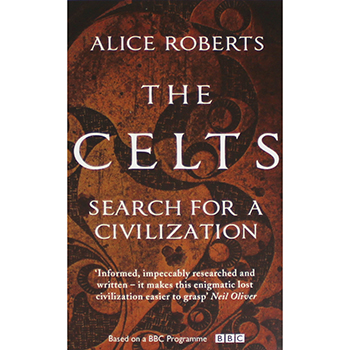
The Celts: Advanced Seafarers or Uncivilized Barbarians?

The Celts: Search for a Civilization

By Alice Roberts

Heron Books (2015)

Book Review

Were the Celts of northern Europe the uncivilized barbarians the Greeks and Romans made them out to be? Alice Roberts thinks not. Her book examines the origin of the Celts, the prehistoric tribe responsible for populating Ireland, Wales, Scotland, Cornwall and early Britain. The conventional view is that the Celts originated in central Europe and gradually migrated west to occupy ancient Gaul (France), Britain, Scotland, Wales an Ireland; south to Egypt and northern Italy; and west as far as Kiev and Turkey. Roberts sides with the more recent view that Celtic civilization developed along the Atlantic coast of Europe – a well-connected group of Bronze Age societies extending from Portugal – and migrated westward to occupy Gaul, parts of Germany, the Balkans, Turkey and northern Italy..

The Celts gives a full inventory of all available archeological, linguistic and genetic evidence, as well as accounts from historical texts and oral myths. The picture Roberts paints is totally at odds with Roman and Greek efforts to portray Celts as uncivilized barbarians. Thanks to their great sophistication in mining, smelting metals into weapons and jewelry, and advanced seafaring, the Celts established major trading centers throughout continental Europe. The Tartessos referred to in the Old Testament at the time of Solomon were early Celts who sailed great ships laden with silver, gold, ivory, apes and peacocks to trade with Mediterranean settlements.

The Phoenicians, the first Eastern Europeans they made contact with, traded wine and manufactured goods for their silver, gold, copper and tin. The earliest written evidence of the Celtic language comes from the beginning of the Iron Age in Southwest Portugal.

In addition to well-developed religious practices, the Celts had a written language and appointed druids to serve as judges, guardians of knowledge, and  priests.

During the Iron Age, they developed a reputation as great warriors and often hired themselves as mercenaries to various kings and emperors. In 387, they sacked Rome for the first time, and in 280 BC they conquered Macedonia and moved south into Greece. Julius Caesar’s primary reason for invading and occupying Gaul was to end the constant Celtic raids on Roman territory.
The Hidden History of Adam Smith, Father of Modern Economics

The Real Adam Smith: Morality and Markets

Directed by John Norberg (2016)

Film Review

This documentary traces the life and thinking of the father of modern economics Adam Smith. The apparent goal is to correct modern neoliberal distortions of Smith’s views on the free market and laissez faire capitalism. Unfortunately the film introduces a few distortions of its own – for example, it credits Smith’s revolutionary ideas for the current prosperity of the Western world. I believe there is far more evidence that Western prosperity has resulted from cheap fossil fuels, the North Atlantic slave trade, the ruthless Western colonization of the Third World, and the global North’s rapacious exploitation of planet Earth and human labor.

This film also erroneously credits Smith for the concept of the “invisible hand” that directs the (largely mythological) “free market.” According to University of Wisconsin History professor Laurence Dickey, it was actually one of Smith’s contemporaries (J. Harris in his earlier “Essay on Money and Coins”) who invented the term.*

In my view, the chief value of the video is the portrait it paints of Adam Smith as a moral philosopher of the Scottish Enlightenment who was chiefly concerned about the plight of the poor. In fact, Smith theorized that human labor was the main source of a society’s wealth a full century before Karl Marx.

Smith was an ardent opponent of the monopolies (such as the 250 year monopoly the British Crown granted the British East India Company), protective tariffs, and the 1773 Tea Act. Passed mainly to prop up the failing East Indian Company, this law taxed East Indian Company tea more cheaply than tea produced in the North American colonies.*

Smith published The Wealth of Nations in 1776, only months before the American War of Independence. The final section of his seven-volume treatise was highly critical of the immense wealth the UK was extracting from the colonies. He also disagreed with the Crown taxing their colonies without allowing them representation in Parliament.


*Page 260 of Wealth of Nations, edited and abridged by Laurence Dickey. See Reclaiming Adam Smith

**The Tea Act allegedly triggered the 1773 Boston Tea Party.


The Mysterious Death of JFK Assassination Witness Dorothy Kilgallen


Denial of Justice: Dorothy Kilgallen, Abuse of Power, and the Most Compelling JFK Assassination Investigation in History

by Mark Shaw

Post Hill Press (2018)

I found this book a big disappointment. Over the last decade Shaw has compiled a massive amount of evidence related to journalist Dorothy Kilgallen’s suspicious 1965 death (see The Dorothy Kilgallen Story/). His evidence includes the complete transcript of Jack Ruby’s trial, which mysteriously went missing for 50 years. That being said, Shaw sorely needs a  editor. The style in which Denial of Justice is written is extremely convoluted, repetitive, and filled with maudlin, hyberbolic and sensationalist prose that has no place in an investigative expose.

One of the main weaknesses of the book is its failure to incorporate the immense body of academic research into the JFK assassination. Calling Kilgallen’s investigation into the JFK assassination “the most compelling in history” is pretty silly, when you contrast it with New Orleans District Attorney Jim Garrison’s efforts to prosecute CIA co-conspirator Clay Shaw in 1967.  Kilgallen was essentially a gossip columnist who covered Broadway stars, murder trials, celebrity weddings, and political scandals.It wasn’t her investigative prowess that posed a threat to the who assassinated JFK – it was her prominent public profile and influence over popular opinion.*

Nowhere in the book does Shaw provide a clear timeline of events immediately following Kilgallen’s death on Sept 17, 1965. This is divided up between four long rambling chapters dedicated to the the personal history and psychological motivations of potential suspects.

There is no question the actions of the NYPD, FBI and New York medical examiner’s of the day of Kilgallen’s death were highly suspect. As best as I can reconstruct, Kilgallen’s butler James Clement was the first to discover Kilgallen’s body a little before 9 am. He found her, still dressed in the cocktail dress she wore the night before, in the third floor bathroom. We know this indirectly from information he related to his wife and daughter.

By 9 am, someone had moved the body from the bathroom to the master bedroom. This is where her hairdresser, who had come to do her hair for an appointment at her son’s school, found her. By this time, her dress and underwear had been removed, and she was dressed in a fancy peignoir. However she was still wearing her hairpiece, false eyelashes and full make-up.

For some reason, the police weren’t notified until 12.30. The FBI barged in before the police arrived, seizing multiple boxes of files that included her notes on Jack Ruby’s trial, her two interviews with him, and the information she obtained from sources in the Dallas police and a recent visit to New Orleans. Random House had agreed to publish a book she was writing about her investigation, which she claimed would “crack the case wide open.”

The NYPD detective assigned to investigating her death wasn’t notified until 3 pm

Her autopsy report concludes she died from “accidental overdose,” despite blood tests revealing she had ingested the equivalent of 15-20 100 mg tablets of Seconal, in addition to the presence of alcohol, Tuinal and Nembutal.


*This related mainly to her 15-year stint on the TV game show “What’ My Line?”


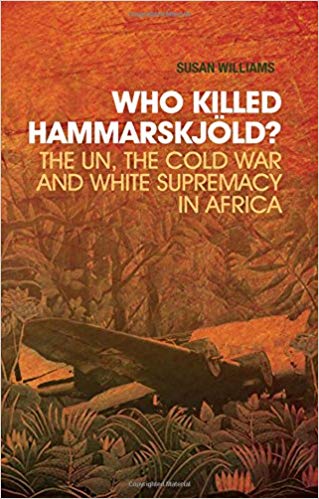
Who Killed Hammarskjold? The UN, the Cold War and White Supremacy in Africa


Who Killed Hammarskjold? The UN, the Cold War and White Supremacy in Africa

by Susan Williams

Hurst and Company London (2016)

Book Review

This book details the author’s extensive investigation into a suspicious 1961 air crash that killed the second UN secretary general Dag Hammarskjold. Her first edition, published in 2011, would trigger a new UN investigation, in 2015, into the cause of his death. In 2016, UN investigators concluded that Hammarskjold died as a result of foul play. However owing to US and UK refusal to release classified files, they couldn’t conclusively identify the individuals responsible.

The book begins by setting the stage for what was clearly an assassination. Williams describes in detail the role of foreign mining companies in fighting full independence of the Congo from Belgian rule. Belgian officers loyal to these companies continued to command Congolese troops following “official”  independence in 1960. When these troops mutinied, the UN declined a request for assistance from Congo’s first prime minister Patrice Lumumba.

His appeal to the Soviet Union (and the arrival of Soviet troops) would lead Katanga province (where most of the mines were located) to secede – with the support of Belgian troops and a bevy of white mercenaries from Rhodesia, South Africa, Britain and France.

At this point, the UN Security Council passed resolution 143, ordering Belgian troops to withdraw and installing UN peacekeepers in Katanga to prevent civil war. The CIA’s response was to assassinate Lumumba and Install their protege Mobutu Sese Seko (who would brutally ruled the Congo/Zaire from 1965-1997) as chief of Congo’s military.

Mobutu, in turn, arrested, tortured and executed all the senior members of the Congolese senate. The Security Council responded with Resolution 161, calling for the withdrawal of all foreign advisors and authorizing the UN to take “all necessary measures” to prevent civil war. This included supplying armed UN troops to protect the Congolese government.

When it was became clear the UN troops (who had significantly  inferior weapons) had no chance against the mercenaries’ superior fire power and Belgian air support, Hammerskjold set out for Nolda in Northern Rhodesia to try to negotiate a ceasefire with Katanga’s acting president Moise Tsombe. The secretary general’s jet mysteriously crashed as it approached Nolda airport.

In additions to hundreds of eyewitnesses (including a crash survivor who spent a week in hospital before he died) who saw Hammerskjold’s plane explode before it crashed, the most intriguing evidence comes from radio traffic between a pilot (reporting his attack on Hammerskjold’s jet) picked up by a US NSA operative in Cyprus and an Ethiopiann short wave operator and mysterious telexes* discovered in South Africa’s Truth and Reconciliation files in 1998. The latter refer to the plot to assassinate the Secretary General as “Operation Celeste,” run by shadowy South African Institute for Maritime Research (SAMIR) mercenaries.

As best as investigators can reconstruct, Operation Celeste planted a bomb on the DC-6 prior to its departure from Leopoldville.** When it failed to explode on take-off, two smaller planes were sent to intercept the jet and prevent it from landing. One pilot fired shots at the DC-6 that triggered the bomb to explode.


* Prior to the advent of the Internet, the telex network was an international system of teleprinters electronically interconnected by telephone lines.

**Leopoldville has since been renamed Kinshasha.

The Mysterious Death of Investigative Journalist and JFK Witness Dorothy Kilgallen

Mark Shaw’s Denial of Justice

2019

Film Review

This is a presentation by author Mark Shaw regarding his latest book Denial of Justice: Dorothy Kilgallen, Abuse of Power, and the Most Compelling JFK Investigation in History.

I’m old enough to remember watching Kilgallen on the quiz program “What’s My Line” in the 1950s and 1960s. I was unaware she was also a celebrated investigative journalist who had covered every major US trial in the 20th century. Actively investigating the JFK assassination at the time of her death, she openly questioned Oswald’s role as the lone nut gunman in her columns in the New York Journal American. Moreover she had a contract with Random House to write a book based on her investigation.

Kilgallen attended the entirety of Jack Ruby’s trial (for the murder of Oswald) in 1964 and was the only journalist to interview him.

Several months before her death, she carried portions of Ruby’s leaked Warren Commission testimony in her column. A few days later, a posse of FBI agents invaded her home demanding the identity of the leaker. She refused to name her source.

In the months leading up to her 1965 death, she received several threats against her own and her children’s lives. The two hairdressers who were her closest confidants also complained of being followed and having their phones tapped.

One of them found her body, which was fully dressed with full make up sitting up in bed. The New York police dismissed her death as an “alcohol/seconal overdose. ” It would be three years before the blood sample taken at autopsy was tested. It was found to contain three different types of barbiturates (seconal, tuinal and phenobarbital).


The Hidden History of East German Privatization

east-germany-and-the-difficult-legacy-of-the-treuhand-dw-documentary-german-history-documentary-youtube-thumbnail

East German Privatization and the Difficult Legacy of the Treuhand

DW (2019)

Film Review

This documentary provides a detailed timeline of the four-year privatization of East Germany following the 1989 fall of the Berlin Wall. The privatization was overseen by the Treuhand Trust. Originally appointed in 1990 by the East German Council of Ministers, it was ultimately run by West German corporate and political elites. Following reunification in August 1990, it was the responsibility of the West German government in Bonn to oversee Treuhand. However the Bundestag provided no oversight at all until a massive Treuhand corruption scandal erupted in 1992.

During its four-year existence, Treuhand privatized 10,000 state-owned East German enterprises, put three million East Germans (70% of the workforce) out of work and permanentlyy deindustrialized East Germany.

According to the filmmakers, some of this disastrous outcome stemmed from the rigid neoliberal bent of Trehand managers; some from bribery and corruption; some from from incompetence; and some from the avarice of West German entrepreneurs who bought West German businesses that competed with them and shut them down. East Germany experienced massive public protests and even a hunger strike as thousands of factories closed and millions of East Germans became jobless.

Some factors contributing East Germany’s financial collapse were beyond Treuhand’s control. At the time the two Germany’s reunited, East Germany lost most of its export market as the Communist regimes in other Eastern bloc countries collapsed. To prevent the East German mark from collapsing, the Bundestag introduced the Deutschmark into East Germany in July 1990. This led to massive price inflation of German consumer goods, leading East German residents to reject them in favor of cheap West German products. With no sales revenue, East German companies were forced to turn to Treuhand for loans and subsidies to pay their staff.

In 1992-93 when the Bundestag intervened, Treuhand was forced to preserve designated East German industries by providing loans and subsidies to businesses willing to modernize.

One-hundred-fifty convictions resulted from the Treuhand corruption scandal. As in the former Soviet Union, East German were promised shares in their state owned enterprises as they were privatized. These shares never materialized.

The Greek documentary Catastroika provides a somewhat different perspective on Treuhand’s role in the wholesale privatization of East Germany’s state-owned industries: See Privatization and the Theft of the Commons

This documentary, which can’t be embedded, can be viewed free at Privatizing East Germany

Fethullen Gulen, Turkey’s 2016 Coup, and the US Charter School Movement

Turkey’s Coup: The Gulen Mystery

RT (2018)

Film Review

This alarming RT documentary series concerns the secretive Turkish imam accused by Turkish president Recep Erdogan of orchestrating the 2016 coup. Fethullen Gulen, founder of Turkey’s Hizmet movement, defected to the US in 1995, after being charged with trying to start a secret religion. At the height of the movement’s power in 2008, it had 2-3 million Turkish followers and ran 2,000 Gulen schools and universities in 140 countries, including the US.

The US is resisting Turkey’s demands for Gulen’s extradition to stand trial for his role in the coup.

What I found most concerning about the series is learning (in Part 4) of Hizmet’s extensive role in starting 170 taxpayer funded Gulen charter schools in the US. The FBI raided a number of Gulen schools in 2011 as part of an ongoing investigation. For some mysterious reason, the mainstream media made no mention of this at the time of the Turkish coup.

Some Russian analysts believe Gulen received CIA support in expanding his private school network to newly independent Muslim republics following the collapse of the Soviet Union.

In 2008, the Justice Department appealed the State Department’s decision to award Gulen permanent residency in the US. They lost the appeal based on two letters from the CIA and one from the US ambassador in Ankara.

Gulen presently lives on a 25 acre estate in Pennsylvania.

Part 1 describes the formation of the Hizmet movement in Turkey in the sixties and seventies and the spread of Gulen schools to Kyrgyzstan, Azerbaijan, Bulgaria, Georgia, Moldova, Bosnia, Ukraine and Russia following the collapse of the Soviet Union. During the same period, they also spread to many countries in Africa and Asia.

Part 2 describes the expansion of Gulen schools into Russia and Germany. After Putin came to power, many Russian Gulen schools were closed after parents complained about their children being indoctrinated with Islamic beliefs.

Part 3 includes interviews with Turkish immigrants in Germany and the extortion-style techniques the Hizmet movement used to pressure them to help fund new Gulen schools.

Part 4 examines the history of Gulen charter school movement in the US. One former American Gulen school teacher describes their abusive treatment of women and the complaint she made to the FBI about her husband being forced contribute 40% of his salary to the Hizmet movement. At the height of their power, the Hismet movement represented a powerful tightly controlled international corporation and had major presence in number of Turkish government agencies.

Part 5 explores the powerful role of the Turkish military in maintaining Turkey’s status as a secular state. It also describes a brief alliance between Erdogan and Gulen in the early 1990s to advocate for greater Islamic influence over Turkish society. Prior to the 2016 coup, the Hizmet movement controlled the second largest media empire in Turkey – with six TV stations, two radio stations and several newspapers, magazines and publishing companies. Following the coup, Erdogan arrested 102,000 members of the Izmet movement and fired 130,000 others who held government jobs. He closed all Turkey’s Gulen schools or arranged for their takeover by local authorities, He also shut down 1,500 Hizmet-funded NGOs and their Turkish media network. The subsequent drop in their funding led to the closure or takeover of many Gulen schools worldwide.

Part 5, which can’t be embedded, can be viewed free at

The Rise and Fall of Fethullah Gulen


War Games: Why NORAD Failed to Stop the 911 Hijackers

9/11 War Games

Directed by James Corbett (2018)

Film Review

This documentary presents a well-produced investigation into the multiple war games the Pentagon coincidentally scheduled simultaneous with the 9-11 attacks on the World Trade Center. In conjunction with the FAA (Federal Aviation Administration), NORAD (North American Aerospace Command have a well established protocol of using Air Force jets to intercept hijacked airliners and either forcing them to land or shooting them down. On 9-11, the protocol failed – no fighters jets were scrambled to intercept the three planes that reportedly crashed into the World Trade Center and Pentagon. All available evidence suggests that four Air Force war games (three involving simulating hijackings) created so much confusion for air traffic controllers and FAA and NORAD officials that they paralyzed their ability to respond to the real hijackings.

The film is based on research by the late Michael Ruppert, archived audio recordings of air traffic controllers and FAA and NORAD, and testimony to the 9-11 Commission.

Much detailed information about these simulated attacks remains classified. However the names of four of the simulation exercises are known:

  • Northern Vigilance – an exercise which sent most of the US fighter jets on duty to northern Canada and Alaska for the day.
  • Vigilant Guardian and Tripod 2 – exercises which inserted numerous false radar blips on air traffic controller screens to test their ability to respond to them.
  • Vigilant Warrior – an exercise consisting of numerous “live fly” hijack drills, in which military personnel dressed as civilians would board civilian flights and simulate fake hijackings.

FAA/NORAD officials confronted with 22 possible hijackings had only eight fighter jets available to respond to them  most were in Canada participating in Northern Vigilance). In three instances (Delta 1989, United Airlines 177 and Continental 321), fighter jets intercepted “simulated” hijackings and forced airliners to land.


Trail of the Spider: The Suppressed Racial History of the American West


Trail of the Spider: A Passage Through Limbo

Directed by Anja Krschner and David Panos (2008)

Film Review

Trail of the Spider is a short feature film in which the suppressed racial history of the American West becomes a metaphor for the racial landscape of East London in the grips of property developers.

The somewhat surreal plot takes place in 1870, at the end of the Civil War and “Indian Wars.” the last days of the “unassigned lands.”

Instead of the Lone Ranger, the hero is Man With No Name, an African American Buffalo Solder* who changes sides and fights for the oppressed instead of the US government.

*The original “Buffalo Soldiers” were members of the 10th Cavalry Regiment of the United States Army, formed on September 21, 1866, at Fort Leavenworth, Kansas. This nickname was given to the Negro Cavalry by the Native American tribes they fought. 


Frida Kahlo and Post-Revolutionary Mexican Art

The Life and Times of Frida Kahlo

PBS (2005)

Film Review

This documentary offers insightful background into Mexican surrealist painter Frida Kahlo, the first Mexican painter to be exhibited in the Louvre.

Lahlo, who was bisexual, was the wife of the celebrated communist mural painter Diego Rivera. She was also briefly lovers with Leon Trotsky and his wife and allowed the latter and his wife to stay in her family home when they fled to Mexico in their efforts to escape Stalin’s agents.

It was via Trotsky she met the French surrealist painter Andre Breton. It was Breton who introduced her to the art world by organizing shows for her in New York and Paris.

For me the most interesting part of the film was its depiction of the post-revolutionary cultural revival that produced her and Rivera. It seems to have been very similar to post-revolutionary Russian and Spanish art. In all three cases there was a creative explosion as artists and intellectuals threw off centuries of cultural oppression in seeking to discover their authentic selves. At the time, many believed Mexico would follow Russia in creating a socialist workers state.


https://vimeo.com/322723914