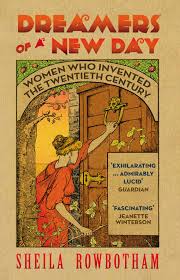
Dreamers of a New Day: Women Who Invented the Twentieth Century
By Sheila Rowbotham (2010)
Book Review
Dreamers of a New Day is about the first international feminist movement in the 1880s and the profound influence feminist organizers and writers had over 20th century life. Most of the women Rowbotham identifies by name are invisible to mainstream society – despite the critical importance of the major social reforms and institutions they fought for and won.
The period 1880-1929 was notable for the wide adoption of mass production and communication, the obliteration of rural life and the treacherous economic instability resulting in recurrent panics and recessions. These major social changes triggered a broad range of anti-authoritarian social movements, including socialism, anarchism, utopianism, populism and numerous other trade union and reform movements. As in the anti-authoritarian sixties, women naturally questioned why the new freedoms men were seeking shouldn’t apply to them, as well. This, in turn, led to the creation of numerous revolutionary and reformist women-led groups.
The Campaign for Social and Economic Equality
Contrary to what they teach in high school, the first women’s liberation movement fought for far more than the right to vote. Early feminists campaigned (and won) equal access to higher education and professions previously closed to them (eg medicine, law, pharmacy, veterinary medicine) and housekeeping arrangements that enabled mothers to meet their children’s needs while simultaneously pursuing careers. The period 1880-1929 saw a lot of experimentation with cooperative kitchens, laundries, bakeries and child care facilities.
The Feminist Campaign for Clean Drinking Water, Sanitation, Birth Control and the Shorter Work Week
The settlement house movement was a direct outgrowth of the feminist movement. Early women-run settlement houses typically offered communal kitchens, organizing facilities for women’s trade unions (the Working Women’s Union was formed in 1881), childcare and parenting advice. The settlement houses (Jane Adams’s Hull House in Chicago is the best known), which were often linked with universities, were directly responsible for the development of the new fields of social science and social work, which scientifically studied the needs of children and families.
These early feminist groups also led campaigns (which they won) for clean drinking water, sanitation services, clean safe streets, housing more conducive to children’s needs, an end to child labor and sweat shops, a shorter work week, subsidized state housing, and maternity benefits for destitute mothers (established in at least a dozen states before Roosevelt enacted the Aid to Families with Dependent Children program in 1935).
On the sexual front, feminists campaigned for (and won) sexual equality to men, including equal access to divorce and equal access to guardianship of children (prior to 1900 wives and children were viewed as the property of men), the right to dress as they pleased, engage in “free love,” legally access birth control and birth control information (illegal under the Comstock Law in the US and the Obscenity Law in the UK), the right to say “cunt,” “cock,” and “fuck” without going to jail, and medical reforms to reduce maternal mortality (in the 1920s, it was four times as dangerous to give birth as to work in the mines).
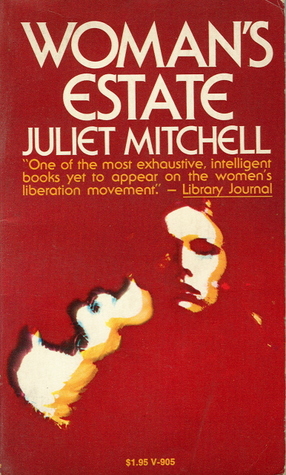
Women’s Estate is about the history of the modern women’s liberation movement. Women’s liberation began in the US in the late 60s and quickly spread to Britain and the rest of the industrialized world. Mitchell compares and contrasts women’s liberation with the earlier feminist movement of 1880-1920, as well as tracing contemporary political influences that shaped it.
Mitchell traces the modern feminist movement to the publication of The Feminine Mystique by Betty Friedan in 1963. In 1966, Friedan would co-found National Organization for Women (NOW) with Gloria Steinem (see Did the CIA Use Gloria Steinem to Subvert the Feminist Movement?). Mitchell classifies NOW as a “reformist” group that limited itself to winning isolated reforms (affirmative action laws, legalized abortion and access to birth control, etc), as opposed to women’s liberation groups which sought to overthrow patriarchy and male-dominated society.
Owing to the immense media attention it received, women’s liberation was the most public revolutionary movement in history. According to Mitchell, its main influences were the mid-sixties black liberation movement, the student movement and the youth (aka “hippy”*) movement.
She traces the official origin of women’s liberation to a protest at Nixon’s 1969 inauguration in which female speakers were taunted with sexually explicit insults. This was the last straw in a long frustrating period in which male antiwar activists edged women out of decision-making and relegated them to typing and tea making.
By 1970, there were women’s liberation groups in all of the developed world, except for Ireland, Austria and Switzerland.
Although women typically experience the most extreme levels of poverty and oppression, the women’s liberation movement, like the earlier suffrage movement, was mainly led by middle class women. According to Mitchell, it’s common for the oppression of underprivileged women to be passed off as natural and unchangeable.
Mitchell devotes most of the book to an analysis of the politics of oppression and the cultural factors (especially so-called “family values) that cause women’s oppression to appear invisible.
In her view, this is why consciousness raising groups were so essential to women’s liberation. By openly sharing their negative treatment by men, women were astonished to learn other women had similar, often identical, experiences. This helped them to acknowledge their individual frustration and suffering was, in actuality, a political problem.
As Mitchell puts it:
The first symptom of oppression is the repression of words: the state of suffering is so total and assumed, it’s not known to be there.
*According to Mitchell, the hippies rebelled against social manipulation and emotional repression by the political establishment without seeking specific political change.
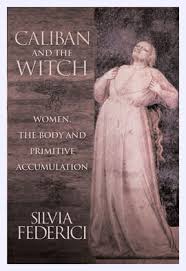
Caliban and the Witch*discusses the critical role witch burning played in the enclosure movement that drove our ancestors from the commons.
Feudalism Characterized by Continuous Rebellion
As Federici ably documents, medieval Europe was characterized by nearly continuous rebellion by serfs against their slave-like conditions. According to Federici, it was only by introducing a reign of terror involving the execution of nearly 200,000 women that the ruling elite succeeding in preventing total insurrection.
In all European countries (both Catholic and Protestant), witch burning was accompanied by legislation expelling women from most occupations and severely restricting their legal and reproductive freedom. The control over women’s reproduction (including a ban on birth control, abortion and all non-procreative sex) was a direct reaction to the population decline caused by famine and plague. Their lower numbers enabled peasants and urban workers to cause an economic crisis by demanding higher pay and improved working conditions.
The True Purpose of the Inquisition
Contrary to what we’re taught in high school and college history classes, the true purpose of the Inquisition was to not to stamp out heresy but to end the continuous peasant revolts. The hundreds of heretical movements (eg the Cathars) the Catholic Church persecuted during the Middle Ages were actually political revolts aimed at creating genuine political and economic democracy. Women figured very prominently in the Cathars and similar heretical religions. In addition to exercising the same rights as men, they also led many food riots and other revolts against enclosure.
Although none of these insurrections succeeded in overthrowing class society, they were extremely effective in winning greater political and economic freedom for both serfs and proletarian workers in the textile industry and other crafts.
The First Worker-Run Democracies
According to Federici’s research, the strength of peasant resistance peaked between 1350 and 1500, due to a severe labor shortage resulting from the Black Death (which wiped out 30-40% of the European population), small pox and high food prices. Highlights of this period include Ghent, which created the first dictatorship of the proletariat in 1378, and Florence, which created the first worker-run democracy in 1379.
The mass refusal of peasants to work under slave-like conditions created a major economic crisis, which the ruling elite addressed through wars of acquisition against other European countries, the colonization of Asia, Africa, America and Oceania and the reimposition of slavery (both in Europe and the Americas).
*Caliban is the subhuman son of the malevolent witch Sycorax in Shakespeare’s play The Tempest.
A big shout-out to the reader who recommended this book to me. I loved it.
With or Without You: What are Men Thinking about Women
Directed by Tom Sands and Ramsay S James (2012)
Film Review
In this highly amusing documentary, the filmmakers ask random men on the street a series of questions about women. They intersperse their answers with so-called “experts”* who have made a life study of male-female relationships.
The overall impression I took away is that men feel a strong expectation to talk about women in terms of their booties, boobs and legs. However most of the men in the film (including the so-called experts) share a strong expectation for women to fulfill deep-seated emotional needs and feel angry and bitter when women fail to do so.
Aside from some really bizarre and convoluted pronouncements, a few of the experts came out with some really valuable insights:
• Human courtship is contaminated by a range of political and sociological factors (I was disappointed the film failed to explore some of these.).
• A man who doesn’t fully know and accept himself is unlikely to have a successful relationship with a woman.
• A man who doesn’t know and accept his feminine side (so-called “feminine” traits such as empathy, nurturing, instinct and intuition) is unlikely to be successful in love.
• Men’s anger towards women nearly always stems from unresolved conflict within themselves or towards their mothers.
*Psychologists, psychotherapists, a sex therapist, a tantric master and an Anglican priest.
Stop Telling Women to Smile is a public art project by African American artist Tatyana Falalizadeh. Her goal is to fight the daily street harassment young women face in New York and other cities (I, too, experienced street harassment until well into my forties).
In this type of harassment, packs of men make obscene catcalls and noises at random women as if they own them.
Falalizadeh interviews women about the intense humiliation and degradation this causes. Each woman identifies the specific message she wishes to convey to her abusers. Then Falalizadeh paints the women and puts up the posters in neighborhoods they frequent.
Examples of messages include:
“Stop Telling Women to Smile.”
“I’m Not Here for You.”
“Women Aren’t Outside for Your Entertainment.”
“Keep Your Thoughts About My Body to Yourself.”
Power is a disturbing documentary about a South African martial arts expert Debi Stevens and her efforts to fight India’s rape culture by teaching Indian girls to defend themselves. The film was produced following the 2012 gang rape and murder of a 23 year old physiotherapy intern on a Delhi bus.
In addition to showing excerpts from some of Stevens’s classes, Power provides disturbing insights into a cultural framework that makes it “okay” for 75% of India’s urban males population to sexually assault women. As in the Middle East, India’s extremely patriarchal and misogynist culture, combined with a large population of permanently unemployed males seems to set the stage for this kind of violence against women.
I found this film particularly instructive in view of recent publicity about migrants committing group sexual assaults in Cologne – in a variant of the Arab rape game Taharrush (see It’s an Arab rape game called Tarrarush).
Jyoti Singh‘s attackers were neither Arab nor Muslim but Hindu.
Co-opting Radical Feminism for Corporate Interests
While preeminent American feminist Gloria Steinem’s CIA background receives wide attention on the Internet, it’s a totally taboo topic in either the corporate or the so-called “alternative” media. Steinem’s work for the CIA front group Independent Research Service first entered the public domain in 1967 when Ramparts magazine exposed both the Independent Research Service and the National Student Association as CIA front organizations.
Fearing unflattering publicity, Steinem gave interviews to both the New York Times and the Washington Post defending her CIA work (see video below). In both articles, she claims to have taken the initiative in contacting Cord Meyers, who headed the CIA’s International Organization Division and their top secret Operation Mockingbird.* Her goal, allegedly, was to seek CIA financing to encourage American participation in the seventh postwar (Soviet-sponsored) World Youth Festival in Vienna in 1959.
The article quotes her: “Far from being shocked by this involvement, I was happy to find some liberals in government who were farsighted and cared enough to get Americans of all political views to attend.”
Steinem served as director of the CIA-funded Independent Research Service from 1958-62. It was her responsibility to organize US students, scholars and writers to attend the yearly World Youth Festival, to observe and takes notes on foreign participants, to distribute pamphlets, flyers and books and to edit a daily propaganda newspaper.
Steinem Threatens to Sue Random House
Steinem’s CIA links came to mainstream media attention a second time in 1979, when the Village Voice ran an article about a chapter Random House had censored from Redstockings Collective’s 1979 book Feminist Revolution. Random House spiked the chapter, which describes Steinem’s earlier CIA work, after Steinem threatened to sue them. This deleted chapter (which you can get free by ordering an out-of-print copy of Feminist Revolution from Redstockings Collective) also suggests her CIA involvement may not have ended in 1969 when she left the International Research Associates. It details the right wing corporate funding which helped Steinem inaugurate Ms Magazine, as well as the magazine’s pivotal role in transforming American feminism from a broad multi-class, multiracial movement to one devoted to divisive male bashing and advancing career opportunities for white upper middle class women.
The original feminists of the sixties and seventies didn’t hate men (at least not the ones I worked with). What they hated was patriarchy and the use of male privilege to deny women and children full equality as human beings.
Operation Mockingbird in Action
In 1960 Clay Felker, a CIA-linked Independent Research Service staffer who accompanied Steinem to the Helsinki World Youth Festival in 1962, became the editor of Esquire magazine, where he published many of Steinem’s early feminist articles. In 1968 Felker started New York magazine, and in 1971 he hired Steinem as contributing editor. It was Felker who published the first edition of Ms Magazine as a New York magazine insert.
As the feminist magazine Off Our Backs states in a 1975 article about the Redstockings scandal, their discovery of Steinem’s earlier CIA employment raised a host of concerns about her sudden installation (mainly by corporate media) as the official leader of the US women’s movement without any previous involvement in feminist groups or campaigns.
Interestingly Ms Magazine‘s first publisher was Elizabeth Forsling Harris, a CIA-connected PR executive who planned John Kennedy’s Dallas motorcade route.
The Turmoil At NOW
In 1966, Steinem was still on the board of directors of International Research Service, when she co-founded National Organization for Women (NOW) with Betty Friedan, author of The Feminine Mystique. A 2001 article in The American Prospect describes (quoting from The World Split Open by Ruth Rosen) how in 1975 prominent NOW members Carol Hanisch and Kathie Sarachild openly accused Steinem of working for the CIA and “directing the movement toward moderation and capitulation.” Ultimately Friedan herself became concerned “a paralysis of leadership” in the movement “could be due to the CIA” and demanded that Steinem respond.
After three months, Steinem wrote a six-page letter to various feminist publications describing her work on two student festivals in 1959 and 1962 that were funded by the CIA. Aiming to deflect the charge she was or had been a government operative, it stated, “I naively thought then that the ultimate money source didn’t matter, since in my own experience, no control or orders came with it.”
The Off Our Backs article also raises questions about a parallel organization Steinem started (in competition with NOW – starting parallel groups is a common strategy employed by US intelligence to sabotage grassroots organizations) in 1971 called Women’s Action Alliance. Located in the same building as Ms. Despite its name, the WAA wasn’t involved in “action,” as its name suggests. It engaged mainly in information gathering. It had a $20,000 grant from Rockefeller Family Fund for the establishment of a “national clearinghouse information and referral service” on the women’s movement. WAA collected information on key women leaders and their groups and activities, presumably facilitation FBI/CIA efforts to monitor them.
Steinem’s Fascination with Fascist Men
Despite her so-called liberal feminist credentials, Steinem has had a clear preference for right wing men, often with CIA and/or FBI links. She had a nine-year relationship with Stanley Pottinger, a Nixon-Ford assistant attorney general, who played a prominent role in undermining civil rights enforcement under Nixon and Ford. He also obstructed FBI investigations into the assassinations of Martin Luther King, and the ex-Chilean Foreign Minister Orlando Latelier.
In 1984 Pottinger was also investigated for participating in Irangate, a CIA scheme to illegally smuggle arms to Iran .
In the 1980’s, Steinem dated Henry Kissinger.
The Use of Black Feminists to Sabotage Civil Rights Organizing
In the late seventies and early seventies, African American organizers became concerned about a pattern in which agents posing as black feminists infiltrated their community groups in an effort to split off women members into separate organizations. They traced this phenomenon back to 1978 when Steinem put a book called Black Macho and the Myth of the Superwoman on the cover of Ms Magazine.
The book was allegedly “written” by a Black “feminist” and “activist” named Michele Wallace. In her early twenties Wallace, who like Steinem came out of nowhere (she was a Newsweek book review researcher), was suddenly being touted as the “leader” of Black feminism. In the book, Wallace called abolitionists like Harriet Tubman and Sojouner Truth “ugly” and “stupid” for supporting Black men. She called Black Revolutionaries “chauvinist macho pigs” and advised Black women to “go it alone.”
Gloria Steinem maintained that Wallace’s book would “define the future of Black relationships” and she pushed hard to make sure the book received massive publicity. Gloria Steinem’s efforts triggered a flood of “Hate Black Men” books and films that continues to this day.
*Operation Mockingbird was a secret CIA campaign to influence the media by placing CIA assets on the staff and editorial board of major publishers and media outlets and by paying reporters a small stipend to publish articles favorable to CIA interests. It allegedly ended in 1976 but many researchers believes it continues under a different name to the present day.
**Irangate was a CIA effort to illegally smuggle arms to Iran to obtain funding for the illegal CIA war against Nicaragua.
Do Communists have Better Sex? is a comparison of sexual mores in East and West Germany prior to the fall of the Berlin Wall. Studies suggest that East German women found sex more satisfying. A 1980 study found that 50% of West German women were unable to achieve orgasm, in contrast to 15% of East German women. The filmmakers attribute this difference to three general factors: the greater economic independence of East German women, a more relaxed attitude towards sexuality that allowed people, rather than the media, to control their sexuality, and the availability of well written sexual manuals about women’s sexual needs.
The Role of Economic Independence
At the end of World War II, East Germany experienced a severe shortage of men as most returning soldiers settled in West Germany. This made it necessary for women to assume men’s roles in East German industry. In contrast West German women were pressured to leave their war jobs to free them up for men. Government, churches and the media bombarded them with the message their chief role in life was to make men happy.
Owing to the large number of war widows raising children, the East German government provided generous social programs, including free child care and cooperative laundries to enable them to work full time. This made them economically independent from men and significantly reduced the pressure for them to marry.
Role of Religion
In West Germany, the church’s preeminent influence made sex a taboo topic until the late sixties. This included sex education in schools, and teachers could be prosecuted for explaining where babies came from.
In East Germany, the Communist Party took the view that healthy sexual relationships were essential for people to develop fully as human beings. The East German government introduced sex education in schools in the 1950s, though they put more emphasis on TV programming that educated parents on dealing with teen sexuality. Consensual sex was legal from age 16 up.
Access to Birth Control
In East Germany oral contraceptives were free for all women 14 and over from the early sixties when they first became available. Abortion (prior to 12 weeks pregnancy) were legal and free from 1972 on. In West Germany, feminists had to fight long and hard to gain access to birth control pills in the late sixties and abortion in 1976.
Pornography and Sexploitation
While the East German government had strict laws against pornography, sex shows and sexploitation,* they were extremely tolerant of nudism at public beaches and campsites. In addition, they directly subsidized the publication of popular sex manuals to keep men up to date on women’s sexual needs.
In West Germany, nudism was illegal, while male-oriented pornography, peep shows and strip clubs proliferated with the 1975 repeal of their pornography law.
*Sexploitation is the commercial exploitation of sex, sexual attractiveness, or sexually explicit material.
Solar Mamas is about the Barefoot College in Rajastan India and the struggles of a Jordanian woman to overcome the sexist attitudes of her husband and other men in her Bedouin village.
The Barefoot College is a non-governmental organization which has training rural women from the developing world to become solar engineers since 1997. The program serves the dual purpose of electrifying poor rural villages and helping these villages out of poverty. After completing a six month training program, the women return to their home countries to train other women in solar installation.
The documentary concerns the first two women selected by the Jordanian Minister of the Environment to attend the Barefoot College. The women come from a village of 300 where all the adults are “unemployed” and the women do all the work (collecting firewood, doing laundry, cooking, cleaning and looking after children). Women with young children receive welfare benefits, which is why the Jordanian government is keen to subsidize their attendance at the Barefoot College.
As the Jordanian women speak no English, their training is based on hands-on assembly experience, aided by a book of color-coded circuit diagrams. Both women are illiterate, as it’s considered shame for Bedouin girls to remain in school past age ten.
Are Women Better at Getting Out of Poverty?
The film focuses on the younger of the two women, who’s forced to discontinue her training after her husband threatens to divorce her and take her children away. Rafea’s mother is caring for her four children during her absence. The husband threatens to take them to another village to be raised by his first wife (he has two).
Rafea returns, tearfully. A month later, despite her mother’s opposition and continuing threats from her husband, she overcomes her fear of her husband and returns to India to complete her solar training.
Towards the end of the film, the Minister of the Environment explains why the Jordanian government only selects women for solar training: they can’t count on men (who often have other wives) to remain in their home village.
If Rafea’s village is anything to go by, I suspect the real reason is that the women develop a stronger worth ethic in looking after their children. The men, in contrast, are bone idle and lay around on mattresses all day.
Below is a presentation by Bunker Roy, founder of the Barefoot College, about its history:
Selling the Girl Next Door is about sex trafficking of American underage girls, a business which has moved off the street and onto the Internet. The sex services of girls as young as eleven are being advertised in the Adult Services section of Backpage.com. They were being sold on Craig’s List until CNN journalist Amber Lyon confronted owner Craig Newmark as part of her investigation.
Obviously no online marketplace is going to accept an ad for prostitution. The girls are listed as “escorts,” with revealing photos and coded language (eg “young,” “fresh,” “innocent”) to indicate they’re underage.
When you look at the millions of dollars the federal government spent on shutting down Silk Road for selling recreational drugs (see Was Silk Road Founder Framed?), it’s ironic – and frankly sickening – that they continue to allow sites like Backpage.com to traffic in underage girls.
Lyon interviews Las Vegas girls convicted for underage prostitution in Clark County juvenile detention center, as well as men who have used their services and judges, lawyers and probation officers who work with them. She also profiles one particular thirteen-year-old, interviewing her mom and going to court with her.
Blaming the Victim
The pimps who run underage girls are always on the lookout for runaways. They use the promise of affection to lure them in and violence to keep them as virtual sex slaves. In most US cities, underage girls arrested for prostitution are locked up in juvenile prisons. City and county authorities claim they have no other way to keep them off the street.
One Las Vegas judge is fronting an initiative to build a safe house for underage victims of sex trafficking as an alternative to prison. He’s being blocked by county authorities – they refuse to cough up $700,000 for probation officers to run it. Federal funding appropriated to combat sex trafficking, only goes to help foreign victims.
In the course of the CNN investigation, the threat of unwanted publicity led Newmark to shut down the Adult Services section of Craig’s List. Backpage.com, the second most popular online marketplace, immediately saw their income spike by billions of dollars. They’re owned by Village Voice Media, who refused to be interviewed by CNN.

 The Most Revolutionary Act