The Reality of Third World Exploitation

One Cube

Pramod Dev (2016)

Film Review

This short documentary examines the brutally exhausting lives of three Indian women forced into formal employment by deteriorating economic conditions.

The first is a young woman who gets up at 4 am to work at a call center; the second is a married mother of two who works in a textile factory all night, does all the housework and sleeps five hours while her kids are at school; the third is a middle aged woman who gets up at 2 am to go door-to-door selling fish.

Most striking about the documentary is the absence of a narrator. Except for the women’s own commentary about their horrendous lives, it’s left to the viewer to decide whether these women are better or worse off by being forced into wage slavery.

According to the film, India has 900,000 young people working at call centers. Forty-five percent are women. The BPOS (Business Productivity Online Services), as they are called, serve 66 countries in 35 languages.

According to manager interviewed by filmmakers, BPOs hire women in preference to men. By this point, most Americans and Europeans are aware they’re talking to someone in India when they call a toll free number for technical support, to change their airline reservation or to place a classified ad in their local newspaper.* Most are more receptive to talking to a female than a male.


*Here in New Plymouth, the call is put through to India when we place a classified ad in the Midweek.


No Maternity Leave? Only in the US

Maternity Leave and Why the US is the Only Developed Nation Without It

Broadly (2016)

Film Review

Maternity Leave focuses on the failure of the US government to offer working mothers paid maternity leave. The US is one of two countries globally (the other is Papua New Guinea) and the only developed country without it. The rest of the world provides paid maternity leave for two simple reasons: 1) because spending time with mom is vital to newborn development and 2) because studies show financial advantages for employers, taxpayers and GDP.

Three states require employers to provide paid maternity leave: California six weeks at 55% salary, Rhode Island four weeks at 60% salary and New Jersey six weeks at 67% salary.

Ninety percent of California businesses report an increase in profitability (owing to the high cost of recruiting and training replacement workers) since they started providing paid maternity leave. Nationwide replacement workers for women who leave work to start a family cost billions of dollars. Forty percent of women without access to paid maternity leave are forced to apply for public assistance, which is also a major burden to taxpayers.

The filmmakers visit excruciatingly poor Papua New Guinea, to investigate their failure to provide paid maternity to leave – only to discover the government of Papua New Guinea provides three months paid maternity leave for public employees. This is a start contrast with an extremely anemic executive order Obama signed in 2015 allowing federal employees to “pre-use” six weeks of paid sick leave (which they haven’t earned yet) as maternity leave.

The filmmakers also visit Sweden, which has the world’s best maternity leave policy. Their generous paid parental leave (480 days per child split between both parents) has helped to bring more Swedish women into the workforce while simultaneously increasing GDP.

They interview a member of Sweden’s Feminist Party, who maintains that paid maternity leave is a matter of full equality for women. True equality means that women enjoy the same rights as men to both a job and family time – they shouldn’t have to sacrifice one for the other.

Real equality also means embracing and valuing traditional women’s work (homemaking, child care and elder care).

The Historical Roots of Patriarchy

Patriarchy, Civilization, Militarism and Democracy

Gwynne Dyer (1994)


This documentary traces the development of patriarchy around 5,000 years ago, which Dyer links to the consolidation of agricultural villages into empires. Simultaneously in Mesopotamia, Central and South America and China, hierarchical political systems formed under a single male dictator who controlled their subjects via absolute terror.

This transition from autonomous villages into heavily militarized states was always accompanied by strict control of women’s behavior. Dyer maintains the ultimate goal of controlling women was to increase the birth rate and produce more male subjects for the rulers’ armies. In Mesopotamia, the formation of new religions (Judaism, Christianity and Islam) glorifying a single male god was the crowning achievement of patriarchy.

According to Dyer, Egypt was the last ancient empire to fully adopt patriarchy. Owing to natural barriers (the Sinai desert and the Mediterranean) that protected it from foreign invasion, it was the last ancient empire to militarize and adopt strict laws restricting women’s freedom.

The 40 minute film is divided into four parts. Parts 2-4 start automatically when the prior part concludes.


Sales of Dystopian Novel Skyrocket Thanks to Trump

The Handmaid’s Tale is a 1990 movie based on feminist Margaret Atwood’s dystopian novel. Sales of The Handmaid’s Tale have recently skyrocketed, largely owing to the extreme Christian fundamentalists in Trump’s new cabinet, his advocacy for military and police expansion and torture and his attacks on women’s rights.

The plot focuses around a military theocracy during a future period in which most have become infertile through toxic chemical exposure. All women are stripped of their rights and all fertile women are enslaved and forced to produce babies for infertile elite couples of the ruling elite.

In addition to the presence of heavily armed military on every street corner, social control is maintained through a perverted fundamentalist Christian doctrine that sanctions slavery and ceremonial rape. Although the lower classes are forced into strict religious conformity, the elite rulers willfully ignore it as they pursue a life of clandestine debauchery.

Last year the film was remade into a 10-part TV series that premiers in April.

Hulu Handmaids Tale Teaser Trailer

Class Conflict in the Suffragette Movement

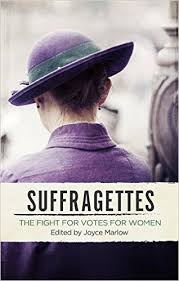
suffragettes

Suffragettes: The Fight for Votes for Women

Edited by Joyce Marlow

Virago Press (2000)

Book Review

This is a somewhat unconventional account of the 100 year battle British women fought to win the vote. As it relies on letters, diaries and newspaper accounts, it brings to light the individual personalities of various suffragette leaders and men who supported them. It also highlights interpersonal and political conflict that arose in the movement.

Much of the dissension arose because of class differences – often the solidly upper middle class leadership was out of touch with the thinking and needs of working women. There were also splits between women who engaged in property destruction (window breaking, fire setting and bombings) and those who advocated non-violence.

Prior to finding this book I was unaware of Queen Victoria’s absolute opposition to equal rights for women, nor the brutal and punitive forced nasogastric feeding imposed on suffragettes in prison. In their struggle to be recognized as political prisoners (and for general improvements in prison conditions), the women frequently engaged in hunger strikes when they were arrested.

It would be 1928 before British women finally won the right to vote on the same basis as men (at age 21). The Franchise Bill they fought for (and won) in 1918 only allowed women to vote when they reached age 30.

The Commodification of Female Sexuality

Sexy Baby

Directed by Jill Bauer and Ronna Gradus (2012)

Film Review

Sexy Baby is a documentary about the commodification of female sexuality and its destructive effect on young women’s identity and self-esteem. It follows three particular women over two years: a 13 year old girl in conflict with her parents over her sexually provocative Facebook postings, a 23 year old who undergoes labioplasty to make her genitals conform to what her boyfriends are seeing in on-line pornography and a pole dancer struggling to cast off her stripper persona for her to be fully appreciated for her intelligence, assertiveness and compassion.

I felt all three stories were very sensitively portrayed. They were interspersed with images of soft porn that most modern teenagers with Internet see from age 12-13 on via the Internet and interviews with teenage boys and men about their attitudes towards pornography and female sexuality.

I found the 13 year old Winifred’s story the most engaging. Winnie is a highly intelligent high achiever. Despite a close and loving relationship with both parents, she succumbs to massive peer pressure to dress provocatively and to post revealing images of herself on Facebook.

I strongly empathized with the parents’ struggle to deal with this behavior. I also strongly support their decision to ban her from Facebook (eight times over six months) whenever her postings became too extreme.

I must admit I prefer her father’s approach to her scanty outfits to her mother’s. Her mom takes the attitude: “It’s your body – you can dress the way you want to.” In contrast, her father is honest about the anxieties her provocative dress provokes in him.

Over time, this seems to be quite effective.

The Role of Patriarchy in Psychological Indoctrination

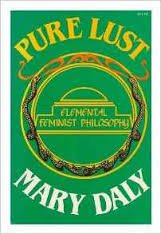
pure lust

Pure Lust: Elemental Feminist Philosophy

By Mary Daly

Beacon Press (1984)

Book Review

Pure Lust* is about the systematic psychological indoctrination of women that occurs under patriarchy.

Daly’s approach to her subject is both historical and etymological. Historically organized religion has assumed primary responsibility for indoctrinating women. Daly focuses mainly on the Catholic religion, particularly the cult of the Virgin Mary and how this doctrine was used to trap women in subservient roles. After identifying clear parallels in the Jewish and Muslim religion, she examines how judges, lawyers and other male-oriented institutional roles have replaced priests in modern secular society.

Women’s Oppression Embedded in Language

The book has a heavy etymological focus, with an exhaustive examination of ways in which women’s oppression is embedded deeply in contemporary culture and language. Women who wish to fully liberate themselves must learn to recognize how language itself oppresses us and, where necessary, invent our own (as Daly does throughout most of the book).

Daly maintains this indoctrination has caused women to become separated from our “elemental race,” which is rooted in harmony with the natural world. Many women sense this – that they have been blocked of their capacity to conceive, speak and act in their own original words. They simultaneously sense their energy is being systematically drained for male use.

According to Daly, the lot of women under patriarchy has been the sacrifice of their personal needs and ambitions for children, husbands, aged parents and “just about everyone else.” This is especially true of poor and minority women.

The Origin of War, Racism and the Rape of the Environment

Simultaneously, unbridled male sexual aggression (a condition based on an obsession with impotence that Daly refers to as “phallic lust”) translates into war, racism, imposed poverty and famine, the rape of the environment and the insidious spread of the drab ugliness of a man made environment that systematically deadens minds.

Sensory Deprivation and “Potted” Desires and Emotions

Within male-dominated “sadosociety,” women aren’t allowed a self – all their experiences must be mediated by men. Daly views the modern commercial building – consisting of square, flat spaces with rigidly uniform decor, hermetically sealed windows, homogenized sound environment and constant light – as the perfect archetype of this mediated environment. The end result is a state of chronic sensory deprivation.

Under patriarchy everything women hear, touch, feel and understand about the world has been processed for us. We live in a society dominated by the mass production of “potted” (ie artificial) desires and emotions. The result is the killing of consciousness and integrity in many women, allowing the routine abuse of the poor, minorities, and so-called enemies to go unnoticed and uncriticized.

Daly also examines the complex dynamics that enable men to recruit women (eg Hillary Clinton) to be token oppressors of other women, ethnic minorities and third world people.


*The title Pure Lust refers to “elemental female lust,” which Daly defines as women’s intense longing for the “cosmic concrescence that is creation.”

The Mommy Tax

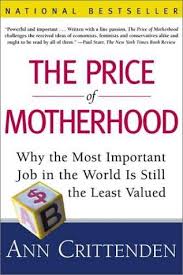
the price of motherhood

The Price of Motherhood: Why the Most Important Job in the World is still the Least Valued

By Ann Crittenden

Henry Holt and Company (2001)

Book Review

The Price of Motherhood is about the refusal of English-speaking countries to acknowledge the vast amount of unpaid labor women invest in their children. Economists agree that two-thirds of society’s wealth is created by human skills, aka human capital. Yet they also refuse to acknowledge thirty years of psychology research demonstrating that the most critical education producing this “human capital” occurs in the first five years of life.

Not only is most of this work unpaid, but mothers who require part time or flexible work arrangements to address their children’s needs pay an enormous penalty in terms of lifelong earning potential. Crittenden refers to this penalty as the “mommy tax.”

According to Crittendon, while the pay differential between men and women continues to narrow, there has been virtually no change in the pay gap between mothers and unencumbered men and women. Numerous studies identify this “mommy tax,” consistently highest in English-speaking countries, as the primary cause of child poverty in the US, the UK, Canada, Australia and New Zealand. Likewise a woman’s “choice” to become a parent is the number one cause of poverty in old age.

Crittenden contrasts the US with France and various Scandinavian countries that support working mothers through policies such as free health care, one year paid maternity leave*, and free childcare. Child poverty virtually unknown in France and Scandinavia. In contrast 22% of American and 25% of New Zealand kids grow up in poverty.

The book is also highly critical of economists’ failure to count women’s unpaid labor in the GDP, given its high importance in creating a skilled workforce.** Despite the US refusal to keep data on “non-market” labor (where no money changes hands), more civilized countries do. Crittenden cites figures from Australia (where it comprises 48-64% of GDP), Germany (where it comprises 55% of GDP, Canada (where it comprises 40% of GDP), and Finland (where it comprises 46% of GDP).

Besides including “non-market” labor in the GDP calculations, the book proposes a number of other policy changes to reduce or eliminate the mommy tax. They include federal laws mandating one year paid parental leave, free health care for all children and primary caregivers, and free preschool for three and four year olds; a shorter work week; and equal pay and benefits for part time work. They also include a federal ban on discrimination against parents in the workplace, a universal child benefit, the creation of a single federal agency to collect child support obligations, and a federal mandate requiring divorce courts to award both parents an equal standard of living where there are dependent children.


*The only six countries that fail to mandate paid maternity leave are the US, Australia, New Zealand, Lesotho, Swaziland and Papua New Guinea.

**See review of Marilyn Waring film Whose Counting

The Refusal of Global Economists to Recognize Women’s Unpaid Labor

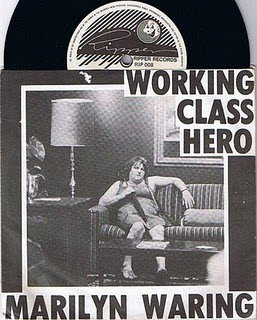
marilyn waring_working_class_hero

Whose Counting?

Directed by Terre Nash (1995)

Film Review


Whose Counting is a 1995 Canadian documentary about the early life of New Zealand feminist Marilyn Waring. With her 1988 book If Women Counted, Waring was the first to challenge whether GDP (gross domestic product) is an effective way to measure the performance of a national economy.

New Zealand’s Antinuclear Ban

The film begins with Waring’s election to the New Zealand parliament in 1977. The youngest member of Parliament (at 23), she was elected to a safe National (conservative) seat in rural Waikato. After serving three 3-year terms, she brought the government down by “crossing the floor” (ie signaling her intention to vote with the Labour opposition on the anti-nuclear issue).

Then prime minister Robert Muldoon called a snap election. He was voted out of office, with 72% of New Zealanders supporting Labour’s platform of permanently outlawing nuclear weapons and nuclear power in New Zealand.

Because the US government refuses to disclose whether their ships are nuclear powered or carry nuclear weapons, as of 1984 all US naval vessels are banned from New Zealand sovereign waters.

Negating Half the Planet

During her term in Parliament, Waring served on the Public Expenditure Committee and was troubled by was she learned was the UN System of National Accounts. As a condition of belonging to the UN, IMF and World Bank, all countries must use this system, developed by economists Maynard Keynes and Nicholas Stern after World War II.

Because this accounting system only attributes value to cash generating activities, it negates the productive activity of over half the planet – and of the planet itself.*

The film has a really humorous scene in rural Africa where women grow and cook all the food, collect all the firewood and water, and do all the housework and child and elder care – while the men lie around all day “supervising” them.

However it stresses that women also work far harder than men in the developed world. Two-thirds of all primary health care is delivered by women in the home. Yet because they receive no cash payments, all this work is virtually invisible.

Counting Environmental Damage as Growth

Waring is also extremely critical of a global accounting system that counts the immense environmental damage caused by the Exxon Valdez spill as positive GDP Growth. Given that the five permanent UN Security Council members (US, UK, France, Russia and China) are also the world’s biggest arms exporters, she finds it no surprise that the carnage of war counts as GDP growth.


*Waring was also an early promoter of the concept of “ecosystem services,” essential services provided by nature in purifying water and air, sequestering carbon, stabilizing climate, providing for food crop pollination, etc.

The film can’t be embedded for copyright reasons. However it can be viewed free at https://www.nfb.ca/film/whos_counting


The Life and Loves of a She-Devil

The Life and Loves of a She-Devil

BBC (1986)

Film Review

A dramatization of Fay Weldon’s 1983 classic, The Life and Loves of a She-Devil is a satire about the sexist and exploitive nature of romantic love.

The heroine is a very ugly woman named Ruth who ingeniously manipulates her husband’s innate sexism to wreak vengeance on him and his beautiful rich mistress Mary Fisher.

Both the book and the dramatization focus on society’s use of romantic love to glamorize the vast amount of unpaid labor women perform for men and society in general.

As Weldon puts it (in the words of a Catholic priest Fisher “seduces”), “love robs women of their identity and creative selves.”

The video below comprises all four episodes in the 1986 series.