Capitalism: The Role of Violence Against Women

Sylvia Federici

Jan 9, 2019 talk

In this talk, Sylvia Federici, author of Caliban and the Witch (see Witch Burning and Women’s Oppression) discusses her two latest books Witches, Witch Hunting and Women and Re-Enchanting the World.

Witches, Witch Hunting and Women elaborates on two key premises: 1) that the extensive free labor women perform is fundamental to the success of capitalism and 2) that violence against women is never accidental. According to Federici, it’s “structural”, ie fundamental to the human exploitation necessary for capitalist accumulation.

Federici divides violence against women into three main categories: domestic, public and institutional. Domestic violence occurs in the context of a domestic relationship, public violence includes non-domestic rape, paramilitary violence and narco-trafficking, and institutional violence consists of police violence, female incarceration (which is increasing) and criminalization of pregnancy.

Federici is also concerned about the growing frequency of actual witchcraft accusations in Latin America, India and Africa. She blames this on what she refers to as “re-colonization,” aka globalization, whereby millions of poor peasants are being driven off their land and turned into refugees. The original witchcraft trials occurred during the 16th and 17th century enclosures, when people were being violently thrown off of communal land.

Re-Enchanting the World, the second book she describes, depicts how this violent dispossession also destroys the community ties and solidarity working people rely on to resist capitalist violence. It strikes a positive note in describing how Latin American women who are forced to urbanize (after losing their land) are starting to collectivize to meet their survival needs. Examples include organizing to fight for access to water and power and to build schools and clinics.

That F Word: Growing Up Feminist in Aotearoa

That F Word: Growing Up Feminist in Aotearoa*

By Lizzie Marvelly

Book Review

The goal of That F Word is to dispel common confusion about the meaning of the word “feminist.” To singer journalist Lizzie Marvelly, the word simply refers to someone who advocates for full women’s equality. She illustrates by demonstrating all the ways in which women aren’t fully equal to men in New Zealand (or the rest of the industrial world).

If women were fully equal, they would enjoy equal pay for equal work, decriminalization of abortion* and equal representation in government, the boardroom and the media and entertainment industry. Domestic violence and rape culture would end because sexual abuse, sexual harassment and domestic violence would be prosecuted to the full extent of the law, as would the routine exposure of 14-year-old boys to misogynist Internet pornography; the widespread use of soft porn to sell commercial products; the continual media pressure on women to hate their appearance; and the constant verbal abuse and rape and death threats against women who openly express opinions in the public arena.

Marvelly views the advent of social media as a two-edged sword for women. Despite the ubiquitous use of social media by insecure men to verbally abuse, degrade and threaten women, it also offers women a unique opportunity to openly share personal experiences of abusive treatment by men. Even more importantly, social media has brought into the open the extreme level of misogyny women experience in contemporary society.

Presented as an expanded memoir, That F Word is a remarkable achievement for a 29-year-old author. In my view, it should be required reading for all men with a genuine desire to understand the condition of women in the 21st century.


*Aotearoa is the original Maori name for New Zealand

**In New Zealand, abortion is still a crime under the Crimes Act – unless a woman obtains independent certification from two health professionals that proceeding with the pregnancy will seriously endanger her mental health.

Bill Cosby: Fall of an American Icon

Bill Cosby: Fall of an American Icon

BBC (2018)

Film Review

This BBC documentary is about the multiple rape charges against Bill Cosby that have surfaced in the last 14 years. It begins with a brief summary of Cosby’s stellar career and his former importance as an African Americans role model. The film highlights his unrelenting philanthropy and promotion of African American education, via millions in donations to Black colleges. In 2004, after the Cosby Show ended, he embarked on a series of nationwide tours in which he railed against black mothers for not getting jobs and not caring for their kids properly.

2004: First Rape Allegation

According to people who worked with him closely, Cosby was known for “cheating,” ie engaging in a series of affairs with women he mentored as proteges. However it wasn’t until 2004 that a woman made a serious rape allegation to Philadelphia police. When Philadelphia prosecutors declined to press charges (for lack of evidence), the victim filed a civil lawsuit. Cosby settled in 2006. The details of the settlement, as well as a four-hour deposition Cosby provided under oath were sealed.

As a consequence of the lawsuit, 13 other women approached the victim’s lawyer about their own experience with Cosby “drugging” and raping them. These new complaints received little media attention until BuzzFeed picked up a story about a Black standup comic named Hannibal Burris making rape jokes about Cosby. More women came forward, and women’s rights attorney Gloria Allred arranged a press conference for those willing to speak publicly about their experiences.

Court Unseals Cosby’s 2004 Deposition

This, in turn, led an AP reporter to apply for Cosby’s 2004 sworn deposition to be unsealed. Although Cosby’s lawyers maintained this violated his right to privacy, the judge ruled his years of public “moralizing” negated his right to privacy.

In the deposition, Cosby acknowledged having sex with women he was mentoring and sometimes giving them quaaludes. This, along with dozens of new complaints from women Cosby allegedly abused, gave prosecutors sufficient evidence to proceed with the 2004 rape case.

Cosby’s first trial ended in a hung jury in June 2017. At his re-trial in August 2017, a jury found him guilty of drugging and sexually assaulting his accuser. Cosby is appealing the charge.

YouTube has taken the video down but it can be viewed for free here:

Bill Cosby: Fall of an American Icon

Patriarchy: An Anthropological Study


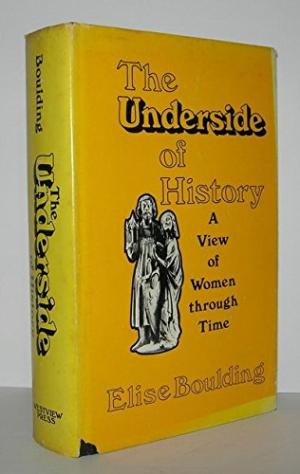
The Underside of History: A View of Women Through Time

by Elise Boulding

Westview Press (1976)

Book Review

Published at the height of the women’s movement, this is a remarkable read. The first book of its kind, it employs extensive anthropological and historical evidence to trace the contribution of women to the rise of civilization. In most historical accounts, the role of women in development has been largely invisible

Beginning with the appearance of our hominid ancestors in Africa two million years ago, Boulding traces their migration to the Middle East, Europe, Asia and North and South America – highlighting the early civilizations that developed in each of these regions. She concludes with the current role of women in each of these geographical areas.

The part of the book I found most surprising describes the role women played in inventing tools from pebbles, bones and skulls to use in food preparation. They also invented ceramic pots and bags made of animal skins to store it and built huts to provide a protected space for child rearing.

During the hunter gather period, men and women played an equal role in production activities and decision making. After they learned to grow their own crops (following a decline in large game animals), women tended to be dominant because hunting was precarious and men relied on women for food. Women also had charge of the first domesticated animals (goats, sheep and pigs) and passed control of their land and livestock in a matrinlineal pattern.

Better access to food increase population density, which in turn necessitated an increase in food production. This led to the discovery of the plow and the domestication of cattle, which shifted basic control of food production to men. They, in turn, assigned women secondary tasks, such as weeding and collecting firewood and water.

The discovery of mining and metal working technology occurred around the same time, which would lead to the rise of trading economies and armies to protect settlers against raiding hunter gatherers. With the rise of cities and militarization, societies were “stratified” for the first time. “Stratification” and the rise of an idle ruling elite (kings and priests) would lead to the development of a social hierarchy that tended excluded women from public spaces and confined them to domestic labor at home.

According to Boulding, women still played a number of public leadership roles during antiquity and the Middle Ages – a privilege they lost during the Industrial Revolution.


Has Democracy Failed Women?


Has Democracy Failed Women?

by Drude Dahlerup (2018)

Book Review

This book challenges conventional wisdom that Greece was the birthplace of democracy, as it totally excluded women from participation in the political process.

Has Democracy Failed Women? starts with a brief review of women’s long difficult battle for the right to vote. New Zealand was the first to grant women a vote in national elections in 1893. Other English-speaking countries, including Britain, enacted women’s suffrage following World War I. Catholic countries, including France, Italy, Chile and Argentina waited till World War II ended. It was 1971 before women could vote in national elections in Switzerland.

It’s well established that democratic assemblies with inadequate female representation, are incapable of addressing the continuing oppression women experience under capitalism.* Yet more the 100 years after first receiving the right to vote, women (who comprise 52% of the population) are still denied full representation in the institutions of power. In the West, only two parliaments have granted women full parity (40-60% representation). In the global South, only Rwanda and Bolivia have as many women as men in their assemblies.

Dallerup blames the “secret garden of politics,” the failure of most political parties to select candidates in a transparent or democratic process, for women’s failure to receive fair representation in government. In most places, party officials limit their candidate pools to well-established old boy networks.

In general, only countries with Proportional Representation (see The Case for Proportional Representation) are likely to achieve more than 25% female representation in their national governing bodies. Countries (like the US, UK and Canada) employing a Plurality/Majority (winner- takes-all) voting system based on geographic districts have the most difficulty achieving adequate female representation. In these countries, a woman usually has to defeat a male incumbent to win a seat.

I was very surprised to learn that 57% percent of countries have achieved better female representation by imposing gender quotas. Pakistan was the first in 1956 (though they have subsequently rescinded the quota), Bangladesh in 1972 and Egypt in 1979. Scandinavian countries took a big step towards gender parity via voluntary party quotas

As of 2015, only three countries had no women at all in government: Bosnia-Herzegovina, Hungary, Pakistan and Saudi Arabia. Trump has only two female cabinet members, the lowest since the 1970s.

In an era in which the power of elected assemblies is being systematically eroded by multinational corporations, Dallerup feels it’s also really important to ensure strong female representation on corporate boards and the regional and international bodies they control. Spain, Iceland, Belgium, France, Germany, India and Norway all have laws requiring a minimum of 40% representation on corporate boards (a move consistently linked with higher profits.


*Interventions Dallerup views as essential to ending women’s inequality and oppression include

  • redistribution of money and resources, eg to single mothers for maternity care and maternity leave
  • actions against the feminization of poverty
  • public services: care for children, the elderly and disabled
  • housing and public transportation
  • an independent judiciary without with gender biases; intervention against domestic violence; anti-discrimination regulations, ie on equal pay and equal treatment; and affirmation action (ie gender quotas)
  • support for men’s role as caregivers, eg paternity leave
  • protection from sexual violence and harassment in peace and war and the inclusion of women in peace negotiations and post-conflict reconciliation

Also published in Dissident Voice

Patriarchy: The Crucial Role of Women’s Unpaid Labor Under Capitalism

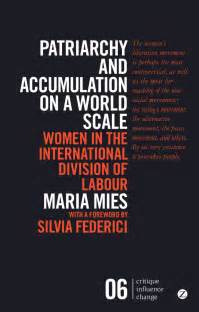
Patriarchy and Accumulation on a World Scale: Women in the International Division of Labour

by Maria Mies

Zed Books (2014 edition)

Book Review

In this 1986 classic, Mies challenges Marx’s description of the unpaid labor of women (childrearing, care of the sick and elderly, housekeeping and subsistence agriculture, handicrafts and firewood and water collecting in the Third World) as part of their “natural” function. In doing so, she provides the first comprehensive economic analysis of patriarchy.

While Marx and Engels readily acknowledge that capitalism oppresses women, they overlook the fact it also exploits them via the massive amount of free labor it makes them provide. According to Mies, it’s only this unpaid labor, which Mies refers to as super-exploitation, that makes wage labor exploitation possible.

Super-exploitation of Women and Colonies Finances Capitalist Expansion and War

She compares the super-exploitation of women under patriarchy to the super-exploitation that occurs under colonization. Both are intimately associated with violence, and both increase during the periods of rapid capital accumulation, which are necessary to finance capitalist expansion and war.

Violence and the Sexual Division of Labor

Based on modern anthropological research, Miles also offers a much clearer explanation of how the sexual division of labor arose, as well as its intimate link with violence. Citing numerous studies, she shows how women’s childrearing role made them them responsible for most food production in primitive societies (80% in hunter gatherer societies). Women also developed the first tools – namely baskets and pots for storing grain.

Popular culture places much more emphasis on the tools invented by men – weapons – and their use in hunting. Current anthropological evidence suggests they played a much bigger role in raiding other tribes to kidnap and enslave women (over time men were also enslaved), both for procreation and their food producing capacity.

Witchcraft Trials, Colonization, Mass Enslavement and the Rise of Capitalism

With the rise of capitalism, violence against both women and colonies (to compel their free labor) significantly increased. The pervasive witchcraft trials (and land confiscations) that began in the late 15th century, accompanied by the violent enslavement of New World colonies and Africans, would create the massive capitalist accumulation required for full scale industrial development.

Why Violence Against Women is Increasing

Mies also provides an eloquent analysis – linked to the intensification of capital accumulation – for the global increase in violence against women and Third World colonies over the last four decades. The onset of global recession in the 1970s forced capitalists to shift their labor intensive work to the Third World, where harsh US- and European-backed puppets use violence to suppress wages..

In the First World, simultaneous cuts in public services, have significantly increased demands on women for free labor (especially in the area of childcare and care of the sick and elderly). The simultaneous increase in violence against women (and the psychic trauma it induces) make it all the more difficult for women to organize and resist this super-exploitation.


Spinsterhood: The Plight of Women Intellectuals

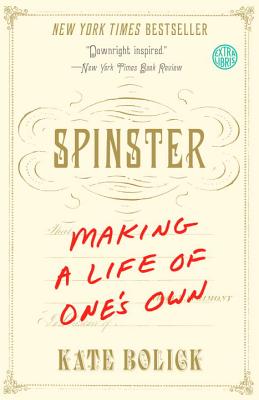
Spinster: Making a Life of One’s Own

Kate Bolick

Broadway Books (2015)

Book Review

In Spinster, the author describes her personal journey navigating the conflict many female intellectuals experience between fully developing their creative potential and succumbing to intense social pressure to marry and have children. Most of the book explores the lives of five significant role models – novelist and playwright Neith Boyce (1872-1951), short story writer and journalist Mae Brennan (1917-1993), social reformer Charlotte Perkins Gilman (1860-1935), poet Edna St Vincent Millay (1892-1950) and novelist Edith Wharton (1862-1937). Tracing the the lives of all five was invaluable to Bolick in her struggle to meet her sexual and romantic needs without making the all-engulfing commitment of marriage and motherhood.

Interwoven among these narratives are important historically data revealing the dramatic change in women’s lives over the last 200 years. For me these sociological pearls were the most interesting aspect of the book.

For example, prior to 1900 the age of consent (for sexual activity) was 10-12 in most states (7 in Delaware), something early feminists campaigned to change to 16-18.

In 1890, 34% of women lived as single women; in 1960 17%; and in 2013 53%. This recent increase in spinsterhood results from a doubling of divorce rates between 1966 and 1979. The divorce rate peaked in 1981, with women seeking most of the divorces. This coincided with their ability to access previously all-male trades and professions. This, in turn, greatly improved a woman’s ability to survive financially outside of marriage.

I was fascinated to learn about “family limitation” – a practice American women engaged in roughly 100 years before the availability of formal birth control. Between 1600 and 1800, married women got pregnant every two years until they died or reached menopause. During this period, average family size was 8.02 children. By 1900, this average had dropped (mainly due to sexual abstinence) to 4 children – by the Great Depression, it had dropped to 3 children. Between the late forties and the late sixties, it rebounded to 4 children, and since the 1970s it has remained at 1-2 children.


Women’s Health: The Rise and Fall of the Male Expert

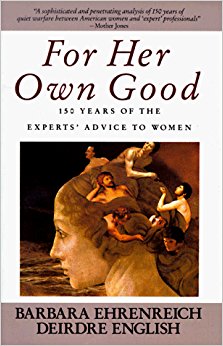
Free PDF:For Her Own Good

For Her Own good is a sociological study of the historical trend of male experts claiming the right to dictate what is best for women. Ehrenreich and English attribute this loss of female autonomy to the sudden and total disruption of centuries-old social roles that accompanied the rise of capitalism.

Elimination of Women’s Traditional Economic Roles

Under pre-capitalist patriarchy, women were totally subject to their fathers and husbands but still derived considerable prestige from the basic survival functions they performed in the home (ie tending gardens, chickens and dairy cows, as well as making butter, cheese, soap and candles and carding, spinning, weaving, and making clothes). With the rise of capitalism, all these functions were shifted into factories, and the household was limited to performing personal biological functions, such as eating, sleeping, sex, birth, dying and care of children and the elderly.

Even the traditionally female role of healing was transformed into a commodity to be sold in the market place. Prior to the advent of capitalism, except for the very rich (who could afford a doctor), healing was the exclusive domain of women.

Women had great difficulty finding a new role for themselves under capitalism, which led to a virtual epidemic of of depression and “neurasthenia,”* especially among upper middle class women.

Medical Care Becomes a Commodity

The book traces the rise of “heroic” medical interventions that arose when medical care became a commodity (doctors had to engage in active and visible treatment to demand a fee). Most of these interventions (especially blood letting, leech therapy, mercury salts) made patients worse, if not killing them. In the 1830s, the US working class rebelled against doctors as members of a parasitic elitist class. A popular health movement, run mainly by women, stressed the importance of fresh air, bathing, herbs, raw foods and daily exercise as a healthier alternative than the quack treatments employed by doctors.

In the 20th century, the rise of the Rockefeller and Carnegie foundations, which enabled the rise of “science based” medical training in medical schools, gradually forced lay midwives and other non-medical healers out of business.

The Myth of Science-Based Medicine

The authors spend the last third of the book delineating how so-called “science-based” medicine was based as much in myth, misogyny and superstition – at least when it came to women – as so called pre-scientific medicine. This is especially clear from the section on childrearing – where expert opinion seems to have reversed itself every few decades.

In the early 20th century, doctors and child guidance specialists insisted a mother’s role was to regiment a child to insure it behaved like a machine. Mother were strongly cautioned against playing with babies, picking them up except for feeding, hugging, kissing or cuddling them.

Follow the 1929 financial crash, experts reversed themselves and told mothers they had to be permissive and allow children to follow their own impulses in decided when to eat, sleep and play.

Child experts reversed themselves a third time when the US fell behind the Russians in the space race in the 1950s. At this point child experts dumped on mothers for not stimulating children enough or setting firm enough limits.


*Neurasthenia is a condition characterized by physical and mental exhaustion of unknown cause.

Abortion Diaries: Using Pregnancy to Stigmatize and Shame Women

The Abortion Diaries

Directed by Penny Lane (2005)

Film Review

The Abortion Dairies features twelve women discussing their personal experience with abortion. Their reminiscences reflect their resentment and anger over the stigma, shame and utter absence of support they felt struggling with an unwanted pregnancy that threatened to destroy their lives.

One women, who genuinely desired to keep her baby, is also highly critical of welfare reforms introduced by Bill Clinton that make it virtually impossible for young single women to raise children on their own.

All deplore taboo around public discussion of abortion despite its prevalence  (annually 1.3 million US women undergo the procedure). Thirty-four percent of teenagers will fall pregnant before age twenty.

Emma Goldman and the American Anarchist Movement

Emma Goldman: An Exceedingly Dangerous Woman

Mel Bucklin (2004)

Film Review

Other than the pro-capitalist depiction of the self-governing anarchist democracy Franco and his Wall Street supporters overturned during the Spanish Civil war, most of this documentary is historically accurate. The commentary, in contrast, is sentimental psychobabble and considerably detracts from the film.

The film beings with Goldman’s arrival in the US in 1885 at age 16 – escaping from an arranged marriage in czarist Russia. It would be four years before she connected with anarchists and other radicals in New York City.

The Panic of 1893, in which the US economy nearly collapsed, would launch her into the public spotlight. She led numerous protests marches of unemployed workers and spent a year in jail for incitement to riot. There was a crowd of 2,800 waiting outside the workhouse on her release.

American anarchists were extremely well-organized during a period of massive labor unrest and saw the wisdom of promoting a powerful speaker like Goldman. She believed that America’s founding father had a hidden libertarian/anarchist streak that had been corrupted by capitalism and often quoted from Jefferson and Paine.

In addition to speeches educating people about anarchism (ie replacing the state with self-governing workers committees and cooperatives), she also lectured widely about free speech, equal rights and economic independence for women, free love and birth control (she was sentenced to 15 days in jail for advocating for birth control in public).

She was an enormously popular speaker and received wide coverage in the mainstream media.

She also campaigned heavily against US entry into World War I, and in June 1917 was sentenced to 22 months for conspiracy to violate the Draft Act.

Shortly after her release in 1919 she was deported to Russia along with thousands of other Eastern European immigrants illegally arrested and deported during the Palmer Raids.

For me the most interesting part of the film concerns her meeting with Lenin in 1921.