Part 3, which covers the period 1601-1800, begins with the resettlement of thousands of Calvinist Scots in Northern Ireland to subdue the indigenous Catholic population. This successful model of “settler colonialism” would be repeated in North America, Australia, New Zealand, Australia and by Israel in occupied Palestine.
Following the execution of Charles I in 1649, Oliver Cromwell invaded Ireland, massacring 3,000 civilians. His 1652 Act of Settlement would deprive Catholic landowners of their property and exile them west of the Shannon River.
In 1690, England’s Protestant lords invited William of Orange from the Dutch republics to dethrone the last Catholic king James II.
Although Catholicism remained Ireland’s state religion, William III’s Penal Laws imposed harsh restrictions on both Catholics and Ulster Calvinists, who were banned from voting, serving in parliament, holding office or running schools. This would cause a massive flood of Scotch-Irish and Catholic immigrants to North America.
Towards the end of the 18th century, Ireland’s Catholic majority became more and more rebellious, inspired by the American (1776) and French (1789) revolutions. In 1796, the new French Republic agreed to provide 15,000 troops to support a (unsuccessful) revolution in Ireland.
Al-Naqba: The Palestinian Catastrophe Episode 1 (1799-1936)
Al Jazeera (2013)
Film Review
This is the most comprehensive documentary of the Zionist movement I’ve ever watched. The cinematography is incredibly beautiful and moving and includes scarce footage of vibrant pre-World War II Palestine.
I continue to be surprised by all the important events Western accounts leave out regarding the history of Zionism. Contrary to Western belief, the Jewish colonization of Israel didn’t began in 1916 with the infamous Sykes-Picot agreement, but with Napoleon’s 1799 proposal to establish a Jewish homeland in Palestine under French protection.
In 1840, when the British Foreign office tried to persuade the Sultan of the Ottoman empire to open Palestine to Jewish immigration, there were only 3,000 Jews in Palestine.
In the 1880s, as the power of the Ottoman empire started to decline, French banking magnate Baron de Rothschild openly campaigned to expand Jewish immigration, spending 40 million francs on the establishment of Jewish settlements in Palestine. The term Zionism* was first coined in 1885, with the first Zionist conference held in Basel Switzerland in 1906.
In 1907, as western Europe actively worked to usurp Ottoman colonies, the British Foreign Office called for the creation of a buffer state in the Arab-dominated Middle East – one that would be friendly to Europeans and hostile to Arabs.
The same year, 40,000 Palestinian farmers were forced off their lands by Jewish immigrants from Europe and Yemen.
By the close of World War I, when Palestine became a British protectorate, there were 50,000 Jews in Israel, 100,000 Arab Christians and 400,000 Arab Muslims.
In 1922, when the League of Nations charged Britain with preparing for the establishment of a Jewish homeland in Palestine, it was opposed by US president Woodrow Wilson.
During the 1920s, Jewish immigration continued to increase, accompanied by increasing confiscation of Arab lands. Between 1922-25, 33,000 Jews immigrated to Palestine. Between 1925-1930, the country was flooded by an additional 175,000 immigrants.
Palestine’s ruler, the Grand Mufti of Jerusalem, approached the issue of Jewish immigration by trying to curry favor with the British colonizers. In contrast Arab (both Muslim and Christian) farmers who were being displaced began organizing and protesting Jewish immigration from 1925 on. The initially peaceful protests were brutally and barbarically suppressed by British troops, in the same fashion as India’s independence movement. Hundreds of protestors were jailed, executed or forcibly exiled.
As Jewish immigration continued to increase (42,000 in 1934 and 62,000 in 1935, The al-Qassam movement, which called for violent revolution to expel the British, launched a six-month Palestine-wide general strike in 1936.
*An international movement calling for the establishment of a majority Jewish state in Palestine via forced displacement of its Arab occupants.
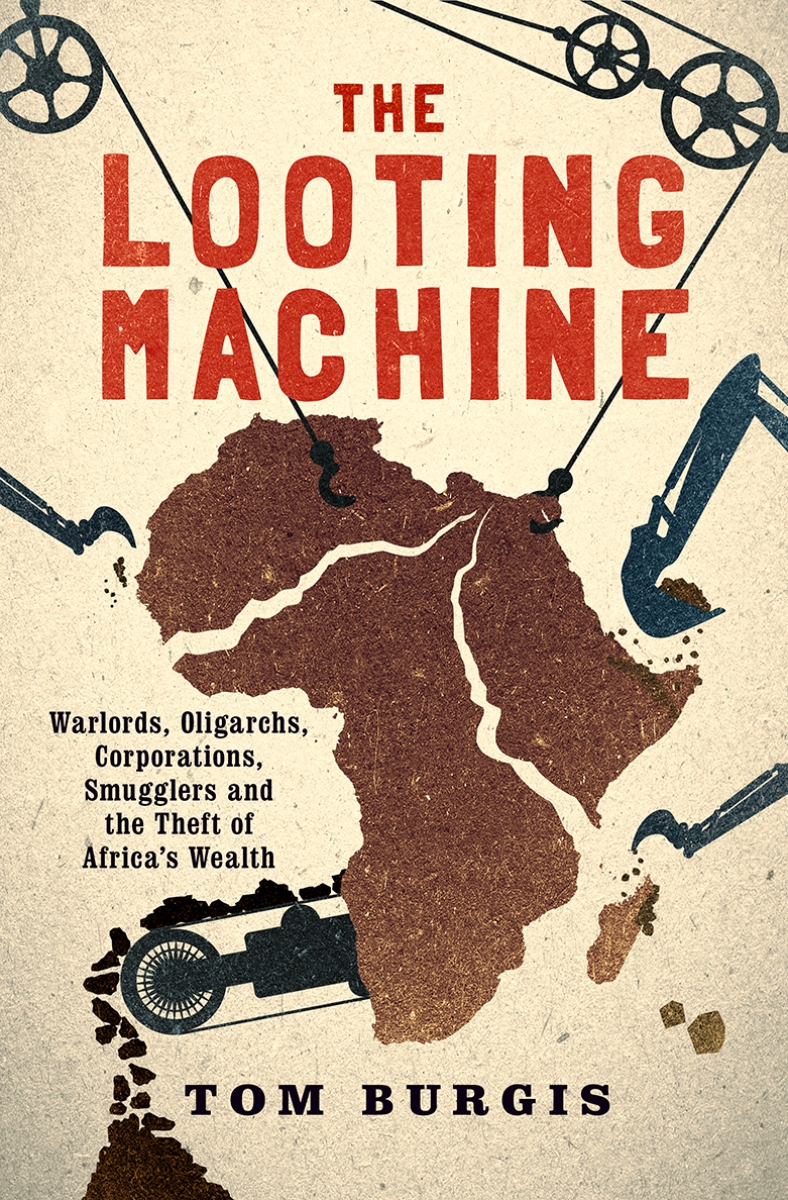
The Looting Machine: Warlords, Smugglers and the Systematic Theft of Africa’s Wealth
Tom Burgis
Harper Collins (2017)
Book Review
This book centers around something global economists refer to as the “Dutch curse.” In 1959, the discovery of oil in the Netherlands led to massive unemployment outside the oil industry. A big increase in dollars generated by oil exports caused major inflation in the local currency. This made imports cheaper than locally produced goods, shutting down hundreds of Dutch businesses and putting thousands out of work.
It’s typical of mineral and oil/gas mining everywhere (including here in New Plymouth) that these industries require vast capital investment but employ only small numbers of workers. According to Burgis, it was the “Dutch curse” that resulted in Russian’s oil-fueled criminal oligarchy prior to the rise of Putin. As the continent richest in natural resources, Africa, which has been ruthlessly exploited by multinational corporations, has a severe case of the “Dutch curse.”
Although multinationals pay far less than market value for oil, gas and precious minerals, they pay corrupt puppet dictators enough that they don’t need to tax their citizens. Burgis maintains this absence of taxation results in a lack of accountability to their citizenry. Instead of holding leaders to account for their failure to provide basic infrastructure, citizens of “resource states” are far more likely to angle for their share of the loot. Retaining power becomes a simple matter of maintain elaborate patronage (payoff) systems and harsh military/security networks.
Burgis also refutes the myth that Africa’s multiple civil wars stem from tribal and religious conflict. Most African wars are pure resource wars (often triggered by CIA and French and British intelligence), with the conflict used as a cover for resource smuggling and even lower net cost to multinationals.
The US government has attempted to crack down on its own corporations via stricter enforcement (since 2000) of the 1977 Foreign Corrupt Practices Act and a section of the 2010 Dodd Frank Act that prohibits the the purchase of Coltan* from armed rebel groups. The new law, which has done little to reduce Coltan smuggling, has opened the door to a Chinese monopoly on the Coltan market.
The Looting Machine presents a detailed country by country analysis, as well as an examination of the Chinese company responsible for most private investment in Africa (there’s less publicly available information about investment by state-owned Chinese companies). Both engage in far more infrastructure development than Western agents do.
Angola – principle export oil, with 70% of oil ventures owned by Hong Kong billionaire Sam Pa, operating as Queensway Group or Chinese International Fund. Half of Angolan residents get by on less than $1.25/day.
Congo – second most important produce of Coltan outside of Australia, also gold, tin, tungsten and diamonds. Residents live on less than $1.00/day.
Nigeria – oil and gas. Cotton/textile industry that flourished in 1980s shut down (causing mass unemployment) by continuous flood of smuggled Chinese counterfeit textiles. Sam Pa and the French oil company Total have teamed up to challenge Shell’s longstanding monopoly on Nigerian oil.
South Africa – rich gold, diamond and platinum exports financed the creation of the apartheid state, in which a tiny white minority controlled the entire economy. Since the fall of apartheid in 1994, this minority has been joined by a handful of Black entrepreneurs.
Botswana – diamonds. Somewhat protected from “Dutch curse” by the creation of value added industries that cut and polish their diamonds prior to export.
Guinea – among world’s richest reserves of iron and aluminum. Bought out by Sam Pa as a result of Western sanctions.
Niger – rich in uranium and the world’s poorest country. France previously held monopoly on Niger’s uranium industry, being replaced by Queensway group based on agreement to invest in infrastructure development and employ local labor. (In most countries, Chinese investors import Chinese labor.)
Ghana – gold. Financed by Chinese Investment Fund after IMF tried to impose structural adjustment conditions** to refinance a World Bank Loan.
Zimbabwe – diamonds, platinum, nickel, gold. Mugabe used revenues from export industries to finance particularly brutal security force. Diamond industry bought out by Queensway as direct result of Western sanctions.
*Coltan is a rare precious metal in high demand for cellphones and laptops.
**IMF structural adjustment conditions typically require debtor companies to privatize state owned industries, legislate deep cuts in social services and accept extensive foreign investment as a condition of receiving World Bank loans.
At present, New Zealand has the second highest rate of mass incarceration in the world (after the US) – with the majority of inmates identifying as Maori. In the following presentation, Maori constitutional lawyer Moana Jackson makes the case for abolishing prisons. He cites the example of Norway, Finland and other Scandinavian countries, which decided decades ago that prisons were unsustainable and ineffective in reducing crime. In Norway, prisons are being replaced by open “habilitation” centers. In Finland, the number of prisons has been reduced from 100 to 20. The latter have mainly been replaced by mental health treatment centers.
Jackson’s main argument is that prisons are a direct result of colonization – that Maori had no prisons before European settlers arrived.* Prior to colonization, the primary Maori concern when people infringed on each other was the disruption in the net of social relationships. Different tribes set aside special facilities where victims and offenders could stay with their families to repair fractured relationships. In modern terminology, the process is referred to as “restorative justice.”** In New Zealand, we have no juvenile lock-up facilities. Instead offenders and their families meet with victims to make reparations.
Jackson also challenges the racist depiction of Maori as violent, naturally aggressive warriors. This stems from a European need to depict indigenous peoples as racially inferior to justify dispossessing. Stripping Maori of their true identity has traumatized generations of young Maori men by providing them with a distorted image of who they really are. Peeling away this lie will be essential to abolishing prisons in New Zealand.
I was intrigued to learned that both Norway and Finland consulted with indigenous Sami (who also had no prisons prior to colonization) in devising alternatives to prison.
*Europeans also had no need for prisons prior to the Enclosure Acts that drove our ancestors off the commons. Deprived of access to land, they had no means of supporting themselves and the majority ended up in prisons and workhouses or “transported” by the courts to the US or Australia. See https://stuartjeannebramhall.com/2015/08/04/forgotten-history-the-theft-of-the-commons/
**South Africa’s Truth and Reconciliation Commission is another famous example of restorative justice.
In 1956 Britain, France and Israel launched an illegal war of aggression against Egypt after President Gamal Nasser nationalized the Suez Canal. As in the more recent US invasions of Iraq, Afghanistan, Libya and Syria, UK Prime Minister Anthony Eden’s real goal was regime change – the removal of Nasser as president. Eden, like Bush and Obama believed the local population would welcome the foreign invasion – that they would use it to rise up and topple their leader.
The humiliation Britain faced over the Suez Crisis would spell the end of their role as the world’s foremost super power.
Part 1 covers Egypt’s war of independence, which began as a mass popular uprising against British military occupation. In 1952, a secret group of Egyptian military officers, led by Nasser, took advantage of the civil unrest to topple King Farouk, establish a revolutionary council and demand the withdrawal of British troops. When Britain and the US tried to isolate Nassar by blocking a World Bank loan for Egypt’s Aswan Dam, Nasser responded by nationalizing the Suez Canal Company (jointly owned by Britain and France). His intention was to use canal profits to pay for the dam.
Part 2 concerns the secret conspiracy hatched by Britain, France and and Israel to invade Egypt, reclaim the Suez Canal and remove Nasser from power.
Part 3 covers the brutal invasion and the armed civilian resistance that fought back against the invaders. It also reveals the humiliating circumstances that forced Britain to withdraw their troops before they ever reached the canal. Because both France and Britain hold vetoes on the UN Security Council, Eisenhower used economic warfare to force Britain to agree to a ceasefire. A coordinated attack on the British pound by Wall Street banks* forced Eden to request Eisenhower’s support for an IMF loan. The latter demanded an immediate ceasefire as a condition of the loan.
*The filmmakers are a bit fuzzy about the coordinated sell-off of the British pound that caused its value to plummet. Based on what Willim Engdahl has written about US economic warfare (see How the US Uses War to Protect the Dollar), I suspect it was instigated by the Economy Warfare division of US Treasury.
Crude Harvest is about a controversial law Mexico has enacted that puts its publicly owned oil industry up for sale to foreign corporations. The law also grants foreign oil companies the right to override the wishes of Mexican farmers if oil is discovered on their land.
Following a massive popular uprising, Mexico nationalized their oil industry in 1938. It’s the last nationally owned oil company to be opened to foreign investment. US oil economies are extremely excited as Mexico is an extremely corrupt country that makes no effort to regulate oil production. They will be allowed to pollute Mexican water and air as much as they like without consequences.
The documentary goes on to reveal how NAFTA has systemically “raped” the Mexican economy and forced the government to sell their oil industry to pay off Wall Street debt. By flooding the Mexican market with cheap (subsidized) American food, the US has wiped out most small Mexican farmers and ranchers and turned many small indigenous villages into ghost towns. Left with no way to support themselves, these former farmers can only survive by turning to organized crime or illegally entering the US.
Once that their lands are to be turned over to foreign oil companies, yet more farmers will lose their livelihood. Meanwhile Mexican debt will only increase as the government loses oil profits that currently comprise 40% of government revenue.
In this presentation, environmentalist and anti-globalization activist Vendana Shiva challenges the Wall Street mythology that economic growth reduces poverty. Using her own country India as an example, she demonstrates how poverty (and inequality) increase in direct correlation to GDP increases.
The examples she offers clearly apply to the US, UK and New Zealand. All three countries are experiencing alarming increases in poverty and inequality as GDP increases. As in India, the quality and availability of health, education and other public services have declined steeply as “growth” has increased.
She goes on to demonstrate what GDP growth really represents: the privatization (ie theft) of natural and public resources by a small number of elites.
In India at present, 1/4 of the population lives in abject poverty and 1/2 of children are malnourished. Vendana blames the increase in hunger on the forced adoption of industrial agriculture and GMO crops. Monsanto and GMO advocates like Bill gates argue that GMOs will decrease world hunger. In India, where Monsanto has successfully lobbied to make it illegal for farmers to save seed, just the opposite has happened.
This due partly to Monsanto’s seed monopoly, which has caused an 8,000% increase in the cost of seed; partly to the high cost of fertilizers, herbicides and pesticides GMO crops require; and partly to the destruction of soil, bees and biodiversity caused by industrial agriculture and GMO crops.
This talk, one of my favorites, is 1999 talk about about US empire. It offers quite a stark depiction of a US foreign policy consisting primarily of continual wars of aggression against democratic governments that thwart Wall Street Interests in exploiting their natural resources and labor force.
Parenti begins with a brief overview of colonization, starting with Western Europe’s colonization of the Slavic peoples and England’s colonization of Ireland. He goes on to to describe how India and Africa both enjoyed advanced and wealthy (far more wealthy than Europe) civilizations until they were invaded by European armies and their economies destroyed.
He proceeds with a detailed inventory of America’s continual invasions, bombing campaigns and covert wars around the world. The last half of the presentation focuses on the deliberate break-up of Yugoslavia by the US security state, demolishing the myth perpetuated by the Clinton administration and the US media that ethnic conflict was the cause of the Balkan wars.
Prior to the collapse of the Soviet Union, Wall Street elites tolerated a socialist state in Yugoslavia (with free health care, education and public transport and housing) because they viewed Yugoslavian president Josip Tito’s independent socialism as a buffer against the Soviet Union.
The initial US attack against Yugoslavia was economic, when Bush senior, in 1990, persuaded Congress to end lending credits to the Yugoslav government. The legislation they passed stipulated that US banks could only loan money to autonomous Yugoslav regions (Serbia, Croatia, Macedonia, Bosnia, etc) provided they declared independence and formed autonomous republics.
Parenti notes the new law was implemented somewhat unevenly, so that only right wing fascist governments qualified for loans. By 1992, internal sanctions against Serbia had resulted in 70% unemployment, widespread malnutrition and collapse of the health care system.
He goes on to provide fresh insight into the background of Slobodan Milosovic – who Clinton described as the “new Hitler” – an anti-communist banker who was the CIA’s first choice to run Serbia. When Milosovic refused to fully embrace US colonization, he was systematically demonized by the Clinton administration and corporate media. In 2006, he would die in prison in the Hague.* The war crimes he was accused of were never substantiated.
Parenti also details the NATO carpet bombing of Serbia (designed to maximize civilian casualty by targeting life support infrastructure, such as power and water filtration plants), the CIA penetration of the Kosova Liberation Army (enabling them to corner the European heroin market), Noam Chomsky’s support for Clinton’s war against Serbia, and the notorious Sarajevo false flag operation (actually carried out by Muslim extremists) used to justify the NATO war against Serbia.
Locked Up Warriors is an Al Jazeera documentary about New Zealand’s mass incarceration of its indigenous people.
New Zealand is second only to the US in its rate of mass incarceration. Although New Zealand’s indigenous Māori make up only 15% of New Zealand, they represent half its prison population. This relates largely to political pressure for longer sentences – despite a host of studies showing long sentences significantly increase re-offending.
For me the most interesting section of the film concerns New Zealand’s gang culture and the longstanding rivalry between our two largest gangs – the Mongrel Mob and Black Power. It’s not uncommon for Māori offenders to be third generation gang members.
Chevron vs the Amazon is an Abbey Martin documentary about Texaco-Chevron’s deliberate dumping of oil and toxic waste in Ecuador’s Amazon rain forest and the vicious dirty tricks they have engaged in to avoid responsibility for cleaning it up.
Texas began drilling for oil in Ecuador in 1964, under a US-installed dictatorship that agreed not to regulate their activities. The amount of oil they spilled into the Amazon was 1700 times the size of the 1989 Exxon Valdez oil spill and 140 times that of BP’s 2010 Deepwater Horizon spill. Indigenous groups filed suit for the extensive damage to their water, health and livelihoods in 1993, a year after Texaco abandoned their Ecuadoran well sites. Texaco settled this first suit by agreeing to a phony remediation scheme that never happened.
Part 1 consists of great footage of the vast amount of oil remaining in Ecuador’s Amazon rain forest and interviews with indigenous Ecuadorans whose entire families have been devastated by the health effects (cancer, leukemia, rashes, miscarriages, birth defects) of the contaminated water they are forced to drink.
Part 2 provides background to the second class action lawsuit brought against Texaco by 30,000 indigenous residents – the largest environmental lawsuit in history. Texaco has a really ugly human rights history, beginning with the bankrolling of Spain’s fascist dictator Francisco Franco and illegal provision of oil, financial support and secret intelligence to Hitler and Mussolini. After losing a series of punitive lawsuits over its environmental crimes, they were forced to merge with Chevron in 2000.
The latter has its own history of human rights and environmental crimes in Nigeria, Kazakhstan, Chad, Cameroons, Equatorial Guinea and Richmond California.
After fighting the suit for eight years in US courts, Chevron eventually won a court ruling that that the suit had to be tried in Ecuador instead. When it was re-filed in Ecuador, Chevron engaged in blackmail, extortion, bribery, illegal surveillance, “judicial terrorism” (bringing 30 lawsuits against oil spill victims for “racketeering”), and “financial terrorism” (suing all the non-profit groups supporting the indigenous plaintiffs).
In 2011 the Ecuadoran plaintiffs ultimately won their suit for $9.6 billion – a ruling confirmed by Ecuador’s supreme court. Instead of paying up, Chevron forced them to file suit in various countries where Chevron has financial assents (including Canada, Brazil and Argentina). A 2016 ruling in US court makes it illegal for Ecuador to file a claim against Chevron’s US holdings.
Part 3 explores the long history of US economic colonization in Latin America (on behalf of Wall Street corporations) via direct military intervention, the installation of puppet dictators and the paramilitary death squad terrorism carried out through Henry Kissinger’s notorious Operation Condor. All this has changed with the 2007 election of Rafael Correa (who granted Julian Assange asylum in London’s Ecuadoran embassy).
At present Chevron seek to perpetuate their economic imperialism via a secret World Bank tribunal in the Hague. There 20 hand picked corporate “judges” have found that the successful lawsuit against Chevron retroactively violates of the 1997 US-Ecuador Bilateral Investment Treaty (Texaco-Chevron left Ecuador in 1992) and ordered Ecuador to pay Chevron $112 million in damages.
2017 update: In March 2017 lawyers representing the Ecuadoran plaintiffs have petitioned the US Supreme Court to overturn the flawed (by bribery and corruption) racketeering conviction against the Ecuadoran plaintiffs and their lawyers. (See Chevron in Ecuador )

 The Most Revolutionary Act