The Disposable People Who Process Our Toxic E-Waste

ToxiCity: A Graveyard for Electronics and People

RT (2017)

Film Review

Toxic e-waste is equally poisonous to the planet and the third world poor who are forced to process it for a living. The only truly humane and sustainable solution to toxic e-waste is to force big tech giants like Apple, Google and Dell (and the billionaires who run them) to assume responsibility for end-of-life disposal, instead of externalizing this cost to the rest of us.

This documentary is about Agbogbloshie in Acra Ghana, the largest toxic waste dump in the world, and the men, women and children who pick through electronic waste from Asia, the US, Australia and western Europe. Although it’s illegal to employ child labor or import e-waste in Ghana, these laws are never enforced.

The filmmakers interview various “waste managers” who run the site, as well as a 10 year old boy, a fifteen year old girl and the “waste site coordinator.”  The latter  adjudicates disputes and deals with the police when fights break out. The 10 year old (an orphan) earns about $8-10 a days from the scrap metal he collects. This is enough to buy two meals. The 15-year-old was forced to leave school because her parents had no money to pay for her school fees, uniform or textbooks. She prepares food to sell to other scavengers and hopes to return to school and become a nurse.

Scavenging e-waste among the burning rubber and plastics at Agbogbloshie is a highly dangerous occupation due to the high risk of cadmium and lead toxicity. Doctors at a nearly clinic also report an increased incidence of respiratory infection among children who live and work there.
 

Why Nearly 1% of New Zealanders Are Homeless

Who Owns New Zealand Now?

Bryan Bruce (2017)

Film Review

At present, New Zealand has the worst rate of homelessness in the OECD. In 2016, 41,000 Kiwis (nearly 1%) were homeless. Half of this number were families with children. This documentary examines the forces behind New Zealand’s homeless epidemic and potential solutions.

The film is highly critical of the neoliberal reforms in the 1980s that transformed New Zealand from a regulated economy to a so-called “market” economy, leading to low wages and soaring inequality. However it focuses mainly on the role of foreign investors, who have driven up housing costs by speculating in New Zealand real estate. Because the government no longer keeps data on the New Zealand property sold to overseas buyers, filmmakers had to go to researchers at the University of British Columbia to get a rough idea about the extent of foreign investment in New Zealand real estate.

As for potential solutions, Who Owns New Zealand Now suggests bringing back the State Advances loan program, (operating in New Zealand from the the early 1930s to the late 1960s), in which the government issued money directly (rather than borrowing it from banks) that Kiwis could borrow to purchase homes. It also examines measures other countries have adopted to discourage foreign speculators from driving up housing costs.

First and foremost the government needs to keep good data on New Zealand real estate being sold offshore. Secondly they need to discourage foreign real estate sales either by implementing a foreign buyers surtax, as Hong Kong and British Columbia do, or charging all buyers a stamp duty tax, as Australia, Canada and the UK do, and/or a capital gains tax when real estate is sold.

Among other reforms advocated in the documentary are a greater restriction in immigration levels, a return to state-funded mortgages and increased government support for cooperative housing, long term lease rentals, construction of smaller, more affordable, family friendly homes and most importantly a living wage for all Kiwis.

Owing to the failure of “the market” to accommodate their housing needs, at present approximately 1/3 of the New Zealand population requires state supported housing.

How Elites Use Mass Immigration to Suppress Wages and Destroy Unions

The Making and Breaking of Europe

Al Jazeera

Film Review

The Role of the CIA in the Formation of the EU

This is a fascinating documentary tracing the political forces leading to the formation of the EU and the rise of right wing nationalist movements that threaten to break it up. I wasn’t a bit surprised to learn of the role the CIA played in the formation of the EU, via the millions they spent on the Action Committee for the United States of Europe (1955-1975). The CIA’s main goal was to create the false impression that European unification enjoyed wide popular support. There’s never been any doubt in my mind that the EU and the state-like bureaucracy it has created in Brussels mainly serves the interests of banks and corporations seeking to undermine and/or control the democratic process.

Working Class Communities Bear the Brunt of Mass Immigration

This film also takes a refreshingly honest look at mass immigration, a policy European elites championed to support the post-World War II economic boom – it was far cheaper than investing in technological innovation or retraining domestic workers. In fact, this is the first acknowledgement I have seen in mainstream media acknowledging that 1) working class communities have always born the brunt of mass immigration policies and 2) the massive influx of people from other cultures creates immense tensions in any community.

The Use of Immigrants to Crush Unions

In the late 1970s, Thatcher and other neoliberal leaders deliberately used mass immigration in strike breaking and other strategies aimed at crushing unions. The de-industrialization of northern Europe and the loss of good paying jobs would only amplify the tensions this created. As would the 2001 war on terror, the targeted Islamophobia propagated by US and British intelligence and ultimately the painful austerity cuts resulting from 2008 global economic collapse.

There seems to be strong agreement among the four “expert” panelists* that the anti-immigrant backlash should have been predictable – there is no possible way for the EU to accommodate the millions of refugees resulting from the US proxy war in Syria.

Since 2015 the strength of this backlash has fueled electoral victories for right wing nationalist groups in nearly all EU countries. All have campaigned on a dual anti-immigrant and anti-EU platform. In Britain, the rise of the United Kingdom (UKIP) party would lead to Brexit (and a 52% vote to leave the EU) in 2016.


*The panelists include a former Greek prime minster, a member of Hungary’s ruling party and Dr Alina Polykova, research director at the Atlantic Council and co-author of the 2015 The Dark Side of European Integration.


25 Years Among the Poorest Children in America

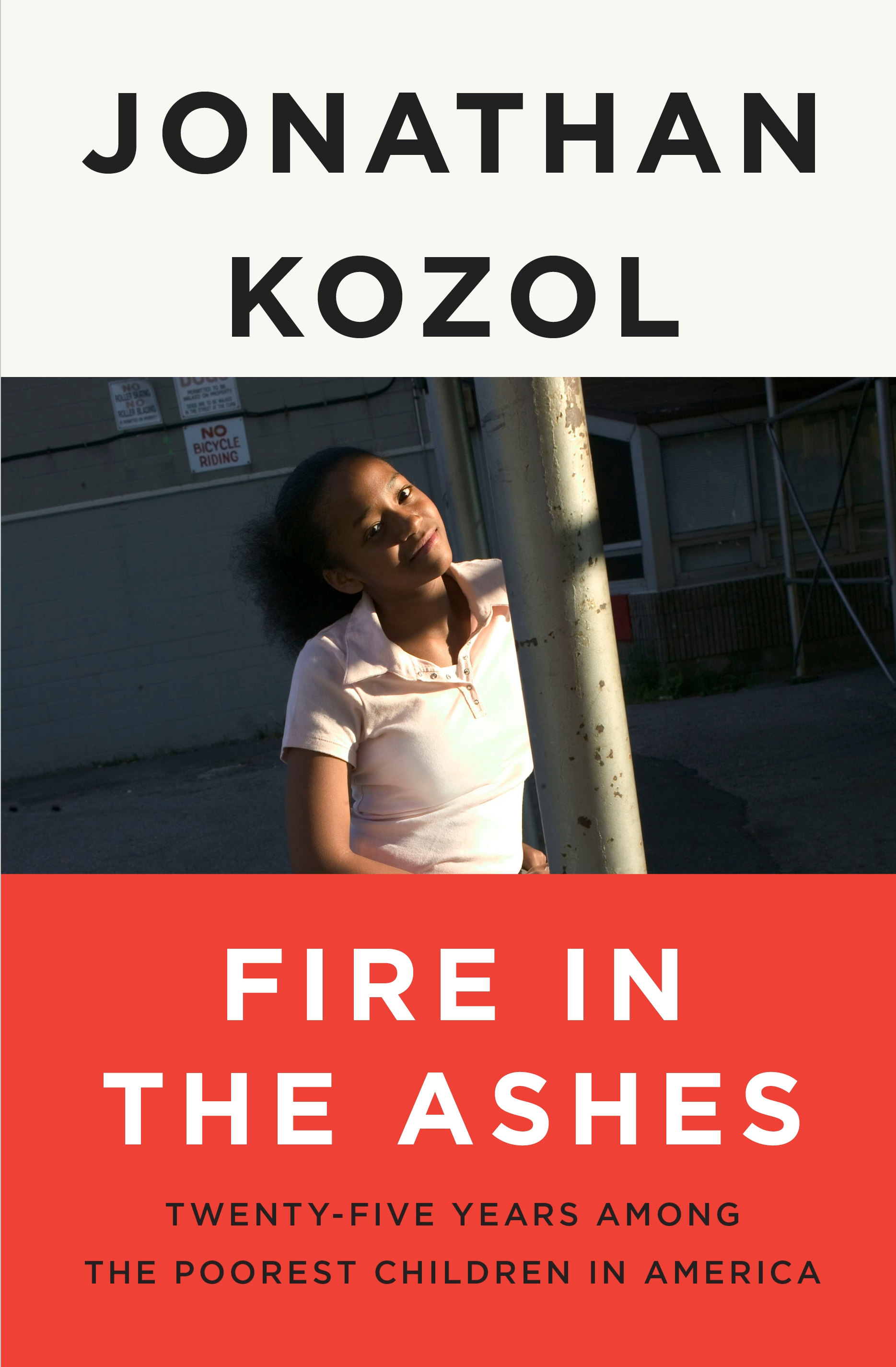
Fire in the Ashes: Twenty-five Years Among the Poorest Children in America

by Jonathan Kozol

Crown Publishers (2012)

Book Review

Unlike Kozol’s prior books, which focus on the abysmal condition of inner city schools, Fire in the Ashes follows the families of specific children Kozol has befriended and their disastrous living conditions. The families he describes are either those he encountered at the Martinique Hotel homeless shelter in midtown Manhattan or those he met through an after school program at St Ann’s Episcopal Church in Mott Haven.

With a media annual income of $17,000 for a family of five, Mott Haven is the poorest neighborhood in the South Bronx and the poorest congressional district in the US. Official unemployment (which doesn’t count those who have given up and quit looking) is 14%.

The book poignantly describes the brutal living conditions the children and their families confront, including chronic malnutrition, chronic asthma (from asbestos and incinerators), sexual exploitation of mothers by shelter guards, grooming by gangs and drug dealers, untreated parental mental illness, repeated episodes of homelessness and overcrowded classrooms and schools (many of which have lost funding to private charter schools).

Kozol follows the children of eight African American and Hispanic families from primary school through adulthood, as they struggle with social service and educational systems that have virtually abandoned them.

Some of the children he befriends graduate from high school (and even college) and end up in long term employment. Others drop out and are swallowed up by the criminal justice system. In each case, the children who succeed do so because someone (a teacher, social worker, pastor or Kozol himself) offers financial assistance to ensure they received the educational support they needed.

Although Kozol (with the help of readers and supporters) has set up an Education Action Fund to assist students from desperately poor racially segregated neighborhoods like Mott Haven, he argues against this type of individual intervention as a long term solution.

The real answer, he maintains, is to provide public schools in neighborhoods like Mott Haven, with the best educational funding (instead of the worst), the smallest classes (at present most classes have over 30 pupils), and the best prepared and best paid teachers (instead of the least experienced, most poorly paid).

The Obscenity of Child Homelessness

Eviction: the Hidden Homeless

The Vision (2010)

Film Review

This documentary studies the devastating effect of homelessness on children. It profiles two British working class families caught between the high cost of housing and hopelessly bureaucratic social services. In both families the father is the bread winner – in one case a bus driver and the other a landscaper.

When the families suddenly become homeless, they are placed in a bed and breakfast, at enormous cost to the local authorities responsible for housing them. This approach – placing families in hotels and bed and breakfast accommodation – is obviously very costly and significantly reduces the number of families local authorities can help. One of the families profiled must compete with hundreds of other homeless families in an on-line lottery for public housing units.

The film emphasizes the horrendous stress homelessness places on children. Besides missing out on regular nutritious meals (due to lack of cooking facilities), frequent placement changes causes them to miss a lot of school. Those who manage to attend face stigma, bullying and deteriorating achievement. Homeless children, on average, miss eleven weeks of school. A single episode of homelessness doubles the odds that a student won’t complete secondary school.

Above all, homeless kids face the continual threat they will be referred to child protective services and be removed from their parents’ care.

The documentary also poignantly depicts the cruelty of one housing bureaucracy when it rules ones of the families as “intentionally homeless,” after the department responsible for their housing subsidy misses the payment deadline to the department that collects their council house rent. This label –  “intentionally homeless” – automatically disqualifies the family for government subsidized housing.

Why Growth is the Main Cause of Poverty

Growth Equals Poverty

Vendana Shiva (2013)

In this presentation, environmentalist and anti-globalization activist Vendana Shiva challenges the Wall Street mythology that economic growth reduces poverty. Using her own country India as an example, she demonstrates how poverty (and inequality) increase in direct correlation to GDP increases.

The examples she offers clearly apply to the US, UK and New Zealand. All three countries are experiencing alarming increases in poverty and inequality as GDP increases. As in India, the quality and availability of health, education and other public services have declined steeply as “growth” has increased.

She goes on to demonstrate what GDP growth really represents: the privatization (ie theft) of natural and public resources by a small number of elites.

In India at present, 1/4 of the population lives in abject poverty and 1/2 of children are malnourished. Vendana blames the increase in hunger on the forced adoption of industrial agriculture and GMO crops. Monsanto and GMO advocates like Bill gates argue that GMOs will decrease world hunger. In India, where Monsanto has successfully lobbied to make it illegal for farmers to save seed, just the opposite has happened.

This due partly to Monsanto’s seed monopoly, which has caused an 8,000% increase in the cost of seed; partly to the high cost of fertilizers, herbicides and pesticides GMO crops require; and partly to the destruction of soil, bees and biodiversity caused by industrial agriculture and GMO crops.

Spyware: the Latest Growth Industry

The Spy Merchants

Al Jazeera (2017)

Film Review

The Spy Merchants is about the spyware private contractors develop for the US and other western governments and the devious tactics they use to illegally sell various surveillance systems to professional hackers, repressive dictators, corporate spies and terrorist groups.

In this investigation, an undercover Al Jazeera reporters approaches various surveillance manufacturers seeking to buy and IMSI catcher and an IT intercept system on behalf of Iran and the repressive government of South Sudan. An IMSI catcher is a software program that can intercept and control (ie send fake messages on their behalf) all the electronic communications of an individual. An IT intercept system is designed to monitor a nation’s entire Internet traffic. Both technologies can sell for as much as 20 million Euros.*

Surveillance exports are supposedly tightly controlled by US and EU regulations. However, as shown in this film, manufacturers of surveillance software routinely circumvent these regulations by falsifying documents or by shipping their products via a third country or a shell company.


* Except in China – Chinese vendors will sell you an IMSI catcher for $300,000

Greek Austerity and the Rise of Fascism

Golden Dawn

Konstantinos Georgousis (2013)

Review

Golden Dawn is a remarkable documentary tracing the rise of the neo-Nazi Golden Dawn party in Greece. Despite their role in several high profile murders, Golden Dawn has held 18 seats in the Greek parliament since 2012.

Their rapid rise to power relates in large part to dire austerity measures the European Union has imposed on Greece. With 28% unemployment (55% youth unemployment) and drastic pension cuts, many starving Greek citizens join Golden Dawn because of their free food distribution programs.

However as Georgousis makes clear, the strong support Golden Dawn enjoys from police (who openly admit to being members), the media, the Greek Orthodox Church and Greek security services is even more instrumental. In all respects the parallels with Nazi Germany are chilling.

Golden Dawn is notorious for openly beating up and murdering both illegal and legal immigrants – with the police looking on and, in many cases arresting legal immigrants instead of perpetrators.

Only anarchist groups have tried to protect immigrants from these attacks. When they do so, the police step in and arrest, beat and torture them.

In 2012, following the murder of a high profile Greek national, the Greek government finally arrested four Golden Dawn leaders on a charge of criminal gang activity. However instead of stripping them of their parliamentary seats, they then directed Greek jail staff to transport them between jail and Parliament.

What I found most remarkable about the documentary is its excellent footage of actual Golden Dawn meetings and its in-depth interviews with some of its members.

More Babies Die in Cleveland than in North Korea, Sri Lanka, Albania and Guatemala

Behind America’s Infant Mortality Crisis

Al Jazeera (2013)

Film Review

Since the mid-1990s, when Bill Clinton eliminated Aid For Dependent Children (AFDC), the US has enjoyed infant mortality rates among the highest in the world. Rust belt Midwestern cities lead the US in infant mortality. The loss of steel, auto and other manufacturing to third world sweatshops has virtually crushed many of these cities, leaving massive unemployment – particularly among African Americans.

Cleveland is the US city with the highest percentage of babies dying during the first year of life – with an infant mortality greater than third world countries like North Korea, Albania, Sri Lanka and Guatemala.

Trying to identify the cause of Cleveland’s skyrocketing infant mortality, filmmakers interview African American mothers and expectant mothers and neonatal specialists. The neonatologists identify prematurity as the number one cause of infant deaths. Factors that contribute to mothers delivering prematurely include homelessness and lack of access to healthy food (or money to pay for it) and prenatal care. Ohio is one of the states where Republican legislators declined federal funds to expand Medicaid (which pays for prenatal care) to the working poor.

The neonatologists also point out the false economy of this ideological stinginess. Ohio’s Medicaid program spends hundreds of millions of dollars trying to keep premature babies alive in state-of-the-art neonatal ICUs – it would cost taxpayers far less to prevent prematurity by ensuring expectant mothers have warm housing, healthy food and prenatal care.

The Professional Criminals Who Control Our Lives

Panama Papers – Shady World of Offshore Companies

Das Erste/NDR (2016)

Film Review

The Panama Papers is a German documentary about the infamous Panamanian law firm Mosack Fonseca, exposed by the Panama Papers leak* in 2015. The law firm, which has offices in 48 countries, assists banks, corporations, heads of state, drug lords and Mafia dons in creating offshore corporations to escape taxes, pension obligations and criminal prosecution in their own countries. In all, Mossack Fonseca has created over 214,000 offshore companies.

The film makers have a particular interest in the German partner, Jurgen Mossack, who immigrated to Panama as a child.

Among the Mossack Fonseca clients highlighted are an Israeli diamond merchant who used his offshore company to bribe a Guinean dictator for free iron mining rights. He later sold them to Brazil for $500 million dollars. Also featured is former Icelandic prime minister Sigmundur Gunnlaugsson, who was forced to step down and he and his wife were discovered to have offshore companies created by Mossack Fonseca.

My favorite segment is the one where the filmmaker goes online to set up his own offshore company for 3,000 euros. Within a week, he receives an official Panamanian address for his company and the minutes of an extraordinary meeting called by the company’s board of trustees. He then flies to Panama to visit his company office – which turns out to be an unoccupied floor in a Panama City office building.


*In 2015 a Mosack Fonseca whistleblower leaked 11 million documents (mainly emails) to a small German newspaper – which immediately shared them with the International Consortium of Investigative Journalists.