Nobel Prize for Walmart

The Battle for Public Control of Money

(This is the second of a series of posts about ending the right of private banks to issue money.)

The Secret of Oz (William Still 2009) primarily addresses the long battle to strip banks of their power to issue money. In the US, this struggle dates back to the Revolutionary War.

The title refers to socialist writer L. Frank Baum’s 1900 The Wonderful Wizard of Oz. According to numerous scholars, the book is loaded with symbols related to monetary reform, the core demand of the Populist movement and the 1896 and 1900 presidential bids of Populist Democrat William Jennings Bryan.

The yellow brick road represented the gold standard, the Scarecrow represented farmers and the Tin Man represented industrial workers. The Wicked Witch of the West was Cleveland banker J.D. Rockefeller and the Wicked Witch of the East New York banker J.P. Morgan. The Cowardly Lion depicted William Jennings Bryan, who abandoned the call for monetary reform. The Emerald City represented (government issued) greenback money and Dorothy’s silver slippers (changed to ruby slippers in the movie) represented Bryan’s call to introduce silver coins to ease the money shortage during the 1890s depression.

Still traces the politics of monetary reform back to 30 AD, when a Nazarene carpenter engaged in violent direct action in a Jerusalem synagogue to evict the private bankers who sold silver coins which were used to pay a compulsory temple tax.

He also explores the use of state-controlled money in the American colonies and the early United States. He focuses particular attention on periods in which private banks deliberately shrank the money supply to trigger depressions (to increase profits or achieve specific political objectives), as well as efforts by Presidents Thomas Jefferson and Andrew Jackson to end private corporate control of money.

Both Jackson and Lincoln oversaw periods in which federal and/or state government issued debt-free money.

The Mayor Who Said No to the Feds

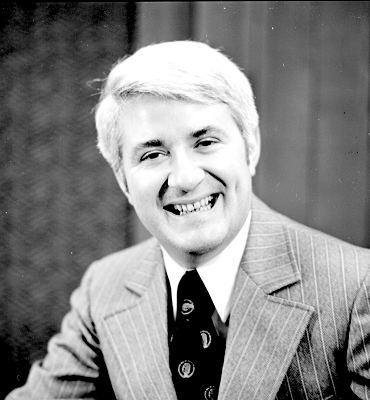
Uhlman

from Seattle City Archives

The Armed ATF Raid That Didn’t Happen

Few Americans have heard of Wes Uhlman, Seattle’s mayor between 1969 and 1977. According to his official biography, his main claim to fame was being the youngest Washington State legislator (at 23) and youngest Seattle major (at 34) ever elected.

Ward Churchill mentions Uhlman in his 1990 Cointelpro Papers. At the time, Uhlman declined to identify the federal agency he crossed swords with. Churchill misidentifies it as the FBI. In 2005 Uhlman disclosed, in an interview with the Seattle Civil Rights and Labor History Project, that the federal agency he confronted to was the Agency for Tobacco and Firearms. The ATF was the main agency responsible for the 1993 Waco massacre. In February 1970, they tried to strong arm Uhlman to agree to an armed raid on the headquarters of the Seattle Black Panther Party.

This was approximately three months after the December 1969 FBI/police raids on the apartments of Chicago Black Panther leader Fred Hampton and Los Angeles Black Panther leader Geronimo Pratt. In Chicago a fourteen man team armed with submachine guns raided Hampton’s apartment at four a.m. on December 3rd. They murdered Hampton and Peoria Black Panther leader Mark Clark in their sleep.

Three days later a forty member Los Angeles SWAT team with 100 back-up officers staged a similar five a.m. raid on Pratt’s apartment. Pratt, who by chance was sleeping on the floor, miraculously survived. None of the LA Panthers, who defended themselves for four hours until the press and public arrived, were killed. Six were injured. All the surviving Panthers, in both Chicago and Los Angeles, were arrested for “attacking the police.”

Two weeks later Pratt was framed for a December 1968 murder he didn’t commit. The FBI knew he was innocent from wiretapping logs (which they concealed from the defense) placing him 350 miles from the murder scene. Pratt’s conviction was overturned in 1997. Following his release, he emigrated to Tanzania, where he died on June 3, 2011.

Uhlman Threatens to Arrest the ATF

In his interview with the Civil Rights and Labor History Project, Uhlman reveals that an ATF agent contacted him in late 1969, only months after he took office. The supposed justification for raiding Seattle’s Black Panther headquarters was that they were stockpiling illegal weapons. Uhlman opposed the ATF plan. As he states in the interview, he feared for the safety of a police undercover agent who had infiltrated the Seattle Panthers. The informant had assured him the Panther’s weapons were legal.

The ATF agent, infuriated when Uhlman refused to go along with the raid, threatened to carry it out without the city’s consent. In response, Uhlman threatened to encircle the Panther headquarters with cops and arrest any ATF agents who broke through police lines.

No Gestapo-type Raids in Seattle

The ATF leaked the outcome of their meeting outcome to the press, hoping to embarrass Uhlman as a “sympathizer of militants.” In a Seattle Post Intelligencer interview, Uhlman made reference to the FBI raid on Fred Hampton’s apartment. He stated he wanted no part of the “trend of attacks” on the Black Panthers.

“We are not going to have any 1932 Gestapo-type raids against anyone.” Adding that the Seattle Black Panthers only had a handful of members, he pointed out that numerous young blacks were “enthralled” by the group’s message. “If you give them a cause, they can make political hay out of it, and the kids will look on them like Robin Hoods.  Then you wind up with 900 Panthers.”

In the aftermath of Uhlman’s controversial stand, he received letters from all over the US. Many attacked the mayor for his decision. Bloggers who are visited by intelligence trolls will recognize the distinctive turn of phrase, especially in the third:

  • “When idiot public officials cast their lot with proven communist agitators and anti-american (sic) bastards as the BLACK PANTHERS then it is time to IMPEACH such public sons of bitches.”
  • “I don’t see why the federal agency had to ask a jerk like you whether they could stage a raid on the black panthers. (sic). This organization is downright rotten, but it takes a rotten jerk to know a rotten organization.  I hope one nite (sic) one of your soul brothers slits your throat.”
  • “Uhlman, you stupid ass, you are just as bad as the people, who are making such an issue of the two panthers who were killed in Chicago.”

An equal number of letters applauded Uhlman’s decision for upholding the Bill of Rights protections against warrantless search and seizure:

  • “You have GUTS—and even more…it would appear you do support the TRUE American spirit and the Constitution of this country.  Let’s keep the principle…MEN ARE CREATED EQUAL!”
  • “As a fifty year old veteran of WWII [with] twenty-one years active military service allow me to extend heartfelt gratitude and congratulations in your brave decision to put the Bill of Rights, for which I have served so long, into effect.”
  • “We need more like you.  I don’t necessarily agree with the Panthers, but the tactics of the Police, et al, frightens me more.”

Despite the controversy, Uhlman won his campaign for re-election in 1973. He retired from politics in 1978 to focus on his legal practice.

A great pity, as Seattle and Washington State lost a true statesman. No current mayors have the testicularity to protect their constituents against flagrant Bill of Rights violations by the Obama administration and US intelligence. At least they didn’t in November 2011, when they colluded with the FBI and Office of Homeland Security in orchestrating a brutal crackdown on Occupy protests.

Let Them Eat Crickets

cricket

(With apologies to Marie Antoinette. This post is dedicated to readers who have lost their pensions or unemployment benefits or who are looking at having their hours, wages or Social Security benefits reduced. Some simple cricket recipes below. Please note in preparing cricket flour, you must first remove the legs and antennae. Next week: garden snails recipe from Gordon Ramsay.)

Excerpts from the UN’s Edible Insects: Future Prospects for Food and Feed

By 2050 the population of the Earth will be 9 billion, and food production will have to double to feed them all. This will be a major challenge, given that oceans are already overfished and a growing shortage of fresh water, which will drastically worsen as the planet warms. The Food and Agriculture Organization of the United Nations believe that edible insects, both as food and animal feed, may be the answer to growing food shortages.

They point out that over 1900 insect species of insects edible and two billion people around the world already consume them as a regular part of their diet. Insects are a highly nutritious and healthy food source with high fat, protein, vitamin, fiber, omega-3 fatty acids and essential minerals. The most common insect species used food are bees, wasps, ants, grasshoppers, locusts, crickets, cicadas, leaf and planthoppers, scale insects and true bugs, termites, dragonflies and flies.

Farming insects for food or animal feed is relatively new but has enormous potential, especially in third world countries. Insect rearing is not necessarily a land-based activity and does not require land clearing to expand production. Moreover because they are cold-blooded, insects are very efficient at converting feed into protein (crickets, for example, need 12 times less feed than cattle, four times less feed than sheep, and half as much feed as pigs and broiler chickens to produce the same amount of protein). Like pigs, they can be fed on organic waste streams.

As a business, insect harvesting and rearing is a low-tech, low-capital investment option that offers entry to the very poorest sections of society, including the landless. Protein and other nutritional deficiencies are typically more widespread in disadvantaged segments of society and during times of social conflict and natural disaster. Because of their nutritional composition, accessibility, simple rearing techniques and quick growth rates, insects can offer a cheap and efficient opportunity to counter nutritional insecurity by providing emergency food and by improving livelihoods and the quality of traditional diets among vulnerable people.

Simple Cricket recipes (from http://www.insectsarefood.com/recipes.html)

It is important to note that crickets should only be purchased from reliable sources. Crickets should be treated much in the same manner as any other raw food, in particular seafood. In other words it is best to keep crickets fresh as possible. Prior to preparing your crickets for a meal place them inside a plastic container or storage bag and keep them in the refrigerator at least for an hour or until you are ready to use them. This will not kill the crickets, but rather slow down their metabolism, inducing a state of hypothermia, in other words, prohibiting their movement when removed from container. If you prefer however, as many people do, feel free to place them inside the freezer for an hour or two as this will definitely kill them, guaranteeing their immobility.

After removing from refrigerator or freezer, place them in a pot of boiling water sized to hold the specific amount of crickets you’re using. Add a few pinches of salt. Boil for about two minutes. This ensures cleanliness. Once boiled, remove from water and let cool. Crickets at this time can be placed in storage bags and kept in the freezer or used right away for any number of recipes. All crickets should be prepared in this manner prior to eating.

Dry Roasted Crickets

Served as a snack for any number of persons

Ingredients:

25 – 50 live crickets – or however many you wish to cook/serve

Directions:

Salt, or any preferred seasoning that can be shaken or sprinkled onto crickets after roasting.

Next, preheat oven to 200 degrees. Arrange the crickets on a cookie sheet, making sure none of them overlap. Proceed to bake at low temperature for about 60 minutes or until the crickets are completely dry or dry enough for personal taste.

Open up oven at the 45-minute mark and test a cricket to see if it’s dry enough by crushing with a spoon against a hard surface or if you prefer, between your fingers. The crickets should crush somewhat easily. If not place them back inside oven until crisp.

Once roasted and cooled down, place a few crickets between your palms and carefully roll them breaking off legs and antennae in the process. This ensures clean and crisp crickets without legs or antennae getting in the way of.

Season them with salt, Kosher salt, sea salt, smoked salt or whatever sort of seasoning you wish. They are very good and healthy to eat as a roasted snack. Eat them on the spot or place them back into the freezer for future use.

Cricket Flour

Ingredients:

4 cups of flour
1 cup of roasted crickets (¼ – ½ cup of crickets to every cup of flour works well.)

Directions:

Break off the antennae and legs by gently rolling the cricket between your hands.
Once you collect enough crickets in a bowl proceed to crush either using a mortar and pestle or rolling pin on a hard surface.

Gather the crushed crickets – they should look like small specks (usually of dark brown color) and blend them well into the flour of your choosing.

Once you’ve blended the crickets with the flour you’re set to use it in any way you wish.

Hoppin’ Good™ Cricket Fried Rice

Serves 4 – 6

Ingredients:

4 cups cold cooked brown rice
1 ½ cups of roasted crickets (about 3 – 4 dozen)
1 cup chopped scallions
½ cup cooked corn kernels
2 large eggs
1 teaspoon Kosher salt
Powdered ginger to taste
Powdered coriander to taste
Garlic powder to taste
1 teaspoon fresh ground black pepper, or to taste
4 tablespoons oil for stir-frying, or as needed
1 ½ tablespoons light soy sauce or oyster sauce, as desired

Directions:

Wash and finely chop scallions. Lightly beat the eggs with salt, ginger, garlic powder, coriander and pepper.

Heat a wok or frying pan and add 2 tablespoons oil. When the oil is hot, add the eggs. Cook, stirring, until they are lightly scrambled but not too dry. Remove the eggs and wipe clean the wok or frying pan.

Add 2 tablespoons of oil. Add rice. Stir-fry for a few minutes, using wooden spoon to break it apart. Add crickets. Add scallions. Stir in soy sauce or oyster sauce as desired. Continue stirring for a few more minutes.

When the rice is heated through, add the scrambled egg back into the pan. Mix thoroughly. Stir in corn kernels. Serve hot.

This dish goes great with any other dish or appetizer, i.e., cooked greens, egg rolls, dumplings, etc.

Where Have All the Unions Gone?

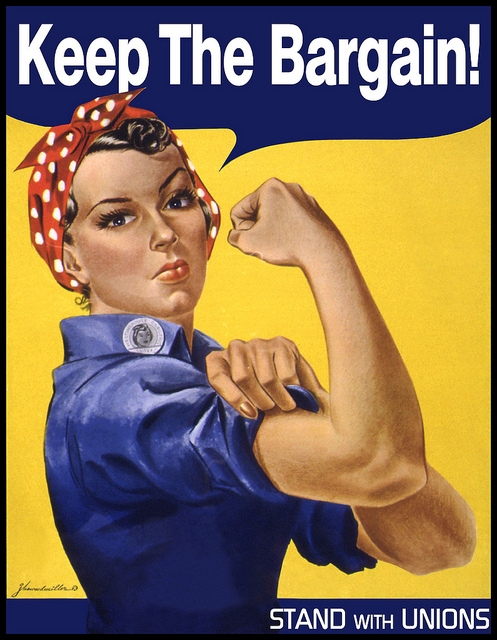
union

Loss of union protection is catastrophic for millions of American workers with no way to protect themselves against layoffs and wage, benefit and pension cuts. In 2013, only 11.3% of US workers belonged to unions. Many Americans are unaware of the deliberate 95-year campaign by Wall Street to destroy the trade union movement. It all started in 1919 when the National Association of Manufacturers engaged Edward Bernays, the father of public relations, to destroy public support for a steel workers strike. Following a brief rise in union activism during the Great Depression, it continued with the punitive 1948 Taft Hartley Act, the expulsion of militant unionists during the McCarthy Era, and the cozy cold war collaboration between the CIA and AFL-CIO bureaucrats. The most decisive blow would be the trade liberalization of the 80s and 90s and the wholesale export of skilled union jobs to third world sweatshops.

Edward Bernays’ Campaign to Demonize Unions

In his 1995 Taking the Risk Out of Democracy, the late Australian psychologist Alex Carey describes how the National Association of Manufacturers engaged Edward Bernays to launch a massive media campaign to reverse public support for steel workers striking for the right to bargain collectively. Bernays first got his start helping President Woodrow Wilson sell World War I to a strongly isolationist and antiwar American public. Following the war, Bernays was immediately engaged by major corporate clients that included Proctor & Gamble, CBS, the American Tobacco Company, Standard Oil, General Electric and the United Fruit Company.

Bernays is also regarded as the father of “consumerism,” the transformation of Americans from engaged citizens into passive consumers by bombarding them with thousands of pro-consumption messages. He was also instrumental  in convincing doctors and dentists (without a shred of scientific evidence) that disposing the industrial toxin fluoride in municipal water supplies would be good for peoples’ teeth.

His media campaign to convince the American public that striking workers were dangerous radicals, Bolsheviks and anarchists was an instant success. The anti-Red hysteria it created ushered in a decade of severe repression, enabling Bureau of Investigation J Edgar Hoover to launch a Red Scare and illegally arrest, detail and deport several hundred suspected radicals.

The 1948 Taft Harley Act

During the Great Depression of the 1930s, unions became popular again. Then, as now, corporations took advantage of high unemployment rates to cut wages, increase hours and force employees to work under unsafe sweatshop conditions. Led largely by the CIO (Congress of Industrial Organizations), organized labor fought back with scores of sit down and wildcat strikes.

Immediately following World War II, the National Association of Manufacturers sought to reverse union gains by ramming the Taft Hartley Act through a Congress dominated by Republicans and conservative southern Democrats. Among other provisions restricting worksite unionization drives, Taft Hartley prohibits mass picketing, as well as wildcat and sit down strikes.

The McCarthy Era

The effect of the 1947 Taft Hartley Act on union membership was almost immediate. In 1946 the Congress of Industrial Organizations (CIO) had 6.3 million members. By 1954, when it merged with the AFL, this number was down to 4.6 million or 34.7% of the American workforce. This percentage steadily declined as union officials used the anticommunist hysteria of the McCarthy Era (1950-56) to expel militant trade unionists from their ranks. The original Taft Hartley Act included a provision preventing members or former Communist Party members from holding office in a labor union – which the Supreme Court struck down in 1965 as unconstitutional. .

Thanks to the Taft Hartley Act and the purging of militant grassroots unionists, a trade union bureaucracy arose that felt closer to management than the workers they supposedly represented. This stemmed, in part, from perks they received for delivering “labor discipline” (i.e. preventing disruptive industrial action). Thus instead of lobbying to repeal Taft Hartley and relying on well-organized rank and file and industrial action, union officials became more focused on “sweetheart deals” they made with managers.

Enter the CIA

According to former CIA officer Tom Braden, many AFL-CIO officers were also on the CIA payroll for their work with USAID in suppressing foreign unions with anti-US leanings. In 1967 Braden bragged about this in the Saturday Evening Post. Founded by prominent Wall Street lawyer Allen Dulles, the CIA has always played a major role in protecting Wall Street interests. They have a long history of overthrowing democratically elected governments that threaten US corporations with overseas investments (e.g. major oil companies and United Fruit Company and Coca Cola in Latin America).

Killing Off American Manufacturing

With Reagan’s election in 1980, numerous trade laws protecting US industries and workers were repealed through the Caribbean Basin Initiative and the General Agreement on Tariffs and Trades. Clinton continued this process by fast tracking both NAFTA and the World Trade Organization treaty through Congress. Once protective quotas and tariffs were repealed, there was nothing to stop Wall Street corporations from shutting down thousands of US factories and reopening them as sweatshops in the third world. In the process millions of US workers lost union manufacturing jobs to take minimum wage jobs at MacDonald’s and Wal-Mart.

The loss of the US manufacturing sector has clearly played a major role in the failed recovery and declining US global influence. This seems an enormous price to pay for the sake of destroying trade unions. Our children and grandchildren, who will reap the consequences, will not look kindly on the neoliberal presidents (Reagan, Clinton, both Bushes, and Obama) who enacted these disastrous policies.

photo credit: DonkeyHotey via photopin cc

In New Zealand We Call It Rogernomics

roger douglasRoger Douglas, from Wikimedia

(The 7th of 8 posts about my new life in New Zealand)

In brief, the policies introduced by Minister of Finance Sir Roger Douglas in the 1980s included the rapid elimination of import tariffs that protected New Zealand farmers and manufacturers; rapid privatization of state owned industries (most ended up under foreign ownership);  stringent anti-union legislation; and substantial cuts in social welfare benefits. With the abolition of import controls, New Zealand companies struggled to compete against cheap imported goods from Asia. This resulted in multiple plant closures, massive layoffs and more than a decade of unrelenting hardship for communities that relied on these industries.

The 1984 reforms also resulted in seven years of continuous economic stagnation, during which the New Zealand economy shrank by 1% in contrast with an average 20% growth in other OECD countries.

The Mass Exodus of Generations X and Y

The most enduring harm stemming from the 1984 reforms is the staggering loss of human capital that continues to this day. At present approximately one million Kiwis – representing one quarter New Zealand’s current population of four million – live overseas.

As I wrote previously, the massive sell-off of both state-owned and private companies to foreign owners has translated into a chronic accounts deficit (negative balance of trade), as profits and dividends disappear overseas. To compensate for this steady loss of wealth, New Zealand, under pressure to increase exports, entered into “free trade” treaties that forced them to reduce tariffs and quotas even more. This led to the shut down of even more factories, which had no hope of competing with overseas companies that paid sweat shop wages to third world workers.

The Student Loan Debacle

In my view, the most damaging neoliberal reform of the 1980s was the decision to replace government subsidized tertiary education (which until recently was standard in most European countries) with a student loan scheme. While lumbering young people with student loan debt can prove problematic for large, broad-based economies like US and Britain, the policy has proved absolutely disastrous for New Zealand. Repaying a student loan is extremely difficult on the low salaries Kiwi professionals earn. Thus a third or more of new college graduates to emigrate. In my view, this continual hemorrhage of human capital is a major reason New Zealand remains near the bottom of OECD countries for economic growth, productivity and salaries.

At present approximately one-third of medical students leave New Zealand following graduation. Many really have no choice, strapped with giant student loan repayments while simultaneously looking to buy a home and start a family. Their only hope of managing this massive financial stress is to seek work in Australia or the UK, where they can command a 20-30% higher salary than here in New Zealand. And once they buy a home and their kids start school, they very rarely return.

A recent study estimated 37% of new NZ teachers leave New Zealand schools within the first three years. In addition to doctors and teachers, New Zealand also loses a large proportion of the nurses, physiotherapists, social workers, audiologists and other health professionals they train – as well as engineers, urban planners and veterinarians, who are also on New Zealand Immigration’s critical skills shortage list.

New Zealand’s Neoliberal Transportation Policy

Other really destructive neoliberal policies New Zealand enacted in the eighties and nineties relate to public transportation: 1) the privatization of New Zealand railways (leading to the immediate shutdown of all but four routes) and 2) the dismantling of local public transportation systems. Both have resulted in extreme reliance on private automobiles and foreign oil, the second biggest culprit in our accounts deficit.

New Zealand, which still has a predominantly rural population (only 1/3 of Kiwis live in major cities), has also been extremely slow in implementing rational growth management strategies. For all these reasons, it holds the embarrassing honor of the highest rate of car ownership in the world.


The Chile of the Pacific

Milton FriedmanMilton Friedman from Wikimedia Commons

(The 6th of 8 posts about my new life in New Zealand.)

An Early Laboratory for Neoliberal Reforms

Overall I have enjoyed numerous lifestyle advantages living in New Zealand. There are a few notable exceptions, of course, beyond the emotional isolation of being separated from my family and American friends. Most relate, either directly or indirectly, to New Zealand’s historic role as “the Chile of the South Pacific.” During the 1980s, New Zealand was used as a laboratory for the neoliberal reforms subsequently implemented by Ronald Reagan and Margaret Thatcher.

In theory, neoliberalism is a “market-driven” approach to economic and social policy that stresses the efficiency of free enterprise and opposes government regulation of corporate recklessness and any government role in public services other than law enforcement. In practice, neoliberal policies have been universally pro-corporate and anti-free market, promoting vast amounts of legislation (tax law, government contracts and direct corporate bail-outs) that favor large corporations at the expense of both small business and ordinary citizens.

The University of Chicago is usually credited as the birthplace (in the 1960s) for neoliberalism and Milton Friedman as its father. A frequently overlooked aspect of the CIA’s 1973 coup in Chile was the direct role University of Chicago economists played in assisting Chilean dictator Augusto Pinochet in setting out the neoliberal economic reforms enforced by his brutal regime. New Zealand played a similar role in the early eighties, by trying out neoliberal policies that were later adopted by Britain and the US.

New Zealand: a Second World Country

At present New Zealand is a relatively poor, second world country. It ranks 20th in GDP for OECD countries. Americans are always struck by the high cost of living here relative to wages and salaries. Although average income is much lower than in other developed countries, the cost of basic necessities is just as high. At times it’s much higher, particularly in the case of gasoline, home energy costs and fresh meat and fish.

Central heating is virtually non-existent – in part because so few people can afford it and in part because the (colder) South Island has no access to piped natural gas. Just so no one has any illusions about our climate, the New Zealand winter is relatively short. However except for the far north, it gets just as cold here as in northern California and the Pacific Northwest.

Here We Call It Rogernomics

In 1975 New Zealand was 10th in the OECD in per capita GDP. Prior to the eighties, the UK was always the primary importer of New Zealand lamb and dairy products. In the early 1980s, these policies changed, and Britain began to favor European Union trading partners over commonwealth countries.

Increasingly, however, many economists blame the draconian reforms Minister of Finance Roger Douglas enacted in 1984 for the decline in Kiwi living standards. So-called “Rogernomics” was responsible for the institutionalization of a large and steady wealth transfer (as profits and dividends) to overseas corporations. This in turn has led to a large, chronic accounts deficit (negative balance of trade), which has led to many other economic problems.

It’s only with the 2008 economic collapse and the non-existent US recovery that American analysts are starting to appreciate the devastating impact that “Reaganomics” – the main culprit in the virtual collapse of American manufacturing – had on the US economy.

In a country 1/60th the size of the US, the damage was much more immediate and obvious.


The Common Misfortunes of Capitalism

cow in streamNote cow in stream

(The 5th of 8 posts about my new life in New Zealand)

Obviously there is both an upside and a downside to living in New Zealand. All developed and developing countries are forced to operate under the same corporate-dominated capitalist system.

New Zealand is no exception and has many of the major economic and social problems other developed countries are experiencing. In a few areas, New Zealand has adopted some of the worst aspects of global capitalism, which results in uniquely negative consequences for the New Zealand public. For the most part, Kiwis retain their commitment to a “democratic socialism” as practiced in most of Europe. The result, in my view, is a society and culture that tends to be far more humane than is found in the US.

That being said, New Zealand shares a number of pernicious social problems found in all modern capitalist countries:

  • Worsening income inequality – only 10% of Kiwis have incomes above $72,000 ($58,216) in US dollars), whereas half the population earns less than $24,000 ($US 19,405).
  • Irrational and blind adherence to a continuous economic growth paradigm. In a small country like New Zealand, this has a devastating impact, in terms of water contamination, habitat destruction and environmental toxins in the food chain. Over the past two decades, dairy intensification has made the most of New Zealand’s picturesque waterways unsuitable for swimming (due to cow shit and fertilizer run-off.
  • Slow uptake of renewable energy production (owing nonexistent finance capital or government subsidies)
  • Slow uptake of sprawl prevention strategies essential to the development of cost-effective public transportation.
  • Heavy corporate media emphasis on stereotypical female roles, resulting in massive pressure on New Zealand women to look young, thin and sexually attractive. Fortunately cosmetic surgery is much less common here than in the US – there aren’t enough Kiwis who can afford it.
  • Factory shut-downs and movement of well-paid union and manufacturing jobs to overseas sweat shops.
  • Massive household debt (146% of disposable income largely owing to chronic low wages).
  • Diets which are excessively dependent on foreign food imports, as opposed to more sustainable reliance on locally and regionally produced food.
  • Factory farming of pigs and chickens. Thanks to the high prevalence of battery hen operations (and constant exposure of chickens to feces), New Zealand enjoys the highest per capita incidence of campylobacter infection in the world.


photo credit: Mollivan Jon via photopin cc

The Sacrifices of Empire

(The 4th of 8 posts regarding my 2002 decision to emigrate from the US to New Zealand)

It only became clear once I left the US the immense sacrifices Americans make for their cheap gasoline and consumer goods (see previous post). The most obvious is a range of domestic programs that other developed countries take for granted. These include publicly financed universal health care (in all industrialized countries except the US) and a range of education, jobs and social programs enacted under Roosevelt, Kennedy, Johnson and Nixon, which Reagan, Bush and Clinton repealed.

With a so-called war on terror on multiple fronts (I can count at least ten countries the US is at war with), federal block grants to states and cities have all been diverted to Pentagon spending. In city after city, there is no money to repair badly decrepit roads and bridges or provide adequate street lighting and policing. While dozens of clinics, libraries and homeless shelters shut their doors and teachers, cops and other state and local employees get laid off.

Sacrificing Democratic Rights and Civil Liberties

As citizens of the world’s greatest military power, Americans also make major sacrifices in terms of democratic governance and civil liberties. This, too, only became clear once I became an expatriate.

Genuine democracy is totally incompatible with military empire. If allowed some say whether to spend most of their tax dollars on weapons and war, the vast majority of Americans would respond with a resounding “no.” Civilian populations are universally repelled by the carnage of war. Women, who comprise more than fifty percent of the population, consistently oppose any military tactics that kill large numbers of civilians. Likewise taxpayers of both sexes expect to see their hard earned tax dollars spent on public programs that benefit them. Not to enrich Wall Street banksters and corporate war profiteers.

Ordinary Romans felt the same way. Which was the main reason their leaders abandoned democracy when they undertook to expand the Roman republic into an empire.

Creating a Constitution Conducive to Empire

There’s also a clear link between the growing wealth an power of banks and multinational corporations and the recent attack on democratic rights and civil liberties (the repeal of habeas corpus and legalized government spying authorized under the Patriot Act and NDAA).

This relates, in my view, to structural flaws in the US system of government that make it less democratic than other industrialized countries. These mostly relate to what the Constitutional framers referred to as “separation of powers.”

In social studies we were taught these “checks and balances” were intended to make the US government more democratic. However it’s clear from the writings of Hamilton, Madison and other constitutional framers that their real intent was to minimize the risk of a direct popular vote harming the interests of wealthy landowners and merchants.

In their writings, the founding fathers make no secret of their imperialistic ambitions (their plans to declare war on the Native Americans and Mexicans who possessed the lands west of the 13 original colonies). This military expansionsim was extremely unpopular with a mainly rural, farming population that experienced immense personal and economic hardship during the Revolutionary War.

And military expansion didn’t end when the US seized the Southwest and California from Mexico. In 1895, the US declared war on Spain to expand the empire to include Cuba, Puerto Rico, Hawaii, the Philippines and other Pacific islands.

Parliamentary Democracy=One Man One Vote

Unlike the majority of industrialized countries, the US doesn’t employ a “one-man-one-vote” system of representational democracy. The only hope our Constitutional framers had of enacting their pro-business, pro-military agenda was to establish two branches of government (the Senate and Presidency) that wouldn’t be determined by direct popular vote. The idea was to block populist legislation enacted by the democratically elected House of Representatives

After 11 1/2 years experience with New Zealand’s, parliamentary democracy, I have absolutely no doubt that it’s more democratic than the US system. Under a parliamentary system, the head of the party controlling the majority of legislative seats automatically becomes chief of state. The moment the prime minister loses the majority he/she needs to pass legislation, the government collapses and a new election is called. This is in marked contrast to the US Congress. The latter has been virtually paralyzed for 30 years – while American schools and the US health care system continue to disintegrate in front of our eyes.

Another important advantage of a parliamentary democracy is the establishment of an official opposition party, which is expected to attack and embarrass the party in power. The result is vigorous and often raucous parliamentary debate, characterized by booing, cheering and outright heckling by members of the opposition parties.

Open “bipartisan consensus,” which is so heavily promoted by the US mainstream media, would be extremely unpopular in New Zealand. The majority of Kiwi voters retain a strong working class consciousness and are extremely dismissive of politicians with open ties to the corporate and business lobby.

Video of Question Time in NZ Parliament:

Progressives Who Oppose Gun Control

2nd amendment

I’ve always been curious how American progressives got on the anti-civil liberties side of gun control. It strikes me as a grave strategic error. I have written elsewhere about the extreme difficulty liberals and progressives face in engaging the working class. I have also been highly critical of their tendency to get sucked into “lifestyle” campaigns (anti-smoking, anti-obesity, vegeterianism, etc.), owing to the strong class antagonism this engenders in blue collar voters.

Contrary to the stereotypes portrayed in the corporate media, class differences – and class hatred – are alive and well in the US. From the perspective of a blue collar worker, the progressive movement is the middle class. They’re the teachers, social workers, psychologists, doctors, lawyers and religious leaders who make the rules for the rest of this. Thus when they tell us not to smoke, eat big Macs, or buy guns, we don’t see this as political reform. We see it as an extension of their (privileged) class role.

Here in New Zealand, young upwardly mobile professionals manifest the same zeal as their American counterparts for anti-smoking and healthy eating campaigns. However there’s no gun control lobby here. It would be unthinkable in a country where one third of the population lives in cities. Gun ownership and proficiency are fundamental to the Kiwi way of life, especially in rural provincial areas.

The History of Progressive Opposition to Gun Control

For a progressive to take a stand against gun control is a pretty lonely place. However I’m not utterly alone. There’s a 1979 book edited by Don Kates entitled Restricting Handguns: The Liberal Skeptics Speak Out. There’s also an organization called the Liberal Gun Club, whose mission is to “provide a voice for gun-owing liberals and moderates in the national conversation on gun rights, gun legalization, firearms safety, and shooting sports.”

Then there’s Sam Smith’s excellent article in the Preogressive Review: “Why Progressives Should Stop Pushing for More Gun Control Laws.” Among Smith’s numerous arguments, three leap out at me: the exacerbation of “cultural conflict” between rural and urban and wealthy and not so well off, the tendency for gun restrictions and prohibition to be intersect with a drive to restrict other civil liberties, and the need for progressives to stop treating average Americans as though they were “alien creatures.” He seems to share my view that progressives lose elections as much because of their condescending attitudes as their issues.

In January  2011 (following Representative Gifford’s shooting and renewed calls for gun control), Dan Baum wrote in the Huffington Post that progressives have wasted a generation of progress on health care, women’s rights, immigration reform, income fairness and climate change because “we keep messing with people’s guns.” He likens gun control as to marijuana prohibition – all it does is turn otherwise law-abiding people into criminals and create divisiveness and resentment.

How Progressives Came to Oppose the 2nd Amendment

None of this explains how progressives got on the wrong side of this issue. US gun manufacturers wrote the first gun control legislation in 1958, in an effort to restrict Americans’ access to cheap imports. However, owing to civil liberties implications, the bill encountered stiff Congressional opposition. Finally in 1968 President Lyndon Johnson played the race card and used the inner city riots to pass a watered down version of the industry’s original gun control bill. It required gun dealers to register guns and ammunition, banned the mail order and interstate sale of guns, and instituted a lifelong ban on felons (even on non-violent convictions) owning guns.

Progressive research into gun control generally makes two equally salient points: 1) the aim of gun control legislation is to control people (mainly disenfranchised minorities and the poor), not guns and 2) in countries with strict gun control laws, the use of deadly force is restricted to the police and army, as ordinary citizens aren’t trusted to play any role (including self-defense) in maintaining law and order.

Using Gun Control to Control African Americans

America’s extreme preoccupation with gun control appears directly related to their 200 year history of slavery and oppressive Jim Crow laws that followed emancipation. As Steve Ekwall writes in the Racist Origins of US Gun Control,and Clayton Cramer in Racist Roots of Gun Control, the targeting of blacks with early gun control laws is extremely blatant.

In the south, pre-civil war “Slave Codes” prohibited slaves from owing guns. Following emancipation, many southern states still prohibited blacks from owning guns under “Black Codes.” This was on the basis that they weren’t citizens and not entitled to Second Amendment rights. After the 1878 adoption of the Fourteenth Amendment, which formally acknowledged blacks as citizens, southern states imposed high taxes or banned inexpensive guns, so as to price blacks and poor whites out of the market.

Ekwall also quotes gun control advocate Robert Sherrill, author of The Saturday Night Special and Other Guns (1972). Sherill states unequivocally that “The Gun Control Act of 1968 was passed, not to control guns, but to control blacks.”

Ekwall goes on to describe the unprecedented 1965-68 race riots in 125 American cities, in which the violence was graphically magnified by extensive TV coverage. The paranoia this engendered in the corporate and political elite was greatly heightened by Stokely Carmichael and other Black Panthers openly advocating violent revolution and the well-publicized protests (and police riot) at the 1968 Democratic Convention in Chicago.

The Last Pro-Gun Democrat

As Joe Bageant writes in Deer Hunting with Jesus, the 1968 pro-war Democratic presidential candidate Hubert Humphrey uttered the last breath of Democratic sanity over the gun control issue. It’s really sad how radical he sounds in 2014:

“The right of citizens to bear arms is just one more guarantee against arbitrary government, one more safeguard against the tyranny which now appears remote in America, but which historically has proved to be always possible.”

photo credit: Whiskeygonebad via photopin cc