The War Against Children

My next two posts relate to the unspeakable trauma Americans experience as children. The first film concerns the transformation of American schools into virtual prisons. The second discusses the deliberate targeting of children by corporate advertising. In both cases, parents are largely helpless to protect their kids. The scars created carry into adulthood.

The War On Kids

Cevin Soling 2009

Film Review

The main focus of The War on Kids is the Zero Tolerance approach to school discipline. The goal of Zero Tolerance is to keep guns, drugs and so-called “super-predators” out of public schools by treating all students like criminals.

The film is full of examples of high performing students receiving lengthy suspensions (as long as six months) for bringing so-called “contraband” to school. This includes nail clippers, nail files  (“weapons”) and Scope mouthwash, Alka Seltzer, Midol and ibuprofen (“drugs”). The documentary describes one girl being suspended for drawing a soldier with a machine gun. A boy who threatened to throw a spitball at another student was referred to police and charged with felony assault.

The increasing presence of armed police in public schools is especially chilling. Instead of allowing school principals to deal with minor behavior problems, police are called and alleged perpetrators (as young as six) are handcuffed and taken to jail.

Often these arrests violate children’s Fifth Amendment rights, especially when the principal asks the alleged perpetrator to write out a statement and hand it over to the police. This typically happens in the absence of legal representation, parental notification or a Miranda warning that students may be incriminating themselves.

Teaching Learned Helplessness

As part of Zero Tolerance, schools demand absolute conformity in dress, appearance, attitude and behavior. Teachers enforce conformity by constantly bullying and yelling at kids. Curiosity and creativity are systematically discouraged by an educational approach that force feeds kids with information.

Near daily exposure to this brutally oppressive environment is inducing a state of learned helplessness and apathy that persists into adulthood. Students are leaving high school with absolutely no idea how a democratic society functions. In a recent survey, 36% of high school students indicated that all newspapers should seek government approval for the news stories they publish.

Erroneous Information about ADHD

The two parts of the film I have a problem with are one that blames declining achievement on teachers’ unions (an urban myth promoted by neoliberal champions of the charter schools movement) and one in which psychiatrist Peter Breggin and two psychologists assert that ADHD is a fictitious disorder promoted by lazy teachers and drug companies.

Breggin, who is an adult psychiatrist without specialized child psychiatry training, makes a number of assertions that are factually inaccurate. The first relates to the diagnosis of Attention Deficit Disorder (ADHD). Here Breggin quotes out of context from the American Psychiatric Association’s to make it appear that schools and teachers are deliberately trying to drug bright and energetic children to shut them up. He also makes claims that Ritalin and similar stimulants cause permanent brain damage and lead to drug addiction. These are also urban myths which are totally unsubstantiated by peer reviewed research evidence.

The assertion by one of the psychologists that Britain has banned the use of Ritalin in children is a blatant fabrication. In 2010, UK doctors dispensed Ritalin prescriptions for 661,413 British children.

Although ADHD is a genuine disorder documented by decades of careful peer reviewed research, the real issue is that 1) it’s being over diagnosed in the US compared to other countries and 2) American kids who take Ritalin and similar stimulants aren’t receiving adequate medical monitoring. There’s also an alarming increase in children’s prescriptions for antidepressants and antipsychotics – despite the lack of efficacy or safety research in patients under eighteen.

It would have been far more helpful if the filmmakers had stuck to established facts, rather than focusing on urban myths and half truths.

The Myth of Homework

The documentary features excellent segments at the end on cliques, bullying and the failure of homework to enhance learning.

Link to film: http://www.filmsforaction.org/watch/the_war_on_kids_2009/

The Tyranny of Opinion Polls

cellphones

In many western democracies, the corporate media has become extremely sophisticated at using opinion polls to manipulate both public sentiment and election results. These polls are made out as a scientifically valid representation of voter sentiment. Pollsters choose a small sample (between 500 and 10,000) of phone numbers at random, ring them and question the people who answer about their political views and/or candidates they support. The results are tabulated and paraded by the media as representing the population at large.

Unbeknownst to the public, these voter surveys are neither scientific nor representative of the public at large. Even more sinister is the secondary purpose they serve in discrediting anti-corporate, so-called “extremist” candidates and parties. Because all opinion polls exclude young, low income and minority voters, conservative candidates and parties always achieve more favorable poll results than they actually enjoy.

The Prevalence of Cellphone-only Homes

Opinion polls become less and less reliable as more and more young and low income people opt for cellphone- only households. The Center for Disease Control estimate that landline-free homes are increasing between 3-5% a year.

The most recent CDC study (2013) shows that 39.4% of all US households have no land line. Young people and low income and minority families the most likely to live in cellphone only homes:

  • 65.6% of adults aged 25-29 live in homes with no land line.
  • 59.9% of adults aged 30-34 live in homes with no landline
  • Hispanic adults (50.5%) are more likely than non-Hispanic adults (32.9%) to live in cellphone only homes.
  • 59.7% of adults renting their home have no land line, more than twice the rate (25.4%) for home owners.
  • 54.7% of adults living below the poverty line have no line line.

Excluded from Opinion Polls

A four-year-old Pew Research Center study found that Democrats ranked 7% lower in public opinion polls that excluded cellphones. With the estimated 20% increase in cellphone-only households in the last four years, that percentage will have grown proportionately.

Gallup, to their credit, now includes some cellphones in their political polling. Even so, cellphone polling introduces a variety of logistical problems affecting its validity. There are no standard directories of cellphone numbers, and many states ban randomized computer generation off cellphone numbers. Cellphone users (especially those whose plans bill them for receiving cellphone calls) are also far more likely to reject a call from an unknown phone number.

Opinion Polls in New Zealand

The percentage of cellphone-only households (estimated at 12-14%) is still quite a bit lower in New Zealand than the US. Even so, Kiwi pundits are beginning to question the validity of voter surveys that exclude specific demographic groups by refusing to ring cellphones.

Why, I wonder, is it still a total non-issue in the US, where an estimated 40% of households are routinely excluded from opinion polls?

photo credit: JR_Paris via photopin cc

How to Stop a Foreclosure

foreclosure

Or Get a Cash Settlement Following Foreclosure

In 2014 most home foreclosures can be stopped, through a myriad of federal and state programs that have sprung up. Given that hundreds of thousands of families continue to lose their homes every month, it’s really sad how few Americans are aware of these programs. Clearly Wall Street banks and the corporate media don’t want struggling families to know about them.

Fix My Payment (www.fixmypayment.com) is a free website and advisory service for homeowners who have lost homes to foreclosure or who are currently struggling with mortgage payments.

Many of the mortgage relief programs listed on the Fix My Payment website stem from settlements the banking industry has made with the Department of Justice, the Federal Reserve, the Office of the Comptroller and various states following criminal indictment for predatory lending practices (i.e. banks sold subprime mortgages to low income borrowers they couldn’t possibly repay) and fraudulent so-called “robo-signing” foreclosures. Others are federal programs enacted in 2009 as part of the Obama administration’s recovery package.

Below are some specific programs:

1. Department of Justice Settlement with Ally/GMAC, Bank of America, Citigroup, JP Morgan Chase and Wells Fargo in predatory lending indictment

Homeowners (and foreclosed homeowners) with mortgages issued by any of the above banks are eligible for mortgage relief under the following conditions:

  • Financial hardship ($17 billion available for principal reduction)
  • Upside down mortgages in which the property is worth less than the mortgage loan ($3 billion in refinancing relief)
  • Borrowers lost property to foreclosure between January 1, 2008 and December 31, 2011

2. Federal Reserve and Office of Comptroller settlement with Bank of America, Citigroup, Wells Fargo, JP Morgan Chase, Aurora Loan Services. MetLife Bank, PNC Financial Services Group, Sovereign Bank, SunTrust Banks and US Bancorp in wrongful “robo-signing” foreclosure indictment (i.e. banks foreclosed on homes without proof of legal title).

Borrowers with mortgages with the above banks are eligible for $3.3 billion in cash settlements if they have lost their home due to foreclosure and $5.2 billion in principal and/or interest reduction to existing mortgages (in cases of financial hardship).

3. Home Affordable Modification Program (HAMP)

Federal assistance the Obama administration enacted in 2009 providing financial incentives for banks and loan servicing companies to rewrite loan terms to help troubled borrowers (excludes mortgages owned or guaranteed by the government-sponsored enterprises Fannie Mae and Freddie Mac).

4. HAMP-VA, HAMP-FHA, HAMP-USDA

The above programs provide incentives for banks and loan servicing companies to write loan terms for mortgages guaranteed by the VA, the Federal Housing Administration or the US Department of Agriculture. (excludes mortgages owned or guaranteed by the government-sponsored enterprises Fannie Mae and Freddie Mac).

5. Housing Affordable Refinance Program (HARP)

Federal assistance the Obama administration enacted in 2009 providing financial incentives for banks and loan servicing companies to rewrite loan terms to help troubled borrowers with mortgages owned or guaranteed by the government-sponsored enterprises Fannie Mae and Freddie Mac.

6. Keep Your Home California (KYHC)

California residents are also eligible for four state programs:

  • The Unemployment Mortgage Assistance Program – helps homeowners who are currently unemployed and receiving California EDD unemployment benefits.
  • The Mortgage Reinstatement Assistance Program – helps homeowners who have fallen behind on their payments and need help in reinstating their loan.
  • The Principal Reduction Program – helps homeowners who have experienced a financial hardship along with a drop in the home’s value.
  • The Transition Assistance Program – provides relocation up to $5,000 in relocation funds to help eligible homeowners transition into a new housing situation after going through a deed-in-lieu or short sale.

Free Personal Assistance

In addition to the numerous options listed on their website, people can also phone (909) 937-2400  or visit a mortgage adviser (without charge) if they live in Los Angeles. In addition to recommending specific programs homeowerns can apply for, Fix My Payment customer service representatives seem to know exactly what documents to file to halt foreclosure proceedings.

The Non-Existent Recovery

Economists predict no end in sight to the present foreclosure crisis. Despite manipulation of the “official” unemployment rate by the Obama administration and the corporate media, the percentage of employed Americans of working age has flat lined. According to the Department of Labor’s own statistics, the percentage of American families in which no one has a job stands at 20%. The percentage of unemployed working age adults stands at 41%. Prior to the 2008 economic downturn, this figure had been stable at 35-37% for nearly a decade.

With the recent news that the US economy shrank by 2.9% in first quarter 2014, the potential for new job creation looks extremely bleak. The technical term for a shrinking economy is deflation. Deflation leads to a downward spiral. A shrinking economy means less money in circulation. Low demand forces retailers to reduce their prices, while consumers postpone purchases in anticipation prices will drop further. As sales continue to decline, companies lay off more workers, which makes finding new jobs even more difficult.

photo credit: JefferyTurner via photopin cc

Is Your Boss Pocketing Your State Income Tax?

corporate flag

Corporate Welfare for Goldman Sachs, Walmart and 2,700 Other Companies

According to investigative journalist David Cay Johnston, more than 2,700 companies have secret agreements to keep the state income tax they withhold from your paycheck.

Goldman Sachs, Walmart, Chrysler, Ford, General Motors, Nissan, Mitsubishi, Motorola, Proctor and Gamble, AMC Theaters, Toyota and Electrolux are but a few of the big name companies involved.

As Johnston writes in a 2011 Reuters column:

“Instead of paying for police, teachers, roads and other state and local services that grease the wheels of commerce, Illinois workers at these companies will subsidize their employers with the state income taxes they pay. The deal to let employers keep half or all of their workers’ state income taxes represents a dramatic expansion of a little-known trend in the law: diverting taxes from public purposes to private gain.”

As of April 2012, the states which have signed these secret agreements included Colorado, Connecticut, Georgia, Illinois, Indiana, Kansas, Kentucky, Maine, Mississippi, Missouri, New Jersey, New Mexico, North Carolina, Ohio, South Carolina, Utah.

Read more at Taxed by the Boss


photo credit: watchingfrogsboil via photopin cc


Our What the Frack Tour – June 21, 2014

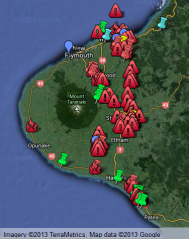
 taranaki frackings siteslegend: red triangle: fracking well sites

red flame: gas/oil production stations

red pin: deep well injection sites

green pin: “land farms” and land treatment sites.

 source: Climate Justice Taranaki

We Have Been Invaded

As you can see from the above map, pristine Taranaki dairyland has been totally invaded and colonized by foreign oil and gas companies. New Zealand’s lax regulatory environment has produced a feeding frenzy. Eager to offshore as much profit as possible, they have transformed our clean green countryside into an industrial site.

A recent report by the New Zealand Commissioner for the Environment is highly critical of both Taranaki Regional Council (TRC) and New Plymouth District Council for their failure to regulate foreign energy companies in accordance with existing New Zealand law.

The PCE, bless her, makes the link between fracking and climate change front and center in her report. In her introduction, she questions the common assertion that natural gas is a so-called transition fuel, given its substantial contribution to atmospheric CO2. She also calls on the New Zealand government to specify exactly how they will fulfill their commitment to reduce New Zealand’s greenhouse gas emissions to 5% below our 1990 emissions by 2020.

Improper Disposal of Fracking Waste

Her report goes on to chastise TRC for the failure to regulate discharge of fracking waste. Despite vociferous complaints from local farmers and residents, TRC continues to permit discharge of untreated fracking waste into streams that provide water for livestock and, and in several cases, human beings.

She’s especially critical of TRC’s use of “visual inspection,” rather than chemical testing, to assess the water quality of these streams. One particularly silly monitoring report refers to inspectors signing off on water quality because they heard frogs singing.

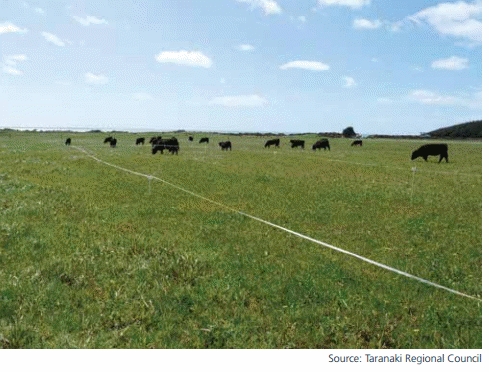
Cows on landfarm“Land farmed” site with grazing cattle

Another common disposal method is to spread wastes on pasture and grow grass and graze cows on it – without testing the cows, grass or milk for heavy metals, barium, benzene, hydrocarbons or other chemicals commonly found in fracking waste.

The experience with toxic sludge in the US is that heavy metals and other toxic chemicals bio-accumulate in plants grown in contaminated soil

Given given that dairy products are New Zealand’s number one export, this so-called land farming could do major damage to our country’s economy. Especially as China, our major export market, is already exquisitely sensitive to the milk contamination issue.

Emergency Evacuation Plans

Another major concern in the PCE’s report relates to the Emergency Evacuation Plans fracking companies are required to file for each drill and production site. Many fracking sites are located less than 500 meters from private homes.

As here

home and well

here

2nd home

here

4th home

and here

third homeSarah Roberts and Robert Moore – Green Party candidates for New Plymouth and Taranaki-King Country

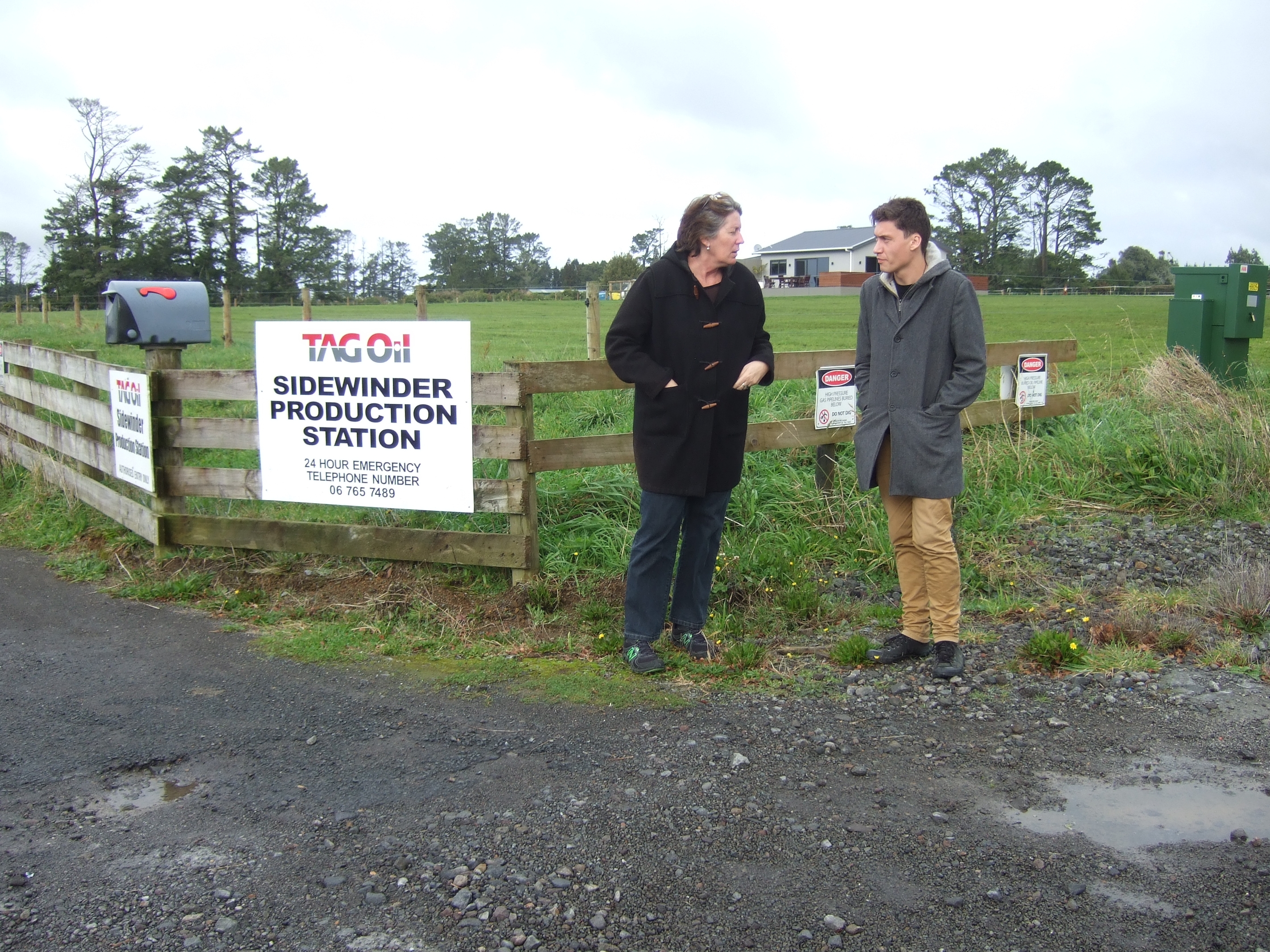
For some reason, none of these residents have been notified that they are slated for evacuation in the case of an accidental gas release or explosion. As an example there are 36 owners and occupiers identified on the TAG Oil emergency management plan (gas release/spill contingency plan covering 500m) at Sidewinder A wellsite. These owners and occupiers will not be aware of this.

Drop in Property Values


for sale

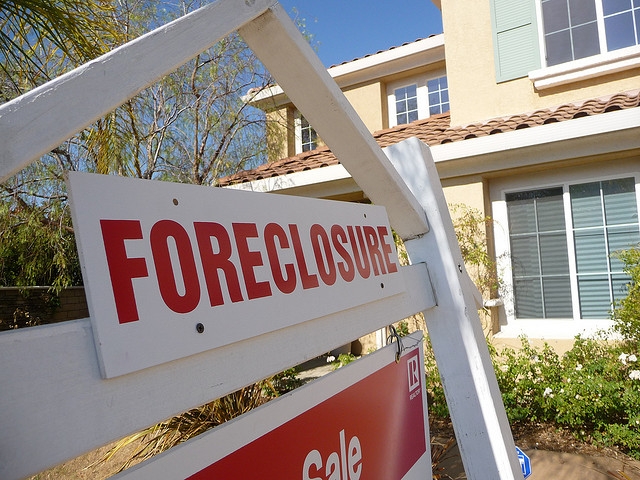
The owners of the last property pictured above are desperate to sell it. The value of properties located adjacent to fracking wells have plummeted.

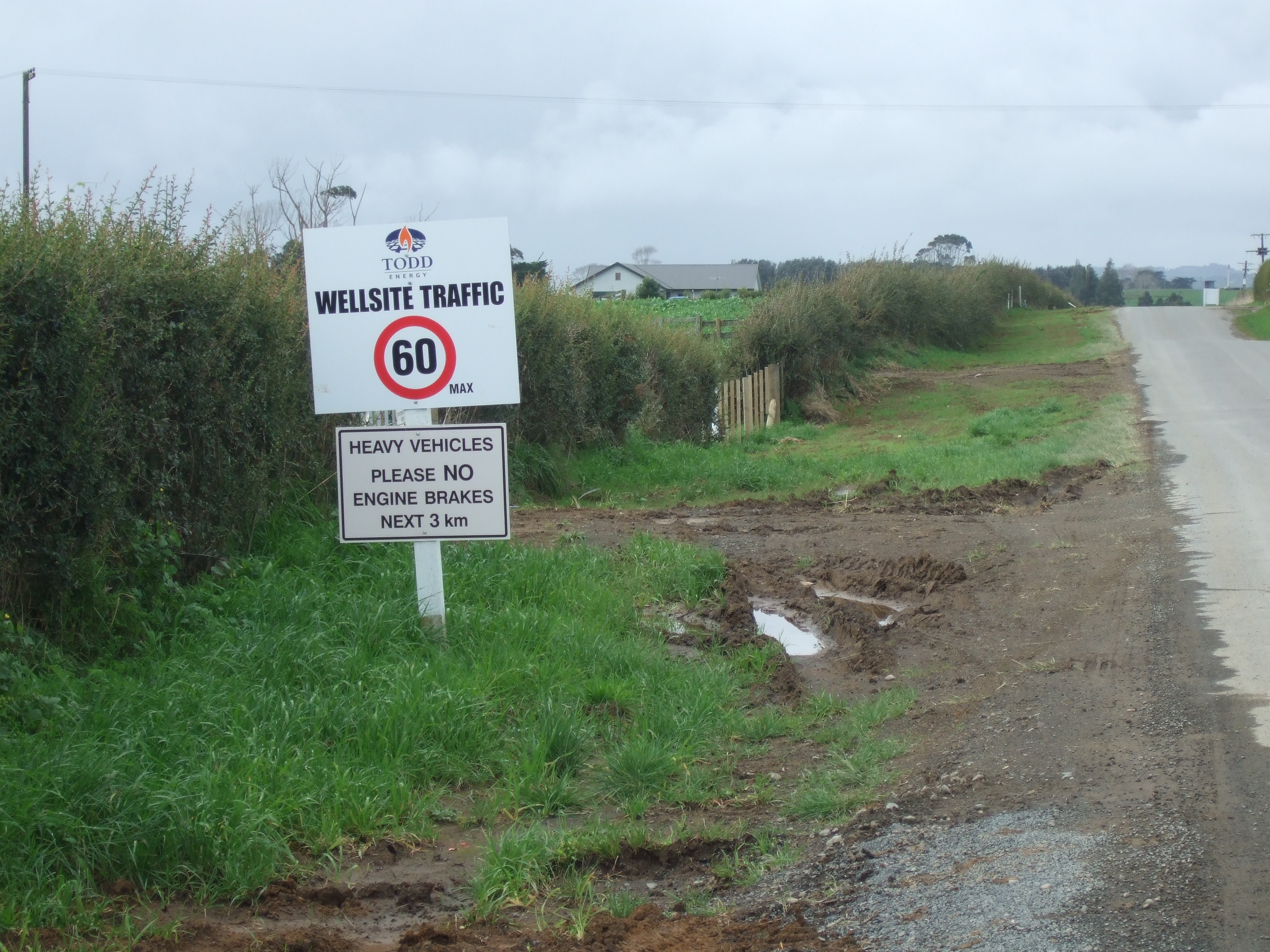
This is due to the constant noise, exposure to air and water pollutants, heavy industrial traffic

industrial traffic

and flaring

flaring

What’s more the property adjacent to fracking wells can’t be insured, owing to the risk of leaking wells, inadvertent gas releases and explosions. Under New Zealand law, the property owner assumes liability for an abandoned well site that leaks.

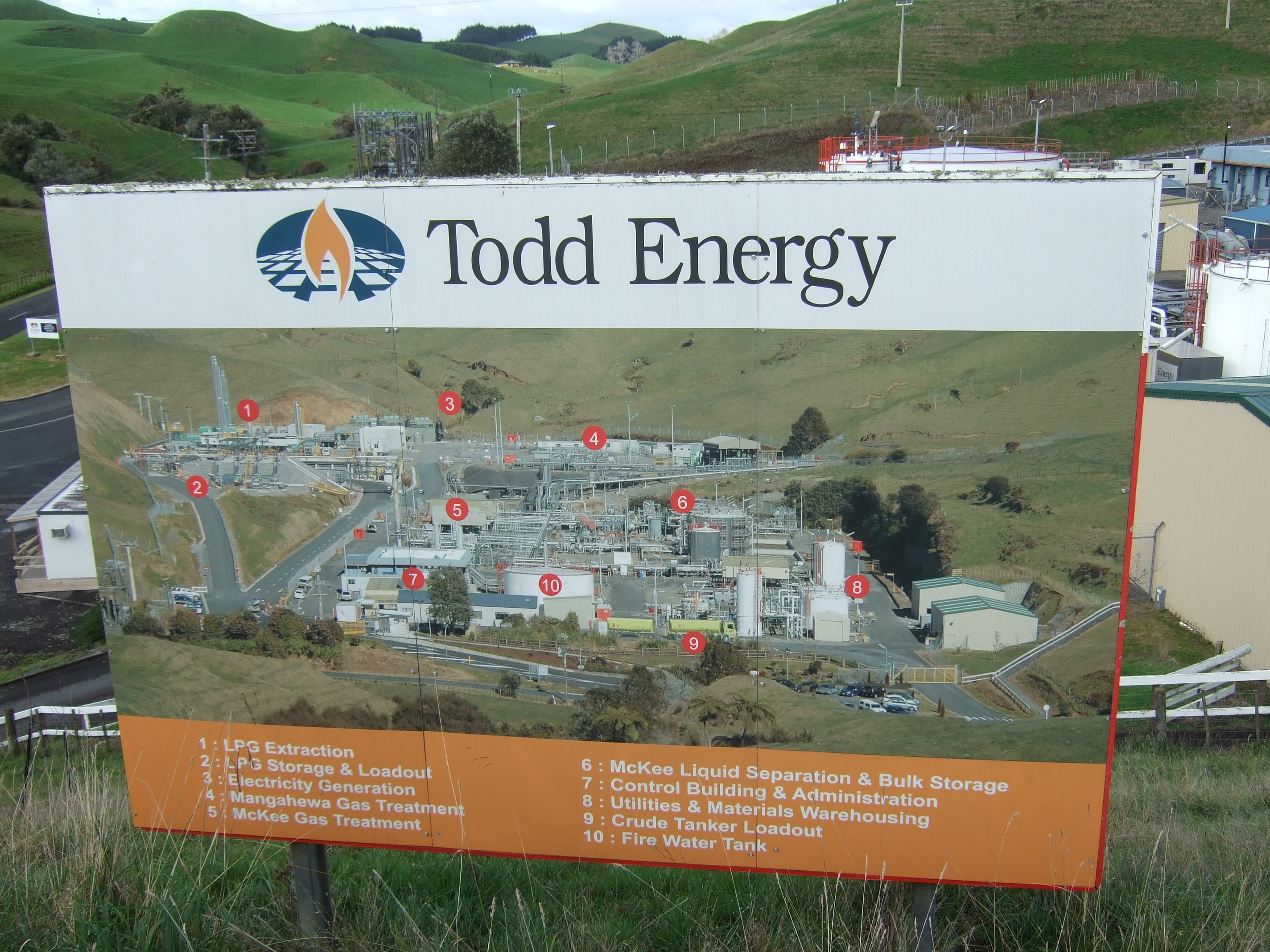
Todd Oil (affiliated with Shell) has recently agreed to top up sales proceeds of land owners forced to sell their property at a loss. But if you live adjacent to a Tag Oil or Greymouth Petroleum fracking site, you’re out of luck.

Health Consequences of Fracking

Because the PCE is only charged with addressing environmental issues, her report doesn’t address the nosebleeds, rashes, cancer clusters and other health issues associated with living near a fracking site.

Waitara valley plant

Nor the disastrous effect of being surrounded by fracking rigs on overall well beings and quality of life. People shouldn’t have to live this way. Why should Taranaki residents sacrifice their livelihoods and the health and well being of their children for the benefit of foreign oil companies?

Todd sign

Community Meeting Regarding Norfolk School

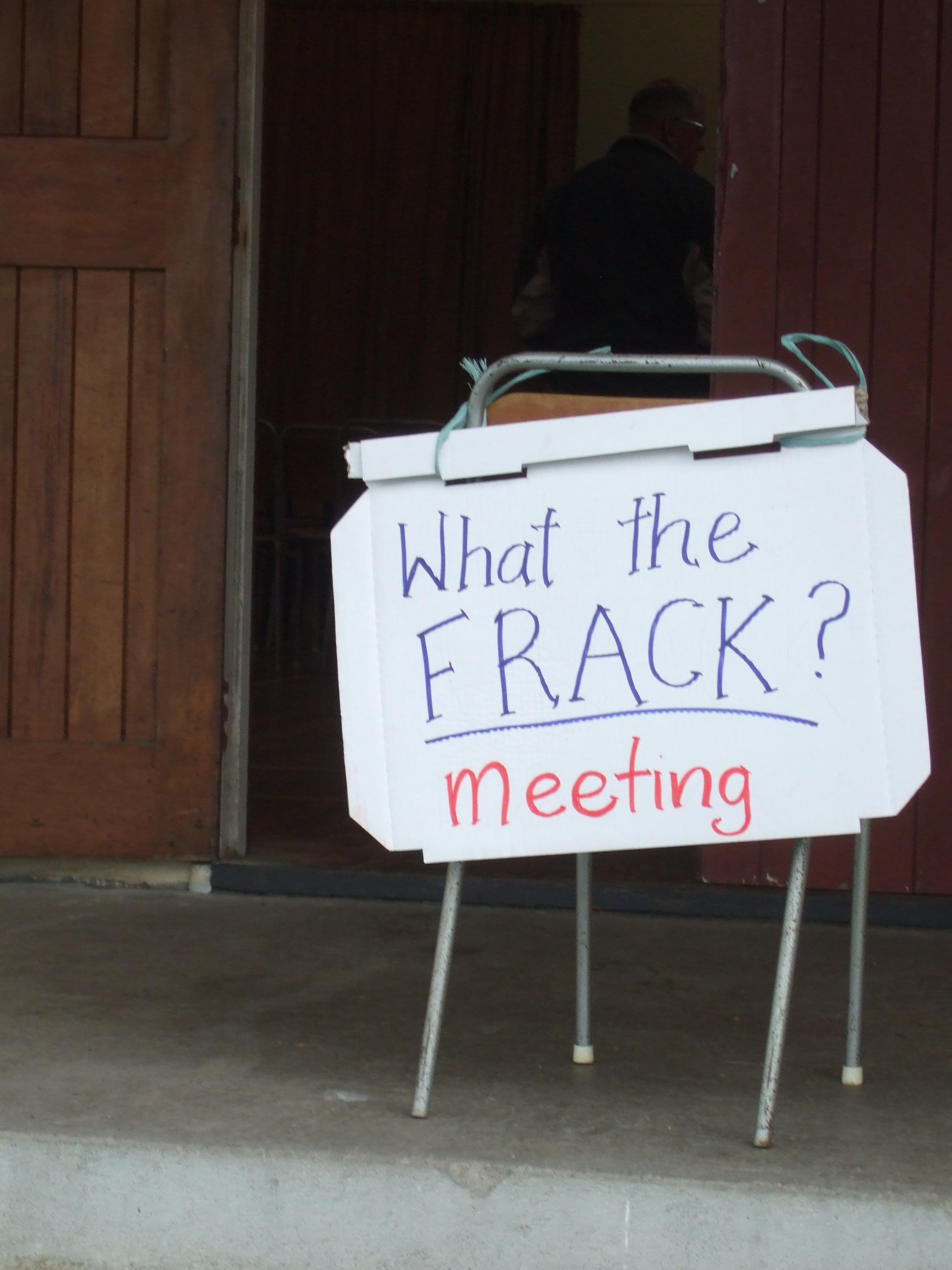
Our What the Frack Tour finished up with a community meeting at Norfolk Hall, a Taranaki country hall between Inglewood and Stratford. TAG Oil is applying to drill their Sidewinder B well site 600 meters from Norfolk Primary School. This isn’t about a couple of exploratory wells. This is about the the potential drilling an on-going extraction of eight wells.

As came out at the meeting, prevailing south westerly winds would make emergency evacuation of the students impossible in the case of an accidental gas release. These can and do occur at Taranaki fracking sites.

what the frack

Read follow up letter from to Taranaki Daily News from one attendee: Not the Good Oil


Speculating with our Food

In 2011, “food derivative” speculation replaced financial derivatives as the hot new investment promoted by major investment banks like Goldman Sachs and JP Morgan. According to numerous studies, food speculation rather than shortages, are the main reason for skyrocketing food costs.

The really scary news is that in addition to speculating heavily on food commodities, these same private equity funds are also buying up huge tracts of land in the third world.

The Great Land Grab

A 2009 research project by the Oakland Institute (The Great Land Grab) reveals startling facts about the corporate land grab in the third world – another major factor in skyrocketing food prices.

According to the International Food Policy Research Institute (IFPRI), foreign investors have secured more than 50 million acres of African farmland to develop factory farms for export crops. In addition to investment banks and private equity funds, multilateral agencies, such as the International Financial Corporation (the private sector branch of the World Bank), are also major players in the “corporatization” of global agriculture.

The IFC plays a dual role in increasing private investment in the third world – via direct investment and by pressuring developing countries to create “business enabling environments.” Another World Bank agency, The Foreign Investment Advisory Service (FIAS ), also plays a role by pressuring third world governments to improve their “investment climate,” by relaxing environmental, tenant rights and food security laws and abolishing tax and duties on foreign investments.

Africa is the major target, both for western investment banks and booming Asian economies, driving tens of thousands of subsistence farmers off land they have farmed for generations.

Corporatizing the Global Food Supply

A UK company started in 1997, called  Emergent Asset Management, claims to be the largest speculative fund investing in African industrial agriculture. It uses private equity to take control of large tracts of African farm land. Their prospectus attracts investors by predicting a armed conflict between the West and China will trigger mass food shortages – accompanied by price spikes that guarantee a handsome return to investors. Emergent’s founders, Susan Payne and David Murrin are former high level traders for Goldman Sachs and JP Morgan – well-known as the architects of food derivative speculation.

Emergent’s direct control of large amounts of agricultural land – combined with its ability to attract investors through its equity fund – puts unprecedented control of the global food supply in private hands. It does so by creating a new type of vertical integration, in which a single company controls vast amounts of land, food production and processing — while simultaneously inflating global food prices due to the speculative nature of the fund. As you can see in the video Emergent uses in their pitch to investors:

The Perp Walk – the 1% Have Names

In 2011, the Oakland Institute fingered other millionaires and billionaires grabbing African land via unscrupulous deals with corrupt village leaders (who sign away communal land rights without community consultation) – and by helping to orchestrate armed attacks on families who refuse to leave their land. At the top of the list are

Bruce Rastetter — CEO of Pharos Ag, which has bought more than 300,000 hectares in Tanzania for large-scale food crop, beef, poultry, and biofuel production. This project will displace tens of thousands of civil war refugees awaiting Tanzanian citizenship.

Leonard Henry Thatcher and David Neiman — runs Nile Trading and Development (NTD), which has bought 600,000 hectares in South Sudan through a secret agreement with influential locals who went behind the backs of other community members.

Kevin Godlington — (close associate of former prime minister Tony Blair) CEO of Crad-l and Director of Sierra Leone Agriculture (SLA) and its parent company, the UK-based CAPARO Renewable Agriculture Developments. SLA has bought 43,000 hectares in Sierra Leone to plant palm oil plantations.

Enter the Bill and Melinda Gates Foundation

The March 31 Guardian reports that the Bill and Melinda Gates Foundation (along with USAID and the Dutch and Danish governments) are backing a new World Bank scheme to further industrial agriculture at the expense of the smallholder farmers who produce 80% of the food consumed in the developing world. The new program is a ranking system called the Benchmarking the Business of Agriculture (BBA).

Here’s what the Our Land is Our Business campaign, organized by the Oakland Institute and like-minded food rights groups, has to say about the BBA:

“Despite a language that claims concerns for small farmers, the goal of this new agriculture-focused ranking system is far too clear: [to] further open up countries’ agriculture sectors to foreign corporations. The doing business [rankings] give points to countries when they act in favor of ‘ease of doing business’. This consists of smoothing the way for corporations’ activity in the country by, for instance, cutting administrative procedures, lowering corporate taxes, removing environmental and social regulations or suppressing trade barriers.”

People can sign on at Our Land is Our Business to send a message to the World Bank about looking after people rather than corporations.


How Big Corporations Avoid Tax

The Tax Free Tour

Film Review

VPRO-Marijee Meerman 2013

The Tax Free Tour is an hour long Dutch documentary (in English) about the highly specialized field of corporate tax avoidance. I found it astounding how many American corporations use overseas tax havens to avoid paying tax in the US. Some of the better known names include Walt Disney, Wells Fargo, Google, AT&T, Apple and even companies that promote themselves as socially responsible, like Starbucks and Amazon.

Apple, one of the worst offenders, pays only 1.9% of their annual income in corporate tax. As a US company headquartered in Silicon Valley, Apple should be liable to the standard 35% corporate tax rate. Their secret is diverting nearly all their income to a subsidiary in Ireland (which has one of the lowest corporate tax rates) – after first passing their royalty income through a Netherlands subsidiary (the Dutch charge virtually no tax on intellectual property revenue), a company listed in Virgin Islands and back to Ireland. In the accounting trade, this is known as a Double Irish with a Dutch sandwich.

The filmmakers calculate that profits offshored for tax avoidance purposes totaled more than $20 trillion in 2010. Approximately 100 of the world’s largest companies have subsidiaries in the Netherlands, owing to their low taxes on intellectual property royalties. Walmart has six Dutch companies, even though they don’t have a single Dutch store. Starbucks also diverts all their royalty income to the Netherlands. Because they have a trademark on “frappuccino,” they declare a certain percentage of the price as a “royalty” (and pay no tax on it).

My favorite part is near the end when a British Select Committee challenges a Starbucks executive on his claim that their British coffee houses have been running at a loss for fifteen years. After asking why they don’t close their British stores, she gets him to admit they avoid $1.6 million pounds in corporate taxes by diverting their UK income to the Netherlands. He won’t tell her how much tax they pay the Dutch government. Allegedly Starbucks and the Dutch government have a secret agreement not to disclose the amount. The committee chair sternly reminds the executive of all the free public services Starbucks receives in the UK, at the expense of other taxpayers.

Amazon avoids corporate tax by diverting a sizable portion of their revenue to Luxemburg. Google shelters their profits in Bermuda. Other favored corporate tax havens include Cyprus, the Cayman Islands, Mauritius, Singapore, Hong Kong, the UAE and Kenya.

The irony is that most of this income can’t be transferred to shareholders. Paying it out as dividends would necessitate repatriating the revenue to the company’s home country – and paying the prevailing corporate rate. Thus much of this money is loaned (as treasury bonds) to deeply indebted western countries – who struggle to balance their books owing to the trillions of dollars lost from tax avoidance.

Crossposted at Daily Censored

Giving Capitalism a Feminine Face

lagarde

Historically the IMF and World Bank, like the WTO, have been characterized by “faceless” leadership. Prior to the mid-nineties, only a handful of liberal intellectuals knew these powerful international institutions existed. Even after the 1999 Battle of Seattle effectively launched the antiglobalization movement, the leaders of these august institutions remained anonymous. When the IMF issued warnings against countries with excessive public spending, they originated from the agency itself, rather than IMF officials.

Prior to his June 2011 arrest for alleged sexual assault, no one outside of France had heard of Dominique Strauss-Kahn, who ran the IMF between 2007 and 2011.

The Historic Role of the IMF

The IMF was founded at the end of World War II at Bretton Woods. The British delegation, led by economist Maynard Keynes, wanted the IMF to be a cooperative fund member states could draw on to maintain economic activity and employment through the periodic economic crises that are characteristic of capitalist economies. The US delegation saw the IMF as more of a bank serving the needs of private lenders by ensuring borrowing states repaid their debts on time (see IMF History).

The US prevailed, and IMF loans came to be known as “structural adjustment” loans because they forced borrowing governments to adjust the structure of their economic activity. In most cases, this involved extreme austerity measures favorable to multinational corporations seeking access to cheap resources and labor markets. Such measures included privatizing publicly owned assets (airlines, telecoms, railroads, health systems, etc); liberalizing trade and financial markets; increasing incentives (corporate and individual tax cuts and waivers of environmental/labor regulations) for foreign investment; and supporting commercial export crops at the expense of food production.

Developing countries that blindly followed these policies, especially in South America and Africa, found their countries mired in debt and huge social inequalities. Russia was one of the most extreme cases: its economy shrank by 55% before President Vladimir Putin set the country on an alternative path to recovery.

Repackaging the IMF’s Image

Given the historic anonymity of the IMF leadership, you have to wonder about all the publicity being lavished on Christine Lagarde, the current IMF managing director. Although global economics is a low priority in the US media, she receives near daily attention in the British and international media. At sixty, Lagarde is still a strikingly attractive woman. Presumably, however, there is some political agenda behind the decision to promote this “rock star of the economic world,” as several media outlets have branded her

Lagarde’s Mission

Besides her carefully cultivated public persona, Lagarde is also unique in her willingness to lay out the IMF’s economic and political agenda. The policies she advocates include

  • Stronger economic growth (allegedly to promote global re-employment)
  • Deeper “integration” of European economies (translation: creation of a centralized fiscal body capable of making budgetary decisions for the entire Eurozone)
  • Improved “fiscal consolidation” for the US and Japan (translation: less deficit spending)
  • More domestic consumption and less reliance on foreign investment and exports in emerging economies (especially China)
  • A stronger firewall against debt contagion (translation: no bailouts) around weaker Eurozone nations like Greece, Italy and Spain
  • “Structural reform” (translation: anti-union legislation and reduced public spending) to improve the “competitiveness” of the industrial north.

Rebranding Structural Adjustment

Lagarde gives double messages about structural adjustment and austerity cuts. After warning that budget cuts lead to “recessionary tendencies,” she states that some countries (which, like Greece, are on the verge of economic collapse) need to cut their public budgets immediately. She feels others can stretch their cuts out over time.

Among specific “structural reforms” Lagarde favors are pension reform, with an optimal retirement age of 67, “wage restraint” (i.e. abandoning the expectation that wages will keep pace with inflation), and social service reforms in which “recipients of social assistance are expected to improve their situation.”*

The Fox Guarding the Henhouse

LaGarde isn’t without her critics. Former IMF chief economist Simon Johnson refers to her appointment as “the fox guarding the henhouse.” Johnson, like former World Bank economist Joseph Stiglitz, has been highly critical of the extreme concentration of financial power and it threat it poses to the global economy. This is the subject of Johnson’s recent book, Thirteen Bankers.

His criticism.of Lagarde centers mainly around her proposal to solve the Eurozone crisis by issuing additional loans to the debt-ridden “peripheral” countries (Greece, Spain, Italy, Portugal and Belgium). He maintains all these countries are looking at a default scenario, no matter how much money she throws at them. He accuses her of allowing EU leaders to use the IMF to conceal flaws in the Eurozone structure from voters.

*A questionable objective in countries with double digit unemployment

photo credit: Adam Tinworth via photopin cc

The Real Cause of Greece’s Economic Crisis

Debtocracy

(2011) Katerina Kitidi and Aris Hatzistefanou

Film Review

The 2011 Greek documentary Debtocracy effectively dispels the media myths about lazy Greek workers and and scofflaw Greek taxpayers being responsible for Greece’s present economic crisis.

The film begins with an overview of what its filmmakers (and I) feel has been a basic goal of both globalization and the creation of a single European currency – namely “labor discipline” and the suppression of wages in heavily unionized countries.

They show how sweeping deregulation in the industrialized world in the 1980s allowed manufacturers to eliminate unions by shutting plants down and reopening them as sweatshops in the third world. The subsequent creation of the Euro as a single currency allowed the central European countries (Germany and France) to use the mechanism of debt to weaken strong unions in peripheral Eurozone countries like Greece, Spain and Italy.

Thanks to relatively weak unions following reunification, Germany imposed a virtual ten year wage freeze. While workers suffered, German companies and banks racked up immense profits and stacks of cash, which they loaned to “peripheral” countries to finance big corporate tax cuts.

The bulk of the film focuses on the concept of “odious” debt and whether the Greek people should be forced to repay fraudulent loans from which they received no direct benefit. As Debtocracy poignantly depicts, Athens and other Greek cities are experiencing a third world humanitarian crisis, with massive homelessness, hunger and untreated illness.

Odious Debt: An American Invention

Odious debt was a principle invented by the US in the early 20th century to avoid repaying Spain’s war debt after the US took possession of Cuba following the Spanish-American War. George Bush invoked it following the US occupation of Iraq. His goal was to avoid repayment of Sadam Hussein’s debts to China, France, Germany and Russia. Since then approximately a dozen countries – most notably Argentina, Ecuador and Iceland – have repudiated so-called “illegitimate” debt incurred by deposed leaders.

The film focuses mainly Argentina’s and Ecuador’s default on their foreign debt. In 2001 the structural adjustments the IMF forced on Argentina bankrupted the country. A popular uprising forced the Argentine president to flee (in a helicopter), and the new government declared the IMF debt illegal and unconstitutional.

When Ecuador experienced a similar economic crisis and uprising in 2007, they, too, sent their president packing in a helicopter. In 2008, their new president Rafael Correa appointed a Debt Audit Commission to study the strong arm tactics (some of which John Perkins describes in Confessions of an Economic Hit Man) that caused Ecuador to borrow billions of dollars to pay for US-built infrastructure that only benefited Ecuador’s wealthy elite. Correa’s Debt Audit Commission ascertained that only 30% of their external debt was legitimately incurred.

CADTM’s Call for a Greek Debt Audit Commission

Iric Toussaint, a French economist who participated in the Ecuadorian Debt Audit Commission, believes a major proportion of Greek debt may have been fraudulently incurred. The following evidence supports this view:

  • Nearly one billion euros of debt resulted from a risky swap (of yen and dollars for euros) Goldman Sachs persuaded Greece to make in 2001. The transaction netted Goldman Sachs $600 million in profit (see Secret Greek loan).
  • Major German and French loans were issued on condition that the Greek government incur further indebtedness to purchase hundreds of millions of euros of German and French armaments.
  • Billions of dollars of Greek debt resulted from major cost overruns on the 2004 Greek Olympics (which cost twice as much as the Sydney Olympics in 2000). These have never been explained nor investigated.
  • In 2010 a former Goldman Sachs official was hired to manage the Greek public debt authority, with the result that the entire 2010 rescue package (103 million euros) was used to bail out Greek banks.

The film also discusses the March 2011 call by the Committee for the Abolition of Third World Debt (CADTM) to create an audit commission to examine Greek public debt. It ends with the ominous sound of a helicopter, eerily foreshadowing the forced resignation of Greek prime minister George Papandreou last November, when CNN advised him to get a helicopter to save himself from angry protestors (see Fall of Papandreou).

The Anti-Fracking Movement Goes International

The anti-fracking movement has gone international, drawing in hundreds of thousands of people who never dreamed of being environmentalists or activists.

Below is a heart-rending video by the Lock the Gate coalition in Australia.

The similarities between the industrialization of prime Australian farmlands and the experience of dairy and organic farmers here in Taranaki are uncanny: the 24/7 glaring lights, noise and fumes and the unexplained health problems, particularly in children.

Most of all the helplessness experienced by families affected by fracking. Once the government allows the oil and gas industry to set up fracking rigs, it becomes the law, and ordinary people have no rights. Livelihoods are destroyed, property values plummet and your land becomes uninsurable.