This is What Democracy Looks Like

2014 marks the fifteenth anniversary of the Battle of Seattle, the week of protests in November-December 1999 that shut down the World Trade Organization (WTO) Third Ministerial Round. Also known as the Doha Round, the intention of these negotiations was to significantly expand the power of multinational corporations to challenge democratically enacted labor, environmental and health and safety laws.

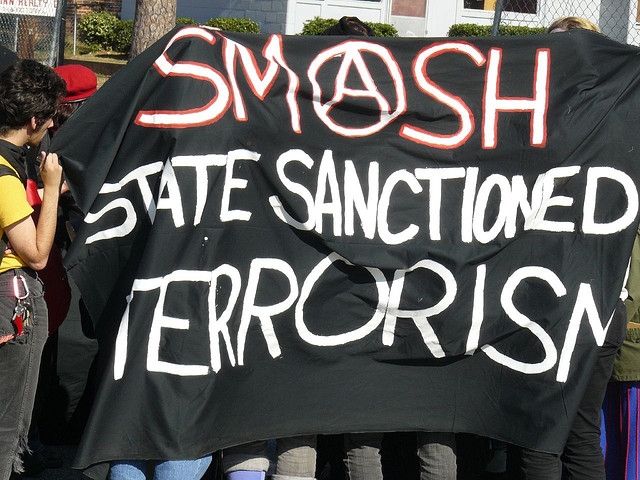
Opening ceremonies had to be canceled on November 30, when seventy to one hundred thousand global protestors stormed downtown Seattle and hundreds of activists chained themselves to cement pipes to block delegates’ access to the Paramount Theater. The police riot which ensued was our first encounter with the police militarization that would characterize the new millennium. Rather than simply arresting them, Seattle police beat, tear gassed and shot rubber bullets at peaceful protestors, journalists and passersby alike.*

Organizing Began in January 1999

I still lived in Seattle in 1999 and participated in the local organizing. We began in January 1999 when Mike Dolan, Public Citizen’s national field organizer, called the first planning meeting at the Seattle Labor Temple. Dolan continued to visit Seattle for monthly meetings, as well as coordinating organizing efforts in Los Angeles, San Francisco, New York, Washington DC and other major US cities.

The biggest challenge in organizing the anti-WTO protest was that hardly any Americans had heard of the WTO in 1999, much less recognized the immense power Clinton was handing to private corporations with the North American Free Trade Act (NAFTA) and the Global Agreement on Tariffs and Trade, the treaty that created the WTO in 1994.

With 100,000 activists descending on Seattle, it became necessary to set up a home stay network to provide them with accommodation. I hosted seven activists in my home, two each from Los Angeles and Alaska, and three from the Mendocino County Rainforest Action Network.

The IFG Teach-In

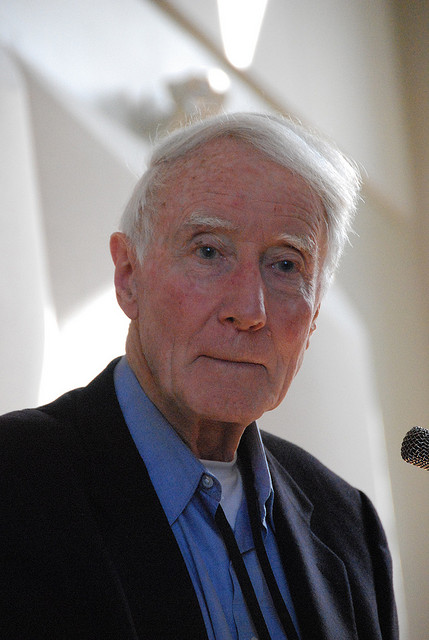
The week started Friday night November 26, when 3,000+ of us packed into Seattle’s Symphony Hall for a two day teach-in organized by the International Forum on Globalization. World famous anti-globalization activists (including Indian anti-GMO activist Vendana Shiva, Malaysian economist and journalist Martin Khor, Canadian water activist Maude Barlow, Canadian environmentalist David Suzuki, French farmer activist Jose Bove, Ghanaian farmer activist Tete Hormeku, anti-sweatshop organizer Kevin Danaher and Owens Wiwa, brother of executed Nigerian environmental activist Ken Saro-Wiwa) each gave twenty minute presentations, followed by questions and small group discussion at the Seattle Art Museum across the street.

Maria Galaradin recorded all the presentations and has many of them archived at TUC Radio

On November 27-29, there were a series of small non-confrontational protest actions organized by specific interest groups. On November 28, I participated in a protest march to the Cargill grain elevator at the port to protest the corporate takeover of global food production by large companies such as Cargill and Monsanto. It was led by representatives of the Zapatistas, Via Campesino and the US National Family Farm Coalition.

Protest organizers had scheduled the main protest, involving fifty thousands global trade unionists and tens of thousands of farm and environmental activists for November 30, the day WTO negotiations were meant to start. We had planned three days of workshops and small localized protests for December 1-3.

Mayor Paul Schell Declares Martial Law

All this changed when Mayor Paul Schell declared martial law and made it illegal to carry anti-WTO signs, wear anti-WTO buttons, chant anti-WTO slogans or carry anti-WTO leaflets into downtown Seattle. Angered by the unprovoked police violence and suspension of our first amendment rights, organizers cancelled all previously scheduled events. Instead we held daily spontaneously organized marches into downtown Seattle – in direct defiance of Schell’s suspension of the Constitution.

Both of the videos below were produced in 2000. The first, Trade Off, by documentary filmmaker Shaya Mercer, focuses mainly on Dolan, his organizing strategy and the wide range of international organizers and groups who helped make the protest possible.

The second video This is What Democracy Looks like was produced by Seattle Independent Media Center, which would spawn the birth of the global IndyMedia network. This film focuses more on the militarized police violence against peaceful protestors and the role of the week long protests in convincing third world WTO delegates to reject the draconian demands of the US and its first world allies.

Obama Resorts to Secret Treaties

Despite numerous attempts by the Bush and Obama administrations, the Doha Round of negotiations was never revived – thanks to the staunch stance of third world delegates.

Obama’s solution has been to try to introduce the same draconian corporate protections through two secret treaties, the Transpacific Partnership Agreement (TPPA) and the Transatlantic Trade and Investment Partnership (TTIP). Negotiations for both treaties are being held in total secret. Although 600 corporations have been allowed to see (and write) the both of them, members of Congress and national parliaments are forbidden to see either treaty until they’re signed. Several sections of the TPPA draft have been leaked by Wikileaks. See New Zealand Kicks Off Global Protest Against TPPA

Obama is lobbying for fast track authority on TPPA. Under fast track, the Senate would be forced to vote the treaty up or down without debating its provisions. Congressional Democrats defeated Obama’s efforts to win fast track on TPPA earlier this year. Recently, however, the President expressed confidence a new pro-business Republican Congress will grant him this authority in 2015.


*Seattle Chief of Police Norm Stamper resigned one week after the WTO protests. He subsequently apologized, in 2009, for excessive and inappropriate use of force by Seattle police. In 2007, a federal jury ruled the city of Seattle was liable for arresting protesters without probable cause, a violation of their constitutional rights. As a result the city awarded a $1 million settlement to the 600+ activists arrested during the 1999 protests.
**The Zapatistas are a Mexican international liberation army founded in 1994 in reaction to the North American Free Trade Act (1994). They control several autonomous areas in rural Chiapas.
***Via Campesina is an international movement which coordinates peasant organizations of small and middle-scale producers, agricultural workers, rural women, and indigenous communities.
The Water Emergency

blue covenant

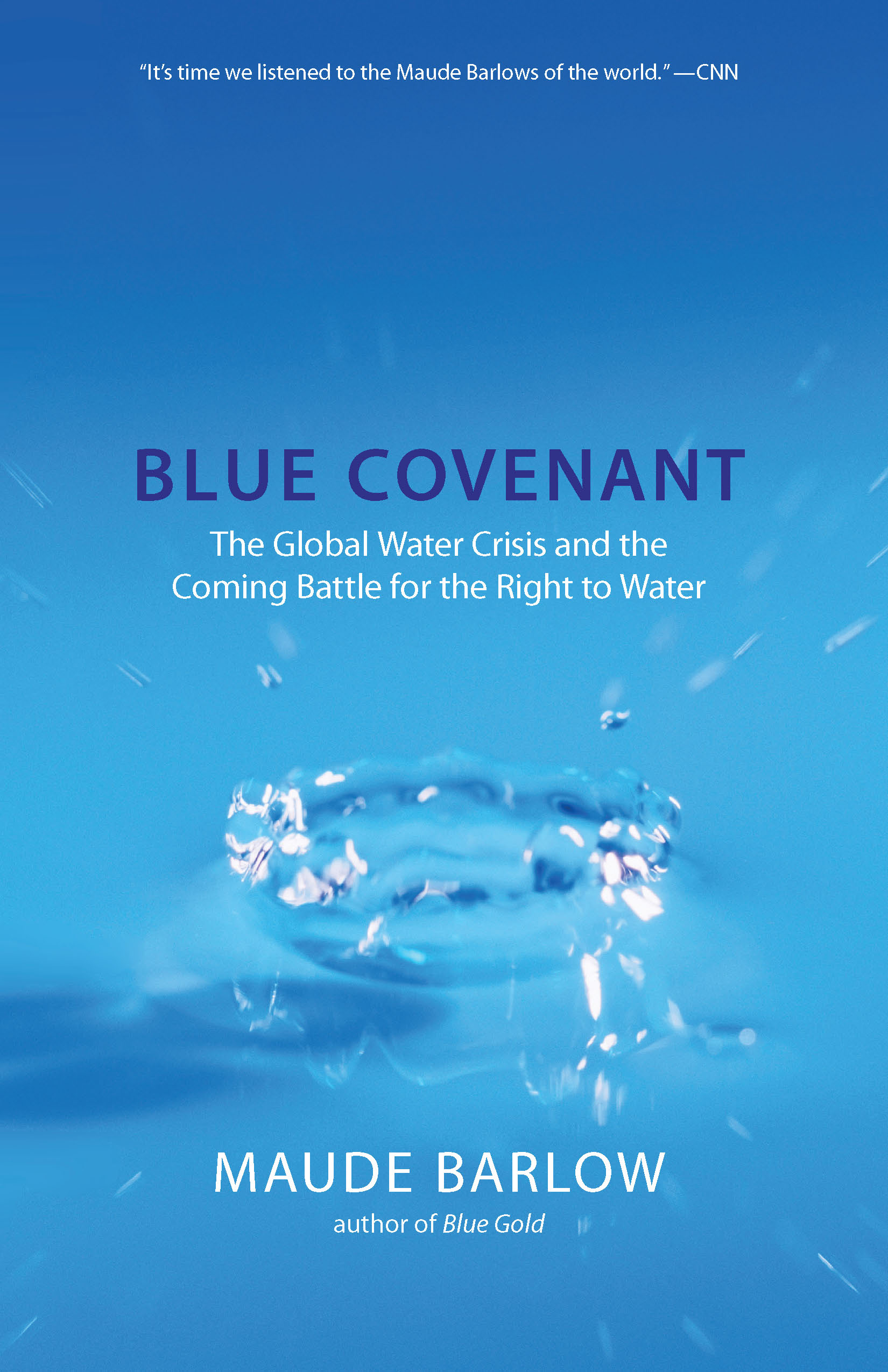
Blue Covenant: The Global Water Crisis and the Coming Battle for the Right to Water

by Maude Barlow

The New Press (2007)

Book Review

Although it receives less public attention, fresh water scarcity is far more urgent and deadly than climate change. With no choice but to drink contaminated water, millions of children under five are dying from infectious diarrhea. Growing water scarcity is also the major driver of illegal immigration. In Mexico alone, nearly 600 farmers a day abandon their land when their wells dry up.

According to the World Health Organization (WHO), 80% of global sickness and disease is caused by contaminated water. In the global south, where only the rich can afford clean water, the poor die of hepatitis, cholera, polio, botulism, salmonella, e coli, campylobacter, viral gastroenteritis and other infectious illnesses transmitted by human feces. In the global north we die at unprecedented rates of cancer and autoimmune disease from drinking water contaminated with endocrine disrupting herbicides and pesticides, industrial toxins, heavy metals, drugs and nanoparticles.

The Cause of Freshwater Scarcity

Barlow identifies seven major factors contributing to the rapid depletion of clean drinking water:

1. Total failure to regulate the massive increase in toxic runoff (animal waste, herbicides, pesticides, antibiotics) from factory farms and industrial sites.

2. Unregulated corporate mining of fossil water from aquifers that are too deep to be replenished by rainwater. Corporations siphon off millions of gallons a day at zero or minimal charge to mass irrigate deserts, manufacture cars and computers, mass produce bottled water* and extract oil from tar sands and oil and gas from shale (aka fracking).

3. Reduced rainfall due to destruction of water retaining landscapes from rapid and haphazard urbanization. Rain that falls on pavement runs off (and ends up in the sea), rather than being absorbed and evaporated.

4. Rapid glacial melting (due to climate change) of glaciers in the Himalayas, Alps and Andes. The Himalayan glaciers are the primary source of water for nearly half of humanity (India, Pakistan, China, Vietnam, Laos, Nepal, Bhutan, Burma, Thailand, Bangladesh and Cambodia).

5. Loss of water from the “virtual water” trade, thanks to International Monetary Fund (IMF) and World Bank policies that force poor countries to sacrifice their scarce freshwater by growing and exporting water intensive crops (eg avocados, citrus, wheat, coffee, cut flowers and biofuel).

6. Ill-conceived technological fixes, such as mega-dams, water diversion and desalinization that reduce, rather than increase, access to clean water. Desalinization is the most destructive, owing to the massive of toxic waste (from chemicals used to clean reverse osmosis filters) discharged to the ocean.

7. Water privatization by powerful multinational corporations. Most of the world’s freshwater is controlled by the French Companies Suez and Veola and the British/German company RWE/Thames.

The Global Water Cartel

During the late 19th and early 20th century, Europe (with the exception of France, where municipal water service has been privately run since the late 1800s), North America, Australia, New Zealand and Japan adopted universal public water and sanitation services in all major metropolitan areas. This never happened in the global south, where cities only provided water service to the wealthy elite. This made it easy for neoliberal institutions like the IMF to force water privatization schemes on countries in the global south with debt problems.

Barlow slams the IMF and World Banking for forcing water privatization schmes on South America, Africa and Asia as a condition of development loans. She’s especially critical of former UN Secretary General Kofi Anan for supporting these policies, in return for major donations Suez and Veola made to UNESCO.

Over the last few decades, Suez, Veola, RWE/Thames and a few smaller corporate players have been targeting cash-strapped US cities with their water privatization schemes. Bankrupt cities like Detroit are being forced to sell their public water systems as a source of revenue.

Water Warriors

Barlow devotes the last third of her book to the “water warriors” around the world who are fighting for clean drinking water to be recognized as a basic human right. Among other reforms, there must be pressure on government to end the virtual water trade by promoting local sustainable farming, to ban private water companies from developing countries, to strictly enforce laws against surface and ground water contamination, to charge corporations full value for the water they take for bottling plants, fracking, manufacturing and flood irrigation and to promote urban planning that accommodates the need for rainwater to be captured and returned to the earth.


* The big three global bottling companies are Nestle, Pepsico and Coca Cola, though Starbucks’s water bottling company Ethos Water is sneaking up on them with their phony campaign to “help children get clean water.”

All Wars are Bankers’ Wars

john adams quote

All Wars Are Bankers’ Wars

Michael Rivero (2013)

Film Review

The purpose of war, according to this brief documentary by radio host Michael Rivero, is to force central banks on countries that try to issue their own money.He makes a compelling argument, illustrated by numerous historical examples. The film’s main value, in my view, is in dispelling common misconceptions about where money comes from. Contrary to popular belief, western democracies don’t issue the money they use to run government services. They borrow the money at interest from privately owned central banks. In the US, this private central bank is called the Federal Reserve.

The American Revolution

Rivero begins by quoting Benjamin Franklin, who saw George III’s Currency Act as the main trigger for the American Revolution. The Currency Act prohibited colonists from using colony-issued currency. Instead they were required to use English bank notes. The latter were borrowed at interest from the England’s private central bank, the Bank of England. This interest payment amounted to a de facto tax on each and every financial transaction.

After the Revolution, the new American government returned to issuing its own currency. This ended in 1791, when Alexander Hamilton persuaded Congress to appoint a private central bank to finance government services. The First Bank of the United States was funded (at interest) by the Bank of England, which was controlled by Nathan Mayer Rothschild.

The War of 1812

Plagued by inefficiency and corruption, the First Bank of the United States was so unpopular that Congress ignored Rothschild’s threats and refused to renew its charter in 1811. Rothschild, whose control over British money enabled him to control both the economy and Parliament, had warned that Britain would declare war to re-colonize the US unless Congress renewed the charter. Although the US won the War of 1812, they were forced to charter the Second Bank of the United State in 1816 to repay their massive war debt. American’s second central bank lasted until 1832, when voters returned Andrew Jackson to a second term based on a campaign promise to shut it down.

The Civil War

From 1832-1862, the so-called “free banking era,” all banks were state charted. In 1862 Lincoln created a national system of banks to fund the federal government and issue currency. When he authorized the US Treasury to issue $150 million in interest-free “greenbacks,” the London Times called for the destruction of the US because of the major threat this posed to the global economy (i.e. international bankers). To punish Lincoln, England and (and France) would provide financial and material support to the southern Confederacy.

Government-issued currency ended for good in when the Wall Street banks conspired with Woodrow Wilson to create a permanent (private) central bank. The Federal Reserve Act was  written in secret by the US banking establishment and rammed through Congress during the 1913 Christmas recess.

World War I and II

According to Rivero, World War I was also a banker’s war, intended to punish Germany for the strict limitations it imposed on its central bank. At the end of World War I, the Treaty of Versailles forced Germany to repay all the war debts of the other European countries, even though Germany hadn’t started the war.

Crushed by this war debt, the only way Hitler could salvage the German economy was to abolish Germany’s central bank and return to interest-free government-issued currency. This move, which infuriated international bankers, resulted in rapid Germany re-industrialization when the rest of the developed world was mired in deep economic depression. It was lauded internationally as the “German miracle.”

Meanwhile in 1933, American bankers and industrialists plotted a “Bankers’ Putsch,” an attempted military coup against Roosevelt. Their goal was to install corporate fascism in the US, along the lines of Mussolini’s government in Italy. General Smedley Butler, the war hero they enlisted to lead the coup, foiled it by exposing it to the House McCormick-Dirkson Committee. The largely pro-business committee instituted a cover-up, until journalist John Spivac uncovered their secret report in 1967.

Breton Woods

In 1946, following World War II, forty-four nations signed an agreement at Breton Woods New Hampshire for the US dollar to replace the British pound as the world’s reserve currency. This was done with two stipulations: 1) that the US dollar would be redeemable for gold at a price of $35 an ounce and 2) that the Federal Reserve wouldn’t issue more dollars than they could redeem in gold.

Because the Federal Reserve is a private banking network, the federal government has no control whatsoever over the quantity of US dollars they issue. In 1971, it became obvious that the Fed was issuing far more dollars than it could redeem (the vast majority of money the Fed creates is electronic money – only about 3% is in notes and coins*). When France asked to redeem its dollar reserves for gold, Nixon unilaterally suspended the gold standard agreed at Breton Woods.

The Birth of the Petrodollar

At this point the US dollar became a “fiat” currency, theoretically back by nothing. In reality, it was backed by oil, through a complex agreement whereby the US agreed to “defend” countries (i.e. not destabilize or declare war on them) if they committed to buying and selling oil in dollars, aka “petrodollars.”

According to Rivero, the US invasion against a long list of Muslim countries is an indirect result of this agreement. Islam prohibits lending money at interest. As Rivero points out, none of seven Muslim countries retired General Wesley Clark has identified as targets for US military aggression (Iraq, Iran, Syria, Libya, Sudan, Somalia, Lebanon) had private central banks prior to US invasion and occupation.**

Historical Inaccuracies

Apart from several minor historical inaccuracies (eg the purpose of Executive Order 11110 that John Kennedy signed in 1961 and Nixon’s alleged pledge of the National Park system as security on US debt), the film serves as an excellent introduction to the hidden role played by private banks in issuing and controlling the global money supply.


*See 97% owned
**Retired General Wesley Clark first revealed the existence of this campaign to conquer the Middle East and North Africa during a Democracy Now interview in 2007.

photo credit: Serfs UP ! Roger Sayles via photopin cc

Also posted at Veterans Today

The Dream of a Stateless Society

Engines of Domination
(2014)

Film Review

In Engines of Domination, filmmaker Justin Jezewski and author Mark Corske lay out a historical and philosophical argument for anarchism – a stateless society people run themselves via direct democracy.

They begin by comparing class society to sheep herding. The latter began around 10,000 BC. Class society began around 5,000 BC when institutions of power (initially kings and priests and later nations and corporations) began domesticating people as well as plants and animals. The goal of this kind of domestication is to capture the energy of an entire community. Initially chattel slavery was the primary mechanism employed to domesticate human beings.

Since no one agrees voluntarily to being treated this way, this has to be done through a combination of force and deception.  The methods employed were developed over centuries through a process of trial and error. “Engines of domination” are the historical institutions that make this domination possible and which keep it in place.

Land Confiscation

The process begins with the confiscation of communal land by force (this happened to Europeans via the Enclosure Acts between 1500 and 1850), forcing the inhabitants to work for the ruling elite by depriving them of the ability to feed themselves. In Corske’s view, this denial of life support is a fundamental act of violence.

Maintaining control of confiscated land requires a command structure, i.e. a monarchy or its equivalent, the rule of law and weapons. Without weapons, domination over other human beings is impossible. Finally the ruling elite creates upper and ruling classes and provides them a range of privileges for keeping the working class in line.

Deception and Thought Control

This is the true structure of modern society. However it has to be concealed via deception and thought control. The working class vastly outnumbers the elite, and human beings would never submit to forced labor voluntarily. Prior to 200 years ago, this thought control was disseminated via state religion (it still is in Israel and Muslim countries). In so-called western democracies, it’s disseminated via compulsory public education and the mass media.

Replacing the Engines of Domination with the Engines of Liberation

At present, the very biosphere that supports human life is being destroyed by a ruling elite whose sole focus is to amass more wealth. The only way to halt this ecological destruction, according to Corske , is to abolish political power, central authority and the institutions that support it. The engines of domination must be replaced by engines of liberation. This may seem like an impossible task, but this is because we are all conditioned to accept our captivity, much like domesticated animals who stay in the cage or pasture even when the door or gate is opened.

Corske believes we must employ the same trial and error process to walk back the layers of institutional domination that enslave us. Although the ruling elite is intensively organized, we have both superior numbers and human nature on our side. Contrary to contemporary mythology, human beings are basically freedom loving and incline towards cooperation rather than violence towards our fellow human beings.

Building a mass movement to take advantage of our superior numbers is essential. Corske feels the best way to do this is to organize for specific reforms with the ultimate goal of abolishing central authority.

This short documentary is based on Mark Corske’s book Engines of Domination, published in 2013.

Portrait of a Working Class Revolutionary

 revolution

Revolution

by Russell Brand

Ballantine Books (2014)

Book Review

Russell Brand introduces his new book Revolution as an answer to a question Jeremy Paxman asked him in the interview that went viral on YouTube. Brand maintained that voting was a waste of time – that there needed to be a revolution. Paxman’s response was “And how, may I ask, is this revolution going to come about?”

This book never really answers Paxman’s question. In fact, it’s really more a memoir than a political treatise. Like his two earlier books (his 2009 My Book Wook and 2010 Booky Wook 2 ), Revolution mainly concerns Brand’s struggle with addiction. In this third book, however, he delineates a clear link between this struggle and his radicalization.

That being said, his new book is a funny, courageous, brutally honest account of the conscious personal changes that have kept him sober for the last eleven years.

Brand’s Personal Demons

Brand describes quite poignantly the demons that plague many working class people – the constant inner voices telling us we are worthless losers and will never amount to anything. This loser mentality, which starts in the working class home, is brutally reinforced in the public school system, through bullying and emotional abuse by teachers. It’s further compounded by TV advertising hammering on our worst insecurities and promising relief through the continuous purchase of products.

Brand experienced it as a constant anxiety in the pit of his stomach, which he could only relieve with drugs and alcohol, compulsive sex and eventually the adulation of an adoring audience. To overcome these addictions, he had to systematically reprogram himself to see how TV advertising was messing with his mind. A life centered around fulfilling our selfish needs is totally empty and sterile. None of us are the center of the universe. Both spiritually and scientifically (according to quantum physics), each of us in only a small part of a much larger whole.

For Brand a new-found belief in God and a recognition of the pivotal role a deeply corrupt capitalist system plays in all human misery were pivotal in this transformation.

Although I take strong exception to the way 12 step programs ram God down the throats of recovering addicts, I totally agree with Brand’s premise that activists must move out of their selfish individualism to have any hope of making successful revolution. True revolution must be aimed at the collective good. If people do it for their own selfish needs, they only end up replacing the old elite with a new one, as happened in the Soviet Union.

Stateless Participatory Democracy

What Brand favors is a political-economic system run on the lines of anarchist participatory democracy. He would have ordinary people running their own neighborhoods, communities, regions and workplaces through popular assemblies and consensus decision making. He gives the example of the popular assemblies that play a direct role in local governance in Porto Alegre Brazil.

The historical revolution he most admires is the Spanish Civil War, though this would seem to contradict his stance on strict nonviolence. Brand is inspired by the way workers pushed aside the capitalist stooges who were running the cities, factories and businesses and started running everything themselves. Unfortunately he seems to overlook the historical reality that these capitalists didn’t step aside voluntarily – that this was accomplished by force.

A Great Read

Despite being a little light on the pragmatics of mass organizing, I found Revolution a great read. Brand is incredibly witty, as well as a classic magpie who remembers everything he reads. His book attempt attempts to synthesize the views of a wide range of political thinkers and activists, though he clearly favors architect and systems theorist Buckminster Fuller, anarchist and Occupy activist David Graeber and political commentator and anarcho-syndicalist Noam Chomsky.

Also posted at Veterans Today

Obama’s Setback in Beijing

itsourfuture


Did China Just Scupper the TPPA?

The Transpacific Partnership Agreement (TPPA) is a secret free trade treaty Obama is negotiating with eleven other Asian Pacific countries (US, New Zealand, Australia, Malaysia, Japan, Chile, Peru, Canada, Mexico, Vietnam, Singapore and Brunei). The President had hoped to seal the deal at the recent Asian Pacific Economic Cooperation (APEC) summit in Beijing. Instead all 21 Pacific Rim countries have agreed to develop a roadmap for a Free Trade Area of the Asia-Pacific (FTAAP) treaty. The FTAAP would include China and Russia, whereas the TPPA excludes them.

China Deliberately Excluded

The TPPA is viewed as a centerpiece of Obama’s “strategic rebalancing” towards Asia. Also known as the “Asian pivot,” Obama’s intention is to counter China’s growing economic strength by isolating them economically and militarily.

The US has required the twelve countries participating in TPPA negotiations to sign a secrecy clause. Only corporations (i.e. the 600 corporations that helped write it) are allowed to see the text of the treaty. Not even Congress is permitted access. If Wikileaks hadn’t leaked large sections of the draft agreement, we wouldn’t even know it existed.

Is TPPA Really a Trade Treaty?

Scheduled to coincide with the APEC summit, November 8 was an International Day of Action against the TPPA, with major protests in New Zealand, Australia, Malaysia and the US. From the sections which have been leaked, it seems the TPPA isn’t a trade treaty at all. It’s really an investor protection treaty, granting corporations the right to sue countries for laws that potentially hurt their ability to make a profit. These lawsuits, involving hundreds of millions of dollars, would be heard by secret tribunals run by corporate lawyers. There would be no right of appeal.

In other words, the intent of the TPPA is to allow corporations to overturn the environmental, labor and healthy and safety laws and regulations of member countries. There’s even a special “transparency” clause inserted by the pharmaceutical industry that would allow them to challenge formularies (in the US this would include Medicaid and the VA) that promote cheaper generic medications.

If finalized, the TPPA would also allow oil and gas companies to overturn fracking bans, Monsanto to overturn GMO labeling laws, investment banks to overturn banking regulations and the telecommunications industry to overturn Net Neutrality laws.

Why the Secrecy?

It’s pretty obvious why Obama is trying to negotiate the TPPA in secret. Prior investor protection treaties (e.g. the Free Trade of the Americas Agreement) have gone down in flames thanks to massive public lashback, both in the US and in treaty partner countries.

Congress isn’t too happy, either, about being denied access to the draft TPPA treaty. In November 2013 Congress voted down Obama’s request for “fast track” authority on the TPPA. Fast track, otherwise known as Trade Promotion Authority, would require Congress to accept the final TPPA deal or reject it. No debate would be allowed on specific provisions.

There are rumors Obama plans to reintroduce TPPA fast track authority before Christmas, hoping for a better outcome with a new, pro-business Republican congress.

The POTUS also had hopes of ramming through an agreement on the TPPA treaty in Beijing, at a side meeting in the US embassy. It appears he did try and failed, as Pepe Escobar describes in a recent RT article Lame Duck Out of the Silk Trade Caravan.

The Effect on Australia and New Zealand

A trade deal that excludes China, their major trading partner, makes absolutely no sense for Australia and New Zealand. Kiwi and Aussie environmental and labor activists are also deeply concerned about signing an international agreement that allows multinational corporations to sue their governments in a secret corporate tribunal. They’ve worked damned hard to win laws and regulations guaranteeing minimal environmental, labor and health safety standards. If the TPPA goes through, these could all be wiped out with the stroke of a pen.

China Aims to Suppress US Influence in Asia

In an interview with Chinese media, Obama denies he was trying to isolate China by pressuring Asian Pacific countries to sign a secret trade deal that excludes them. Yet it’s pretty obvious to all concerned that’s exactly what he’s trying to do.

It’s also pretty clear that Chinese president Xi Jinping outmaneuvered him. In addition to getting all 21 APEC nations to sign onto an FTAAP feasibility study, China signed other trade deals geared towards reducing US dominance in the region.

On Monday the Chinese and Malaysian central banks signed a deal to establish a yuan clearing bank (to facilitate energy and other trade deals in local currencies rather than US dollars).

Russia and China signed a  similar deal to conduct oil trades in rubles and yuan, rather than US dollars. According to Russian president Vladimir Putin, the new agreement will significantly reduce US influence over world energy markets.
Back in October,

Back in October, China launched the Asian Infrastructure Investment Bank a rival to the US-dominated World Bank and Asian Development Bank.


photo credit: rawEarth via photopin cc

Also published in Veterans Today

The Art and Science of State Terrorism

state terrorism

Part 4 of Counter-intelligence: Shining a Light on Black Operations

“Necrophilous” is Part 4 of a five part documentary by Scott Noble called Counter-Intelligence: Shining a Light on Black Operations.

In Part 4, filmmaker Scott Noble examines the sadistic fixation of the National Security State with death, pain and permanent injury of individuals and groups whose democratic yearnings conflict with the financial interests of US corporations. He likens this fixation to the psychopathology that motivates serial killers.

Necophilous is defined as having an abnormal fascination with death and the dead. Part 4 begins by examining the decision, in 1945, to drop two atomic bombs on Japan.

A nuclear bomb deliberately targets civilians, a war crime under the Geneva Convention. Truman’s claim that nuking Japan spared GIs the bloodshed of a land invasions turns out to be completely bogus.

He already knew the Japanese were on the verge of surrendering. In fact Secretary of War Henry Stimson was afraid the Japanese would surrender before the US got the chance to deploy atomic weapons – which were mainly intended to terrorize the Soviet Union.

The School of the Americas

Exhibit two is the School of the Americas (SOA), founded in 1946 at Fort Benning Georgia. More than 60,000 soldiers and police from US client states have trained in counter-insurgency techniques (aka state terrorism) at SOA. The use of deaths squads who disappear and assassinate pesky intellectuals, educators, labor leaders and human rights advocates figures prominently in the SOA curriculum.

The CIA-installed Guatemalan dictatorship first used it in the 1950s. After the CIA itself used it during Operation Phoenix in Vietnam, it would be replicated by US-backed regimes of terror throughout Latin America. The same “men in black” reappeared in Bush’s campaign to terrorize Afghans and Iraqis who resisted US occupation.

Aided by Kubark, the official CIA torture manual, the instructors at SOA are also the world’s leading experts in torture. The only purpose of torture is to induce fear and compliance in a hostile population. Despite its role in inducing false confessions, it never produces meaningful intelligence. This is confirmed by decades of research.

Total War and the War on Terror

A final form of American state terrorism is “Total War,” in which civilians are deliberately targeted for extermination.

US dedication to Total War predates the Geneva Convention that declared it a war crime. It dates back to the near total extermination of the Native Americans, followed by the mass slaughter of the Philippine population during US occupation (1898-1946), Vietnamese civilians during the Vietnam War, Clinton’s deliberate bombing of essential Iraqi infrastructure in 1991 and the use of white phosphorus and depleted uranium against civilians during the second invasion of Iraq in 2003.

In fact the War on Terror is really a War OF Terror, aimed at expanding the US empire to include seven Middle East and North African (MENA) countries: Iraq, Libya, Sudan, Somalia, Syria, Lebanon and Iran.*

As Noble ably documents, plans for the American conquest of the above seven countries first crystallized in 1979 under Carter’s National Security Adviser Zbigniew Brzezinski. A fundamental aspect of this campaign has been covert US support for Islamic fundamentalism – the self-same “terrorists” we are fighting in the so-called War on Terror – in Saudi Arabia, Egypt, Palestine, Afghanistan, Syria and elsewhere.

“Necrophilous” concludes by examining evidence that 9-11 was most likely an engineered false flag operation to justify the decades-long war that would be required to establish a permanent military presence in the Middle East and North Africa. The military build-up for the invasion of Afghanistan began months before the so-called “attack” on the Twin Towers.


*Retired General Wesley Clark first revealed the existence of this campaign to conquer the Middle East and North Africa during a Democracy Now interview in 2007

photo credit: Kurt and Sybilla via photopin cc

Counter-intelligence: Shining a Light on Black Operations
Scott Noble
Metanoia Films (2013)

Also posted on Veterans Today

The History and Purpose of False Flag Operations

chavez

Part 3 of Counter-Intelligence: Shining a Light on Black Operations

“The Strategy of Tension” is Part 3 of a five part documentary by Scott Noble called Counter-intelligence: Shining a Light on Black Operations. In it, filmmaker Scott Noble offers a textbook examination of the use of “false flag operations” to manipulate public opinion and our elected representatives.

While “white” propaganda is openly acknowledged by the country that disseminates it (e.g. Voice of America), with “black” propaganda the state sponsor is hidden. A false flag operation is an extreme form of black propaganda (usually involving murder) which is falsely blamed on an enemy.

The CIA has a long history of planting bombs and creating mayhem to achieve specific political objectives. In 1953, CIA operatives posed as communists to plant bombs and threaten Iranians opposed to democratically elected people who didn’t support Mohammad Mossadegh. The instability this created laid the groundwork for a military coup that removed Mossadegh from power and replaced him with the fascist US-friendly despot Shah Mohammad Reza Pahlavi.

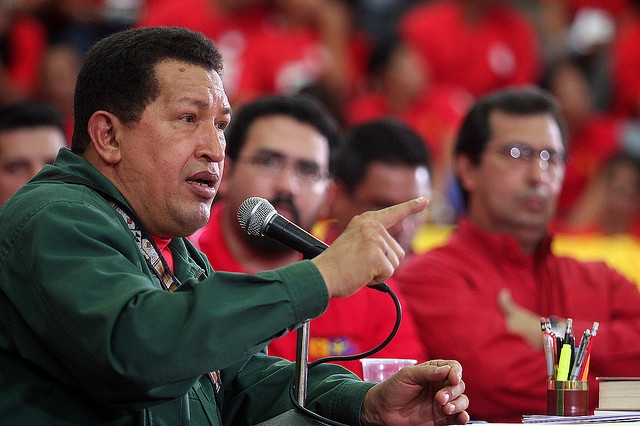
In a 2002 false flag operation, members of the opposition shot and killed their own protestors and blamed it on the Venezuelan military. They then used this atrocity to justify the CIA-sponsored coup against Chavez. This false flag was exposed when it came out that a video condemning the event was filmed before it actually occurred.

Operation Gladio

Most of Part 3 concerns Operation Gladio, an extensive network coordinated by the CIA, MI6 (British intelligence) and NATO, which orchestrated numerous false flag bombings, kidnappings and mass shootings throughout Europe between 1945 and the early nineties. By blaming the bombings and other terrorist acts on leftists and communists, the mission of Gladio was to discredit left leaning parties and to install repressive governments that were more friendly to US interests.

In Italy, Gladio was linked to the Masonic P2 (Propaganda Duo) Lodge, the mafia and Italian bankers, industrialists and fascists. In 1978, Gladio operatives kidnapped Italian prime minister Aldo Moro and murdered him. This was just after he went against Henry Kissinger’s warning not to incorporate the Italian communist party into his coalition government.

In Belgium, Gladio operatives pursued a strategy of storming supermarkets and mowing down shoppers with machine guns. By posing as leftists, they hoped to generate support for a right wing government that would agree to house American nuclear missiles on Belgian soil.

A Common Pretext for War

False flag events are also a common strategy for instigating war. In 1931, the Japanese blew up their own railroad and blamed it on Manchurian dissidents to justify the invasion of Manchuria. Eight years later, Hitler staged a false flag attack on a Polish radio station to justify the invasion of Poland.

Some false flag events are totally fictitious – the enemy is merely accused of an atrocity which hasn’t actually occurred. The best example is the so-called Gulf of Tonkin incident in 1964, in which the Johnson administration accused the North Vietnamese of torpedoing the USS Maddox. Johnson used this non-event to justify a full scale land invasion of Vietnam.

That’s Just a Conspiracy Theory

Whistleblowers, researchers, historians and journalists who expose false flag events are commonly accused of indulging in conspiracy theories. The implication is that only people who are mentally unbalanced or grossly misinformed have any interest in exposing historical events that have been purged from the public record. According to Noble, this is a remarkably effective tactic for suppressing public discussion of government misconduct.

Counter-intelligence: Shining a Light on Black Operations
Scott Noble
Metanoia Films (2013)

photo credit: ¡Que comunismo! via photopin cc

Also posted at Veterans Today

New Zealand Kicks Off Global Protest Against TPPA

Thousands marched in 17 New Zealand cities yesterday, with nearly 200 taking over the streets in New Plymouth (pop 55,000). The Transpacific Partnership Agreement is another “free” trade agreement like NAFTA and GATT (the treaty that formed the World Trade Organization).

Only this trade deal is being negotiated in total secret. Obama has forced the leaders of 11 other countries to keep the TPPA negotiations secret until it’s signed. Neither Congress nor any members of parliament have seen the text.

What we do know about the TPPA is that it gives immense power to global corporations. If the text is released before the treaty is signed, it will face the same massive public opposition that scuppered the Free Trade of the America Agreement (FTAA). It’s only because Wikileaks has leaked portions of the TPPA that we know anything about it.

Here in New Zealand, we are mainly concerned about provisions in the TPPA allowing private corporations to sue governments if their environmental, labor or health and safety laws interfere with their ability to make a profit. Kiwi activists have worked hard to win regulations guaranteeing minimal environmental, labor and health safety standards. If our prime minister signs the TPPA, some secret corporate tribunal in Geneva could dismantle all these laws.

The 12 countries negotiating the TPPA are the US, New Zealand, Australia, Malaysia, Japan, Chile, Peru, Canada, Mexico, Vietnam, Singapore and Brunei.

You can read about our New Plymouth protest (and watch a video clip) at the Taranaki Daily News site.

Activists in North America will be demonstrating against the TPPA (or TPP as they call it) the entire week.

Protests will be happening in California, Florida, Oregon, Washington DC, Colorado, Massachusetts and Pennsylvania. To join in – and learn what else you can do (especially if you live in other states) – go to Stop Fast Track Week of Action


The CIA Role in Narcotics Trafficking

 peter dale scott

Part 2 of Counter-intelligence: Shining a Light on Black Operations

“Deep state” is Part 2 of a five part documentary by Scott Noble called Counter-Intelligence: Shining a Light on Black Operations. Historian and former diplomat Peter Dale Scott coined the term Deep State to describe the shadow government that operates outside our so-called democratic institutions to service the needs of America’s wealthy elite.

This episode focuses on close historical links between the Mafia and CIA and the role of narcotics trafficking in all major CIA covert operations. CIA drug trafficking serves two main purposes. In addition to providing off the books (not reportable to Congress) income for clandestine operations, it’s also a source of ready-made criminal networks. The latter are valuable as a conduits for weapons delivery to CIA mercenaries and as lethal enforcers of corporate interests against labor and human rights activists.

Scott, who is interviewed at length, stresses the instrumental role of the CIA in ALL global narcotics trafficking. The converse is also true. Citing the French Connection (centered in Marseilles) and the Golden Triangle (in Southeast Asia) as prime examples, he makes the case that all major narcotics hubs collapse following CIA withdrawal from the region.

“Deep State” also shines a light on current drug operations in Afghanistan and Columbia. At present Afghanistan is the world’s leading heroin producer,  a direct result of CIA involvement in the region. Colombia, in turn is the world’s largest purveyor of cocaine, thanks to the CIA decision to use Colombia to “block the spread” of communism from Cuba to the rest of Latin America.

According to filmmaker Scott Noble,  all major Wall Street banks have engaged in laundering profits from illicit narcotics. Illegal drugs are America’s third biggest commodity, with the wealthy elite siphoning off the vast majority of drug profits. They also rake in immense profits from the prison industrial complex, a growth industry that owes its existence to the so-called War on Drugs. Wells Fargo and other Wall Street banks are major investors in the prison privatization industry.

Counter-intelligence: Shining a Light on Black Operations
Scott Noble
Metanoia Films (2013)
photo credit: jimforest via photopin cc
Also posted at Veterans Today