Out of the Shadows celebrates the hard work of third world activists who have dedicated their lives to bringing mental health care to their countries. It presents a striking contrast to the neglect and abuse the mentally ill experience in the US.
Globally half a billion people suffer from mental disorders, such as depression, bipolar illness and schizophrenia – more than all AIDS, malaria and TB cases combined. Yet owing to profound stigma, publicly funded mental health services are virtually non-existent in many third world countries. India, for example, spends less than 1% of their health budget on mental health. And in Togo, mentally ill men and women are chained to trees.
The documentary highlights activist-created programs providing free mental health services (funded by private European and Canadian donors) in India, Benin, Ivory Cost, Burkina Faso and Jordan.
This documentary showcases US policies which are shutting down psychiatric hospitals and community mental health centers and warehousing America’s mentally ill in jails and prisons. It features in-depth interviews with two mentally ill women who survived lengthy incarcerations, as well as commentary by psychiatrists, mental health workers and prison reform advocates.
America’s barbaric treatment of the mentally ill constitutes a crime against humanity under international law. Sadly it’s not a new problem. Thanks to the steady cutbacks in mental health services and housing subsidies that began under Reagan, it was clear by the mid-eighties that most mentally ill Americans were ending up in jails and prisons and on the street.
In 2002, Bush junior made even deeper cuts in mental health funding to finance the wars in the Middle East. Meanwhile, thanks to the 2008 global economic scam (which effectively transferred billions in taxpayer dollars to billionaires), states cut an additional $5 billion in mental health services* and eliminated 4,500 psychiatric beds.
Police Harassment of the Mentally Ill
The documentary begins by highlighting the brutal treatment of the mentally ill at the hands of police. When I practiced in Seattle, police routinely underwent crisis intervention training that enabled them to recognize when suspects were psychotic and to appropriately de-escalate threats of violence. This training also made it far more likely mentally ill offenders ended up in treatment facilities – as opposed to jail or prison.
Thanks to ongoing budget cuts and the militarization of local policing, most cities have abandoned routine crisis intervention training. In recent years, it’s become common for cops to kill psychotic individuals when they create a disturbance on the street – either by shooting them or repeatedly tasering or beating them to death. The lucky ones end up with lengthy prison sentences.
To his credit, New York city mayor Bill De Blasio re-instituted crisis intervention training for New York cops in 2014.
Private Prisons (Housing 1/3 of Mentally Ill Offenders)Are the Worst
This is Crazy continues by examining the brutal treatment psychotic inmates receive from prison guards. There is often no effort, especially in private prisons, to ensure they receive their prescribed medication. Instead guards physically abuse them and put them in solitary confinement in a (mostly futile) effort to get them to comply.
Warehousing the mentally ill in jails and penitentiaries also rips of taxpayers – as it costs $15 billion more annually than outpatient mental health treatment.
Once mentally ill convicts are released from prison, they rarely get appropriate aftercare. Conventional probation services make no effort to ensure that they access housing or appropriate aftercare services. Many end up returning to the streets to live.
People Get Ready: The Fight Against a Jobless Economy and a Citizenless Democracy
Robert McChesney and John Nichols (2016)
Film Review
An extremely inspiring public presentation in which McChesney and Nichols talk about their latest book (of the same name)
McChesney begins with research indicating that 50% of current jobs will be eliminated by robots and artificial intelligence in the next 10-20 years. He also talks about the inherent inability of a scarcity/profit based economic system to address this crisis.
For me, the most interesting part of his presentation was a discussion of Franklin D Roosevelt’s Second Bill of Rights.* According to McChesney, both Germany and Japan incorporated this Second Bill of Rights into their constitutions after World War II. This, in his view, explains why both countries have become economic powerhouses.
Both men talk about the crucial need to form a post-capitalist society and economic system. Nichols talks more about the large global movements which have formed to build this new system. He, like McChesney, has been surprised by the popular candidacies of Donald Trump and Bernie Sanders. The book predicts the appearance of proto-fascist and democratic socialist candidates in response to growing popular resistance movements. However neither expected it to happen so quickly.
The best part of Nichols’ talk is his discussion of the massive Luddite and Chartist movements in Britain (and the populist and progressive movements in the US) that would ultimately lead to universal suffrage, honest elections and the rise of the trade union movement.
Nichols stresses that none of these reforms resulted from the heroic efforts of a political savior – they all resulted from the dedicated and persistent mass organizing of ordinary people.
*Roosevelt’s Second Bill of Rights included the basic right of all Americans to
• Employment (right to work)
• Food, clothing and leisure, via enough income to support them
• Farmers’ rights to a fair income
• Freedom from unfair competition and monopolies
• Housing
• Medical care
• Social security
• Education
Tell Donald Trump: Make a deal with your Las Vegas hotel employees!
Hello!
I am a housekeeper at the Trump Hotel in Las Vegas. This past December, a majority of employees like me at Trump Las Vegas voted YES to a union. But Trump’s company has refused listen to us and honor the results of our election.
Instead, they’ve blocked negotiations through legal challenges – which so far have gone nowhere. A federal officer recently recommended that the company’s list of objections be “overruled in their entirety” – and that the NLRB certify the union.Instead of sitting down to negotiate a fair contract, Trump company lawyers are still fighting to overturn the election.
If Donald Trump wants to “Make America Great Again,” he should start by negotiating a deal with his us – his Las Vegas hotel employees – just like his company did for workers at Trump Toronto in Canada.
Just last year, Trump workers in Canada voted for a union and have since negotiated their first contract – a deal that gives workers much like us a chance to provide for their families, keep their kids healthy, enjoy job protections and security, and one day retire with dignity.
We just want a fair deal like Trump workers in Canada got.
Donald Trump wrote the book on The Art of the Deal. It’s time he sits down and negotiates with us. We deserve to have our vote counted.
Leave it to the banksters to come up with new ways to gouge poor people who are forced to use their services and pay their exorbitant bank charges.
According to Al Jazeera, federal and state prisons are aiding and abetting the latest banking scam by substituting release cards for the cash they owe prisoners and immigrant detainees on their release. The funds on the pre-paid debit cards include cash confiscated at the time of incarceration, the remainder of money sent by family members and scant earnings from prison jobs.
In addition to the Federal Bureau of Prisons, 17 states are using them in state prisons. Their use is even more widespread in city and county jails.
Gouging Prisoners with Astronomical Fees
Unlike consumer debit cards, prison-issued cards are unregulated and subject to exorbitant fees. On reviewing contracts in various states and counties, journalist Amadou Diallo found banks were charging nearly $3 per withdrawal and $1.50 per balance inquiry, in addition to weekly account maintenance fees up to $2.50. Cardholders who try to close or their accounts can be charged closing fees of $30.
Diallo gives the example of one inmate who left prison with $120 – he could only use $70 of it because of the fees. Inmates with less than $30 on their cards can’t use them at all because of the closing fee.
Immigrants who are deported on release from detention centers have it even worse, as most cards don’t work outside the US.
JPMorgan Chase Exclusive Federal Prison Vendor
JPMorgan Chase is the exclusive release-card vendor in federal prisons. At state and local facilities, the cards are provided by a handful of smaller vendors such as JPay, Keefe Group, Numi Financial and Rapid Financial Solutions.
JPay also operates electronic money transfers for 25 state department of corrections agencies and 60 county jails. Families can be charged 30 percent or more on funds transferred to love ones in prison. Money orders have been eliminated as an option for sending funds at some facilities. Facilities that still allow them require families to mail the money orders to the banking vendor – not the prion or jail where inmates are held.
Serving a combined population of more than 1.4 million inmates netted JPay $50 million in revenue in 2013, according to the Center for Public Integrity.
For more information and to join the campaign to stop banks from profiting off the misfortune of prisoners, detained immigrants and their families, go to the Stop Prison Profiteering website at http://nationinside.org/campaign/StopPrisonProfiteering/
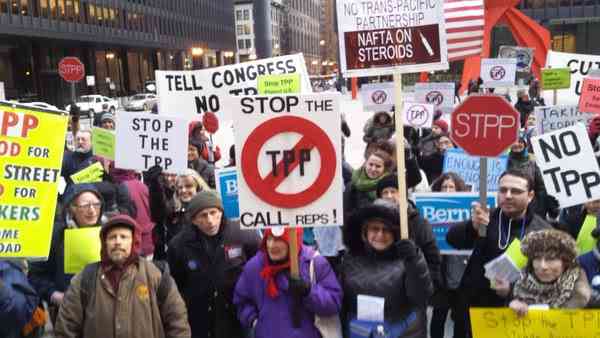
Frack-Free Illinois and The Fox Valley Citizens for Peace and Justice initiated a coalition of 36 unions and civic groups, who on February 4, 4:00 pm, staged a rally in Chicago’s Federal Plaza protesting President Obama’s signing of the Trans-Pacific Partnership (TPP), a so-called free trade agreement between 12 Pacific-rim countries (comprising 40% of the world’s commerce), which covers a wide spectrum of trade, banking, intellectual property regulations, etc., and allows foreign corporations to sue governments for loss of potential profits.
Protesters called the TPP a massive corporate coup benefiting the 1% and harming the 99%. The rally then marched to the Bank of America, where the Chicago Teachers Union was holding its own rally, decrying recent job cuts, underfunding of schools, toxic loans to the CPS from BOA and the breakdown of contract negotiations.
The two rallies briefly merged in mutual support, cheering to each other, before the TPP crowd proceeded to Union and Ogilvie Stations to pass out fliers to evening commuters.
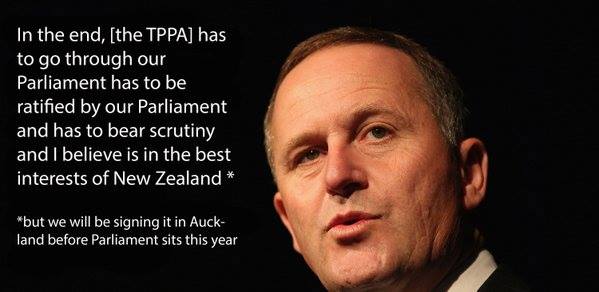
New Zealand trade lawyer and activist Jane Kelsey explains what the TPPA text means for New Zealand when it is signed on Thursday the 4th of February next week, and what activists can do.
Report from first nationwide Townhall meeting in Auckland last night – in advance of TPPA signing ceremony in Auckland on February 4th. It excoriates our prime minister John Key for trying to turn New Zealand into a US colony.
*
There’s nothing in this deal that benefits anyone other than the already wealthy. It locks NZ into being a garden for America’s food chain, which is fine for Farmers and the National Party, but kinda screws the rest of us.
Last nights TPPA meeting was incredible and sobering.
The level of bullshit the Government have used to cover over what the TPPA is really about and the ludicrous ways they’ve measured the economic impacts for NZ have never been so vigorously argued than last night.
The page views for the live stream were in the tens of thousands.
If you had viewed the discussion, you would have heard things never discussed by the mainstream media.
Like the GCSB mass surveillance, the issue of the TPPA isn’t left or right. No one wins by allowing the Government to sign us up to a deal that creates a de facto upper chamber to our Parliament which is controlled by American Corporations.
The economic gains are an illusion. The protections to our environment are a lie. The ability for Maori to uphold the Treaty has been terminally weakened. We will have to pay more for our medicines. We open ourselves up to be manipulated by American Corporations.
There’s nothing in this deal that benefits anyone other than the already wealthy. It locks NZ into being a garden for America’s food chain, which is fine for Farmers and the National Party, but kinda screws the rest of us.
Raw Deal: How the “Uber Economy” and Runaway Capitalism are Screwing American Workers
by Steven Hill
St Martin’s Press (2015)
Book Review
Raw Deal is about all the creative ways Wall Street and Silicon Valley have invented to exploit American workers since the 2008 meltdown escalated the wholesale destruction of US jobs. As of 2015 the US economy had shed a total of 12 million jobs, a figure that is increasing rather than decreasing.
The book mainly focuses on so-called sharing platforms, such as Airbnb, Uber, Task Rabbit and their imitators. However author Steven Hill also includes chapters on the phenomenal growth of permatemp “contract” labor, the burgeoning System D or gray labor market (where employers pay cash under the table) and the steady replacement of workers by robots, computers and apps.
The Myth of Worker Independence
For me, the most valuable chapters expose the total fraud being perpetrated on the US public about Airbnb, Uber and Task Rabbit, namely the immense benefit they offer the economy, the environment and worker independence by eliminating the middleman. The myth about freeing up US workers by making them micro-entrepreneurs is exactly that: a carefully constructed lie.
Centering these enterprises around web-based apps only thinly disguises what they really are: a labor force made up entirely of contract employees. It’s an immediate win-win for the employer, who reduces his labor costs by 1/3 by eliminating his obligation to pay Social Security, Medicare, unemployment tax or health or pension benefits. And an immediate lose-lose for the “microentrepreur,” who as a member of the precariat,** never knows where his next dollar is coming from.
Hyperexploitation: the Fastest Way to Become a Billionaire
The CEOs who run Airbnb and Uber are both thirty-something billionaires (Task Rabbit founder and CEO Leah Busque is only a millionaire), who got their by hyperexploiting their employees.
Brian Chesky is the 34 year old billionaire who founded Airbnb, a company using a web-based app to enable ordinary moms and pops to rent out their spare rooms to tourists. Guests pay a 6-12% service fee and hosts 3%. Airbnb, which operates in 34,000 cities and 192 countries, is bigger than the Hyatt Hotel chin. It’s valued at $25 billion.
The company has been banned in numerous cities and countries owing to its violation of short term rental laws (most cities place a maximum of 30 days on rentals) and their refusal to pay hotel tax.
There’s the additional problem of Airbnb being taken over by real estate agents and slum lords seeking to cash in on a lucrative unregulated market. Of the 5,000 accommodations listed on the website, 2/3 are entire homes or buildings with no owner present, and 1/3 are controlled by people with two or more listings. In San Francisco, New York and other cities with rent control, unscrupulous slum lords are evicting whole blocks of elderly and disabled tenants to turn their buildings into Airbnb accommodation.
Uber Modeled After Ayn Rand’s Philosophy
Uber is a web based taxi services that recruits drivers to use their private vehicles to carry fares. Uber founder and billionaire Tavis Kalanick, who fancies himself an Ayn Rand revolutionary, prides himself on breaking laws he finds inconvenient
Uber, which is worth $51 billion, has gone from scandal to sandal owing to its refusal to perform criminal background checks on their drivers (after a number stole from passengers or physically/sexually assaulted them) or pay livery taxes or carry commercial liability insurance; their brutal exploitation of drivers; and their failure to protect passenger privacy.
Kalanick faces criminal charges in South Korea and Uber has been banned in France, Spain, Germany, Denmark, Netherlands and Denmark. It has also been banned (or severely curtailed) in Virginia, Maryland, South Carolina, Nevada, Miami, Philadelphia and New York City.
Rent-a-Slave
Task Rabbit was founded in 2009 by Leah Busque to connect “domestic freelancers” with customers needing tasks and errands done. It expanded to include all forms of temporary work (Walmart uses Task Rabbit, where it pays a 26% commission, as opposed to the 40% charged by conventional temp agencies).
The most controversial aspect of the Task Rabbit platform was the “bidding auction,” where “rabbits” competed with one another to provide the lowest bid for the service desired. After a storm of controversy Task Rabbit ditched the bidding auction in 2014.
*According to Forbes, the total value of the global System D economy is $10 trillion
**In sociology and economics, the precariat is a social class of people whose life is dominated by a total absence of financial predictability or security.
State and Revolution is principally a diatribe against anarchism. Vladimir Lenin, the leader of the October 1917 Bolshevik revolution, wrote this book in hiding in Helsingfors (Finland). He defines the state as “an organ of domination of one class by the other by means of a standing army, police, prisons and an entrenched bureaucracy.”
I was particularly intrigued to re-read State and Revolution in view of Carroll Quigley’s revelations, in Tragedy and Hope, about the role Wall Street interests played in funding the Bolshevik revolution.
Lenin notes three main differences between Marxists and anarchists as regards the state:
1. Anarchists demand abolition of the state within 24 hours. In contrast, Marxists “know” the state can’t be dissolved until class differences are eliminated. They believe the state (ie the dictatorship of the proletariat) will wither away once the capitalist elite is dissolved.
2. Following revolution, Marxists will substitute organized armed workers for the old state. Anarchists (according to Lenin) have no idea what will replace the state.*
3. Marxists want to make use of the modern (ie capitalist) state to prepare workers for revolution – anarchists reject this as a strategy.
State and Revolution reiterates many of the arguments Marx and his supporters used to expel Bakunin from the First International Working Men’s Association at the 1872 conference in the Hague. Although the anarchists made up most of the sections of the First International (they were extremely powerful in Spain, where they had the largest contingent of grassroots supporters), Marx and his supporters controlled the General Council (the leadership body) of the First International.
Bakunin, who was unable to attend the Hague conference, called a second rival congress in Saint Imier Switzerland. Bakunin’s international working men’s association was far larger and lasted longer than its much smaller Marxist rival. The latter was largely isolated in United States and collapsed in 1876
I take strong exception to a number of Lenin’s arguments for a strong central state following revolution. Dismissing the anarchist proposal for a federation of self-governing units as totally “Utopian,” he claims that “human nature can’t do without subordination, control and managers” and that a strong (armed) central government is essential to “suppress excesses on the part of idlers, gentlefolk and swindlers.”
In my view, Lenin makes a big mistake in blaming “human nature” for the social problems that clearly result from capitalist oppression and exploitation.
Nevertheless his observations about the fraudulent nature of representative democracy suggest little has changed over the last hundred years:
“In any parliamentary country, the actual work of the state is done behind the scenes and is carried out by the departments, the offices and the staffs. Parliament itself is given up to talk for the specific purpose of fooling the people.”
*Untrue. Bakunin, the founder of collective anarchism (aka participatory democracy), proposed replacing the state with federations of collective work places and communes.



 The Most Revolutionary Act